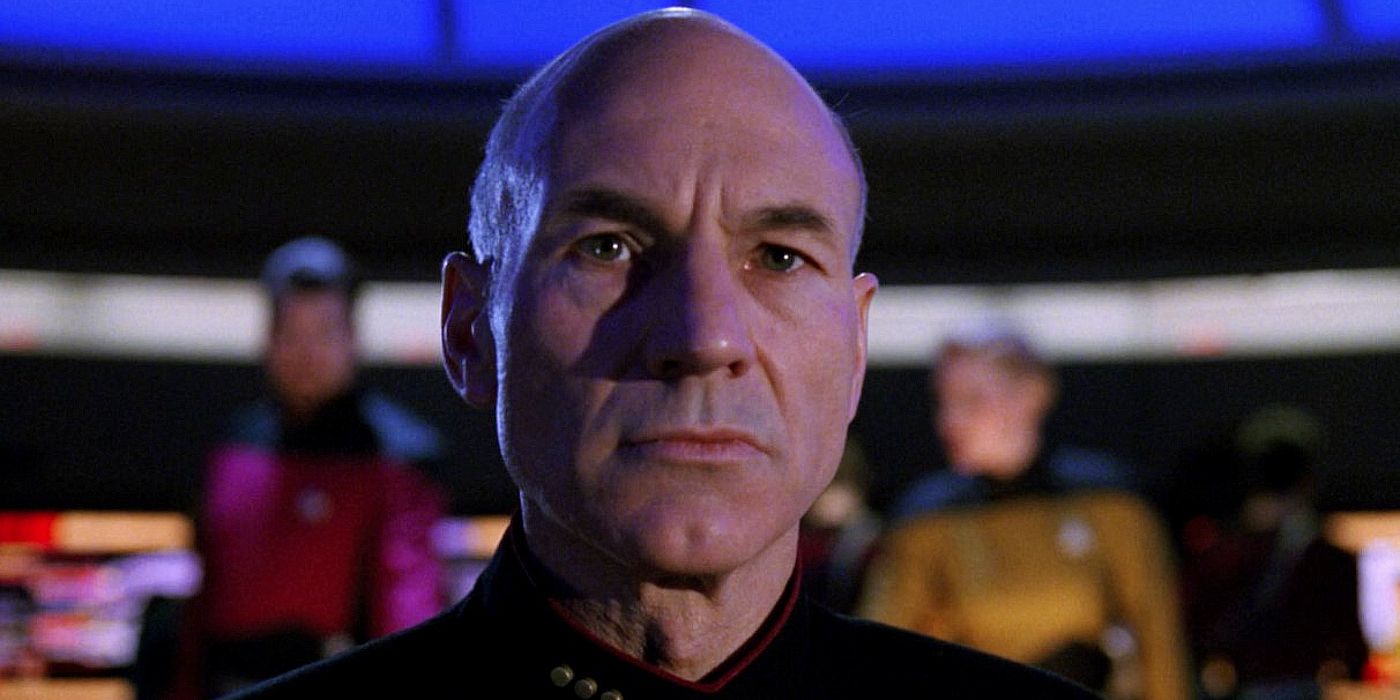
Throughout his time as captain, Jean-Luc Picard made many difficult choices, but one of the most debated occurred in the episode “I, Borg.” In this installment, Picard had to overcome his deep-seated animosity towards the Borg, stemming from his previous capture and torture. He was then confronted with a challenging ethical question: should he destroy an entire species to ensure the safety of others?
Before the episode “I, Borg,” the Borg were believed to be a collective consciousness without individual thinking. However, the episode challenges that idea when Picard discovers they are capable of identity and reason. This leads him to make a difficult decision with far-reaching consequences, solidifying the episode’s place as a pivotal moment in The Next Generation.
Picard’s History with the Borg Fuels His Decisions in This TNG Episode
In this episode of The Next Generation, Captain Picard first considers wiping out the Borg because of his earlier experience being captured by them. That two-part story profoundly changed both Picard and the direction of the series. While the Borg first appeared in Season 2’s “Q,” “The Best of Both Worlds” is generally seen as the most important episode for establishing them as a threat.
The Borg usually aim to absorb entire species into their collective, rather than targeting individuals. However, when it came to integrating humanity, they needed someone to act as a key connection. In the episode “The Best of Both Worlds,” the Borg bypassed the Enterprise’s defenses and beamed directly onto the bridge, specifically targeting Captain Picard due to his high standing and leadership within the Federation.
Capturing and assimilating Captain Picard would give the Borg everything they needed to understand and exploit Starfleet’s systems and procedures. With his knowledge, they could secretly dismantle the Federation, making their invasion much easier. Picard’s leadership skills and strategic mind made him the ideal tool to speed up humanity’s forced integration into the Borg Collective.
It was horrifying to watch Captain Picard get captured by the Borg. They didn’t just imprison him; they completely broke him down and rebuilt him as Locutus. They replaced parts of his body with machinery – I remember being sickened by the sight of his metallic arm and the Borg implant drilled into his skull, not to mention they replaced one of his eyes with a terrifying laser scope. The worst part wasn’t even the physical changes, though. They linked his mind to the Borg Collective, stripping away everything that made him him. And because of that connection, the Borg gained access to all of Starfleet’s most sensitive information. It was a devastating loss on so many levels.
When Picard was captured by the Borg, it had terrible consequences for Starfleet, most notably during the Battle of Wolf 359. The Borg used the information they gained from Picard to inflict a crushing defeat, destroying dozens of starships and killing over 11,000 people. Picard was deeply haunted by the events of Wolf 359 long after he was rescued.
Following the battle, many who survived were turned into the Borg themselves. Picard believes he was responsible for countless deaths and also for the loss of many fellow Federation members who were forced to become the Borg. Although the Enterprise crew eventually rescues Picard and restores his mind, he remains deeply traumatized, a struggle vividly portrayed at the end of “The Best of Both Worlds.”
In the episode “I, Borg,” Captain Picard is deeply haunted by his experiences with the Borg, particularly the trauma he suffered and witnessed at Wolf 359. He’s forced to confront these painful memories while trying to decide the fate of a species that took so much from him. Throughout the first half of the episode, it’s evident that his past is weighing heavily on his mind and influencing his decisions.
“I, Borg” is often hailed as a standout Star Trek episode because Picard has a uniquely strong reason to eliminate the Borg. At first, he thinks a quick victory will make up for the disaster at Wolf 359, but the situation quickly becomes much more complicated and morally challenging.
Picard’s Vision of The Hive Mind is Challenged in The Next Generation’s “I, Borg”
The episode “I, Borg” begins much like a typical Star Trek story. The Enterprise detects a weak signal from a planet and sends a crew to investigate, believing it might be a distress call. They find a crashed ship and several dead Borg drones, but surprisingly, one is still functioning.
The atmosphere immediately becomes tense. The crew wants to transport the wounded Borg directly to sickbay, but Captain Picard firmly orders him to be taken to a detention cell instead, with medical equipment moved there for treatment. Picard views the Borg not as a patient, but as a subject for study. Though usually a good listener, Picard is unyielding in how he intends to handle this Borg captive.
In “The Best of Both Worlds,” Captain Picard’s tendency to distance himself from his crew hints at deeper, unresolved emotional issues. Counselor Deanna Troi senses his distress and attempts to help him address it, but Picard avoids the conversation. While Troi is simply doing her job, Picard struggles to admit his own vulnerability and connection to the problem. He claims to have dealt with it, but his behavior suggests otherwise.
After securing the captured drone, Geordi and Data come up with a daring plan to destroy the Borg. They propose to Picard that they could load a complex, unsolvable puzzle – essentially a virus – into the drone. When the drone reconnects with the Borg collective, this puzzle would spread, ultimately causing the entire Borg network to collapse.
Picard completely supports the plan, believing it’s a smart approach that avoids putting Starfleet in direct danger and would remove a significant threat. However, Dr. Crusher objects to the idea of wiping out an entire species, and Picard disregards her concerns. As Geordi works with a drone, he uncovers information that makes their decision increasingly difficult from a moral standpoint.
Throughout the episode, Beverly Crusher maintains a hopeful outlook, believing the situation can be resolved in line with Starfleet principles. However, Picard argues the Borg aren’t a race to be destroyed, but rather a spreading illness. Crusher’s perspective particularly impacts Geordi La Forge, and his conversations with the Borg drone lead him to see things more like she does. Geordi realizes the drone possesses a unique personality of its own.
Geordi starts to see the drone as a person and gives it the name Hugh, which it happily accepts. This simple act – and Hugh’s emotional responses – completely changes how everyone views the drone. Geordi comes to understand they aren’t dealing with a simple machine or a threat to be eradicated, but with a living being capable of independent thought. Because of this, Geordi can no longer justify deceiving Hugh and using it to destroy its own kind.
Picard had strong feelings about the Borg, and initially disliked how Geordi was interacting with Hugh. He decided to test Hugh, bringing him in for a direct confrontation. Pretending to be Locutus, Picard spoke to Hugh as if he were still connected to the Borg collective, ordering him to try and assimilate the crew. When Hugh refused, Picard understood he’d misjudged the situation.
Hugh Changed Picard’s Perception of the Borg in Star Trek: The Next Generation
Hugh’s unique identity makes Picard question what he believes is right. The Federation is dedicated to protecting individual rights, and forcing Hugh to help destroy the Borg would go against everything Starfleet stands for. Ultimately, Picard lets Hugh choose whether to remain on the Enterprise or return to the Borg wreckage and rejoin the collective. Hugh understands that staying with the crew would put them at risk.
In the end, Hugh chooses to rejoin the Borg Collective. Captain Picard understands this means the Borg will continue to exist, but he’s shifted his perspective. He no longer sees them as a threat to be destroyed, but as beings capable of redemption. Picard prioritizes compassion, even if it means letting the Borg escape. This makes his decision in the episode “I, Borg” one of the most difficult and morally challenging moments in The Next Generation’s history.
Found an error? Send it so it can be corrected.
Read More
- United Airlines can now kick passengers off flights and ban them for not using headphones
- Gold Rate Forecast
- How to Complete Bloom of Tranquility Challenge in Infinity Nikki
- How to Solve the Glenbright Manor Puzzle in Crimson Desert
- 8 Actors Who Could Play Blackbeard In One Piece Live-Action Season 3
- How to Get to the Undercoast in Esoteric Ebb
- All Golden Ball Locations in Yakuza Kiwami 3 & Dark Ties
- A Dark Scream Theory Rewrites the Only Movie to Break the 2-Killer Rule
- Is Wuthering Heights a romance? Update on Margot Robbie movie controversy
- Every Main Character’s Age in Twilight
2026-01-22 07:12