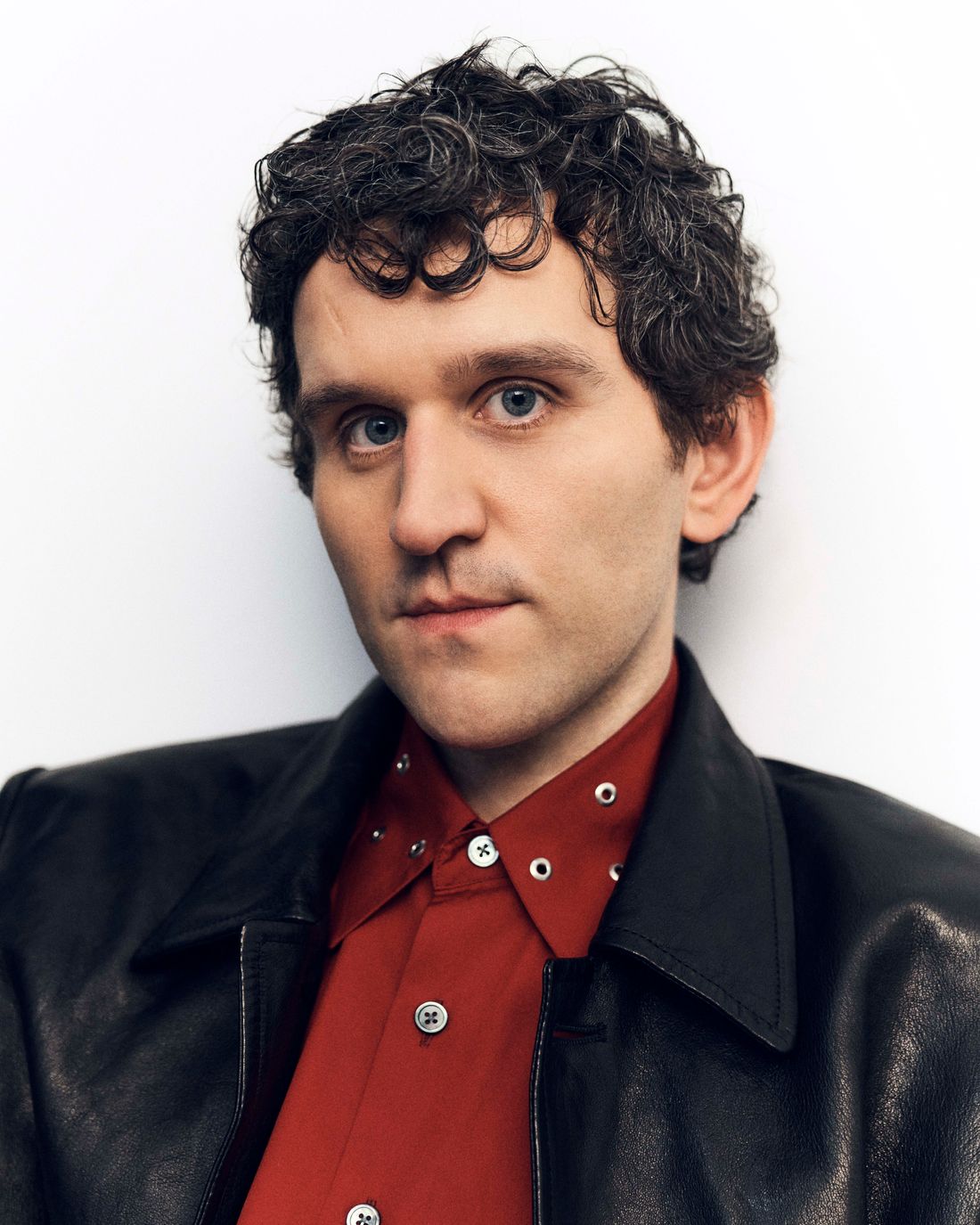
Harry Melling is searching for a book called Box Hill, which served as the inspiration for his film, Pillion. At the Strand bookstore on the Upper West Side, the actor—thin and wearing a large winter jacket and curly hair—carefully scans the fiction shelves, hoping to find the author, Adam Mars-Jones. Despite checking the sections for ‘M’ and ‘J’, they can’t locate it. Melling, originally from London, isn’t surprised. Box Hill gained some attention in England when it was released in 2020—The Guardian called it “the biggest small book of the year”—but it didn’t become widely known in the United States. The novel explores a complex and sometimes violent relationship between two men in the 1970s.
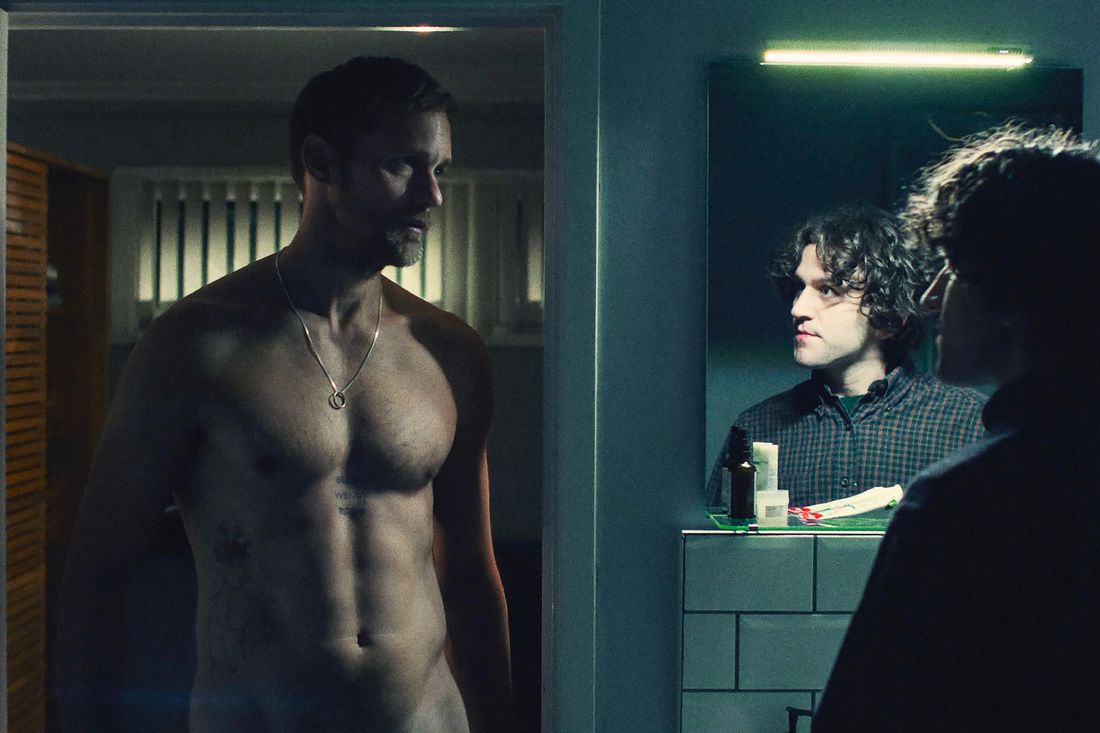
According to Melling, the film Pillion is truly unique. Director Harry Lighton updated the story from the 1970s to the present day, casting the imposing Alexander Skarsgård as Ray, a handsome but emotionally unavailable biker, and Melling as the quiet, unassuming parking attendant who becomes involved with him. This erotic comedy-drama—which some are calling a “dom-com”—marks Lighton’s first feature film, following a series of successful short films (Melling had previously enjoyed Lighton’s Wren Boys). Pillion was picked up by A24 in October 2024 and generated buzz at the Cannes Film Festival in May 2025, winning both a screenplay award and a Palm Dog Award for its canine actors. The film gained considerable recognition during awards season this fall and winter, earning three BAFTA nominations (currently under consideration) and several accolades from independent film groups and critics’ associations. Now, Pillion is finally being released widely across America.
The film’s marketing has understandably focused on Skarsgård’s physique and hinted at its provocative content. However, the movie itself is surprisingly gentler than the novel, which opens with graphic sexual violence. According to director Harry Lighton, as explained by Melling, the film aims to draw the audience in with a sense of comfort before subtly challenging or shocking them, then returning to that comforting feeling.
Much of the film’s emotional impact comes down to Joe Melling’s performance. Audiences going to see Bill Skarsgård will quickly realize that Melling is the character’s emotional center. We experience the world of kink through Colin, a kind and gentle man. We first meet him singing in a somewhat awkward barbershop quartet at a local English pub. (Melling actually trained his voice for the role and has a beautiful tenor.) When he meets Ray, he nervously tries to connect, and their first encounter on Christmas Eve involves Ray immediately demanding a sexual act in public. Melling portrays this scene with a complex mix of embarrassment and pleasure. Both the director and Melling were interested in exploring a character who discovers himself through surrendering control. “Even though he’s not very good at it,” Melling explains, “he’s genuinely enjoying the experience.”
Colin doesn’t fully understand what he’s agreeing to when he promises to do anything Ray asks, and Ray isn’t clear about his expectations either. This lack of understanding creates friction in their relationship, much like a flawed foundation in a romantic comedy. Colin goes to great lengths for Ray – cooking, sleeping on the floor, even letting Ray cut his hair and wearing a chained lock. However, he gradually begins to ask for things in return, like a day off or a visit with his family. The actor playing Colin subtly portrays this growing confidence with clever and often humorous moments. We see a playful spark in his eyes when he mischievously tinkers with Ray’s motorcycle, and he adopts a deliberately affected manner when talking about his biker boyfriend at work.
When you meet Melling, he’s genuinely interested in what others think, often asking for my opinions on movies or books. He was particularly eager to hear if I was looking forward to seeing Wuthering Heights, as he was. At the bookstore, he doesn’t just browse – he happily shares recommendations, including a novel called Brian by a former Antiques Roadshow host, Jeremy Cooper, about a man who loves going to the movies. He gets excited when he sees a copy of the script for Oh, Mary!, remembering that he once worked with the play’s writer, Cole Escola. He flips through the many copies of the popular hockey romance, Heated Rivalry; he hasn’t read or watched it yet, but people keep mentioning it during interviews for Pillion. He opens a copy at random and reads a line aloud, chuckling, “He preferred blowjobs,” before putting it back with the rest.
While researching the film, director Melling and his team spent time with the real Gay Bikers Motorcycle Club, a gay leather group who advised on the movie and even appeared as extras. Melling rode with them – experiencing the ‘pillion’ position that inspired the film’s title – and joined them at Cambridge Pride. They even showed him the proper way to polish a boot! When filming a forest orgy scene, the club members brought their own props and helped choreograph the scene. However, the relationship depicted in Pillion isn’t meant to be a positive example. Healthy relationships establish boundaries upfront, but in the film, Colin is immediately swept away by Ray and gives him free rein. Melling admits some viewers have criticized Ray’s behavior, and he agrees there’s a lack of clear boundaries. He believes this ambiguity is intentional, drawing audiences in and making them question what’s happening.
In Pillion, the actor Melling faced a unique challenge: making a quiet, unassuming character like Colin captivating for the audience. He wondered how to portray someone who doesn’t dominate a scene, yet still holds your attention. A key to his approach was making bold physical choices, even while playing such a meek character. Melling has refined features, but isn’t built like a typical action hero, and Pillion specifically highlights the contrast between his physique and that of his co-star, Alexander Skarsgård, who is known for his imposing frame. When asked about playing characters who aren’t traditionally flattering, Melling says he doesn’t see them that way. He’d rather play a complex, flawed character than someone who simply needs to be attractive. He jokes that he wouldn’t even be good at playing the latter.
Colin Melling considers his current role his biggest challenge yet. After leaving the studio, he and I went to a pub called the Dead Poet, which he picked because of its Edgar Allan Poe theme. He then walked me through his career, which often involved playing supporting characters. He’s best known for playing Dudley Dursley in the Harry Potter films. While his scenes took place in the less glamorous, non-magical world, and his character evolved from a spoiled bully to someone who regretted his actions, the sheer popularity of Harry Potter means that role will likely be remembered for a long time. (He’s also been frequently asked about J.K. Rowling’s views on transgender people, and he’s always responded clearly: “Transgender women are women and transgender men are men. Every single person has the right to choose who they are.”)
Perhaps growing up in an acting family – his grandfather, Patrick Troughton, famously played the second Doctor in Doctor Who during the 1960s – helped him stay grounded. He saw Harry Potter as a great experience, but not the ultimate goal. “I wanted to have careers like Fiona Shaw and Richard Griffiths [who played his parents in the films]—even when I was just 10 years old!”
Unlike many child actors who move on to different careers or take breaks, Jamie Melling immediately continued his training at the London Academy of Music & Dramatic Art after his time in the Harry Potter films. He quickly built a strong stage career, appearing in productions of Mother Courage and Her Children and King Lear (twice, with different acclaimed actresses playing Lear). He also starred in the London and subsequent American run of the comedy Hand to God. Beyond acting, Melling is also a writer, creating and performing in his own play, Peddling, which was inspired by a childhood experience and praised by the New York Times for his “powerful and delicately calibrated” performance. While currently focused on acting, Melling hopes to write more in the future, noting that the demands of an acting career make it difficult to establish a consistent writing routine.
While chatting at a lively pub, Melling talked about his career as a series of different phases. After starting as a child actor and appearing in Harry Potter, he went to drama school and performed on stage. Then, he began taking on more unusual and experimental film projects. This shift started when he auditioned for the Coen brothers’ 2018 Netflix film, The Ballad of Buster Scruggs, where he played a man with no limbs who was displayed as a sideshow attraction by Liam Neeson. Like in Pillion and other roles, Melling brings genuine emotion to potentially disturbing characters. In one scene, his character, an ‘Artist,’ dramatically recites poetry to a crowd, only to be replaced by a performing chicken – and you can see the sadness in Melling’s eyes. Melling appreciated that the Coen brothers encouraged actors to be creative and take risks, saying he enjoys exploring different ideas to see what works best. You can imagine he would have even suggested trying out a particular acting choice, if the character wasn’t already missing limbs.
After gaining the approval of directors Joel and Ethan Coen, actor Harry Melling found his career taking off. He credits them with opening up a whole new phase for him, leading to roles like Edgar Allan Poe in The Pale Blue Eye, a villain in The Old Guard, Malcolm in Joel Coen’s Macbeth, and an early admirer of the lead character in The Queen’s Gambit. He’s now working on a musical about taxidermy with Jodie Comer, a project he feels prepared for thanks to his experience in a barbershop quartet in Pillion. While his career path might seem unusual – he’s notably played a character tormented by bikers twice – Melling says this variety is intentional. Over a fruity cocktail, he shared advice from veteran actor Toby Jones, who told him to “always be a moving target.” Melling explains this means constantly challenging expectations and pursuing his own direction, rather than letting others define his career.
Read More
- United Airlines can now kick passengers off flights and ban them for not using headphones
- Crimson Desert: Disconnected Truth Puzzle Guide
- Katanire’s Yae Miko Cosplay: Genshin Impact Masterpiece
- How to Get to the Undercoast in Esoteric Ebb
- All Golden Ball Locations in Yakuza Kiwami 3 & Dark Ties
- All Itzaland Animal Locations in Infinity Nikki
- All 9 Coalition Heroes In Invincible Season 4 & Their Powers
- HBO’s Harry Potter Is Already Breaking My Heart
- Gold Rate Forecast
- Zendaya’s 4 Big 2026 Movies Could Beat Brie Larson’s Box 2019 Office Record
2026-02-20 18:56