Author: Denis Avetisyan
A new benchmarking framework aims to transform access to AI-powered weather prediction, focusing on improving monsoon onset forecasts and enabling better climate adaptation strategies.

This review proposes a decision-oriented benchmarking approach to evaluate and refine AI weather forecasting models, with a specific application to the Indian monsoon and its impact on low- and middle-income countries.
While artificial intelligence weather prediction (AIWP) models increasingly outperform traditional methods, their evaluation often overlooks practical decision-making needs, particularly for vulnerable populations. This study, ‘Decision-oriented benchmarking to transform AI weather forecast access: Application to the Indian monsoon’, introduces a framework connecting meteorological skill with actionable insights, demonstrated through improved forecasting of the Indian monsoon’s onset-critical for rain-fed agriculture. We show that AIWP models skillfully predict agriculturally relevant indices weeks in advance, informing a large-scale initiative delivering forecasts to 38 million farmers and successfully capturing an unusual monsoon pause. Can this decision-oriented approach serve as a blueprint for leveraging AIWP to enhance climate adaptation strategies worldwide?
The Inevitable Uncertainty of Prediction
The Indian monsoon, a seasonal reversal of wind patterns and a primary driver of the South Asian economy, presents a persistent forecasting challenge with far-reaching consequences. Agriculture, which sustains a substantial portion of the population, is heavily reliant on predictable rainfall, and deviations from normal patterns can lead to crop failure, food insecurity, and economic instability. Beyond agriculture, sectors like water resource management, infrastructure planning, and disaster preparedness are all intrinsically linked to accurate monsoon predictions. Despite advances in meteorological science, the complex interplay of atmospheric and oceanic factors governing the monsoon’s behavior continues to pose significant hurdles, demanding constant refinement of forecasting models and techniques to mitigate potential socio-economic impacts.
Conventional Numerical Weather Prediction (NWP) models, the workhorses of meteorological forecasting, operate by solving complex equations governing atmospheric behavior on a three-dimensional grid. While these models have demonstrably improved weather predictions over recent decades, their inherent limitations pose challenges, particularly concerning localized forecasts crucial for regional applications like agriculture. The sheer computational demand of simulating atmospheric processes at high resolution – necessary for pinpointing rainfall in specific areas – requires substantial supercomputing resources and time. Furthermore, the models’ reliance on initial atmospheric conditions means even minor inaccuracies can cascade into significant forecast errors, especially over longer timescales. This computational expense and sensitivity to initial conditions restrict the practical implementation of high-resolution NWP models for consistent, detailed monsoon predictions across the diverse Indian landscape.
The inherent unpredictability of the climate system is intensifying the challenge of monsoon forecasting. Shifts in global weather patterns, driven by factors like rising greenhouse gas concentrations and altered ocean currents, are contributing to more frequent and intense extreme weather events, and increasing the variability of the monsoon itself. This escalating climate variability introduces greater uncertainty into predictive models, demanding more sophisticated approaches that can account for a wider range of potential scenarios. Consequently, there is a pressing need for improved forecasting capabilities – models that integrate advanced data assimilation techniques, higher resolution simulations, and a deeper understanding of complex climate interactions – to mitigate the risks associated with both monsoon failures and devastating floods.
The Core Monsoon Zone (CMZ), encompassing regions vital to Indian agriculture, demands particularly precise onset forecasts due to its direct impact on crop yields and food security. Accurate prediction within this zone-typically weeks before the first rains-allows farmers to optimize planting schedules, select appropriate crops, and prepare for potential water management challenges. Delayed or inaccurate forecasts can lead to significant economic losses, affecting both individual livelihoods and national agricultural output. Therefore, substantial research focuses on refining predictive models specifically for the CMZ, integrating factors like land surface temperatures, atmospheric circulation patterns, and increasingly, machine learning algorithms, to deliver actionable insights for timely agricultural planning and mitigate the risks associated with monsoon variability.
From Equations to Echoes: A Paradigm Shift
AIWP (AI-based Weather Prediction) Models represent a departure from traditional Numerical Weather Prediction (NWP) techniques by employing machine learning algorithms to directly learn the intricate patterns governing monsoon systems. Unlike NWP, which relies on solving complex physical equations, AIWP models are trained on large datasets of historical weather observations to identify and replicate relationships between input variables and monsoon behavior. This approach allows the models to capture non-linear interactions and complex dependencies often difficult to represent explicitly in NWP systems, potentially leading to improved forecast skill, particularly regarding the timing, intensity, and spatial distribution of monsoon rainfall. The machine learning framework facilitates the incorporation of diverse data sources and enables adaptation to changing climate conditions without requiring modifications to the underlying physical models.
AIWP models utilize extensive historical climate data, notably the ERA5 reanalysis dataset, to establish relationships between atmospheric variables and monsoon behavior. ERA5 provides hourly estimates for over 50 atmospheric, land, and ocean variables dating back to 1979, creating a comprehensive record of climate variability. This data is employed in training machine learning algorithms to recognize complex patterns and predict future monsoon conditions. The large dataset size and high temporal resolution of ERA5 are critical for the models to accurately capture the nuanced characteristics of the monsoon system and improve forecast skill compared to methods relying on limited data or simplified physical assumptions.
A consistent and objectively defined monsoon onset is critical for training and evaluating AIWP models. Traditional definitions often rely on subjective interpretations of rainfall patterns and spatial coverage. To address this, a refined Monsoon Onset Definition utilizes a multi-dimensional approach, incorporating parameters such as rainfall intensity, spatial extent of precipitation exceeding a defined threshold, and the zonal wind component at 850 hPa. This definition provides a quantifiable target variable for model training, enabling consistent evaluation of forecast skill across different years and regions. The resulting dataset, labeled with the refined onset dates, serves as ground truth for supervised learning algorithms, minimizing ambiguity and maximizing the accuracy of AIWP predictions.
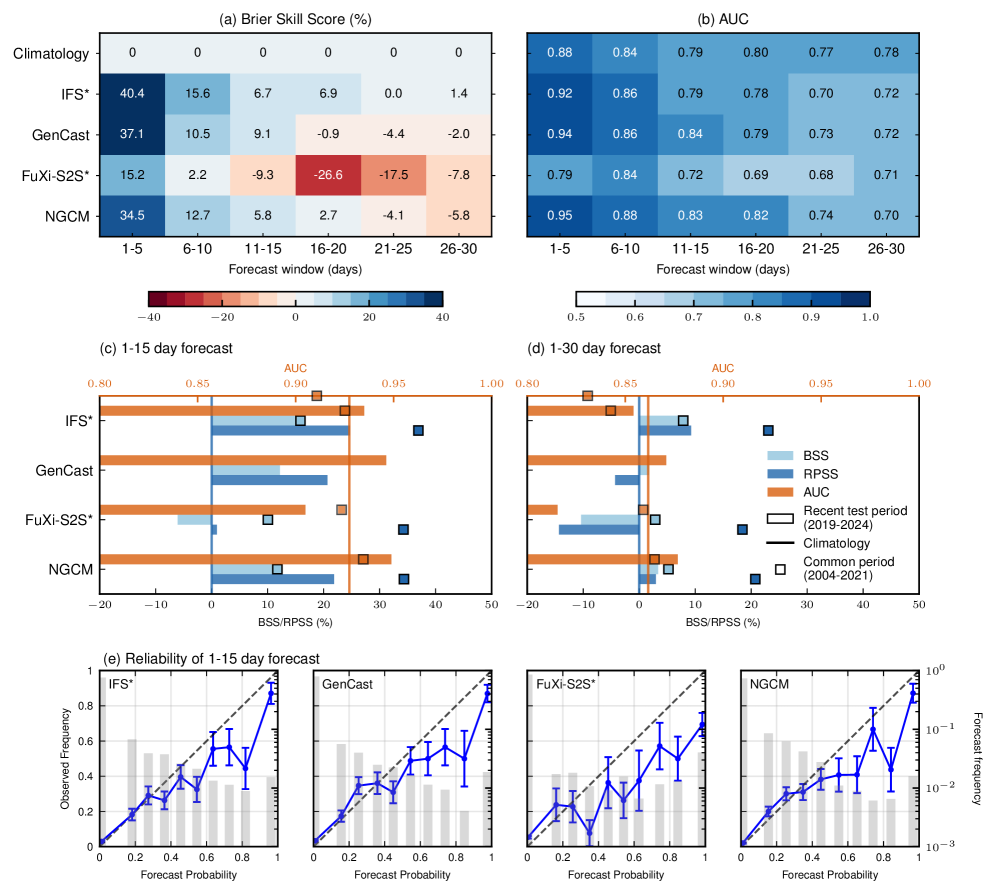
AIWP models are designed for deployment within existing operational weather forecasting infrastructure, utilizing standardized data formats and APIs to ensure compatibility. This facilitates scalable predictions, processing large datasets with optimized computational resources. Independent evaluations have demonstrated the models’ ability to produce skillful forecasts of key monsoon variables – including rainfall and wind patterns – up to three weeks in advance, representing a significant extension of the typical skill horizon for many regional monsoon prediction systems. These forecasts are generated with relatively low computational cost compared to comprehensive numerical weather prediction models, making them suitable for real-time operational use and ensemble forecasting applications.
Quantifying the Inevitable: Metrics of Imperfection
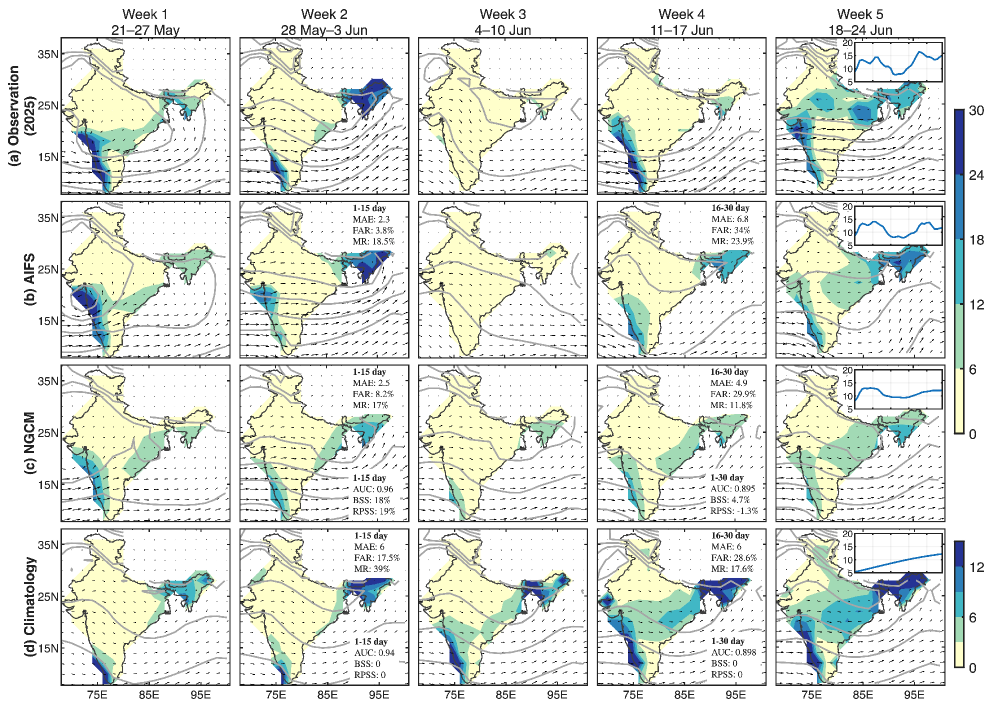
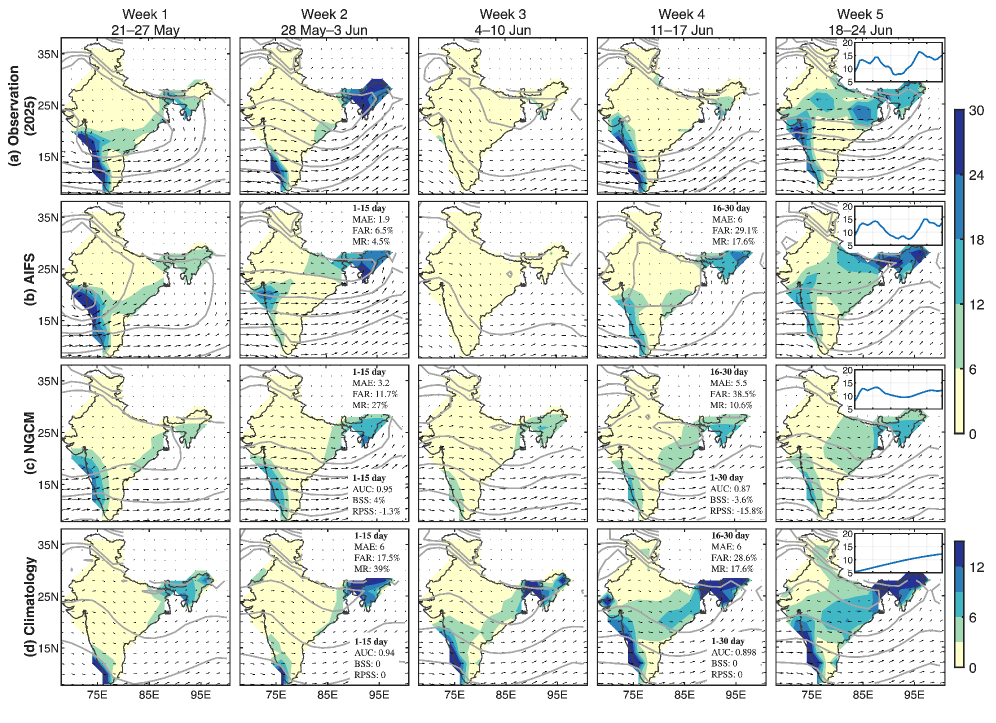
Forecast accuracy is determined through the calculation of several key metrics: Mean Absolute Error (MAE) quantifies the average magnitude of error between predicted and observed rainfall; False Alarm Rate (FAR) represents the proportion of predicted rainfall events that did not occur, calculated as FAR = \frac{False\ Positives}{False\ Positives + True\ Negatives}; and Miss Rate (MR) indicates the proportion of actual rainfall events that were not predicted, calculated as MR = \frac{False\ Negatives}{False\ Negatives + True\ Positives}. Utilizing these three metrics in combination provides a holistic assessment of model performance, capturing both the bias and the overall reliability of the probabilistic rainfall forecasts.
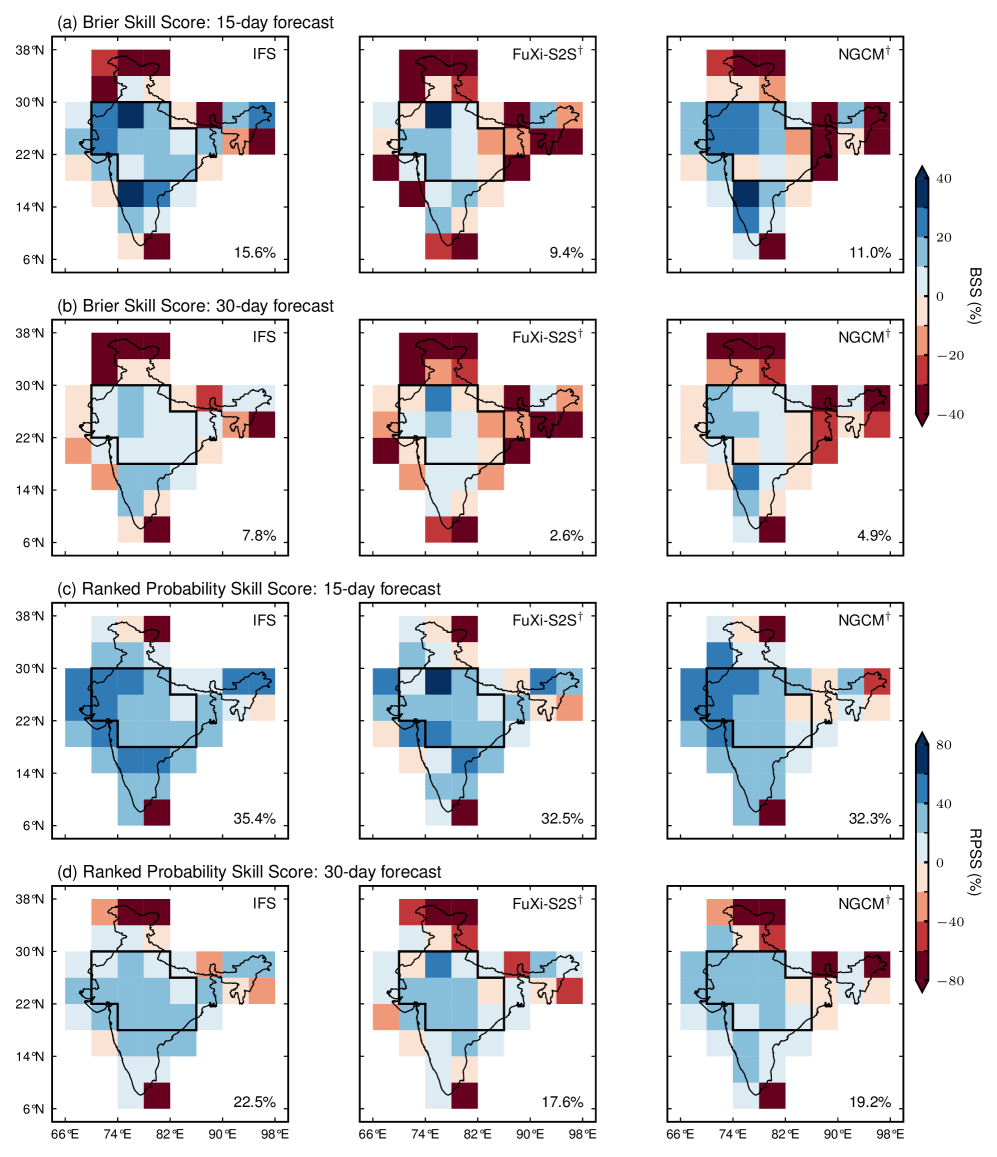
The skill of probabilistic forecasts is objectively measured using the Brier Skill Score (BSS) and the Area Under the Receiver Operating Characteristic curve (AUC). The BSS, calculated as 1 - \frac{MSE_{forecast}}{MSE_{climatology}}, assesses the accuracy of probabilistic predictions relative to a climatological forecast, with values exceeding zero indicating improved performance. Similarly, AUC quantifies the model’s ability to discriminate between events and non-events; an AUC greater than 0.5 demonstrates skill over random predictions. Both metrics provide a standardized assessment of forecast reliability, with positive values consistently denoting performance superior to that of a baseline climatological forecast.
Ensemble forecasting, a technique utilized to improve AIWP predictions, involves generating multiple forecasts by running the model with slightly varied initial conditions or model parameters. This creates a distribution of possible outcomes, rather than a single deterministic forecast. The spread of this ensemble provides a measure of uncertainty; a wider spread indicates higher uncertainty in the prediction. By analyzing the ensemble mean and variance, the robustness of the forecast is increased and the reliability of predictions, particularly for extreme rainfall events, is improved compared to single-model forecasts. This approach effectively mitigates the impact of individual model errors and provides a more comprehensive assessment of potential outcomes.
Model evaluation relies on the India Meteorological Department (IMD) Gridded Rainfall dataset as the source of ground-truth observations. This dataset provides a spatially and temporally consistent record of rainfall across India, derived from a network of rain gauges and radar observations. Utilizing IMD Gridded Rainfall ensures a realistic assessment of AIWP predictions, as the model’s forecasts are directly compared against observed rainfall patterns validated by the national meteorological agency. The IMD data undergoes quality control and standardization procedures, providing a reliable benchmark for quantifying forecast accuracy and identifying potential biases in the AIWP model.
Beyond Accuracy: The Value of Anticipation
Artificial Intelligence Weather Prediction (AIWP) models are demonstrably outperforming conventional forecasting techniques, especially when predicting the precise timing and location of monsoon onsets. These advancements stem from AIWP’s capacity to analyze complex, non-linear relationships within vast datasets-something traditional numerical weather prediction (NWP) models often struggle to achieve. While NWP relies on solving complex physics equations, AIWP learns directly from historical weather patterns, allowing it to identify subtle indicators of localized monsoon arrival with greater accuracy. This is particularly crucial for regions where rainfall patterns are highly variable, and even a small improvement in forecast precision can significantly impact agricultural planning and disaster preparedness. The enhanced performance isn’t merely statistical; it translates to a more reliable and actionable understanding of monsoon behavior, enabling targeted interventions and resource allocation.
Decision-oriented benchmarking moves beyond simply assessing forecast accuracy and instead prioritizes the demonstrable value of predictions in real-world applications, particularly within agricultural planning and resource management. This approach rigorously evaluates how effectively forecasts translate into actionable insights for stakeholders, such as farmers and policymakers. The focus isn’t solely on if a prediction is correct, but how a correct prediction empowers informed decisions regarding planting schedules, irrigation strategies, fertilizer application, and overall resource allocation. By quantifying the economic and societal benefits derived from these data-driven forecasts, decision-oriented benchmarking provides a compelling justification for continued investment in advanced meteorological modeling and dissemination systems, ultimately aiming to enhance food security and build resilience within vulnerable communities.
Unlike Numerical Weather Prediction (NWP) methods-which demand substantial computational resources and time due to their complex physics-based simulations-data-driven models present a significantly more efficient pathway to forecasting. By leveraging statistical relationships learned from historical climate data, these models drastically reduce computational demands, allowing for scalable predictions across vast geographical areas and at much higher temporal resolutions. This efficiency is not merely academic; it translates directly into the capacity to deliver timely forecasts, even to regions with limited computational infrastructure, and enables the rapid processing of data crucial for proactive decision-making in sectors like agriculture and disaster management. The resultant speed and accessibility are key differentiators, allowing these models to complement-and, in certain contexts, potentially surpass-traditional forecasting approaches.
Accurate prediction of the monsoon’s arrival within the Central Monsoonal Zone (CMZ) holds immense significance for regional agricultural productivity and disaster preparedness. Timely forecasts enable farmers to strategically plan planting schedules, optimize irrigation, and select appropriate crop varieties, ultimately maximizing yields and minimizing potential losses due to delayed or erratic rainfall. In 2025, data-driven monsoon forecasts reached an estimated 38 million farmers, providing critical information to support informed decision-making and enhance resilience against climate variability. This widespread dissemination, facilitated by accessible communication channels, demonstrates the practical impact of improved forecasting capabilities on livelihoods and food security across the region, and underscores the potential for scalable solutions in climate-sensitive agricultural systems.
The pursuit of increasingly accurate weather prediction, as detailed within this framework for AI-driven monsoon forecasting, resembles a garden constantly shaped by unforeseen forces. The system doesn’t simply become more accurate; it adapts, evolves, and occasionally sprawls in unexpected directions. As Paul Erdős observed, “A mathematician knows all there is to know; a physicist knows some of it, but I know nothing.” This sentiment echoes the inherent limitations in even the most sophisticated models. Long-term stability isn’t a sign of success; it’s a harbinger of unobserved vulnerabilities. The focus on decision-oriented benchmarking isn’t about achieving perfect prediction, but about cultivating a resilient system capable of navigating inevitable uncertainty and providing actionable insights even amidst evolving conditions.
What Lies Ahead?
The pursuit of improved weather forecasting, even one grounded in decision-oriented benchmarks, inevitably reveals the limitations of the framing itself. This work, focused on the Indian monsoon, offers a refined method for evaluation, but evaluation is merely a snapshot – a temporary alignment of metrics. Scalability is just the word used to justify complexity, and each additional layer of algorithmic sophistication introduces new vectors of potential failure. The very notion of a ‘perfect’ forecast remains a myth, a comforting fiction needed to sustain the effort.
The true challenge isn’t simply to predict the monsoon’s arrival with greater accuracy, but to accept the inherent unpredictability of complex systems. A focus on probabilistic forecasting is a step in the right direction, acknowledging uncertainty, yet even probabilities are anchored to models, to assumptions about the world that will eventually prove incomplete. The emphasis on climate adaptation, laudable as it is, implies a belief in control-a capacity to mitigate the impacts of a system that, by its nature, resists such attempts.
Future work will likely push further into the realm of ensemble forecasting, striving for ever-finer granularity and more robust modeling. But it should also consider a parallel path: a deliberate embrace of imperfection, a focus on building systems that are resilient despite their inherent limitations. Everything optimized will someday lose flexibility, and the most valuable forecasts may not be those that predict the future with certainty, but those that prepare for any eventuality.
Original article: https://arxiv.org/pdf/2602.03767.pdf
Contact the author: https://www.linkedin.com/in/avetisyan/
See also:
- United Airlines can now kick passengers off flights and ban them for not using headphones
- Crimson Desert: Disconnected Truth Puzzle Guide
- All 9 Coalition Heroes In Invincible Season 4 & Their Powers
- Invincible Season 4 Episode 6 Release Date, Time, Where to Watch
- Mewgenics vinyl limited editions now available to pre-order
- The Boys Season 5 Spoilers: Every Major Character Death If the Show Follows the Comics
- Grok’s ‘Ask’ feature no longer free as X moves it behind paywall
- Assassin’s Creed Shadows will get upgraded PSSR support on PS5 Pro with Title Update 1.1.9 launching April 7
- Does Mark survive Invincible vs Conquest 2? Comics reveal fate after S4E5
- Grey’s Anatomy Season 23 Confirmed for 2026-2027 Broadcast Season
2026-02-04 18:07