Author: Denis Avetisyan
A new framework leverages high-altitude platforms and drones to rapidly restore communication and provide critical environmental data in the wake of natural disasters.
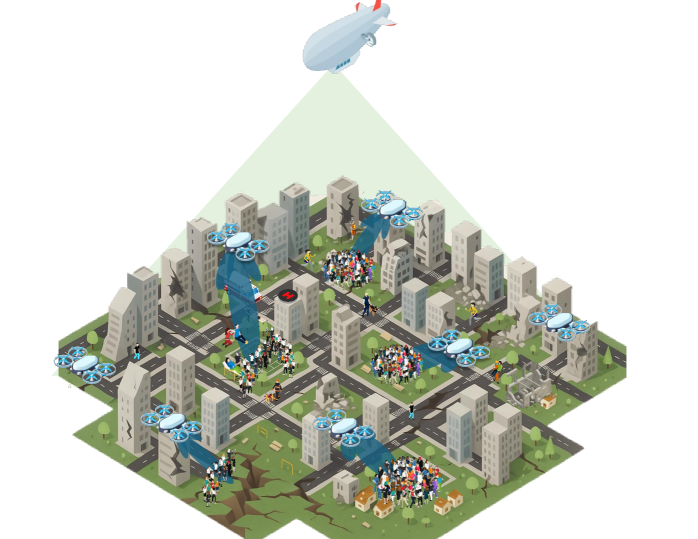
This review details an integrated sensing and communication (ISAC) framework utilizing non-terrestrial networks (NTN) with high-altitude platform stations (HAPS) and unmanned aerial vehicles (UAVs) for post-disaster scenarios.
Maintaining reliable communication and situational awareness following natural disasters presents a significant challenge as terrestrial networks often fail. This paper introduces ‘ISAC-over-NTN: HAPS-UAV Framework for Post-Disaster Responsive 6G Networks’, an integrated sensing and communication (ISAC) architecture leveraging uncrewed aerial vehicles (UAVs) and a high-altitude platform station (HAPS) to establish resilient connectivity and environmental monitoring. Through innovative beamforming techniques, the proposed framework simultaneously provides data transmission and Doppler-based motion detection, achieving up to 90% sensitivity and 88% accuracy in identifying users in critical locations. Could this ISAC-over-NTN approach represent a paradigm shift in disaster response, proactively bridging the gap between communication and critical information gathering?
The Fragility of Connection: When Networks Fail Us
Following major disruptive events, such as earthquakes, hurricanes, or widespread flooding, conventional communication systems frequently experience catastrophic failures. This stems from the reliance on geographically fixed infrastructure – cell towers, fiber optic cables, and data centers – which are susceptible to physical damage and power outages. Consequently, first responders often find themselves unable to coordinate effectively, and affected communities are cut off from vital information and assistance. The loss of communication not only impedes rescue efforts but also exacerbates the crisis, hindering damage assessment, resource allocation, and the dissemination of critical public safety alerts. This isolation can dramatically increase the scale of suffering and impede long-term recovery efforts, highlighting the urgent need for resilient alternatives to traditional terrestrial networks.
Conventional communication networks, often structured around centralized hubs and limited redundancy, exhibit a critical weakness when confronted with disruptive events. These architectures depend on the uninterrupted functionality of key components; damage to a single central node or transmission line can cascade into widespread outages, effectively severing vital links. This inherent vulnerability dramatically impairs situational awareness for first responders, hindering coordinated relief efforts and exacerbating the challenges of disaster response. Consequently, a reliance on these traditional systems can significantly delay the delivery of crucial aid and impede effective communication between those providing assistance and the affected populations, underscoring the necessity for more resilient and decentralized network designs.
In the wake of large-scale disruptions, establishing dependable communication proves vital, yet conventional network designs often falter due to centralized vulnerabilities. Consequently, a pressing need exists for communication systems capable of swift deployment and sustained operation even when traditional infrastructure is compromised. This demand fuels exploration into innovative network topologies – such as mesh networks and decentralized architectures – that prioritize redundancy and resilience. These emerging designs aim to bypass single points of failure by distributing communication pathways, allowing data to reroute around damaged areas and maintain connectivity for first responders and affected communities. The pursuit of these adaptable networks represents a critical step towards mitigating the communication challenges inherent in crisis scenarios and bolstering overall disaster preparedness.
Beyond Terrestrial Limits: Expanding Connectivity with Non-Traditional Networks
Non-Terrestrial Networks (NTN) leverage a combination of platforms – Unmanned Aerial Vehicles (UAVs), High Altitude Platform Stations (HAPS), and satellites – to extend communication infrastructure beyond traditional terrestrial base stations. This architecture provides significantly wider coverage areas, particularly in remote or geographically challenging locations where deploying conventional infrastructure is impractical or cost-prohibitive. Crucially, NTN enhances network redundancy; if a terrestrial node fails or is damaged, the NTN components can maintain connectivity, ensuring service continuity. The multi-platform approach also enables layered connectivity, with satellites providing broad regional coverage, HAPS offering localized high-bandwidth access, and UAVs delivering on-demand, highly targeted communication capabilities. This integrated system increases overall network resilience and availability.
Unmanned Aerial Vehicles (UAVs) provide a versatile and quickly deployable communication solution, particularly beneficial in disaster response. Their ability to establish temporary communication networks without reliance on existing terrestrial infrastructure allows for immediate connectivity in areas where infrastructure has been damaged or is unavailable. This capability supports critical applications such as search and rescue operations, damage assessment, and the coordination of relief efforts. UAVs can be equipped with various communication payloads, including radio relays and mesh networking capabilities, to extend coverage and provide localized communication within affected zones. Deployment times are significantly reduced compared to traditional methods, enabling rapid establishment of essential communication links within hours, rather than days or weeks.
Successful deployment of Non-Terrestrial Networks (NTN) relies heavily on sophisticated signal processing to address inherent challenges like atmospheric interference, Doppler shifts, and signal propagation delays. These techniques must effectively manage inter-satellite, satellite-to-ground, and inter-user interference to maintain acceptable service quality. A key performance indicator for reliable connectivity is the Signal-to-Interference-plus-Noise Ratio (SINR); achieving a median SINR of -3 dB across all user types-including those in adverse propagation conditions-is considered a critical threshold for ensuring consistent performance and minimizing data loss. This target SINR requires adaptive beamforming, interference cancellation, and robust modulation and coding schemes tailored to the dynamic characteristics of the NTN environment.
Refining the Signal: Precision in Beamforming and User Selection
Minimum Mean Square Error Zero-Forcing (MMSE-ZF) beamforming employs a spatial filtering technique to mitigate interference in wireless communication systems. Utilizing a Uniform Planar Array (UPA) configuration, this method estimates the signal and noise covariance matrices to create beams directed towards intended users while nullifying interference from other users and noise sources. The resulting improvement in Signal-to-Interference-plus-Noise Ratio (SINR) is achieved by minimizing the mean square error between the desired signal and the received signal, effectively enhancing signal quality and supporting higher data rates. The UPA geometry provides increased spatial resolution and flexibility in beam steering compared to linear arrays, contributing to more precise interference cancellation and improved SINR performance.
Semi-Orthogonal User Selection (SUS) operates by prioritizing users with minimal interference correlation, effectively creating a selection of users that can be served simultaneously with reduced inter-user interference. This is achieved by analyzing the channel matrix and selecting users whose channels are sufficiently orthogonal. Complementing SUS, intelligent resource scheduling algorithms like the Reuse Scheduler dynamically allocate radio resources – frequency, time, and spatial streams – to maximize network throughput. The Reuse Scheduler optimizes allocation by strategically reusing frequencies across different cells while mitigating interference through careful planning and adaptive power control, thereby increasing the overall network capacity and spectral efficiency. These techniques are often implemented in conjunction to provide a robust and efficient means of managing interference and improving network performance.
Accurate user positioning and velocity estimation are critical for the performance of advanced beamforming and resource scheduling techniques. These estimations are primarily achieved through Doppler Estimation, which analyzes frequency shifts in received signals to determine user movement. The accuracy of these estimations is further refined using the Cramér-Rao Bound (CRB) analysis, a statistical method for determining the lower bound on the variance of an estimator. Doppler-based mobility detection, specifically, achieves a performance level of 0.938 as measured by the F1-score, indicating a high degree of accuracy in identifying and tracking mobile users within the network.
Sensing the Future: Integrated Communication and Sensing (ISAC)
The emerging framework of Integrated Sensing and Communication (ISAC) represents a paradigm shift in wireless systems, moving beyond simple data transmission to actively perceive and interpret the surrounding environment. Unlike traditional networks focused solely on relaying information, ISAC systems simultaneously transmit data and emit signals used for sensing – effectively merging communication and radar functionalities. This capability allows devices to not only connect users but also to map spaces, detect objects, and track movement in real-time, dramatically enhancing situational awareness. By leveraging the same radio frequency resources for both tasks, ISAC promises increased spectral efficiency and reduced hardware complexity, unlocking possibilities for applications ranging from autonomous navigation and smart cities to industrial automation and enhanced public safety – all while laying the groundwork for more intelligent and responsive wireless networks.
Accurate tracking of user movement is now achievable through the integration of Kalman Filter (KF)-based tracking with Integrated Sensing and Communication (ISAC) systems. This synergy allows networks to not simply transmit data, but also actively perceive and predict the location of users in real-time. The KF algorithm efficiently processes the sensed information, filtering noise and estimating user trajectories with high precision. This capability is paramount for intelligent resource allocation, ensuring that bandwidth and power are directed to where they are most needed as users move within the network. Maintaining seamless connectivity with dynamic users-those in transit or operating in unpredictable environments-becomes significantly more reliable, improving the overall quality of service and enabling a more responsive and efficient communication infrastructure.
Recent advancements demonstrate that integrating Integrated Sensing and Communication (ISAC) within Non-Terrestrial Network (NTN) architectures significantly enhances user detection and communication reliability, even when terrestrial base stations fail. Studies reveal a remarkable 90% precision and 88% accuracy in identifying user locations, maintaining consistent connectivity despite disruptions-a performance level exceeding that of traditional terrestrial networks, particularly in disaster recovery scenarios. This capability is not merely incremental; it represents a fundamental shift towards more resilient communication systems, promising unprecedented adaptability and capacity, and laying a crucial foundation for the development of 6G networks capable of operating effectively in challenging and dynamic environments.
The pursuit of resilient communication networks, as detailed in this framework, echoes a fundamental tenet of rational inquiry. It acknowledges the inherent fragility of single points of failure – terrestrial infrastructure in this case – and proposes redundancy through non-terrestrial networks. This aligns with René Descartes’ assertion, “Doubt is not a pleasant condition, but it is necessary to a clear understanding.” The ISAC-over-NTN approach doesn’t presume the reliability of existing systems; rather, it actively seeks to disprove potential communication breakdowns through diverse sensing and beamforming strategies. This framework doesn’t offer definitive solutions, but a methodology for continual refinement in the face of uncertainty, acknowledging that correlation between sensing data and network performance is, at best, suspicion, not proof.
Where Do We Go From Here?
The proposition of layered non-terrestrial networks-UAVs augmenting high-altitude platform stations-offers a superficially elegant solution to post-disaster communication. However, the resilience claimed hinges on a multitude of assumptions regarding atmospheric conditions, platform endurance, and, crucially, the correlated failures of those platforms themselves. How sensitive is the projected coverage to even modest deviations in these parameters? The simulations presented provide a baseline, yet real-world deployment will inevitably introduce cascading uncertainties.
Further investigation must address the practicalities of dynamic beamforming in a highly contested radio frequency environment. The efficacy of integrated sensing and communication (ISAC) is predicated on minimizing interference-a feat easily stated, but difficult to achieve when every node is simultaneously transmitting, receiving, and attempting to build an environmental map. The presented framework prioritizes coverage; however, the trade-off between data rate, sensing accuracy, and energy expenditure remains largely unexplored.
Ultimately, the true test lies not in demonstrating feasibility, but in quantifying robustness. A shift in focus toward adversarial testing-modeling deliberately disruptive events and platform failures-would yield a more pragmatic assessment of this architecture’s potential. The question isn’t simply whether this system can work, but how gracefully it degrades when subjected to the inevitable chaos of a real disaster.
Original article: https://arxiv.org/pdf/2601.15422.pdf
Contact the author: https://www.linkedin.com/in/avetisyan/
See also:
- United Airlines can now kick passengers off flights and ban them for not using headphones
- How to Complete Bloom of Tranquility Challenge in Infinity Nikki
- Katanire’s Yae Miko Cosplay: Genshin Impact Masterpiece
- Gold Rate Forecast
- All Itzaland Animal Locations in Infinity Nikki
- How to Get to the Undercoast in Esoteric Ebb
- A Dark Scream Theory Rewrites the Only Movie to Break the 2-Killer Rule
- 8 Actors Who Could Play Blackbeard In One Piece Live-Action Season 3
- Fire Force Season 3 Part 2 Episode 24 Release Date, Time, Where to Watch
- Australia’s New Crypto Law: Can They Really Catch the Bad Guys? 😂
2026-01-25 06:56