At its heart, Star Trek has always celebrated venturing into the unknown, learning about new life forms, and embracing diversity throughout the galaxy. This theme is woven through the show’s stories, and each captain has brought their own unique perspective to Starfleet’s goals and ideals.
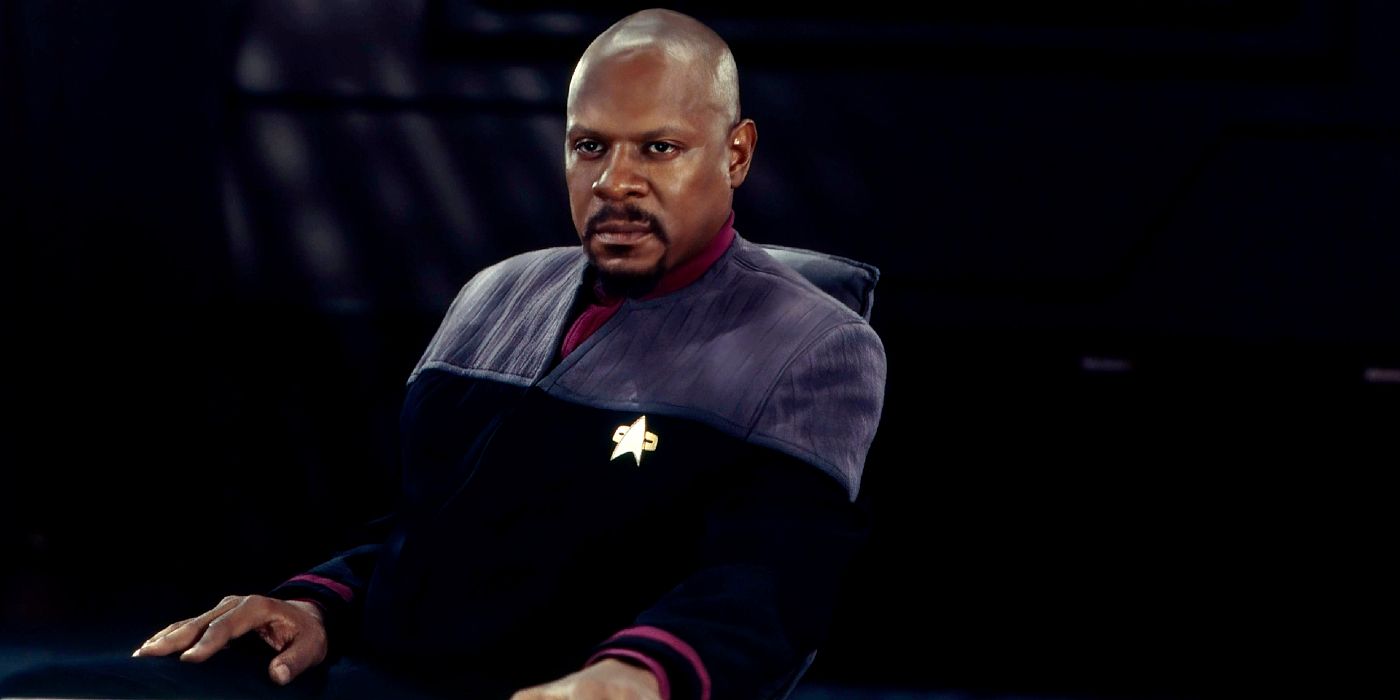
Perhaps no captain embodied Starfleet’s ideals more clearly than Benjamin Sisko, played by Avery Brooks. In the very first episode, “Emissary,” Sisko gives a speech that perfectly captures Starfleet’s dedication to exploring and learning, better than any other moment in the entire series.
Sisko Uses Baseball as an Analogy for Linear Time in Deep Space Nine
The first episode introduces Commander Sisko as he pilots the USS Rio Grande into a recently discovered wormhole. Once inside, he encounters the Prophets – beings without physical form who appear as people he’s familiar with, like his son, Jake (Cirroc Lofton), and his deceased wife, Jennifer (Felecia M. Bell).
Prophets don’t experience time as a sequence of events like humans do; they perceive all time – past, present, and future – simultaneously. From their perspective, Q appears to be reckless and doesn’t consider the impact of what he does, but Captain Sisko disagrees with this assessment.
As a movie buff, I always appreciate a good character arc, and Sisko’s really gets to me. He tries to help others understand tough stuff – like how actions have consequences, and dealing with loss – by sharing his own life. He’ll talk about meeting his wife, Jennifer, on the beach, and how choosing to be with her meant embracing everything that came with it, even the joy and eventual heartache of having their son. It’s a powerful way to connect, you know?
Realizing the Prophets still didn’t fully grasp the concept, Sisko tried explaining it using baseball. He described how each pitch is unpredictable, and players react to whatever happens, creating a game that evolves without a predetermined result. This illustrated how events can unfold naturally, even without knowing the future.
I’ve always been struck by Sisko’s explanation of why he doesn’t want to know what’s coming. He really gets to the heart of what it means to be human, arguing that it’s the search itself – not just finding answers, but constantly creating new questions – that truly defines us. It’s a beautiful, and frankly iconic, sentiment.
He explains that humans are natural explorers, venturing into the galaxy to learn and grow. His goal isn’t to conquer through force, but to share ideas and build a peaceful coexistence.
Star Trek Has Always Been About the Pursuit of Knowledge and Understanding
As stated in the mission of TOS, the goal is to explore new and unusual worlds, discover new life forms and civilizations, and approach the unknown with both curiosity and respect. This involves expanding our understanding, seeking out new experiences, and working to bring peace throughout the universe.
This idea is best illustrated by Starfleet’s Prime Directive. First appearing in the original Star Trek episode “The Return of the Archons” (Season 1, Episode 21), the directive requires Starfleet officers to understand and respect the cultures of alien species before initiating contact or conflict.
As a lifelong Star Trek fan, one thing that’s always struck me is the Prime Directive – that core rule about not interfering with developing civilizations. It’s been a constant thread throughout all the shows and movies. Sure, there have been times when Captain Kirk, or other captains, bent the rules – I always think of that episode ‘Miri’ where he had to vaccinate those kids, even though it technically broke the directive. But those moments were always about preventing a greater harm or saving lives. And beyond that, every Starfleet crew I’ve seen has been driven by a genuine thirst for knowledge – it’s just built into who they are.
The series consistently emphasizes a commitment to discovery and knowledge. This is perfectly captured in a famous line from Captain Picard (Patrick Stewart), who concludes with the hopeful sentiment, “Let’s see what’s out there,” embodying Starfleet’s core purpose of exploration, observation, and learning.
In Season 5, Episode 19, “The First Duty,” Captain Picard delivers a powerful line – “The first duty of every Starfleet officer is to the truth, whether it’s scientific, historical, or personal.” Spoken with Patrick Stewart’s characteristic gravitas, this quote highlights Starfleet’s dedication to honesty and seeking understanding, even when doing so is challenging.
Starfleet officers are trained to approach new cultures and people with respect and understanding. For example, in the episode ‘The Devil in the Dark’ (Season 1, Episode 25), Captain Kirk and his crew encounter an alien creature, the Horta, that is attacking miners. Instead of immediately destroying it, they try to communicate and figure out why it’s behaving that way. They eventually discover the Horta was simply protecting its young.
In the Star Trek: The Next Generation episode “Who Watches the Watchers” (Season 3, Episode 4), the crew of the Enterprise observes the Mintakans, a civilization that hasn’t yet developed warp drive, to learn about their culture. Similarly, in the Deep Space Nine episode “Captive Pursuit” (Season 1, Episode 6), O’Brien studies the Tosk, an alien species, and the customs of those who hunt them, collecting information about their traditions before getting involved.
Throughout the series, the characters consistently rely on logic and reason to make choices. Each mission centers around a desire to learn – whether it’s about new cultures, strange scientific events, or the galaxy’s hidden secrets.
Sisko’s Line in Deep Space Nine’s Opening Episode Sums Up Starfleet’s Purpose
Many people consider Picard a strong moral leader, and that’s understandable considering his frequent discussions of ethics. However, other Starfleet captains, particularly Benjamin Sisko, demonstrate equally strong moral character.
What truly makes these moments powerful is how they connect with us. Using the baseball example, the speech clearly ties our understanding of time passing to the excitement of what might happen next, ultimately delivering the most clear and meaningful message of the entire series.
Sisko embodies Starfleet’s goals in a particularly effective way because he explains the reason for exploration, rather than simply stating it. While Picard, in “Encounter at Farpoint,” declares the mission of exploration, Sisko demonstrates why that mission is important.
He argues that not knowing what the future holds is actually a huge benefit for humanity, allowing us to learn and discover things we otherwise couldn’t. He compares this to the excitement of baseball – life’s unpredictability creates opportunities for both progress and peace. As seen with characters like Lokai and Bele in Star Trek: The Original Series (Season 3, Episode 15), knowing the future would eliminate both the potential for discovery and the chance for peace.
As a huge Star Trek fan, I’ve always believed the core of the show is about building bridges and finding ways to live together, and that’s exactly what Starfleet represents. Commander Sisko really sums it up when he talks about how we, as humans, can overcome anything if we use our minds and try to understand each other. To me, that monologue perfectly captures the hopeful message of Star Trek: there’s always something new to learn, discover, and strive for, and that’s what makes it so special.
Read More
- United Airlines can now kick passengers off flights and ban them for not using headphones
- Crimson Desert: Disconnected Truth Puzzle Guide
- How to Get to the Undercoast in Esoteric Ebb
- All 9 Coalition Heroes In Invincible Season 4 & Their Powers
- All Golden Ball Locations in Yakuza Kiwami 3 & Dark Ties
- Warframe Voruna Prime access begins on April 8 for all platforms, new deluxe cosmetic Warframe skins revealed
- Katanire’s Yae Miko Cosplay: Genshin Impact Masterpiece
- Zendaya’s 4 Big 2026 Movies Could Beat Brie Larson’s Box 2019 Office Record
- Dakota County’s plan to end hunger involves locking mayors in escape rooms
- All Itzaland Animal Locations in Infinity Nikki
2026-01-08 18:21