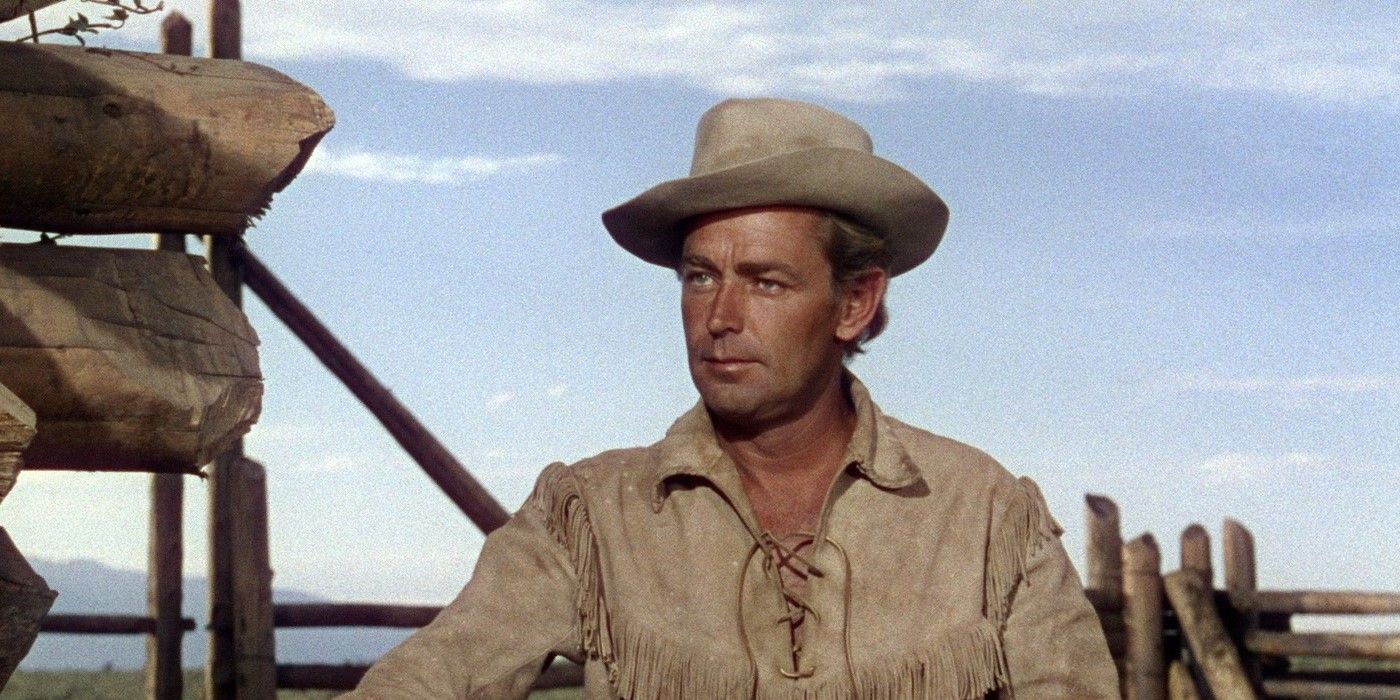
Movies like Shane and The Gunfighter redefined the Western genre, creating the lasting image of the gunslinger that we still see today. These films paved the way for countless stories inspired by directors like George Stevens, John Sturges, and Howard Hawks, but one film, despite its huge impact, was actually rejected by its own writer.
The 1950s brought a fresh perspective to Western films, featuring more complex characters and morally ambiguous heroes. As in previous years, many successful Westerns were based on novels, and these adaptations changed how viewers saw cowboys and frontier life. In 1953, Alan Ladd starred as a particularly influential Western hero, though the author who originally created the character later rejected the portrayal.
How Shane Shaped America’s Western Mythology
In 1953, director George Stevens released his film adaptation of Jack Schaefer’s novel, Shane. The story, first published in installments in Argosy magazine in 1949, redefined the classic American gunslinger character. The film begins with a mysterious stranger calmly riding into a quiet valley in Wyoming. He soon discovers the Starrett family is in a dispute with Rufus Ryker, a powerful cattle baron who refuses to acknowledge their ownership of the land. Ryker wants to keep the valley open for his cattle and is determined to force the Starretts off their property, even if it means using violence.
The film Shane primarily focuses on the internal struggles of its protagonist, a gunslinger seeking a peaceful life and a chance to escape his violent past. He tries to signal this change by trading his cowboy attire for work clothes and avoiding conflict whenever possible. However, when Ryker and his gang begin to terrorize the Starrett family, Shane realizes that protecting them may require him to embrace the violence he desperately wants to leave behind. Having experienced the devastating consequences of gunfights, he feels compelled to shield his friends from that fate, even if it means taking matters into his own hands – a task he understands all too well as a gunslinger.
The movie concludes with Shane, injured but having secured the valley’s safety, riding off to allow a new era of American development to begin. He moves beyond being just a character and becomes a legendary figure, representing the quintessential gunslinger. Since then, filmmakers such as Sergio Leone and Clint Eastwood have drawn inspiration from this classic Western for their own films.
The 1950s were a hugely influential decade for Western films. While John Ford created sweeping epics like The Searchers, Fred Zinnemann revolutionized the classic lawman story with High Noon. These films completely reshaped the Western genre, and every Western made since has been influenced by the innovations of that ten-year period.
Why Jack Schaefer Rejected His Own Story
Jack Schaefer, the author of the story that inspired the film Shane, surprisingly changed his mind about his own work after seeing George Stevens’ adaptation. It wasn’t the movie’s accuracy or the character of Shane that bothered him, but rather his own perspective on the conflict between settlers and the land. As he became more involved in environmental and conservation efforts, he began to sympathize with the wilderness itself and question the settlers’ struggle. He realized that, like many writers who romanticize the frontier, he now saw the settling of the American West as a loss, rather than a victory.
Schaefer’s shift in perspective reflects a common dilemma for Western novelists. While settlement was a fundamental part of the West’s development, bringing American society and industry to the frontier, it wasn’t simple. Homesteaders were often hardworking families trying to build lives as the modern world grew around them, frequently clashing with those who sought to exploit the land. However, the reality of homesteading and its consequences were often at odds with conservationist ideals. This became even more problematic as some began to sympathize with the plight of Native Americans, making it increasingly difficult to support the practice.
This approach would actually align more closely with how Schaefer viewed things later on. He envisioned a story about independent ranchers clashing with a dishonest cattle baron – an Irish rancher named Denton Baxter, modeled after Ryker. Unlike Stevens’ 1953 film, the heroes in this version are frontiersmen defending themselves against those who were settling the land, suggesting that right and wrong in the West weren’t always clear-cut.
The story was revisited in 1985 with Clint Eastwood’s film, Pale Rider. While closely based on Schaefer’s novel, it explored similar themes with a greater sense of moral complexity—a hallmark of Eastwood’s work. The setting shifted from the Montana wilderness to mountain mines, and it’s likely the original author wouldn’t have been pleased with this updated version either.
Schaefer’s Change of Heart Doesn’t Undermine the Story
The story’s power doesn’t really come from the conflict over land, but from the classic image of the lone gunslinger. It could have worked just as well if the hero was defending ranchers instead of settlers, although focusing on settlers actually strengthens the story’s overall message. Had the author written against the idea of homesteaders, it would have gone against historical events, even if it aligned with his later beliefs.
Shane is a man struggling to find his place in a changing world, one that no longer seems to need someone like him. Getting involved with the Starretts pulls him back into the violent life he tried so hard to escape. Ultimately, the story shows that a person can’t truly escape their past or their inherent nature, and serves as a cautionary tale against choosing violence. When Shane says goodbye to Joey, he’s leaving the boy in a new, more peaceful America – a world Shane himself will never experience. This highlights the weight and lasting impact of the traditional American idea of heroism, and where that concept truly began.
It’s fitting that the story of Shane would eventually be rejected by its author, mirroring the film’s tragic themes. Like the hero being ostracized, the author distanced himself from his own creation, creating an ironic parallel. This complex relationship between author and work actually encourages deeper analysis and debate. The story isn’t just a simple tale of powerful landowners overpowering settlers; its underlying issues took decades to fully appreciate and understand in their historical context.
Honestly, one of the things that really bothered Bernard DeVoto was how Western stories always painted settlers as the good guys. When George Stevens’ film became a huge hit, he felt it reinforced this idea, and every movie that followed just kept repeating it. It accidentally made conservationists look like the bad guys, while glorifying unchecked expansion. And looking at things now, with everyone so aware of environmental issues, I can totally see why he felt that way. It’s like the story got the moral compass flipped!
Shane’s Legacy is an Untouchable Part of Hollywood
The core story of Shane has resonated in countless films, from classic Westerns like Clint Eastwood’s Pale Rider to more recent movies such as Drive. This influence peaked with James Mangold’s Logan (2017), which clearly drew inspiration from the original. Mangold demonstrated that the enduring appeal of Shane isn’t tied to a specific setting or time period, but to its central theme: the conflicted antihero. These characters are often haunted by their past and struggle to find belonging in a changing world. This makes them a uniquely powerful and timeless archetype, especially relevant in our constantly evolving and often troubled times.
It’s common for authors to later question their own work, and when they share those feelings, it often sparks debate. Jack Schaefer’s novel Shane famously shaped the Western genre, and his later reservations about it highlight how complicated our understanding of the past can be.
Read More
- United Airlines can now kick passengers off flights and ban them for not using headphones
- Gold Rate Forecast
- All Golden Ball Locations in Yakuza Kiwami 3 & Dark Ties
- How to Solve the Glenbright Manor Puzzle in Crimson Desert
- How to Complete Bloom of Tranquility Challenge in Infinity Nikki
- 8 Actors Who Could Play Blackbeard In One Piece Live-Action Season 3
- How to Get to the Undercoast in Esoteric Ebb
- Netflix’s 4-Part Crime Thriller Is One Of Its Very Best
- Katanire’s Yae Miko Cosplay: Genshin Impact Masterpiece
- Best Zombie Movies (October 2025)
2026-02-11 04:43