Author: Denis Avetisyan
A new deep learning framework leverages satellite data and physics-informed machine learning to accurately and efficiently estimate tropical cyclone intensity and size.
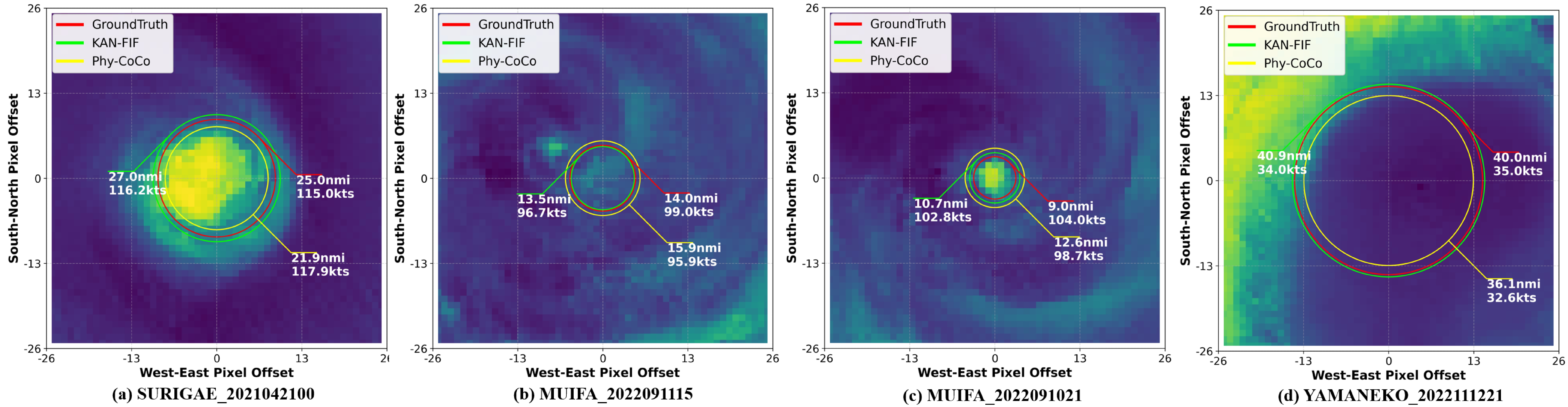
The KAN-FIF system utilizes spline-parameterized Kolmogorov-Arnold Networks for real-time cyclone analysis on edge computing devices.
Accurate and timely tropical cyclone (TC) estimation is critical for disaster mitigation, yet current physics-guided deep learning models often struggle with computational efficiency and parameter bloat on edge devices. This challenge is addressed in ‘KAN-FIF: Spline-Parameterized Lightweight Physics-based Tropical Cyclone Estimation on Meteorological Satellite’, which introduces a novel framework leveraging Kolmogorov-Arnold Networks (KANs) to achieve high-fidelity TC intensity and size prediction with significantly reduced computational cost. Experiments demonstrate that KAN-FIF achieves a 94.8\% reduction in parameters and a 68.7\% faster inference speed compared to state-of-the-art models, while maintaining superior accuracy-paving the way for real-time TC monitoring directly on satellite platforms-but how can this approach be further extended to incorporate more complex atmospheric interactions and improve long-term forecasting capabilities?
The Inevitable Limits of Prediction
For decades, the Dvorak Technique served as a cornerstone of tropical cyclone intensity estimation, relying on satellite imagery analysis to assess storm structure and predict its strength. However, this method, and other traditional approaches, inherently simplify the incredibly complex physical processes driving TC development. Subtle variations in atmospheric conditions – like wind shear, sea surface temperatures, and upper-level outflow – can dramatically influence a storm’s behavior, nuances often lost in the broader classifications used by these techniques. Consequently, forecasts based solely on these methods frequently exhibit inaccuracies, particularly when dealing with rapidly intensifying storms or those exhibiting atypical structures. The limitations highlight the need for more sophisticated modeling capable of capturing the full spectrum of TC dynamics and integrating a wider range of observational data.
The escalating intricacy of global weather systems necessitates a paradigm shift in tropical cyclone forecasting. Contemporary atmospheric dynamics are characterized by increasingly non-linear interactions and a proliferation of influencing factors – from subtle shifts in sea surface temperatures and atmospheric pressure to the complex interplay of upper-level winds and moisture transport. Consequently, traditional predictive models, often reliant on simplified assumptions, struggle to capture these nuanced behaviors. Advanced modeling approaches are now focused on assimilating a wider array of data – encompassing satellite imagery, radar observations, buoy readings, and even aircraft reconnaissance data – to build more comprehensive and realistic simulations. The ability to integrate these diverse data streams and accurately represent the subtle changes within these complex systems is paramount to improving forecast accuracy and mitigating the devastating impacts of tropical cyclones.
Despite the potential of deep learning to revolutionize tropical cyclone (TC) prediction, a significant hurdle remains in translating these advancements into practical, real-time forecasting capabilities. Current deep learning models, designed to capture the intricate nuances of TC formation and intensification, frequently demand substantial computational power and memory. This reliance on high-performance computing infrastructure limits their deployment on edge devices – such as those aboard weather satellites or deployed in remote field stations – and restricts their use in time-sensitive applications. The substantial resource requirements not only increase operational costs but also impede the rapid dissemination of critical forecasts to vulnerable populations, creating a need for more efficient and streamlined deep learning architectures tailored for resource-constrained environments.

A Framework for Controlled Complexity
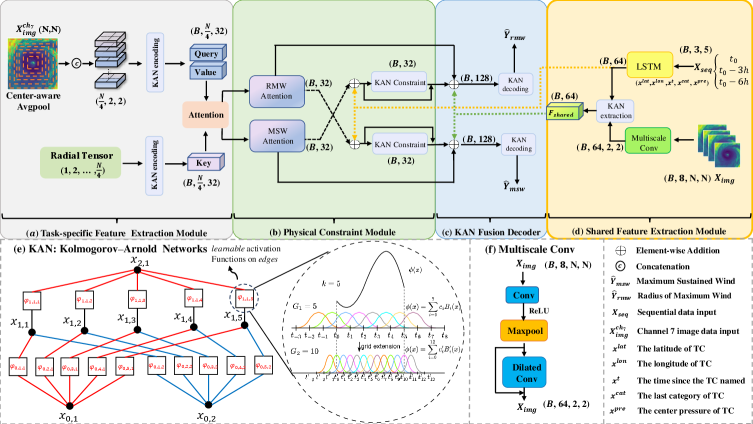
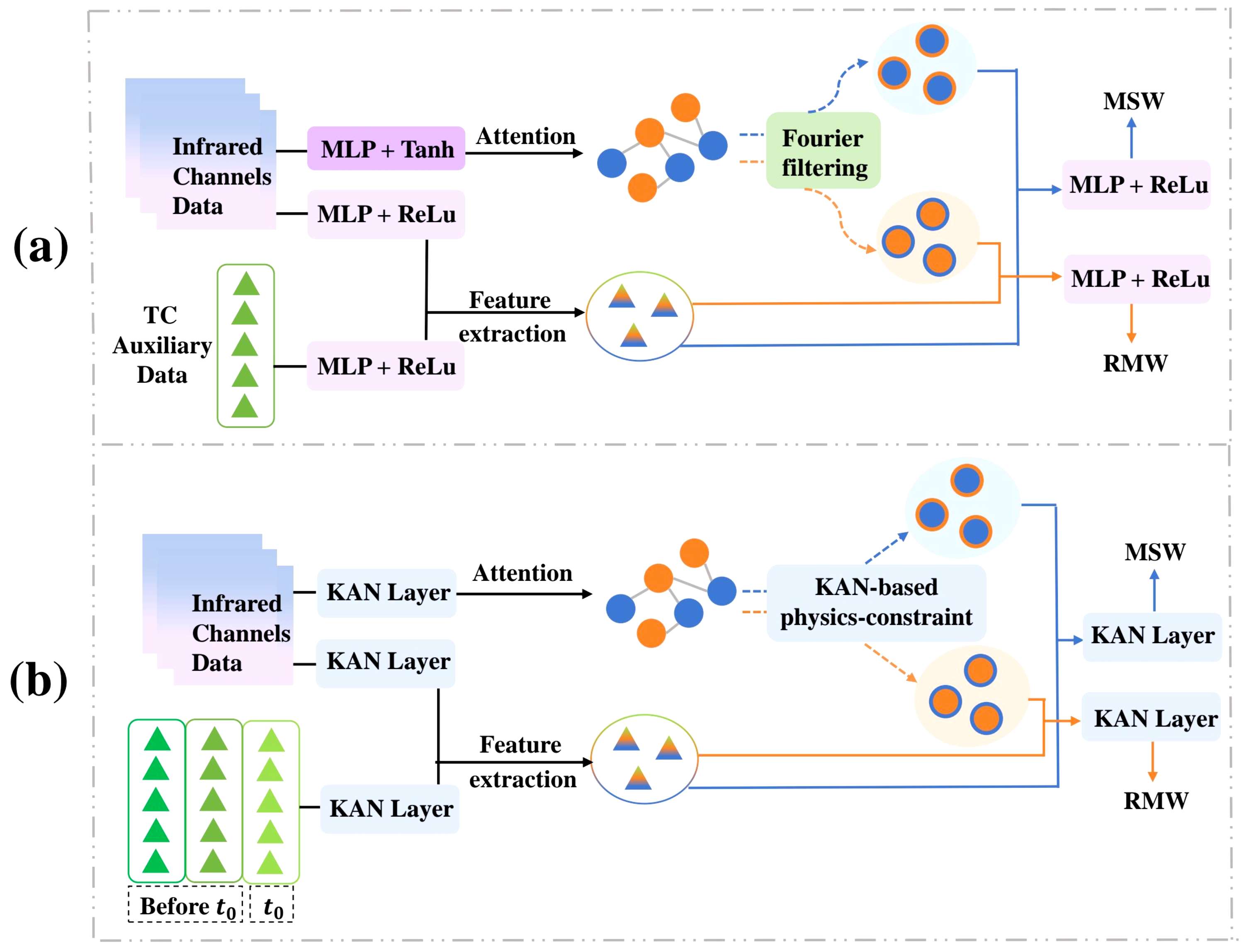
The KAN-FIF framework leverages Kolmogorov-Arnold Networks (KANs), a type of neural network utilizing spline-based functions for parameter efficiency and faster computation compared to traditional fully-connected layers. KANs achieve this by representing functions as a sum of radial basis functions, reducing the number of required parameters. This is combined with the integration of physics-based constraints directly into the model architecture. These constraints act as regularization terms during training, guiding the network to produce outputs consistent with known physical laws governing the target TC estimation problem. The resulting hybrid approach aims to improve both the accuracy and generalization capabilities of the model, particularly in scenarios where training data is limited or noisy.
Integrating physical relationships into the KAN-FIF framework reduces dependence on large, exclusively data-driven training sets. This approach leverages established physical principles to constrain the model’s learning process, improving its ability to generalize to unseen data and maintain performance under varying conditions. By encoding prior knowledge, the model requires fewer data points to achieve comparable accuracy to purely data-driven models, and demonstrates increased robustness to noisy or incomplete inputs. This is achieved by biasing the model towards solutions that are not only consistent with the training data, but also adhere to known physical laws, thereby preventing overfitting and enhancing predictive reliability.
The KAN-FIF framework prioritizes implementation on resource-constrained edge devices through architectural optimizations and integration with the AscendCL Framework. These optimizations focus on reducing model size and computational demands without significant performance degradation, enabling real-time processing with limited power and memory. The AscendCL Framework, a heterogeneous computing platform, provides tools and libraries for efficient deployment and acceleration of neural networks on edge hardware, facilitating the execution of complex calculations required for accurate thermal conductivity (TC) estimation directly on the device.
The Illusion of Complete Information
The KAN-FIF framework addresses the complexities of tropical cyclone (TC) evolution by integrating spatially-detailed information from satellite imagery with the sequential data provided by time-series observations. This fusion is achieved through a dedicated architecture designed to process these distinct data modalities. Satellite imagery contributes to an understanding of the TC’s physical structure, including eye characteristics and spiral band formations, while time-series data, such as historical wind speeds and central pressures, captures the dynamic changes occurring over time. By combining these perspectives, KAN-FIF aims to create a more holistic representation of the TC, enabling improved short-term forecasting of its intensity and trajectory. This approach moves beyond reliance on either spatial or temporal data alone, leveraging the complementary strengths of each to provide a more comprehensive analysis.
The model’s training and validation relied on a combined dataset sourced from the FY-4 Series Meteorological Satellite and the Tropical Cyclone Multi-scale Model (TCMM) Dataset. The FY-4 series provides high-resolution, multi-spectral imagery capturing atmospheric and cloud characteristics crucial for tracking tropical cyclone (TC) development. Complementing this, the TCMM dataset offers a comprehensive collection of simulated TC data, including wind fields, pressure distributions, and storm tracks. This integration yields a robust dataset, allowing for the training of a model capable of generalizing across various TC scenarios and validating its performance against a diverse range of simulated events, ultimately improving predictive accuracy.
Model performance was quantitatively assessed using both Mean Absolute Error (MAE) and Root Mean Square Error (RMSE) as key performance indicators. Results demonstrate a substantial improvement in predictive accuracy compared to existing methods; specifically, the model achieved a 32.5% reduction in MAE for Maximum Sustained Wind (MSW) prediction and a 31.9% reduction in RMSE. These metrics were calculated based on a held-out validation dataset, ensuring an unbiased evaluation of the model’s generalization capabilities. The observed reductions in both MAE and RMSE indicate a consistent and significant improvement across the prediction task.
The KAN-FIF model demonstrates significant efficiency gains over current physics-guided models, achieving a 94.8% reduction in parameter count. This reduction in complexity facilitates deployment on resource-constrained hardware; specifically, the model achieves an inference latency of 14.41 milliseconds per sample when executed on the Qingyun-1000 edge computing device. This performance allows for real-time predictions of typhoon characteristics without requiring substantial computational resources, enabling broader applicability in forecasting and monitoring systems.
The Inevitable Imperfection of Preparedness
The KAN-FIF framework represents a significant advancement in tropical cyclone forecasting, directly impacting the ability to mitigate disaster. Its computationally efficient design allows for rapid analysis of complex atmospheric data, yielding accurate predictions of storm behavior with minimized delay. This speed is critical; timely warnings, even improvements of just a few hours, provide communities with the necessary lead time to implement effective preparedness measures. Consequently, the framework doesn’t simply predict where a storm will go, but empowers proactive responses that demonstrably reduce potential damage to infrastructure and, most importantly, safeguard human life by enabling targeted evacuations and resource deployment before a storm makes landfall.
The KAN-FIF framework demonstrably enhances disaster preparedness by providing precise estimations of critical tropical cyclone characteristics. Accurate forecasting of Maximum Sustained Wind – the cyclone’s peak intensity – and Radius of Maximum Winds, which defines the area of most severe impact, directly informs strategic decisions. These data empower authorities to implement targeted evacuation plans, prioritizing vulnerable populations within the highest-risk zones. Furthermore, a refined understanding of a cyclone’s size and strength allows for optimized resource allocation – ensuring that personnel, supplies, and medical aid are deployed efficiently to areas predicted to experience the most significant effects, ultimately minimizing potential damage and saving lives.
The KAN-FIF framework leverages a Static Computation Graph to achieve notable gains in predictive efficiency and dependability. Unlike dynamic graphs that recalculate pathways with each new data input, a static graph predefines the entire computational process, allowing for significant optimization before runtime. This pre-calculation not only accelerates predictions – vital for time-sensitive applications like tropical cyclone forecasting – but also ensures consistency in results, as the computational steps remain fixed. This reliability is paramount in operational settings where decision-makers require predictable and repeatable outputs for effective resource allocation and timely warnings, minimizing the potential for errors stemming from fluctuating calculations.
The pursuit of computationally efficient models, as exemplified by KAN-FIF’s application of Kolmogorov-Arnold Networks, isn’t merely about shrinking code; it’s about acknowledging inherent systemic limitations. The framework’s ability to perform accurate estimations on edge devices highlights a crucial tenet: true resilience begins where certainty ends. Donald Knuth observed, “Premature optimization is the root of all evil,” and this holds profound weight. KAN-FIF doesn’t attempt to eliminate computational cost, but rather to adapt to it, building a system that thrives within constraints. This adaptation, a mindful acceptance of imperfection, is the art of fearing consciously – monitoring not for the absence of failure, but for its inevitable revelation.
What Lies Ahead?
The pursuit of cyclone intensity estimation, even when elegantly distilled into a spline-parameterized framework, merely shifts the locus of uncertainty. KAN-FIF, in its attempt to compress a chaotic reality into manageable parameters, has not solved the problem of prediction, but rather relocated its fragility. The edge, as a computational haven, is not a refuge from the storm, but another point of potential failure. Each bit compressed, each parameter pruned, is a prophecy of information lost-a narrowing of vision as the system approaches the unknowable heart of the cyclone.
Future work will inevitably focus on multimodal data fusion, but the true challenge isn’t simply adding more signals. It’s acknowledging that each sensor offers a partial, distorted view-a fragment of a truth that can never be fully assembled. The system does not become more robust with each added input; it becomes more complex, its internal contradictions multiplying like phantom storms.
Perhaps the most fruitful path lies not in refining the estimation itself, but in embracing the inherent indeterminacy. A system that acknowledges its own limitations-that outputs not a single intensity, but a distribution of probabilities-would be a more honest, and ultimately, a more valuable tool. If the system is silent, it’s not because it knows; it’s because it has ceased to listen.
Original article: https://arxiv.org/pdf/2602.12117.pdf
Contact the author: https://www.linkedin.com/in/avetisyan/
See also:
- United Airlines can now kick passengers off flights and ban them for not using headphones
- How to Complete Bloom of Tranquility Challenge in Infinity Nikki
- Gold Rate Forecast
- Katanire’s Yae Miko Cosplay: Genshin Impact Masterpiece
- How to Solve the Glenbright Manor Puzzle in Crimson Desert
- All Itzaland Animal Locations in Infinity Nikki
- All Golden Ball Locations in Yakuza Kiwami 3 & Dark Ties
- 8 Actors Who Could Play Blackbeard In One Piece Live-Action Season 3
- All 10 Potential New Avengers Leaders in Doomsday, Ranked by Their Power
- A Dark Scream Theory Rewrites the Only Movie to Break the 2-Killer Rule
2026-02-15 07:50