Author: Denis Avetisyan
New research shows that deep learning models can effectively identify galaxy mergers, even when subtle tidal features are the key indicators.
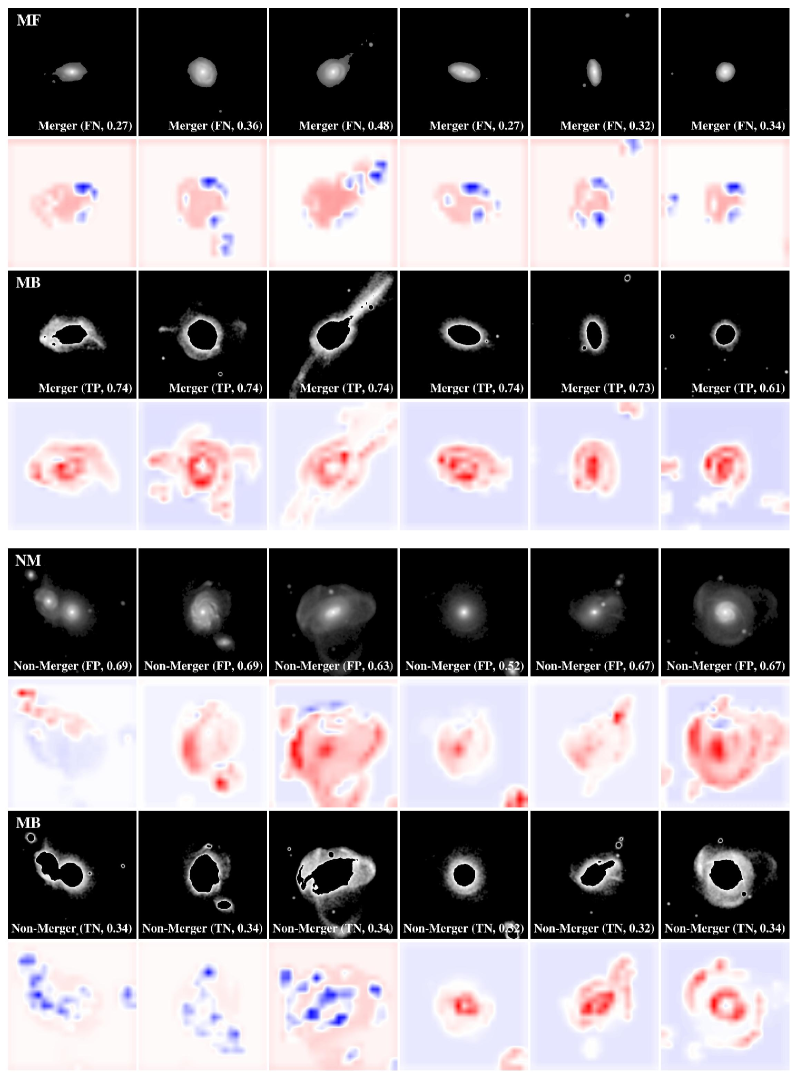
Convolutional neural networks, trained on the TNG50 simulation, demonstrate the potential to classify mergers from future deep imaging surveys like LSST, leveraging faint tidal features as crucial discriminators.
Distinguishing between merging and non-merging galaxies remains a fundamental challenge in understanding galaxy evolution. This study, ‘Convolutional Neural Networks for classifying galaxy mergers: Can faint tidal features aid in classifying mergers?’, investigates the feasibility of employing convolutional neural networks (CNNs) to identify mergers in deep imaging data, specifically exploring whether faint tidal features-often below 26\,{\rm mag\,arcsec^{-2}}-can improve classification accuracy. Using high-resolution simulations from the TNG50 project, the authors demonstrate that a CNN model can achieve 67-70% accuracy, representing a \sim 5% improvement when trained on images emphasizing these faint features. Could leveraging these subtle signatures unlock a more complete picture of merger rates and the processes driving galactic assembly, particularly with forthcoming data from the Rubin Observatory’s LSST?
The Illusion of Stability: Pinpointing Collisions in a Dynamic Cosmos
The evolution of galaxies is rarely a solitary process; mergers and interactions with other galaxies play a fundamental role in shaping their size, structure, and stellar populations. However, pinpointing these galactic collisions is surprisingly difficult. While major mergers produce dramatic visual distortions, a significant portion of galactic evolution occurs through the accretion of smaller galaxies or ‘minor mergers’ which leave only subtle ripples and faint tidal streams in observational data. These delicate features are easily obscured by the intrinsic light of the galaxies themselves, the vast distances involved, and the limitations of current telescope resolution. Consequently, many mergers remain hidden from view, potentially leading to an incomplete understanding of how galaxies grow and change over cosmic time. Detecting these subtle distortions requires advanced image processing techniques and sophisticated modeling to disentangle the faint signals from the noise and truly reveal the history of galactic assembly.
Existing techniques for identifying galactic mergers face significant hurdles when confronted with the sheer scale and subtlety of astronomical data. Traditional methods, often reliant on visual inspection or simplified algorithms, struggle to detect the faint tidal tails, distorted isophotes, and other subtle morphological disturbances indicative of a recent or ongoing merger. This is particularly true for mergers involving smaller galaxies or those observed at high redshifts, where these features are significantly dimmed and blurred. The immense volume of data generated by modern sky surveys further exacerbates the problem, making manual classification impractical and overwhelming automated systems. Consequently, current merger catalogs are likely incomplete, potentially biasing studies of galaxy evolution and the overall cosmic structure formation process – a challenge researchers are actively addressing with novel machine learning approaches and more sensitive observational strategies.
Cosmic structure formation relies heavily on understanding how galaxies assemble over time, and accurately identifying merger events – particularly those involving smaller galaxies – is paramount to this understanding. These smaller mergers, though less visually dramatic than collisions between large spirals, are statistically more frequent and contribute significantly to the growth of massive galaxies and the build-up of galactic halos. Current cosmological models often struggle to reproduce observed galaxy populations without accurately accounting for the contribution of these minor mergers, which can subtly alter galactic morphology and trigger bursts of star formation. Refined merger classifications, achieved through advanced data analysis and simulations, allow researchers to test and improve these models, leading to a more complete picture of how the universe evolved from its initial conditions to the complex web of galaxies observed today.
Constructing Reality: Simulating a Universe for Training
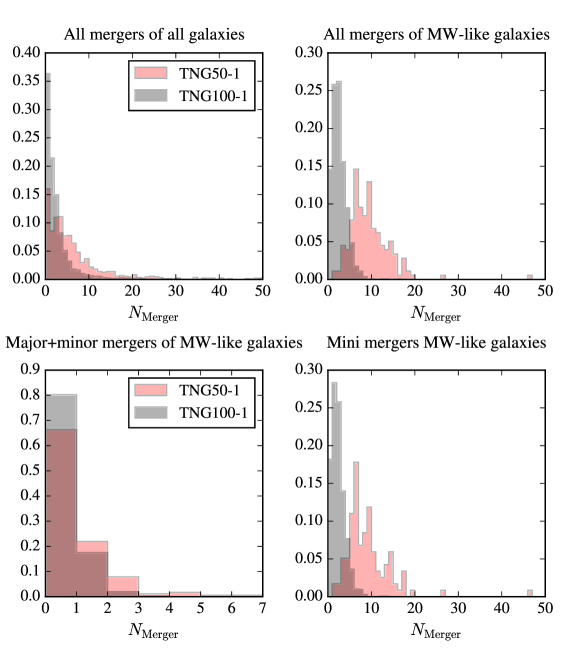
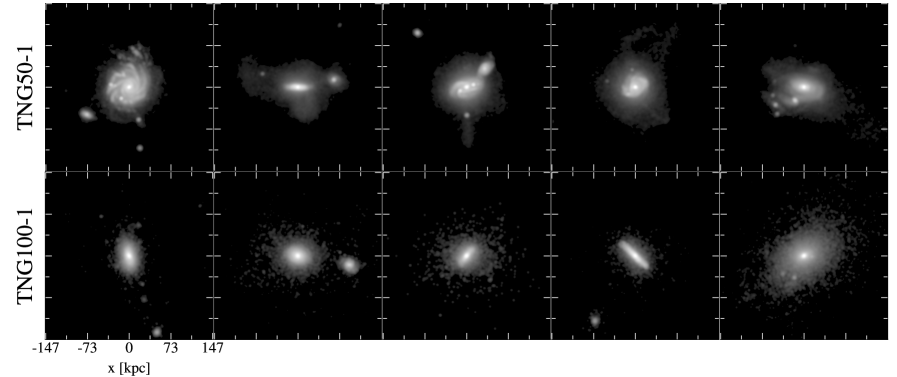
The TNG50 simulation is a cosmological model encompassing a volume of 50 Mpc/h, populated with over eight million dark matter particles and one million baryonic cells, providing a high degree of resolution for modeling galactic evolution. It utilizes a fully coupled hydrodynamical treatment, incorporating gravity, hydrodynamics, star formation, chemical evolution, and active galactic nuclei (AGN) feedback. This allows for the generation of a diverse catalog of galaxy merger events, varying in mass ratios, orbital parameters, and viewing angles. The simulation’s output was processed to create a synthetic dataset containing images of galaxies undergoing mergers, representing a statistically significant sample for machine learning applications and exceeding the scale of currently available labeled observational data.
Rendering the TNG50 simulation data in the KK-Band – a portion of the electromagnetic spectrum around 22-27 GHz – was specifically chosen to highlight faint tidal features indicative of galaxy mergers. These features, resulting from gravitational interactions, appear as extended, low-surface-brightness structures. The KK-Band’s wavelength is particularly sensitive to the cooler dust and gas present in these tidal tails and bridges, enhancing their visibility compared to optical or near-infrared observations. This approach effectively amplifies the signal of ongoing mergers, allowing for more accurate identification and characterization of these events within the simulation data, and ultimately improving the training of machine learning models designed to detect mergers in real astronomical images.
The creation of a synthetic dataset was essential for the development and assessment of machine learning models designed to identify galaxy mergers. Real-world, labeled data for this task is inherently limited due to the time and resources required for manual classification of merger events. This scarcity presents a significant bottleneck for training robust machine learning algorithms. The synthetic dataset, generated from the TNG50 simulation, provided a substantially larger and fully labeled dataset, overcoming this limitation and enabling effective model training and independent validation of performance metrics. This approach allowed for a statistically significant assessment of model accuracy and generalization capabilities, which would not have been feasible with available observational data alone.
The TNG50 simulation facilitated the study of galaxy mergers incorporating ‘mini-mergers’ – low-mass galaxies merging with larger counterparts – due to its high resolution. Observational identification of these events is challenging because the low luminosity and small size of mini-mergers often render them unresolved or indistinguishable from other galactic features in existing datasets. The simulation allowed for detailed analysis of these previously unresolvable events, providing a controlled environment to quantify their frequency, mass ratios, and contributions to the growth of larger galaxies. This synthetic data is critical for understanding the hierarchical structure formation of galaxies and validating models reliant on the contribution of low-mass merger events.
Unveiling the Hidden: A Deep Learning Glimpse into Collisions
The implemented convolutional neural network (CNN) architecture utilized dilated convolutions to address the challenge of identifying subtle distortions indicative of galaxy mergers. Standard convolutions are limited by their receptive field – the area of the input image that influences a neuron’s activation. Dilated convolutions introduce spacing between the kernel elements, effectively increasing the receptive field without increasing the number of parameters. This allows the CNN to capture large-scale patterns and faint tidal features that might be missed by standard convolutional layers. The dilation rate, a hyperparameter controlling the spacing, was optimized during model training to maximize the detection of these subtle, yet critical, merger indicators.
To address the limited size of the initial training dataset and enhance model performance, several data augmentation techniques were employed. These included random rotations, horizontal and vertical flips, and minor elastic distortions applied to the galaxy images. Specifically, images were rotated by angles between 0 and 360 degrees, flipped along both axes with a 50% probability, and subjected to random elastic deformations with a maximum displacement of 5 pixels. This effectively increased the dataset size by a factor of six, providing the CNN with a wider range of examples and improving its ability to generalize to unseen data, ultimately bolstering its robustness against variations in image orientation, alignment, and minor distortions.
The convolutional neural network (CNN) demonstrated a capacity to identify faint tidal features – the morphological distortions resulting from gravitational interactions between galaxies – with a peak accuracy of approximately 70%. These features, often subtle and diffuse, serve as primary indicators of ongoing or completed galaxy mergers. The 70% accuracy represents the highest performance achieved during validation testing, evaluated against a held-out dataset of galaxy images. This performance level indicates the model’s capability to reliably detect merger signatures, despite the low signal-to-noise ratio frequently associated with these features and the inherent complexities of astronomical image data.
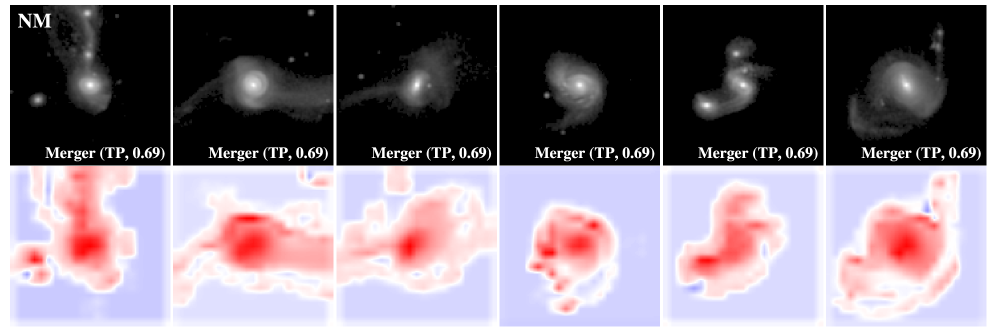
Gradient-weighted Class Activation Mapping (Grad-CAM) was employed as a post-hoc interpretability technique to visualize the regions of input images that most influenced the CNN’s classification decisions. This involved using the gradients of the target class with respect to the final convolutional layer’s feature maps to weight these maps, effectively highlighting the image areas considered most important by the network. Analysis of the resulting heatmaps consistently demonstrated that the model was attending to faint tidal features – the extended streams of stars resulting from gravitational interactions – indicative of merging galaxies, thus validating the model’s learned representations and confirming its focus on the salient morphological indicators for merger identification.
A Universe Observed: The Legacy of LSST and Precision Cosmology
The forthcoming Legacy Survey of Space and Time (LSST) at the Rubin Observatory promises a deluge of astronomical data, presenting both remarkable opportunities and significant hurdles for the study of galaxy mergers. Unlike previous surveys, LSST’s wide-field imaging and frequent observations will capture an immense catalog of galaxies at various stages of interaction, potentially increasing the known merger rate by orders of magnitude. However, this sheer volume of data necessitates automated classification techniques; manually identifying mergers within the LSST dataset is simply impractical. The challenge lies in developing algorithms robust enough to distinguish genuine mergers from background noise and other galactic phenomena, while also efficiently processing the terabytes of images generated each night. Successfully navigating these computational demands will unlock a wealth of information about galaxy evolution and the large-scale structure of the universe, but requires innovative approaches to data handling and analysis.
The anticipated data deluge from the Rubin Observatory’s Legacy Survey of Space and Time (LSST) presents a unique opportunity to comprehensively map galactic mergers throughout cosmic history, and a newly developed convolutional neural network (CNN) is poised to capitalize on this wealth of information. Previous merger identification efforts have been limited by both observational constraints and the challenges of automated analysis; however, this CNN model demonstrates a significant advancement in accurately classifying these events at an unprecedented scale. By efficiently processing the massive LSST datasets, the model promises to deliver a far more complete catalog of galaxy mergers than previously attainable, enabling researchers to move beyond statistically limited samples and explore the subtle details of how galaxies grow and evolve through these interactions. This detailed census of mergers will not only refine existing models of galaxy evolution but also provide crucial insights into the formation of large-scale cosmic structures.
A precise census of galactic mergers, including detailed measurements of the mass ratio between colliding galaxies, offers a powerful new lens through which to investigate the processes shaping the cosmos. These collisions aren’t random events; they fundamentally alter galactic morphology, trigger bursts of star formation, and can even fuel the supermassive black holes at galactic centers. By quantifying how frequently galaxies of different sizes merge, and by characterizing the resulting stellar populations and black hole activity, researchers can rigorously test current models of galaxy evolution. Furthermore, the distribution of mergers across cosmic time provides critical insights into the growth of large-scale structures, such as galaxy clusters and filaments, ultimately refining the broader understanding of cosmic structure formation and the universe’s expansion history.
The culmination of this research has yielded a convolutional neural network achieving a median Area Under the Curve (AUC) of 67% in identifying galaxy mergers, representing a significant leap forward in automated astronomical analysis. Notably, training the model with masked bright features – deliberately obscuring intensely luminous areas – improved the merger identification rate by approximately 5%. This seemingly subtle refinement allows the network to focus on more nuanced morphological details, leading to a more comprehensive catalog of merging galaxies. The enhanced precision facilitated by this model is poised to usher in a new era of precision cosmology, where increasingly detailed observational data can rigorously test and refine existing models of galactic evolution and the very structure of the universe, moving beyond theoretical predictions towards empirically validated understanding.
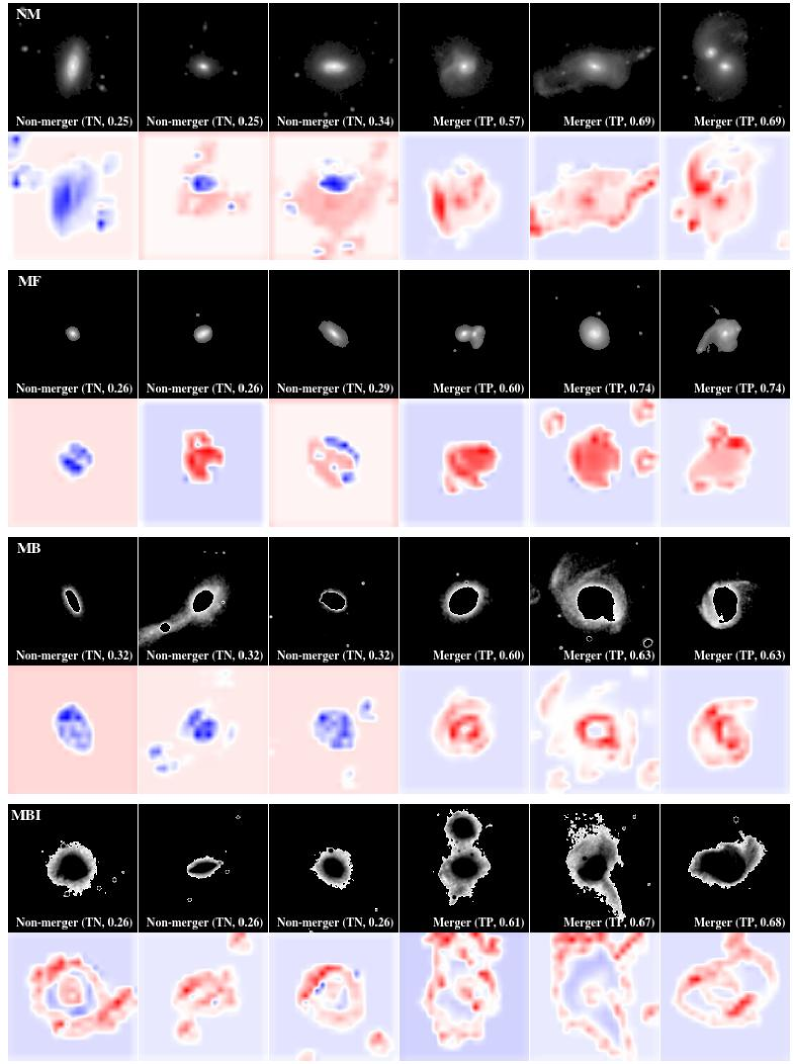
The pursuit of classifying galaxy mergers through convolutional neural networks, as demonstrated in this work, feels a bit like attempting to map the unmappable. The model’s success hinges on identifying faint tidal features – ephemeral echoes of galactic interaction. It recalls Newton’s observation, “I do not know what I may seem to the world, but to myself I seem to be a boy playing on the seashore.” Each identified merger, each successfully classified image, is merely a ripple on the vast ocean of the unknown. The model, trained on the TNG50 simulation, can only extrapolate from what it has ‘seen’, and the true complexity beyond the observable data remains frustratingly elusive. Any confidence in complete understanding is a comforting illusion.
Where Do We Go From Here?
The demonstrated efficacy of convolutional neural networks in discerning galaxy mergers, even those exhibiting subtle tidal features, presents a curiously limited triumph. The success hinges, of course, on the fidelity of the TNG50 simulation-a meticulously crafted universe, yet still an artifice. The true cosmos rarely conforms to idealized models; the faint, asymmetrical perturbations that betray a merging history are frequently obscured by dust, redshift, and the inherent noise of observation. The model’s performance will inevitably degrade when confronted with data beyond the simulation’s parametric space.
Future work must address the question of transferability. Can a network trained on TNG50 generalize to the diverse morphologies and observational biases present in actual deep imaging surveys, such as those anticipated from LSST? More critically, the reliance on simulated data fosters a dangerous complacency. A statistically significant detection rate, even with faint features, does not equate to a fundamental understanding of the underlying merger process. The accretion disk exhibits anisotropic emission with spectral line variations, demanding further investigation into the physical mechanisms driving these mergers.
Ultimately, the pursuit of automated merger identification serves as a humbling reminder. Each successful classification is merely a temporary reprieve from the vastness of the unknown. Modeling requires consideration of relativistic Lorentz effects and strong spacetime curvature, and the edge of what we think we know remains perpetually distant-a horizon, much like that surrounding a black hole, beyond which even the most elegant theory may vanish.
Original article: https://arxiv.org/pdf/2602.03312.pdf
Contact the author: https://www.linkedin.com/in/avetisyan/
See also:
- United Airlines can now kick passengers off flights and ban them for not using headphones
- Crimson Desert: Disconnected Truth Puzzle Guide
- All 9 Coalition Heroes In Invincible Season 4 & Their Powers
- Mewgenics vinyl limited editions now available to pre-order
- Grok’s ‘Ask’ feature no longer free as X moves it behind paywall
- Assassin’s Creed Shadows will get upgraded PSSR support on PS5 Pro with Title Update 1.1.9 launching April 7
- Grey’s Anatomy Season 23 Confirmed for 2026-2027 Broadcast Season
- Viral Letterboxd keychain lets cinephiles show off their favorite movies on the go
- Does Mark survive Invincible vs Conquest 2? Comics reveal fate after S4E5
- Zero Parades – For Dead Spies is launching on May 21 for PC and it will be Steam Deck Verified
2026-02-05 02:14