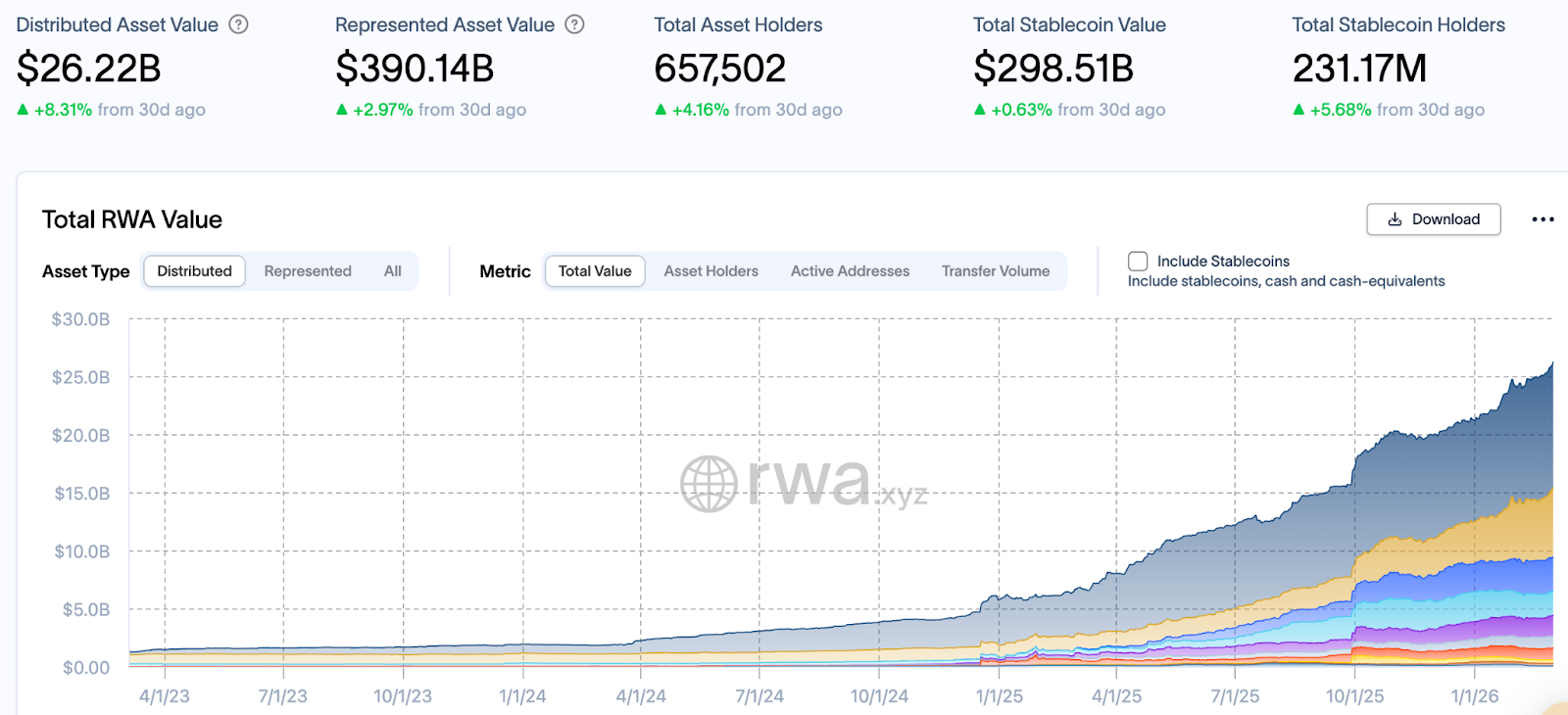
The total value of real-world assets represented on RWA.xyz is currently around $390 billion, nearing the $400 billion mark and potentially shifting how the market views this type of investment.
We recently interviewed Pauline Shangett, Chief Business Officer at Gate Group and CSO at ChangeNOW, in two separate conversations for BeInCrypto, to get her insights on the future of Real World Assets (RWAs).
Lee notes a shift in the market towards more reliable investments with clear pricing and active trading, away from riskier, less popular options. Shangett adds that companies are now prioritizing regulatory compliance and resale potential *during* product development, instead of trying to address these issues later on.
In my research, both individuals I spoke with emphasized a growing sophistication in the market. This helps me understand why products like BlackRock’s tokenized money market fund were able to launch and quickly gain traction with institutional investors.
Let’s unpack this.
The Catalyst for Change
The process of turning Real World Assets into tokens is gaining significant traction. However, neither Kevin Lee nor Pauline Shangett think this change happened because of one specific technological advancement.
Lee rejects the idea of a defining unlock:
This growth happened because we changed our strategy to focus on investments that are consistently in demand and easy to trade. We used to try tokenizing unusual assets like timberland, carbon offsets, or golf club memberships, hoping that would automatically create a market for them. But we realized that wasn’t enough to guarantee trading activity.
He believes the last year saw a shift in how the industry approached innovation. Rather than trying to create new uses for cryptocurrency through code alone, the focus turned to leveraging the benefits of blockchain technology – like 24/7 availability, immediate transactions, and easy asset transfer – for existing, well-established markets.
Shangett frames the transition as structural:
As a researcher tracking the growth of Real World Assets (RWAs), I’ve been observing the recent $400 billion scale-up, and it wasn’t the result of one breakthrough. Instead, three key developments happened around the same time. First, regulators in Beijing provided a clear legal framework for RWAs. Simultaneously, the QXMP protocol developed a way to reliably prove the authenticity of physical assets on the blockchain. Finally, BlackRock demonstrated that large institutional investors are willing to invest in tokens that are both compliant and offer returns. It was the convergence of these three things that really drove the growth we’ve seen.
She explained that the industry mostly moved beyond simply asking “can we put this online?” in 2022 and 2023. While early tests showed that assets could be turned into tokens on the blockchain, those tokens often lacked trading activity and faced unclear legal rules for a long time – essentially, they were products waiting for customers.
She believes the key change happened when investors stopped supporting projects that were well-designed technically but couldn’t actually be traded. This led to a more careful approach, where ensuring a project could be easily bought and sold, and meeting regulatory requirements, became essential from the very beginning, rather than being considered later additions.
The Central Tension in RWA 2.0
Tokenizing a bond is straightforward. Making it reliably tradable at any moment is not.
The technology for connecting different blockchains is better than ever, with systems like Chainlink CCIP, Axelar, and LayerZero allowing for secure communication and proof of ownership across networks. While this makes it easier to move assets around, simply having movement isn’t enough to create a robust and thriving ecosystem.
Lee makes the point:
As tokenized assets become more easily exchanged and used across different platforms, the issue of fragmented liquidity will lessen.
He believes that openly displaying prices encourages trading activity and investment, ultimately leading to tighter price differences and more connected markets.
Shangett underlines the liquidity issue:
“Issuing a token is easy, selling it anytime is the hard part. The main challenge is liquidity.”
Being able to use a token across different blockchains proves who owns it, but it doesn’t guarantee anyone will buy it. For a token to be easily sold, there needs to be available funds waiting in the market. If there isn’t enough initial buying and selling activity, expanding to more blockchains could just spread out the lack of available funds, rather than solving it.
Instant settlement moved risk upstream
Tokenization often promises incredibly fast transactions – almost immediate settlements. This sounds ideal, potentially eliminating risks like failed trades and concerns about who you’re dealing with. However, this speed also removes the natural breathing room that traditional markets have to correct errors or handle unexpected issues.
Lee pushed back on this argument:
As an analyst, I often see settlement delays in traditional finance not as deliberate safety measures, but as simple limitations of old systems. And frustratingly, even within the normal settlement timeframe, mistakes made during execution are rarely fixable.
It’s essential to prioritize risk management from the very beginning. Checking and controlling potential issues *before* a trade is much more effective than trying to fix problems *after* it’s done, whether you’re using traditional systems or blockchain. As processes become faster with new technology, having strong upfront controls becomes even more important.
Shangett reaches the same conclusion from another angle:
The immediate and irreversible nature of blockchain transactions has both advantages and disadvantages. Unlike traditional finance, where there was time to fix errors after a transaction, blockchain eliminates that buffer. However, the industry didn’t ignore this risk. Instead, it developed new security measures. Between 2025 and 2026, the focus shifted from simply trusting the code to a system where safeguards are built directly into it.
She describes the industry’s new protection architecture, where:
When a transaction is disputed, the money is temporarily held by a neutral third party while a mediator decides the outcome. Instead of canceling the original purchase, a separate refund transaction is issued. This process preserves the permanent record of the original transaction while allowing for a short period to resolve the issue.
As settlements happen faster, the system will need stronger checks before processing transactions and clearer procedures for dealing with any problems that arise afterward.
CEXs as Digital Investment Banks
When traditional assets like government bonds and stocks are traded on the same platform as cryptocurrencies like memecoins, that platform effectively acts as a place to manage a diverse investment portfolio.
As I’ve been watching the market, centralized exchanges, or CEXs, are clearly evolving. They’re moving beyond just offering a wide range of cryptocurrencies to becoming full-service financial platforms. The focus is shifting towards helping users build well-rounded portfolios, maximize their capital, and access financing across different asset classes. This is a big change, especially for those of us who initially came to crypto for quick trades. Now, the appeal is about diversifying investments, earning more consistent returns, and having access to risk management tools that weren’t available before – things you simply couldn’t find within the crypto world alone.
Shangett describes the market’s evolution from a risky, unpredictable environment – like a casino – to something more akin to a modern digital investment bank. This shift has clear consequences: tokenized Treasury bills allow more people to invest in government debt with smaller amounts of money, and tokenized stocks introduce cryptocurrency users to the patterns of traditional stock markets, but without the usual market closing times.
We’re starting to see the move towards digital assets reflected in traditional financial systems. For example, in January 2026, ICE/NYSE plans to launch a platform for trading tokenized stocks and ETFs around the clock, pending regulatory approval. However, the SEC has clarified that these tokenized securities are still subject to all existing federal securities laws, no matter how they’re structured.
As more real-world assets become tokenized and widely available, they’ll be subject to greater oversight, moving beyond the experimental phase. This new stage, often called RWA 2.0, represents the industry’s efforts to grow and operate effectively under increased scrutiny.
Read More
- United Airlines can now kick passengers off flights and ban them for not using headphones
- How to Complete Bloom of Tranquility Challenge in Infinity Nikki
- Gold Rate Forecast
- How to Solve the Glenbright Manor Puzzle in Crimson Desert
- 8 Actors Who Could Play Blackbeard In One Piece Live-Action Season 3
- A Dark Scream Theory Rewrites the Only Movie to Break the 2-Killer Rule
- All Itzaland Animal Locations in Infinity Nikki
- All Golden Ball Locations in Yakuza Kiwami 3 & Dark Ties
- All 10 Potential New Avengers Leaders in Doomsday, Ranked by Their Power
- How to Get to the Undercoast in Esoteric Ebb
2026-03-05 19:34