Author: Denis Avetisyan
New research leverages machine learning models trained on detailed simulations to rapidly and accurately forecast the outcomes of stellar collisions.
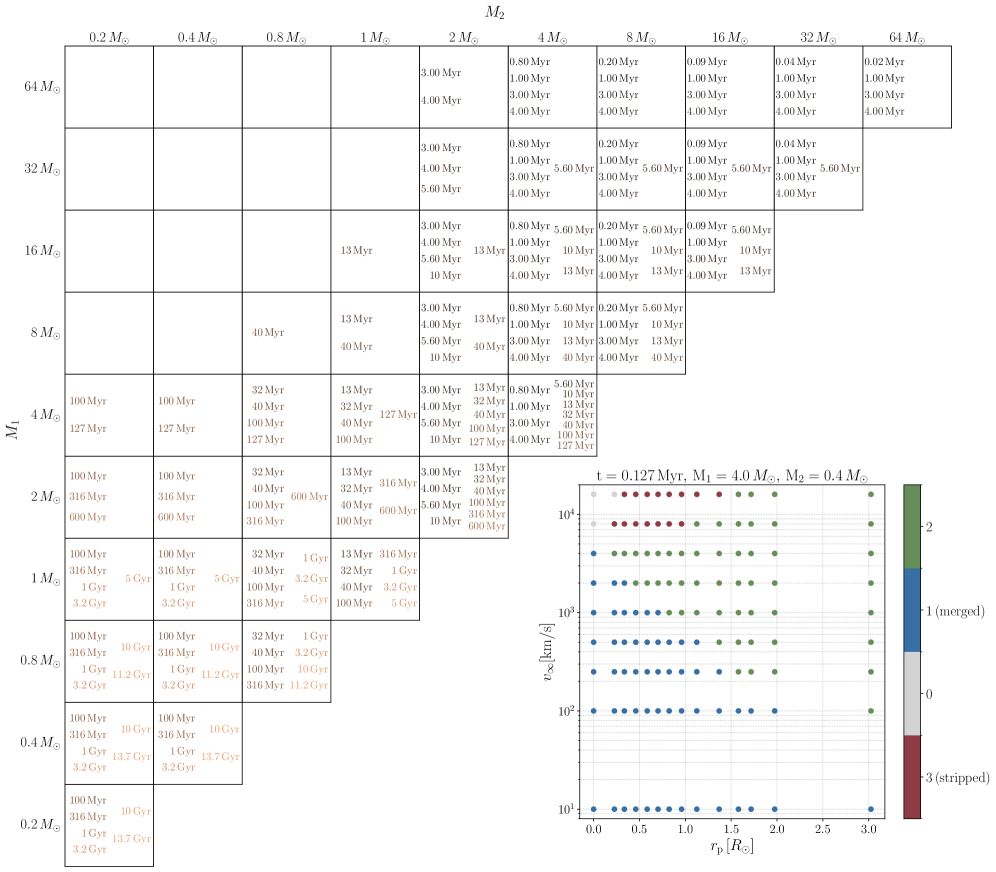
This review details machine learning methods for predicting the results of Smoothed-Particle Hydrodynamics (SPH) simulations of stellar collisions, focusing on remnant properties and mass loss.
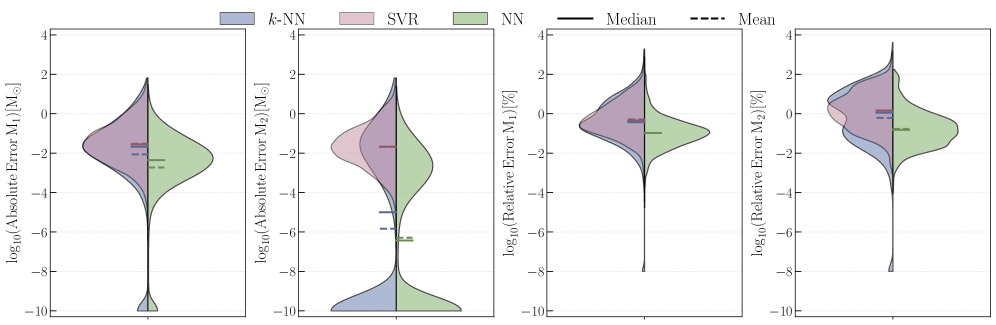
While detailed hydrodynamic simulations are crucial for understanding stellar collisions, their computational cost limits their use in large-scale $N$-body modeling of dense stellar environments. This research, presented in ‘Machine Learning Methods for Stellar Collisions. I. Predicting Outcomes of SPH Simulations’, addresses this challenge by training machine learning models on a comprehensive grid of 27,720 smoothed particle hydrodynamics (SPH) calculations of main-sequence star collisions to rapidly and accurately predict collision outcomes and remnant masses. Achieving classification balanced accuracy of 98.4\% and regression errors as low as 0.11\%, these models – publicly available through the collAIder package – offer a computationally efficient alternative to traditional methods. Will this approach unlock new insights into the formation of massive black holes and the dynamics of dense star clusters?
The Violent Dance: Collisions in the Cosmos
The universe isn’t a peaceful expanse; within the crowded confines of globular clusters and the energetic hearts of galactic nuclei, stellar collisions are remarkably common. These aren’t glancing blows, but catastrophic mergers that dramatically alter the composition and evolution of stellar populations. The sheer density of stars in these environments guarantees frequent encounters, leading to the formation of unusually massive stars, blue stragglers – stars appearing younger than their surroundings – and even exotic objects like black holes. This collisional process doesn’t simply destroy stars; it acts as a powerful engine for stellar evolution, continuously reshaping the demographics of these dense cosmic neighborhoods and influencing the overall dynamics of galaxies. Consequently, understanding the frequency and outcomes of these collisions is crucial for accurately modeling the histories and future evolution of these stellar systems.
Predicting the aftermath of stellar collisions presents a formidable challenge to astrophysicists, as the resulting remnant mass and the potential creation of exotic objects are governed by a complex interplay of factors. These events don’t simply yield a combined mass of the progenitors; instead, significant mass loss occurs through ejected material, and the collision dynamics determine whether a stable, massive star forms, or if an unstable configuration leads to a core-collapse supernova or even the birth of a black hole. Furthermore, collisions can synthesize heavy elements and create unusual stellar objects like blue stragglers or Thorne-Żytkow objects, demanding sophisticated models to accurately trace the energy transport, nuclear reactions, and hydrodynamic processes at play. The sheer diversity of possible outcomes, coupled with the extreme physical conditions, necessitates ongoing research and advanced computational techniques to fully unravel the mysteries hidden within these violent cosmic encounters.
Simulating stellar collisions presents a formidable challenge to modern astrophysics. While established computational methods, such as smoothed-particle hydrodynamics and N-body simulations, provide valuable insights, they often fall short of fully resolving the intricate physics at play. These events involve extreme densities, temperatures, and magnetic fields, demanding exceptionally high resolution to accurately capture processes like mixing, energy transport, and the formation of heavy elements. Consequently, even relatively simple collision scenarios can require immense computational power and time – often pushing the limits of available supercomputing resources. Furthermore, accurately modeling the aftermath – the formation of exotic objects or the dispersal of collision debris – necessitates incorporating complex equations of state and radiative transfer, adding another layer of difficulty to these already demanding calculations.
The Algorithmic Mirror: Predicting Stellar Fates
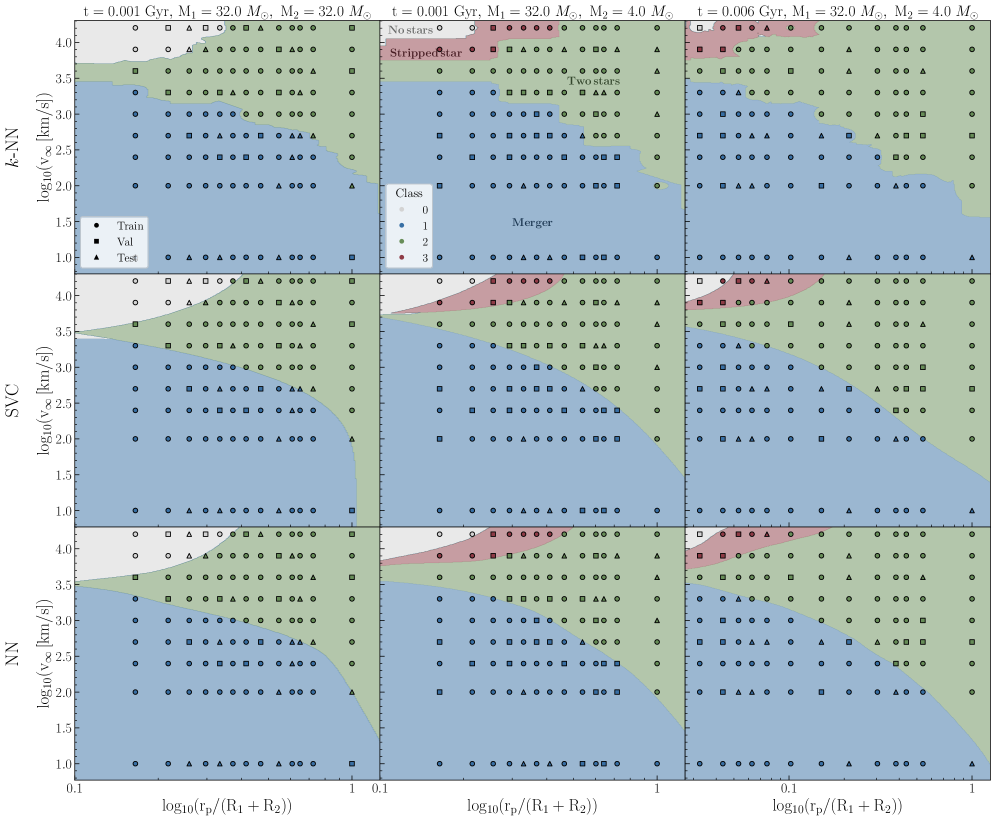
Traditional modeling of stellar collisions relies heavily on computationally intensive hydrodynamical simulations, requiring significant processing time and resources to determine post-collision outcomes. Machine learning provides an alternative approach by training algorithms on the results of these simulations, enabling rapid prediction of collision fates without repeating the full simulation process. This offers a substantial reduction in computational cost, allowing for the analysis of a larger parameter space and the potential for real-time predictions in scenarios such as galactic dynamics modeling. The predictive accuracy is directly correlated to the size and quality of the training dataset, and ongoing research focuses on expanding these datasets to encompass a wider range of stellar masses, impact parameters, and equation of state models.
Both Neural Network and Support Vector Machine (SVM) algorithms were implemented to capitalize on their complementary strengths in predicting collision outcomes. Neural Networks excel at identifying complex, non-linear relationships within high-dimensional datasets, allowing for nuanced pattern recognition in collision parameters. Conversely, SVMs demonstrate robust performance in classification tasks with well-defined boundaries, efficiently categorizing collisions based on predicted results-specifically, whether they produce a merger, a bounce, or a flyby. Utilizing both approaches allows for cross-validation and leverages the benefits of each algorithm’s inherent capabilities, improving the overall predictive accuracy and reliability of the system.
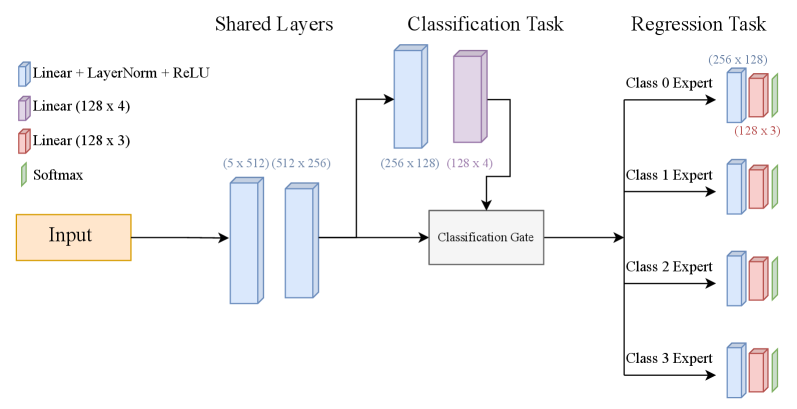
The implemented Neural Network utilizes a MixtureOfExperts (MoE) architecture to enhance predictive accuracy across a diverse range of stellar collision events. This approach divides the network into multiple “expert” sub-networks, each trained to specialize in a specific subset of collision parameters – such as stellar mass ratios, impact velocities, and equation of state. A gating network then dynamically assigns each collision scenario to the most relevant expert(s), effectively creating a conditional computation process. This specialization allows the MoE network to model complex relationships more efficiently than a monolithic network, improving performance on scenarios with varying characteristics and reducing overall computational cost by activating only pertinent network components during inference.
The Test of Reality: Validating the Predictions
Validation of the machine learning model was performed by comparing its outputs to those generated by established high-fidelity simulations, specifically Smoothed-Particle Hydrodynamics (SPH) and N-body (NNBody) simulations. These simulations serve as a ground truth against which the model’s predictions are assessed. Rigorous comparison involved evaluating the model’s performance across a substantial dataset of collision scenarios, ensuring the machine learning approach replicates the outcomes predicted by these computationally expensive, yet highly accurate, simulation methods. This process confirms the reliability and accuracy of the model’s predictive capabilities before deployment.
Model validation prioritizes the accurate prediction of collision outcomes, specifically focusing on two key metrics: remnant mass and the categorization of collision results defined as CollisionOutcome. Remnant mass represents the total mass of the stellar object(s) remaining after a collision event. CollisionOutcome classifies the collision based on predefined criteria, enabling differentiation between merger events, disruptive collisions, and other possible results. The model’s performance is evaluated on its ability to precisely predict these values, providing a quantitative assessment of its effectiveness in simulating stellar collision dynamics.
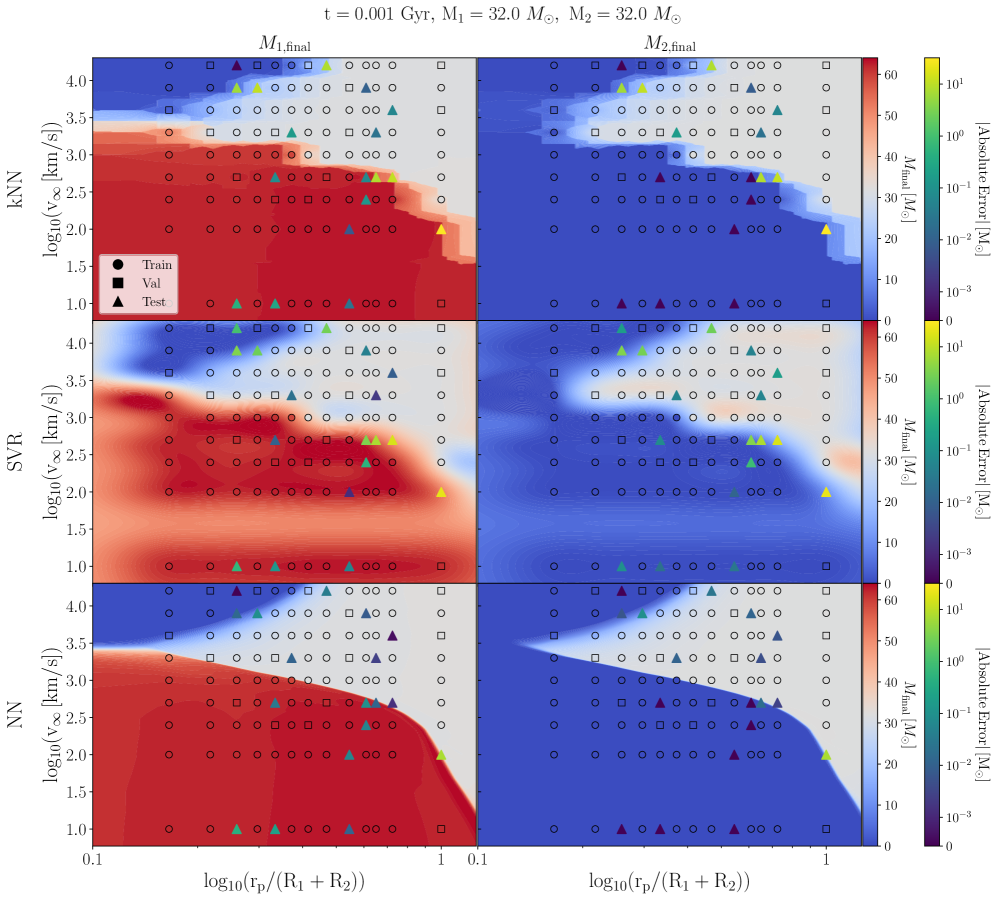
Model validation against high-fidelity simulations yielded a median absolute error of 0.00441 M☉ for primary stellar final masses and 3.7 x 10⁻⁷ M☉ for secondary stellar final masses. This level of accuracy was achieved while substantially reducing computational expense compared to traditional simulation methods. Furthermore, the model’s balanced accuracy in categorizing collision outcomes reached 98.4%, performing comparably to Support Vector Machine classification with an accuracy of 97.7%.
Echoes of Creation: Impacts on Galactic Evolution
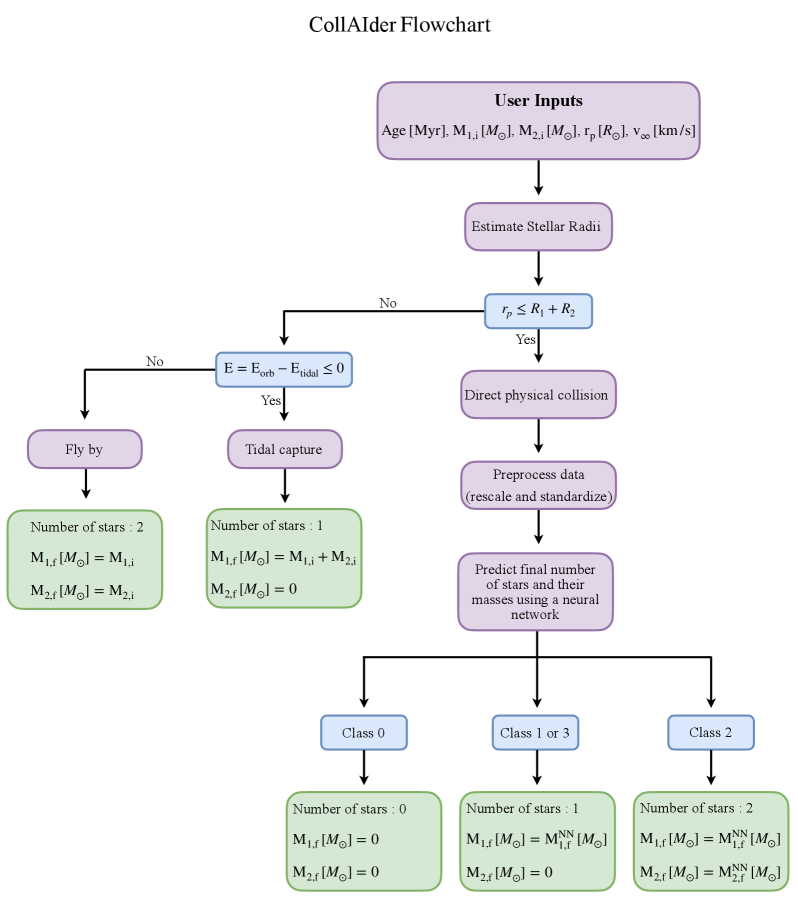
The formation of blue stragglers-stars that appear younger than their host stellar populations-presents a compelling puzzle in astrophysics, and current research suggests stellar mergers as a primary mechanism. These unusual stars aren’t formed through typical stellar evolution; instead, they gain youthfulness by accreting mass from companions or merging with other stars. A sophisticated computational model allows researchers to simulate these dynamic interactions, tracking the orbital evolution and eventual collision of stars within dense stellar environments. By varying parameters like stellar mass, velocity, and initial separation, the model can reproduce the observed characteristics of blue stragglers, including their enhanced brightness and extended lifespans. This process not only explains the existence of these stellar anomalies but also provides insights into the frequency of stellar mergers and their contribution to the overall stellar population within galaxies, offering a deeper understanding of galactic evolution.
Tidal Disruption Events (TDEs) – dramatic occurrences where a star wanders too close to a supermassive black hole and is ripped apart – offer a unique window into the environments surrounding galactic nuclei. Simulations reveal the frequency of these events is heavily influenced by the density of stars near the black hole, as well as the black hole’s mass and spin. The resulting flare of radiation from the disrupted star provides information not only about the stellar composition, but also about the accretion disk forming around the black hole and the dynamics of the galactic center itself. By modeling the characteristics of these flares – their luminosity, duration, and spectral properties – researchers can constrain the properties of black holes and gain a better understanding of how galaxies evolve, including the rate at which black holes grow and influence their host galaxies.
The intricate dance of stellar collisions isn’t simply a destructive event; it’s a crucial engine for galactic evolution, largely driven by the significant mass loss that occurs during these interactions. As stars merge or partially disrupt one another, substantial amounts of stellar material are ejected into the interstellar medium, enriching it with heavier elements – a process known as chemical enrichment. This ejected material, forged in the cores of stars, becomes the building block for future generations of stars and planetary systems. Detailed modeling of this mass loss, factoring in collision velocities and stellar compositions, allows astronomers to refine existing models of stellar evolution and better understand the observed abundance of elements throughout galaxies. Consequently, studying these events provides valuable insights into how galaxies transform over cosmic timescales and how the universe gradually transitioned from a state of pristine hydrogen and helium to the complex chemical landscape observed today.
Beyond Prediction: Charting a Course for Future Discovery
Future refinements of this collision prediction model will center on integrating the intricacies of Peculiar Velocity – the deviation of galaxies from the Hubble flow – to achieve a more nuanced understanding of galactic interactions. Currently, models often assume a uniform expansion, but galaxies possess unique, locally-defined motions that significantly influence collision probabilities and rates. Incorporating these velocities, derived from large-scale structure simulations and observational data, promises to elevate the model’s fidelity by accounting for the complex gravitational choreography within cosmic filaments and voids. This will not only improve the accuracy of predicting collision events but also offer deeper insights into the processes driving galaxy evolution and the formation of larger structures in the universe, ultimately providing a more realistic portrayal of the cosmos.
The model’s predictive power is directly linked to the breadth of scenarios it has learned from; therefore, future development will prioritize a significantly expanded training dataset. This involves incorporating a wider range of collision parameters – varying stellar masses, impact velocities, and galactic environments – to move beyond the limitations of currently available simulations. By exposing the machine learning algorithm to a more diverse set of astrophysical events, researchers aim to enhance its ability to accurately predict collision outcomes, even when faced with previously unseen conditions. This expanded dataset will not only improve the model’s precision but also its generalizability, allowing it to reliably forecast collision rates across a greater spectrum of cosmic phenomena and ultimately refine understanding of galactic evolution.
The model’s sustained performance, achieving a balanced accuracy of 78.6% when tested on previously unseen, extrapolated datasets, signifies a substantial leap forward in astrophysical prediction. This result isn’t merely incremental improvement; it showcases the capacity to generalize beyond learned examples, a critical requirement for forecasting events in the vast and complex universe. The success of this machine learning approach suggests a fundamental shift in the field, one where data-driven algorithms move beyond descriptive analysis to proactively anticipate phenomena and unlock previously inaccessible insights into cosmic processes. It heralds a future where machine learning isn’t simply a tool for analysis, but a core component of astrophysical discovery, promising to redefine how the cosmos is understood and explored.
The pursuit of predicting stellar collision outcomes, as detailed in this research, echoes a fundamental challenge in theoretical physics. Any model, no matter how meticulously constructed, operates within defined boundaries of knowledge. As Igor Tamm observed, “Any theory is good until light leaves its boundaries.” This sentiment resonates deeply with the work presented; machine learning, trained on SPH simulations, offers a powerful tool, but its predictive capacity remains contingent on the scope of the training data-the ‘light’ illuminating its understanding. The research acknowledges this inherent limitation, offering a computationally efficient approach while implicitly recognizing that even the most sophisticated model is but an approximation of a vastly complex reality, a fleeting glimpse before the event horizon of the unknown.
Beyond the Horizon
The demonstrated capacity to predict the outcomes of Smoothed Particle Hydrodynamics (SPH) stellar collision simulations with machine learning represents a localized success. However, the very act of approximating a complex physical process with a learned model invites scrutiny. The fidelity of prediction is, ultimately, bounded by the scope and quality of the training dataset. Extrapolating beyond the parameter space explored in these simulations – differing metallicities, stellar compositions, or initial conditions – may reveal the inherent limitations of the learned representation, much like observing the redshift of distant light.
Future work must address the question of generalizability. Incorporating data from simulations employing alternative hydrodynamical schemes, or even direct comparison with observational constraints – however sparse – will be crucial. The model’s performance regarding the prediction of mass loss, and the formation of potential fallback disks, deserves particular attention. A nuanced understanding of these phenomena is vital, yet prone to systematic errors in both simulation and, now, in learned surrogates.
The pursuit of computationally efficient models carries an inherent risk: a seductive simplification that obscures fundamental physics. The true test will not be merely the accuracy of prediction, but the capacity to identify – and acknowledge – the limits of what can be known. Perhaps, in the end, this work offers not so much a solution, as a refined mirror reflecting the boundaries of present understanding.
Original article: https://arxiv.org/pdf/2602.10191.pdf
Contact the author: https://www.linkedin.com/in/avetisyan/
See also:
- United Airlines can now kick passengers off flights and ban them for not using headphones
- Gold Rate Forecast
- How to Solve the Glenbright Manor Puzzle in Crimson Desert
- How to Get to the Undercoast in Esoteric Ebb
- All Golden Ball Locations in Yakuza Kiwami 3 & Dark Ties
- 8 Actors Who Could Play Blackbeard In One Piece Live-Action Season 3
- How to Complete Bloom of Tranquility Challenge in Infinity Nikki
- A Gamer’s Guide to the YouTube Algorithm
- Is Wuthering Heights a romance? Update on Margot Robbie movie controversy
- Binance’s Bold Bitcoin Bet: $1B SAFU Fund Dives Into Crypto’s Deep End
2026-02-12 17:41