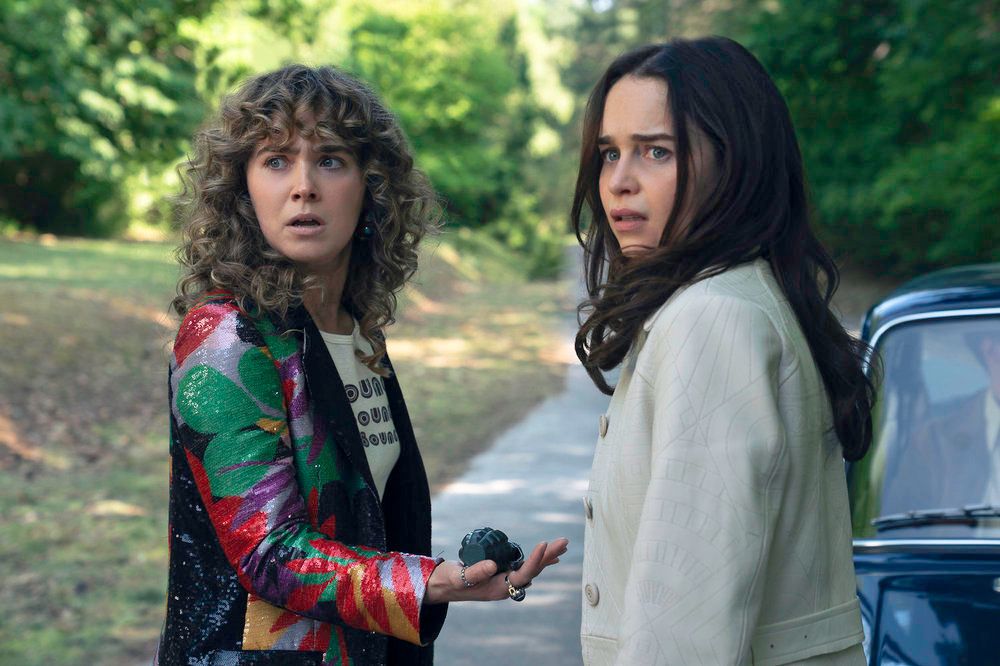
Beatrice and Twila are typical best friends – they share wine, vent about work, exchange recipes, and go shopping. Their conversations sometimes take wild turns, like debating whether they’d do anything – even something unthinkable – to prevent a global disaster. But this isn’t just a thought experiment for them. They find themselves facing this very question when they meet a KGB agent while trying to uncover what happened to their CIA-agent husbands in 1970s Moscow. Twila even encourages Beatrice to wear red lingerie to seduce him, jokingly referencing communism. The show, Ponies, isn’t subtle or a perfectly crafted spy thriller. What it is, though, is a genuinely enjoyable story about a close friendship.
The strongest on-screen friendships feel like a natural blending of personalities, where the characters subtly influence each other over time. The series Ponies perfectly captures this dynamic. Clarke plays Beatrice as reserved and proper, while Richardson’s Twila is wild and outgoing, and their chemistry creates a relationship reminiscent of classic feminist comedies like Dick, Romy and Michele’s High School Reunion, The Heat, and Spy. (This kind of pairing is familiar territory for co-creator Susanna Fogel, who also wrote Booksmart and The Spy Who Dumped Me.) Even though the plot of Ponies gets incredibly convoluted – I’ve watched the finale three times and still don’t fully understand all the twists and betrayals – Clarke and Richardson’s connection is undeniable and makes the show work.
In Moscow in 1976, Beatrice and Twila’s husbands, Chris and Tom, were both working as intelligence officers – secretly exchanging information, tracking down Russian contacts, and trying to recruit spies for the United States. Meanwhile, Beatrice and Twila spent their days trying to find basic goods like eggs and sugar, and carefully watching what they said in their apartments, which were likely bugged by the Soviets. They immediately clashed when they met at a market near the embassy. Beatrice, a refined Wellesley graduate with a Russian-speaking background, found Twila, a free-spirited woman with a rock-and-roll style, off-putting. Their first conversation quickly fizzled, leading to a silent agreement to avoid each other. They bonded only over their shared complaints about life in the Soviet Union – the poor quality produce, unreliable electricity, and unfashionable clothing. The problem isn’t that the show accurately portrays the shortages that existed in the USSR at the time, but rather that it presents these realities in a predictable and unimaginative way.
Okay, so the show kicks off with this really gut-wrenching scene. Chris and Tom’s boss, Dane Walter – played by Adrian Lester, though honestly, I kept thinking how incredible the late Lance Reddick would have been in the part – delivers the devastating news to their wives, Beatrice and Twila: their husbands are gone, killed while on duty. Walter, who runs the CIA’s Moscow station, is super tight-lipped, just saying it was a plane crash. But Beatrice and Twila aren’t buying it; they’re determined to find out what really happened and stay in Moscow. They come up with this audacious plan: they hustle their way into secretary positions at the U.S. embassy, and then basically strong-arm Walter, his right-hand man Raymond, and this shadowy guy Emile into teaching them the spy trade. Their angle? They figure as women, people will underestimate them, giving them an edge. As Twila puts it, people either see them as potential dates or wives, and that’s it. The idea is nobody would suspect the Americans of sending a woman – or anyone considered a ‘person of no interest’ – into the field, letting them accomplish things others can’t. It’s a smart, if risky, gamble, and honestly, I was hooked from the start.
Walter tried to convince his boss that the Soviets wouldn’t use female spies, arguing it would give them an advantage. I disagree, having watched six seasons of The Americans, which clearly shows female case officers were common. However, the show Ponies often stretches believability. For example, a supposedly clever KGB agent falls for a woman posing as a teacher without questioning her strange actions. The plot also relies heavily on chance and characters making unrealistic errors. Walter frequently overlooks protecting their key asset, and the embassy makes a careless hiring mistake. As the season progresses, the story becomes increasingly contrived and full of plot holes. While the show’s visual style, with its split screens and camera angles, is a nice nod to the time period, it sometimes feels like a way to distract from the weak plot.
The show Ponies smartly showcases the talents of Clarke and Richardson, giving each actress a chance to bring her unique style to her character. Clarke occasionally portrays Beatrice with a commanding, almost regal intensity, reminiscent of Daenerys Targaryen, even issuing orders to Soviet soldiers. However, she also captures Beatrice’s earlier vulnerability and frustration, showing the character’s growth from a frightened negotiator to a confident operative. Richardson’s character, Twila, initially seems carefree and unfiltered, recalling her role as Portia in The White Lotus. But Richardson adds a playful physicality – her head tilts, hip movements, and confident walk – that emphasizes Twila’s energetic and optimistic personality.
The show is consistently hilarious, largely because of the contrast between what Beatrice and Twila think their secret jobs will be like, and what they actually end up doing. A running joke is that Twila always processes things a little slower than Beatrice – she even calls a broken copy machine a curse word! She stubbornly refuses to learn to type, despite her boss’s orders, and surprisingly, she gives Beatrice advice on flirting. One particularly funny moment involves her wildly expressive eyebrows as she instructs her friend on how to playfully tease Andrei, and actress Michaela Richardson delivers the line with such self-aware humor that it works perfectly.
While Beatrice delves further into her investigation of Andrei, Twila starts looking into the disappearances of women from Moscow’s brothels. When questioned about her motivation, Twila replies, with a mix of resignation and pride, that she’s simply “an anonymous woman.” The show, Ponies, is fast-paced, lighthearted, and occasionally superficial, but it truly shines when exploring the complicated dynamic between two women who must become invisible to thrive professionally, yet crave connection and understanding in their blossoming friendship. This exploration touches on a fundamental truth that transcends the political tensions between America and the Soviet Union. Ponies envisions a world where a woman can confidently claim her place, and that’s a powerful message.
Read More
- United Airlines can now kick passengers off flights and ban them for not using headphones
- Crimson Desert: Disconnected Truth Puzzle Guide
- All 9 Coalition Heroes In Invincible Season 4 & Their Powers
- Mewgenics vinyl limited editions now available to pre-order
- Grey’s Anatomy Season 23 Confirmed for 2026-2027 Broadcast Season
- Viral Letterboxd keychain lets cinephiles show off their favorite movies on the go
- The Boys Season 5 Spoilers: Every Major Character Death If the Show Follows the Comics
- How to Get to the Undercoast in Esoteric Ebb
- All Golden Ball Locations in Yakuza Kiwami 3 & Dark Ties
- Does Mark survive Invincible vs Conquest 2? Comics reveal fate after S4E5
2026-01-14 23:55