U.S. military strikes on Iran have jolted global energy markets, sending oil prices toward seven-month highs and injecting fresh uncertainty into inflation, central bank policy, and U.S. financial markets as traders brace for a volatile week ahead.
Oil Prices Predicted to Climb After U.S. Military Action Against Iran
President Donald Trump confirmed Feb. 28 that American forces, in collaboration with Israel, had begun major combat operations against Iran, sharply escalating tensions in one of the world’s most critical energy corridors. The announcement pushed geopolitical risk to the forefront of trading desks from New York to London and across Asia. Because nothing says “I’m stressed” like paying more for gas.
Brent crude closed the week near $73 per barrel, up roughly 16% since the start of the year, as investors priced in the potential for supply disruptions. Several market scenarios now point toward $80 oil if shipping flows through the Strait of Hormuz face credible threats or interruptions. Because the world’s most dramatic chokepoint is now a $100-per-barrel drama.
About 20% of globally traded crude – roughly 13 million barrels per day – and a similar share of liquefied natural gas pass through the Strait of Hormuz, making it one of the most strategically sensitive chokepoints in the global economy. Even a partial disruption, analysts say, could ripple quickly through fuel, freight, and insurance markets. Because the world’s economy is just a bunch of people waiting for a ship to pass.
In a note shared with Bitcoin.com News on Sunday, Nigel Green, founder and chief executive of Devere Group, said the current repricing is rooted in operational risk rather than pure speculation. Because when your entire economy depends on a narrow strait, you’re basically playing Russian roulette with a loaded gun.
“Energy markets are entering a repricing phase driven by operational risk rather than speculation,” Green said. The Devere Group executive added:
“When close to one fifth of global crude flows transit a single maritime corridor, even a marginal probability of disruption demands a higher structural risk premium.”
He added that physical supply does not need to halt for prices to climb. “Insurance costs, shipping reroutes and precautionary stockpiling alone can tighten supply expectations. Spare global production capacity remains concentrated among a handful of Gulf producers, the Devere Group founder said, while commercial inventories across OECD economies sit below long-term averages. Because the world’s oil reserves are like a party where everyone’s pretending they have a backup plan.
Green explained that a sustained disruption of 1 million barrels per day – about 1% of global supply – would be enough to shift balances in a market already priced for moderate demand growth. He further noted that markets beyond oil are reacting in tandem. U.S. Treasury yields have reflected safe-haven demand in recent sessions, while gold has strengthened as investors hedge geopolitical risk, Green observed. Because when in doubt, buy gold. Or, as I call it, “the ultimate panic button.”
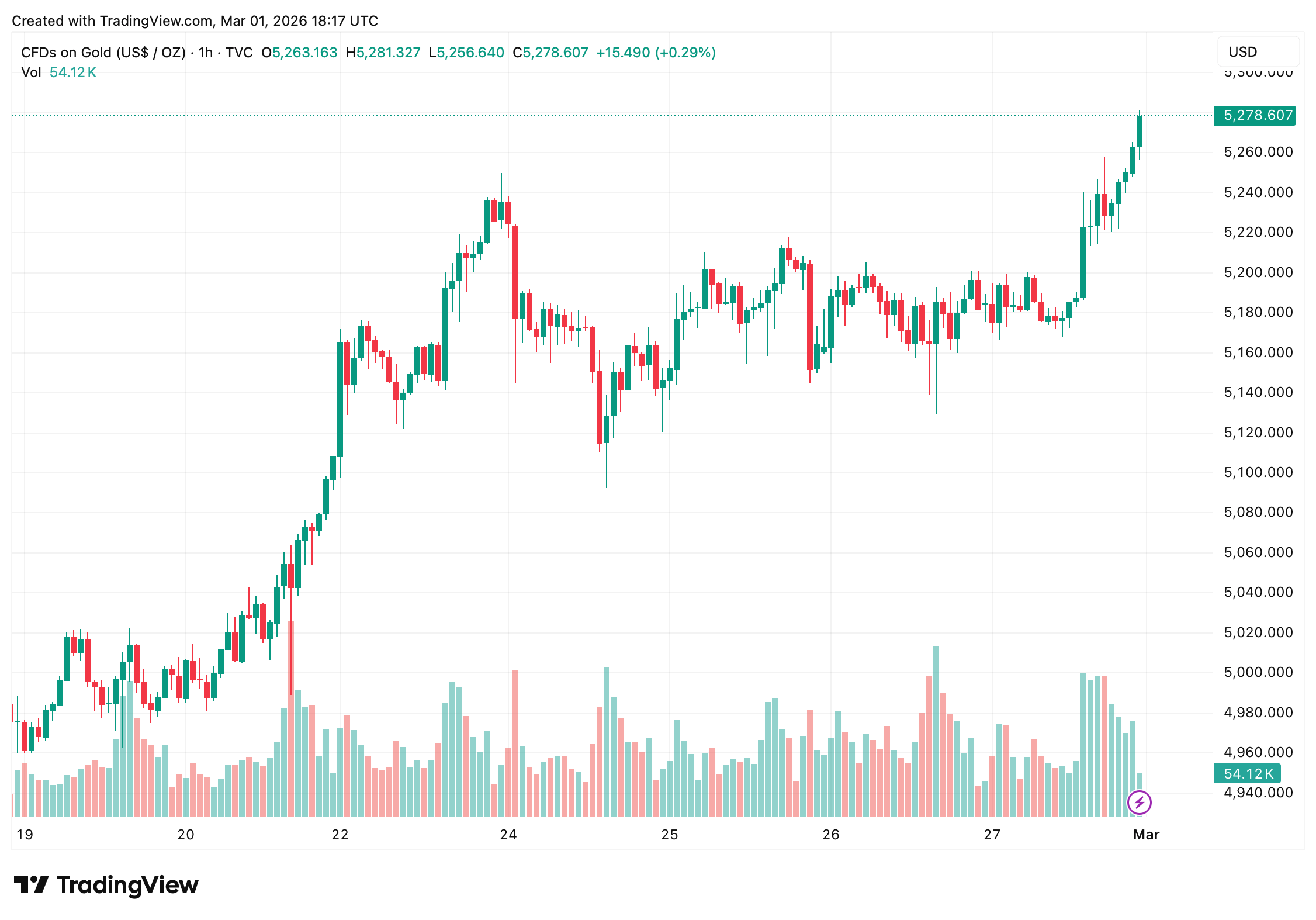
Gold has logged a 5.5% increase over the last five trading sessions. The U.S. dollar and Japanese yen are drawing defensive flows, Green’s analysis detailed, and emerging market currencies with higher volatility profiles face renewed pressure. Green remarked that a $10 to $15 increase in crude could complicate the outlook for inflation and interest rates in the United States and abroad. Because inflation is just the universe’s way of saying, “You’re doing great, but pay more.”
“Central banks that were expected to consider rate reductions later this year will face a more complicated calculus if energy feeds back into consumer prices and inflation expectations,” he disclosed in his analysis.
At the same time, the oil-producing alliance known as OPEC+ moved to modestly increase supply. Saudi Arabia, Russia, Iraq, the United Arab Emirates, Kuwait, Kazakhstan, Algeria and Oman met virtually on Sunday, March 1 and agreed to resume unwinding part of their voluntary output reductions. Because OPEC+ is the slowest movers in the game, but they’re still trying to keep up.
The group approved a production adjustment of 206,000 barrels per day for April, part of a broader plan to phase out 1.65 million barrels per day in additional voluntary cuts first announced in April 2023. Officials stated the increases could be paused or reversed depending on market conditions, and reaffirmed their commitment to full conformity under the Declaration of Cooperation, monitored by the Joint Ministerial Monitoring Committee. Because nothing says “we’re in control” like a committee that’s monitoring itself.
In his analysis, Green further explained that Asian economies are particularly exposed. The Devere Group executive detailed that India, South Korea, and Japan rely heavily on Gulf energy flows, with India sourcing close to half its crude imports via the Strait of Hormuz. Because the world’s most dramatic chokepoint is also the most convenient for everyone.

On social media, plenty of posters are convinced oil and gas investors can hardly wait for Monday’s opening bell. Moreover, earlier Sunday morning, it was reported by several accounts that Iran struck the oil tanker Skylight near the strategic Strait of Hormuz, injuring four crew members and prompting an evacuation, Oman’s maritime security center said. Many argue that even the threat of a Strait of Hormuz closure “would likely result in oil prices surging above $100/barrel.” Because the world’s most dramatic chokepoint is now the most expensive.
Whether the latest escalation proves brief or drags into a prolonged standoff, energy markets are now trading on risk as much as fundamentals. With a key shipping corridor under scrutiny and policymakers already juggling inflation pressures, the coming sessions will test how much geopolitical premium investors are willing to bake into oil, bonds, and equities at once. Because nothing says “I’m prepared” like paying extra for the same gas.
FAQ 🔎
- How do U.S. strikes on Iran affect oil prices in the United States?
U.S. military action raises the risk of supply disruption through the Strait of Hormuz, increasing global crude prices that influence U.S. gasoline and energy costs. Because your gas bill is now a geopolitical thriller. - Why is the Strait of Hormuz important to global energy markets?
About 20% of globally traded crude oil passes through the Strait of Hormuz each day, making it a critical supply route. Because the world’s economy is held hostage by a narrow strait. - What did OPEC+ decide after the Iran conflict escalated?
OPEC+ approved a 206,000-barrel-per-day production increase for April while retaining flexibility to adjust output based on market conditions. Because OPEC+ is the slowest movers in the game, but they’re still trying to keep up. - Could higher oil prices impact U.S. inflation and interest rates?
A sustained rise in crude prices can feed into consumer energy costs, potentially complicating inflation trends and central bank rate decisions. Because inflation is just the universe’s way of saying, “You’re doing great, but pay more.”
Read More
- United Airlines can now kick passengers off flights and ban them for not using headphones
- Solo Leveling’s New Manhwa Chapter Revives a Forgotten LGBTQ Story After 2 Years
- The Boys Season 5 Spoilers: Every Major Character Death If the Show Follows the Comics
- Grok’s ‘Ask’ feature no longer free as X moves it behind paywall
- Mewgenics vinyl limited editions now available to pre-order
- Gold Rate Forecast
- How to Get to the Undercoast in Esoteric Ebb
- Assassin’s Creed Shadows will get upgraded PSSR support on PS5 Pro with Title Update 1.1.9 launching April 7
- TikToker’s viral search for soulmate “Mike” takes brutal turn after his wife responds
- All Itzaland Animal Locations in Infinity Nikki
2026-03-01 21:57