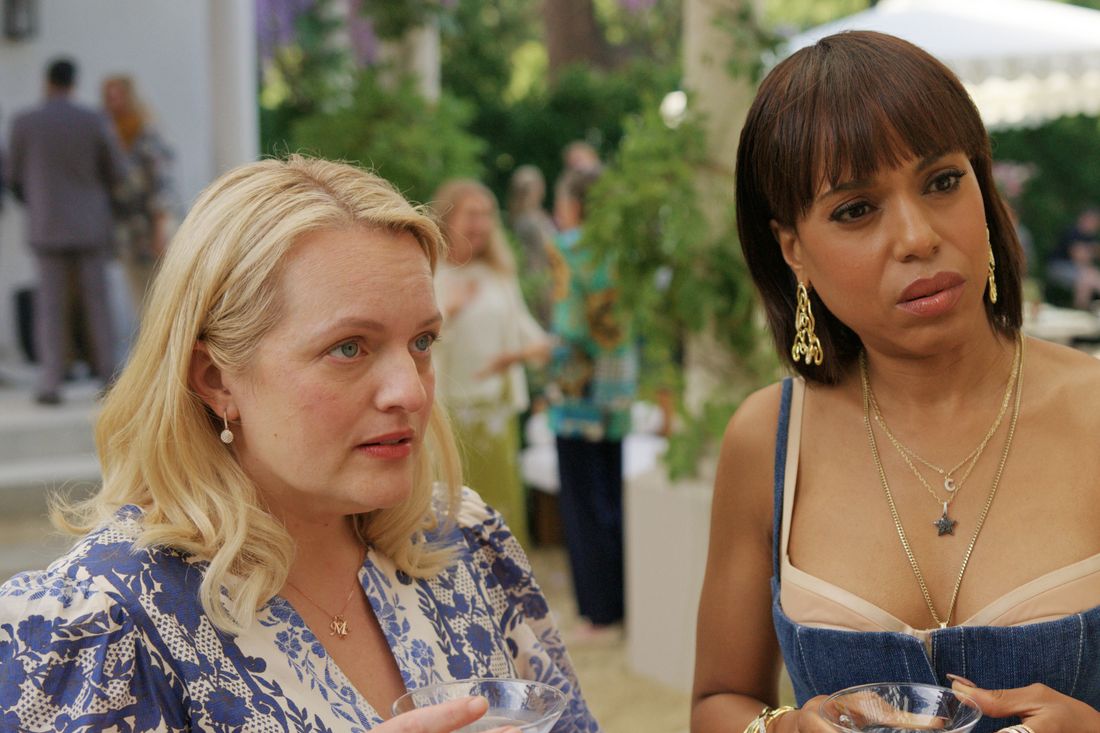
Within just three episodes of Imperfect Women, one of the main characters explicitly states what the series title already suggests: she’s flawed. During an awards ceremony where Eleanor (Kerry Washington) is recognized for her charity work, she admits to feeling like a “fraud” and a “monster,” emphasizing that no one is perfect. Fittingly, the episode is also titled “Monster.” This constant repetition of themes – through obvious dialogue and episode titles – feels like a strained effort to convince viewers – or perhaps the show itself – that Imperfect Women offers genuine insight.
This show follows a familiar pattern: a group of wealthy women pretending to be friends while secretly undermining each other, leading to their own downfall. Everyone is struggling, the men are all problematic, and no relationship is healthy. The characters are constantly envious of others. While other shows in this vein, like The Better Sister and All Her Fault, offered compelling characters or surprising twists, this one feels predictable. Imperfect Women reveals the core mystery halfway through, but then continues on without any real surprises, making it feel drawn out and uninspired.
The series Imperfect Women, created by Annie Weisman and based on Araminta Hall’s 2020 novel, centers around three lifelong friends: Eleanor, who runs an international organization; Mary (Elisabeth Moss), a mother and former aspiring writer; and Nancy (Kate Mara), a mother and former ballerina. The show explores their complex past through flashbacks, though it doesn’t show their formative college years where their strong connection first developed. As Eleanor says, they always envisioned a future together, but that dream is broken when Nancy, the most well-known and wealthy of the three, is found murdered. Nancy’s death receives significant media coverage, partly due to her marriage to Robert (Joel Kinnaman) from a very wealthy California family. Before her death, Nancy admits to Eleanor that she feels Eleanor understands her better than she understands herself, but all three women are keeping secrets. Surprisingly, those secrets largely involve betrayals amongst the friends themselves. Imperfect Women is structured like the novel, divided into three parts, each focusing on one woman’s perspective through voice-over narration. While intended to give each actress a distinct voice, the women’s struggles—attraction to the wrong people and unrequited love—are so similar that the sections often feel repetitive.
Eleanor is the first to be questioned. She knew about Nancy’s affair but dismissed Nancy’s pleas for help when she tried to end it, especially because her lover, David (whom Eleanor and Mary haven’t met), had become a stalker. Washington excels at portraying a detached, dismissive character, and she didn’t take Nancy seriously due to her long-held jealousy of Nancy’s husband, Robert, whom Eleanor has secretly admired for years. She reasoned that if Nancy was willing to cheat on Robert, she didn’t deserve help. Everyone is aware of Eleanor’s feelings, and Mary frequently mocks her for it. Mary appears happily married to the self-absorbed English professor Howard (Corey Stoll), with a family and a house, but often makes cutting remarks about Eleanor’s perpetual single status. Secretly, however, Mary has been accepting money from Nancy to help her family financially, as Howard is constantly losing teaching positions – a situation Moss handles with forced gratitude. With Nancy gone, Eleanor and Mary are forced to confront how little they truly knew about each other’s relationships with Nancy, and about Nancy herself. An artist whose work Nancy supported points out, “Your friend was spiraling downward. She was suffering… If you didn’t notice, it’s because you chose not to.” Mary and Eleanor are stunned. Absolutely stunned!
The women’s bewilderment highlights the main weakness of the series Imperfect Women. It relies heavily on tired tropes—like infidelity, past trauma, and societal biases—to follow a predictable pattern for each of the three characters: a difficult past leads to internal struggles, which then culminates in a revelation about their shared experiences. The narration is especially problematic, bluntly telling us what each woman thinks and, unintentionally, revealing that the show defines them primarily through their relationships with men, rather than as individuals. The series quickly reveals each woman’s arc; for example, Eleanor’s hidden feelings for Robert signal a coming self-discovery, Nancy’s background explains her spending habits, and Mary’s storytelling ability foreshadows her self-deception. These are all very obvious and lack depth.
While Imperfect Women aims to challenge the judgment faced by Eleanor for her casual approach to sex, Nancy for her infidelity, and Mary for her self-sacrificing motherhood, the show ironically burdens these women with the very relationship issues that define them. Instead of offering a nuanced critique of patriarchal structures, the series relies heavily on conflicts with controlling men who try to dismantle the women’s friendship, feeling like a simplistic ‘us versus them’ narrative. A symbolic scene involving a waiter and a fractal tattoo, meant to highlight the shared pain of self-doubt and misplaced value in men, ultimately reflects the show’s own shortcomings and lack of depth.
“Imperfect Women” feels like a vehicle for stars and producers Moss and Washington to revisit familiar territory from their previous hits, “The Handmaid’s Tale” and “Scandal.” The show relies heavily on characters delivering emotional speeches about love, experiencing heartbreak, and then finding solace in female bonding – it’s a predictable formula. Unfortunately, the performances feel stiff, with actors often delivering lines that simply explain the plot and appearing lost or tearful. While the series does have a few engaging cliffhangers and some clever dialogue that creates suspense around the characters’ desires and motivations, these moments aren’t enough to overcome the show’s slow pace and excessive filler. The show repeatedly emphasizes how caring and trusting these women are, to the point where it feels unbelievable that they would be manipulated against each other. Ultimately, “Imperfect Women” may actually portray its characters as naive rather than strong, and that might be the most interesting thing about it.
Read More
- United Airlines can now kick passengers off flights and ban them for not using headphones
- Crimson Desert: Disconnected Truth Puzzle Guide
- All 9 Coalition Heroes In Invincible Season 4 & Their Powers
- Invincible Season 4 Episode 6 Release Date, Time, Where to Watch
- Mewgenics vinyl limited editions now available to pre-order
- The Boys Season 5 Spoilers: Every Major Character Death If the Show Follows the Comics
- Assassin’s Creed Shadows will get upgraded PSSR support on PS5 Pro with Title Update 1.1.9 launching April 7
- Grok’s ‘Ask’ feature no longer free as X moves it behind paywall
- Does Mark survive Invincible vs Conquest 2? Comics reveal fate after S4E5
- Grey’s Anatomy Season 23 Confirmed for 2026-2027 Broadcast Season
2026-03-19 01:58