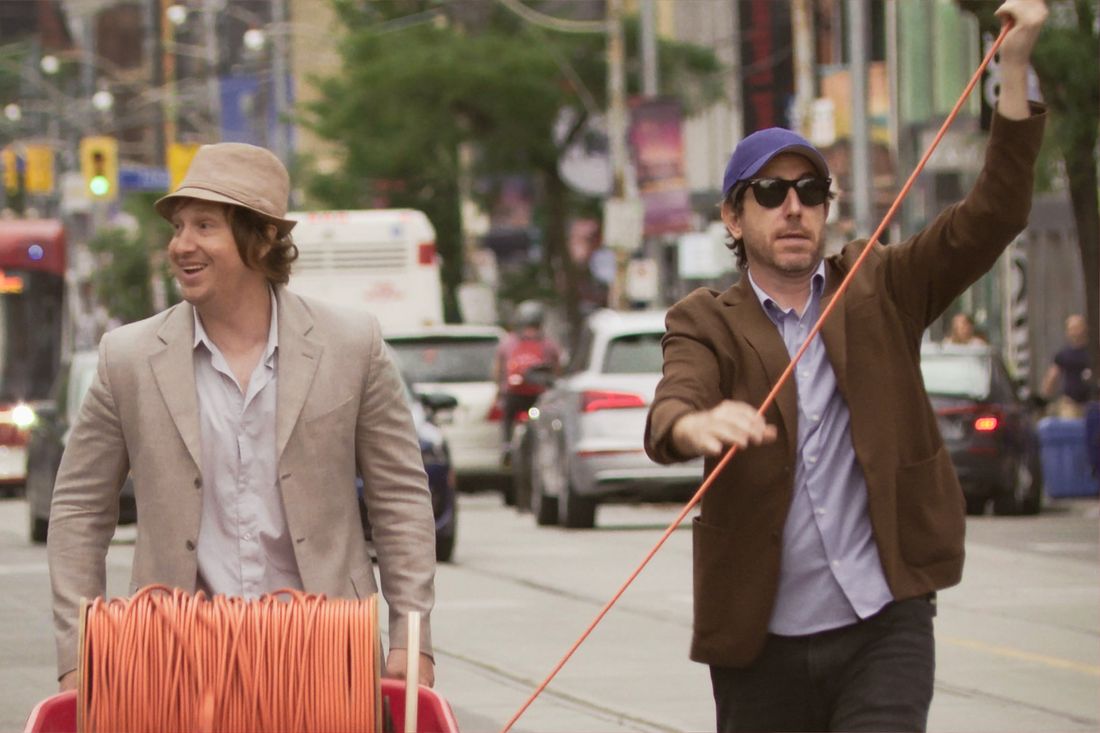
While it’s easy to compare Nirvanna the Band the Show the Movie to similar low-budget comedy-documentaries, like those made by Nathan Fielder or the Jackass films, a surprising comparison might actually be Mission Impossible: The Final Reckoning. The film opens with an intense scene at the CN Tower (which didn’t allow the filmmakers to film there), featuring stunts that could be frightening for those afraid of heights. Nirvanna the Band the Show, originally a web series from 2007-2010 and later a TV show on Viceland from 2017-2018, wasn’t known for action. But to justify making a movie, creators Matt Johnson and Jay McCarrol performed daring physical feats, all in an attempt to land a gig at the Rivoli concert venue in Toronto.
Okay, so trying to explain Nirvanna the Band the Show the Movie is… tough. Basically, it stars Johnson and McCarrol as fictionalized versions of themselves – Matt and Jay – who are in a band called Nirvanna the Band (totally different from that Nirvana!). The whole thing revolves around them desperately trying to get a gig at the Rivoli in Toronto, hoping it’ll be their big break. Honestly, it wasn’t really about much, it felt more like a series of funny sketches than a traditional story. Both the original web series and the TV show were all about these guys causing chaos around Toronto, constantly dragging unsuspecting people into their schemes, all in pursuit of that one elusive show.
After his successful show, Blackberry, Johnson was given the chance to turn it into a movie. This film is much bigger and bolder, featuring incredible stunts, time travel, and a reimagined version of history. Watching it is both confusing and incredibly funny – it feels like a blend of Caught by the Tides and Back to the Future. Johnson and McCarrol worked for years, carefully assembling the movie shot by shot and stunt by stunt. They didn’t intentionally set out to create something so unbelievable, but the film leaves you constantly wondering how they achieved it, all while keeping you entertained.
This film evolved quite a bit from your original concept. What was your initial idea for the movie?
Matt Johnson: We wanted to make this movie quickly, inspired by the success of Blackberry and with funding from the Canadian government. The original plan was to have the two characters from Nirvanna the Band interact with people from different cultures, similar to the movie The Trip, which Jay and I both enjoy. We even considered a non-traditional, tour-documentary style. However, when we reviewed the footage, it lacked the scope needed for a feature film. It felt more like an episode of a TV show – like the movies based on the Canadian show The Trailer Park Boys, which are similar in scale.
Jay McCarrol explained they felt while reviewing their work, something would inevitably be lacking, regardless of how well they completed it.
We filmed this movie in various US cities where we didn’t have any contacts, and we really struggled to piece the story together. Eventually, we decided to set it in Toronto, which was right in our own area. That made all the difficulties we faced much easier to handle. It wasn’t that filming in America was hard, actually, sometimes it was quite the opposite. I think most Americans are naturally comfortable in front of a camera – it’s like the whole country is full of people who know how to perform. Everyone we met was charming and seemed like they could be on a game show.
Filming in Canada simplified things considerably. A key technique we used throughout the movie was repetition. We often spent weeks, even months, capturing sequences bit by bit, one shot at a time. For instance, the scene where a cable is pulled from the CN Tower to Queen Street wasn’t filmed all at once; we shot it gradually over several weeks, a few shots each time.
A lot of our scenes in Toronto involve interacting with regular people and getting them to unknowingly help with what the characters are doing. These aren’t actors; they don’t know it’s a performance. We call this “social engineering.” A great example is the CN Tower sequence at the beginning of the movie. When you see Jay and me on the ledge, it doesn’t seem like we’re controlling the camera. Actually, it’s a GoPro worn by a tour guide we’d never met. We subtly directed him to look and move in ways that created the shots we needed, all without him realizing it. The amazing part is that we walked away with the footage!
We aim for our camerawork to feel as natural as wildlife documentaries you’d see on National Geographic. We put a lot of thought into making it seem realistic – like the cameraman just happened to catch Matt running with a large cable. We analyze how a four-person camera crew would actually film something amazing, and that process helps us define the boundary between what’s real and what’s staged. We push the limits as much as possible without actually resorting to fiction. Most of the time, what you see on screen is exactly what happened, about 90 percent of the time.
Does the tension increase when a risky scene, like the CN Tower sequence, seems like it’s actually going to work out?
Johnson: I think Jay and I tend to hold back a lot, and we often pull back from pushing things too far. Our editors, Curt Lobb and Bobby Upchurch, frequently tell me I didn’t take a scene far enough and that it could have been even more impactful.
McCarrol: It’s really hard to stay committed.
I think it really shows how Canadian we are – or at least how I am. When we’re filming, I’m so focused on not bothering people that I always pull back before we cause any real disruption.
Did you intentionally include the CN Tower as part of broadening the project’s reach?
Johnson: Yes, that was one of the very first things we decided to do.
For us, featuring the CN Tower felt like a big achievement within the world of Nirvanna. The show initially started as a way to authentically share our lives, but then we began having fun showcasing different locations around Toronto. Through that, we realized the CN Tower truly represents our city.
The question was about how much planning goes into the elaborate stunts, specifically mentioning the trolley stunt coinciding with Taylor Swift’s Eras Tour concert. Johnson explained that their producer, Matt Grayson, is the key to making these shoots happen. It’s not about avoiding legal trouble, but about maximizing efficiency. Grayson strategically plans shoots during times of existing large-scale chaos, like a major concert, so their activity blends in and doesn’t draw extra attention. He consistently uses this approach to make complicated filming possible without permits and in a short timeframe.
Someone mentioned that a good lawyer is like the fifth member of our team, and that’s definitely true for us. Our lawyer, Chris Perez, is involved in almost every decision we make. This has been the case since my first film, The Dirties. We’re really pushing the boundaries of what’s legally allowed under fair-use law, and we can only do that because Chris has guided us through each film, explaining what we can and can’t do. It’s actually a creative process – we write detailed explanations of why certain clips or songs are important to the story. It’s strangely reminiscent of school assignments, where we have to build a case – like, a two-paragraph argument for why Back to the Future or a particular song is essential to the film – again and again.
If the current wording doesn’t work, we can easily revise it to align with a defensible argument.
Okay, so with this new film, a big thing for me was Back to the Future. It’s funny because the characters go back to 2008, which was right around when our web series first started. Looking back, there’s some comedy in the older stuff that hasn’t held up super well – jokes referencing Bill Cosby and Russell Peters, and even a nod to The Hangover. It got me thinking about how my comedy has evolved since then. Have I become more careful about what I joke about? Honestly, not really. I pretty much feel like everything’s fair game. Especially with Nirvanna the Band the Show, if something makes us genuinely laugh while we’re filming, we think it’s worth exploring. It’s a pretty loose process; Curt and Bobby are the only ones who see the initial footage, so we really let loose and act like total goofballs. Maybe there’s a little bit of self-editing happening on a deeper level, but not intentionally.
I believe people naturally want to avoid causing offense. When we film and create spontaneously, there’s no pre-written script, and a lot comes out. Generally, everyone agrees that if we use provocative or controversial language, we have a greater duty to make it witty and find the right balance. We aim for broad appeal, wanting audiences to understand we’re all in on the joke and can laugh together. It feels rewarding when we can take risky or rude material and still create a positive, shared experience for everyone, even families. With the web series, we appreciated being able to test limits because that felt appropriate for the time.
Johnson: There’s nothing that little kids like more than taboos. They feel sacred.
McCarrol: Like sticking your hand in the cookie jar.
Just so you know, I’m heading out into the snow to go to a Magic: The Gathering tournament – you can probably see me moving around!
McCarrol: Oh, that’s today!
Are you here to compete, or just watch?
Johnson: A bit of both, actually. I’d really enjoy playing in a tournament just for the fun of it – that’s always been a dream of mine. Right now, I’m writing and directing the Magic Card movie for Legendary and Hasbro.
I have one final question, circling back to our earlier discussion about TV movies and The Trailer Park Boys. What, in your opinion, makes a TV movie successful, or how did you approach adapting a show for a different format?
Johnson: I think Bobby deserves credit for this insight, but a successful TV adaptation can act as an introduction to the show for new viewers. In fact, for many people, this movie will be their first experience with the characters – essentially serving as a pilot episode. We intentionally designed the movie so that if someone has never seen the show before, they’ll be eager to start watching it afterward, rather than it being something only existing fans would appreciate.
Read More
- United Airlines can now kick passengers off flights and ban them for not using headphones
- How to Complete Bloom of Tranquility Challenge in Infinity Nikki
- Gold Rate Forecast
- How to Solve the Glenbright Manor Puzzle in Crimson Desert
- 8 Actors Who Could Play Blackbeard In One Piece Live-Action Season 3
- All Itzaland Animal Locations in Infinity Nikki
- All Golden Ball Locations in Yakuza Kiwami 3 & Dark Ties
- A Dark Scream Theory Rewrites the Only Movie to Break the 2-Killer Rule
- All 10 Potential New Avengers Leaders in Doomsday, Ranked by Their Power
- NEXO PREDICTION. NEXO cryptocurrency
2026-02-13 17:56