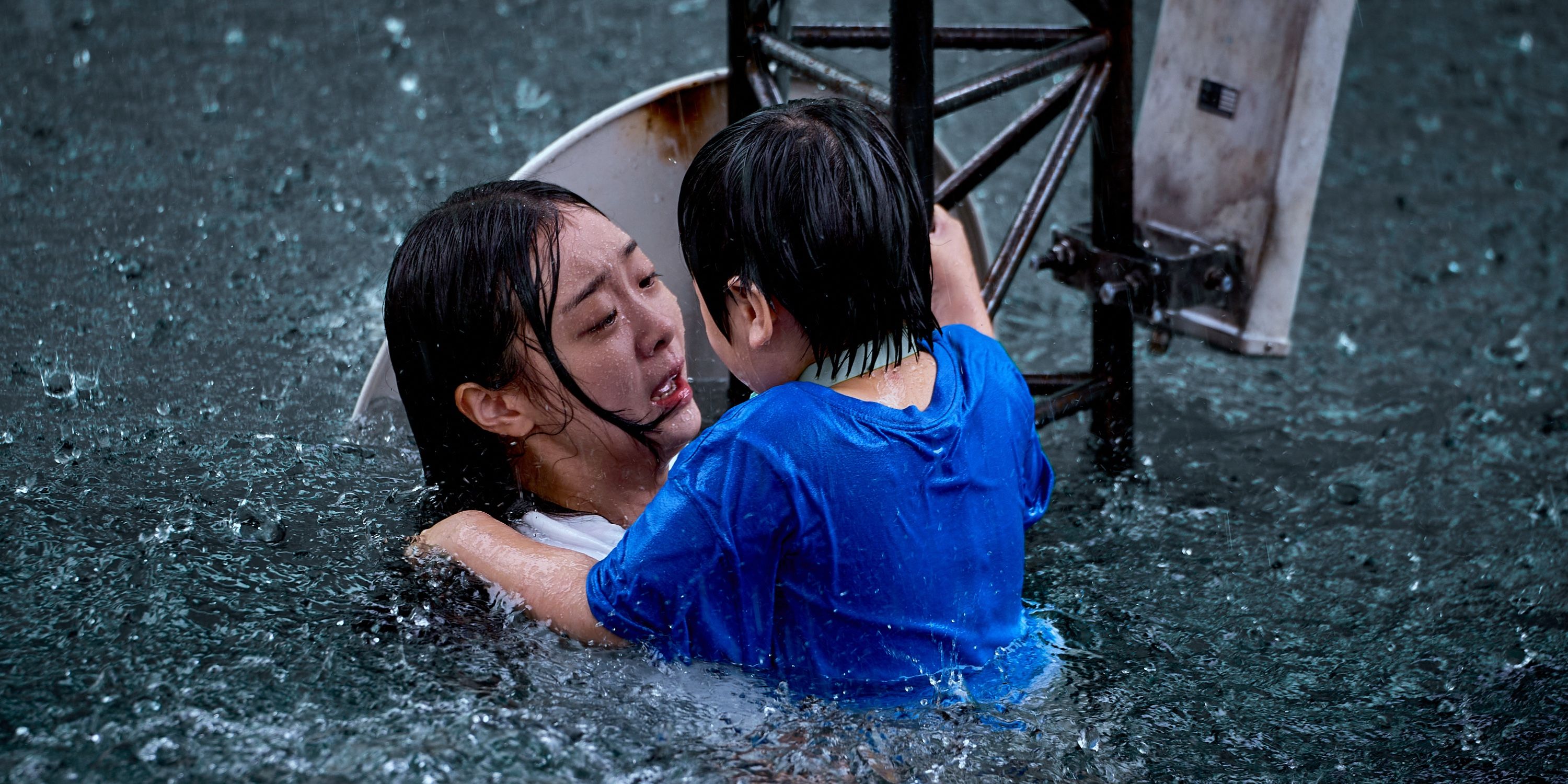
Right before Christmas 2025, a new South Korean disaster movie, The Great Flood, became a global hit. Directed by Kim Byung-woo, who also directed The Terror Live, the film stars Kim Da-mi (known from The Witch) and Park Hae-soo (Squid Game). The movie centers around a mother (Da-mi) struggling to protect her young son after a massive flood destroys their apartment building in Seoul. Park Hae-soo plays a determined rescue agent sent to save them from the 30th-floor rooftop by helicopter.
It seemed like a sure hit: a new disaster movie with stunning effects and a heartfelt story about a mother’s desperate attempt to save her son. However, something unexpected happened. As reviews came out, it became clear that The Great Flood wasn’t resonating with audiences. Its Rotten Tomatoes score quickly dropped to 52%, and viewers rated it even lower with a mere 35% approval. The film didn’t live up to expectations, and many viewers felt disappointed, almost as if they’d been misled.
The Great Flood Begins as a Disaster Movie, Before Taking a Sharp Left Turn
The play, The Great Flood, gets off to a fantastic start. It immediately creates a believable home life, hinting that something unsettling is about to happen.
One slow morning in Seoul, Dr. Gu An-na and her young son, Ja-in, are going about their day. An-na is preoccupied with her phone while Ja-in excitedly asks to go swimming and diving. The scene unfolds as An-na casually prepares breakfast, seemingly ignoring Ja-in’s requests, even when he points out there’s a pool nearby. It isn’t until water starts leaking into the kitchen and wetting her feet that she finally notices what’s happening.
Okay, so imagine this: I’m looking out my window, thirty stories up, and a massive flood is bearing down on us. It’s truly horrifying. I slowly walk over, and what I see is just… devastating. The entire area is underwater, and it’s not just water – there are cars, trees, and, tragically, bodies being swept along by the current. It’s a truly terrifying sight, and it immediately puts you on edge.
An urgent announcement suddenly blares over the intercom, instructing everyone to move to higher floors. However, the power immediately goes out, trapping thousands of families and causing widespread panic. The stairwells quickly become jammed with frightened people as the water level continues to rise.
I was so relieved when Son Hee-jo showed up – he’s a UN security officer and seems to know exactly what’s going on. He’s been sent to get An-na, Ja-in, and me to a rescue helicopter. He explained things are much worse than we thought. Apparently, asteroid pieces hit Antarctica, which caused sea levels to rise dramatically. It’s already completely flooded Japan, and it’s heading our way too – it’s terrifying!
He shocked An-na by revealing that the world as they knew it was about to end. Her company, which developed artificial intelligence, was key to rebuilding humanity using synthetic people. Because she was the last scientist working on the ‘Emotion Engine’ – the part of the project that gave these synthetic humans realistic emotions – she had to board a spaceship leaving Earth.
This Twist Moves the Netflix Film Into Sci-Fi Territory
The film takes a surprising turn into science fiction with the introduction of a major twist. It quickly reveals that the flood An-na is struggling to survive isn’t actually happening – she’s trapped in a simulation, endlessly repeating the scenario. The goal? To successfully protect Ja-in, who repeatedly disappears at a crucial moment.
Each time An-na runs through the simulation, she improves her skills and reflexes. This allows her to effectively help people in need, such as a girl stuck in an elevator, a woman in labor at a difficult moment, and an elderly couple facing an attack.
In the end, the audience learns that the original An-na actually died on the space shuttle after being saved from the rooftop. The shuttle was hit by pieces of an asteroid. As she was dying, she begged her colleagues to copy her memories into the Emotion Engine, believing that the key to creating genuine emotions in artificial beings lay in recreating a mother’s love for her child.
The truth comes out: Ja-in wasn’t actually her biological son. He was a lifelike artificial human named An-na, originally created five years prior as part of a previous experiment to study emotions. Despite his origins, An-na did develop genuine feelings. As a result, his ‘mother’ is forced to repeatedly run a dangerous flood simulation until she’s prepared to prioritize his life over her own, even if it means sacrificing herself.
Surprisingly, this situation puts even more pressure on An-na than a real flood would. If she can’t save Ja-in and the Emotion Engine breaks down, it could lead to the extinction of humankind.
Did The Great Flood’s Twist Ruin the Film?
From the start, they knew their idea was a gamble: lure audiences in with the familiar thrills of a disaster movie, then completely subvert their expectations. Stories about families fighting for survival against natural disasters feel very different from thought-provoking science fiction about artificial intelligence, simulated realities, and what it means to be human.
Luckily, the gamble paid off for most viewers, sparking really interesting discussions about what the movie truly meant. The twist is cleverly done, with hints throughout the first part of the film that, looking back, foreshadow the fact that An-na’s journey isn’t what it seems. This makes it a twist that actually makes sense upon rewatching – something many films with surprises don’t achieve.
The movie quickly became a source of intense debate, with many viewers feeling tricked by its marketing as a disaster film, or finding the actual twist confusing and difficult to follow. Social media and Reddit were filled with disappointed fans calling the movie a waste of time, riddled with inconsistencies, and just plain confusing. Critics largely agreed, describing it as a film with initial promise that ultimately got lost in a complicated and illogical time-loop storyline.
I’ve been pondering the negative reactions to this film, and I’m trying to pinpoint exactly what didn’t land with audiences. Was it simply that people expected a more thrilling, expertly crafted disaster movie and felt let down? Or did they genuinely find the science fiction elements unconvincing and poorly thought out? It’s a tricky question, and I think it’s probably a bit of both.
The initial response to this film feels similar to the one that met Dark City in 1998 – another movie exploring simulated realities that turned out to be more complex than it initially seemed. Only time will tell if The Great Flood will eventually be reappraised and gain a dedicated fanbase, like Dark City did.
Looking back, I think we should have really marketed the movie as a mind-bending sci-fi thriller, more like Inception or Edge of Tomorrow – films that clearly influenced it. It would have given audiences a better idea of what they were in for, and maybe helped them connect with it more.
Let’s consider this: if The Great Flood were a modern sci-fi thriller – the kind where viewers expect a technological twist – would it have been so harshly criticized? Probably not. However, that raises another point: would revealing the twist beforehand have lessened the film’s impact? Almost certainly, yes.
Read More
- United Airlines can now kick passengers off flights and ban them for not using headphones
- Crimson Desert: Disconnected Truth Puzzle Guide
- How to Get to the Undercoast in Esoteric Ebb
- Katanire’s Yae Miko Cosplay: Genshin Impact Masterpiece
- All Golden Ball Locations in Yakuza Kiwami 3 & Dark Ties
- All Itzaland Animal Locations in Infinity Nikki
- Zendaya’s 4 Big 2026 Movies Could Beat Brie Larson’s Box 2019 Office Record
- Gold Rate Forecast
- Australia’s New Crypto Law: Can They Really Catch the Bad Guys? 😂
- Fire Force Season 3 Part 2 Episode 24 Release Date, Time, Where to Watch
2026-01-09 07:11