Author: Denis Avetisyan
A new approach leverages the power of graph neural networks and strategically perturbed input data to generate more reliable probabilistic forecasts of sea surface temperature.
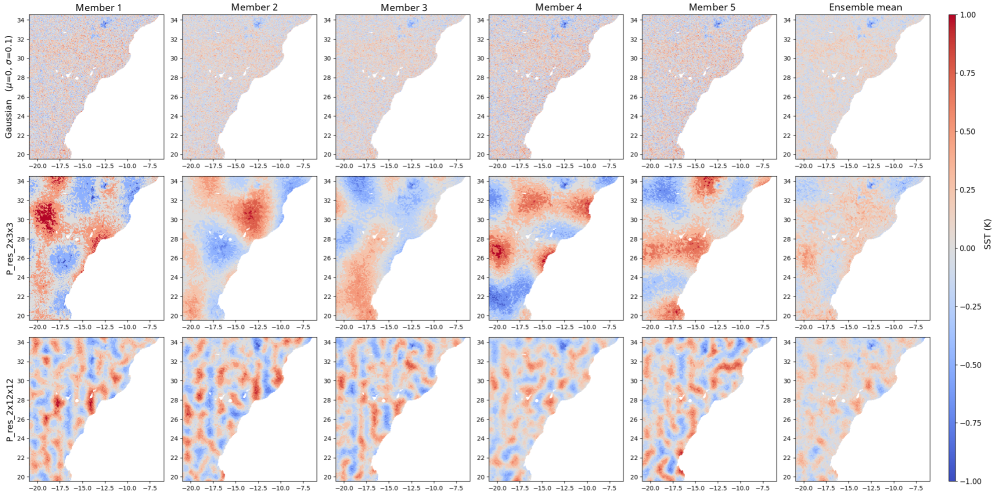
Researchers demonstrate that incorporating structured noise, such as Perlin noise, into ensemble forecasting with graph networks improves the quantification of uncertainty in regional ocean temperature predictions.
Accurate regional ocean prediction demands both computational efficiency and robust uncertainty quantification, yet achieving calibrated probabilistic forecasts remains a persistent challenge. This is addressed in ‘Ensemble Graph Neural Networks for Probabilistic Sea Surface Temperature Forecasting via Input Perturbations’, which investigates ensemble strategies using Graph Neural Networks (GNNs) and explores how the design of input perturbations affects forecast skill and uncertainty representation. The research demonstrates that ensembles generated with spatially coherent perturbations, such as Perlin noise, yield better calibrated probabilistic forecasts than those using purely random noise, without requiring additional model training. Could this approach unlock a cost-effective pathway to improved operational regional ocean prediction systems that accurately reflect forecast uncertainty?
The Rising Demand for Oceanic Understanding
The escalating demands of the Blue Economy – encompassing sustainable seafood, renewable energy, and maritime transport – are placing unprecedented pressure on ocean resources, simultaneously highlighting the critical need for robust ocean forecasting. This growth, coupled with global commitments to the Sustainable Development Goals, particularly those related to climate action, food security, and marine conservation, requires a deeper understanding of ocean dynamics. Accurate predictions of ocean currents, temperature, and salinity are no longer simply academic pursuits; they are essential for optimizing fisheries management, mitigating the impacts of coastal hazards, ensuring the safe and efficient operation of offshore infrastructure, and effectively modeling the ocean’s role in climate regulation. Consequently, stakeholders – from policymakers and industry leaders to coastal communities – increasingly rely on reliable ocean forecasts to inform decision-making and promote sustainable practices.
Established numerical ocean models, the cornerstone of ocean forecasting for decades, face inherent limitations as demands for predictive accuracy increase. These models rely on solving complex equations describing ocean currents, temperature, and salinity, demanding significant computational resources – a challenge exacerbated by the need for higher resolution to capture increasingly detailed phenomena. More critically, the ocean is rife with processes occurring at scales smaller than current models can realistically resolve – turbulent mixing, internal waves, and intricate coastal interactions – forcing scientists to employ simplifying assumptions that introduce inaccuracies. While continually refined, these models struggle to fully represent the non-linear and multi-scale dynamics of the ocean, particularly in regions with complex topography or strong currents, ultimately hindering their ability to reliably predict critical events like harmful algal blooms, marine heatwaves, or the dispersal of pollutants.
The escalating demand for detailed ocean understanding is prompting a significant evolution in forecasting techniques. Traditional numerical ocean models, while foundational, face inherent limitations in computational efficiency and accurately representing the intricate interplay of ocean processes. Consequently, researchers are increasingly turning to data-driven methodologies, particularly those powered by Machine Learning. These approaches bypass some of the computational bottlenecks of physics-based models by learning directly from vast datasets of ocean observations – encompassing satellite data, buoy measurements, and historical records. This allows for the creation of predictive models that can capture complex, non-linear relationships and potentially offer more accurate, higher-resolution forecasts, even in data-sparse regions. The promise lies in augmenting, or even replacing, components of traditional models with Machine Learning counterparts, leading to a future where ocean predictions are more responsive, reliable, and capable of supporting a sustainable Blue Economy.
Graph Neural Networks: A Natural Alignment with Oceanic Systems
Graph Neural Networks (GNNs) are particularly well-suited for modeling oceanographic systems due to the irregular and complex geometry of the ocean surface and underlying currents. Traditional machine learning methods often require data to be structured on a regular grid, which can introduce significant approximations and computational inefficiencies when applied to naturally irregular domains. GNNs, however, operate directly on graph structures, allowing them to represent spatial relationships and dependencies without the constraints of fixed grids. This capability is crucial for accurately capturing phenomena like eddies, fronts, and boundary currents which do not align with grid lines. By representing ocean features as nodes and their interactions as edges, GNNs can effectively learn and predict complex ocean dynamics from sparse and irregularly distributed observational data.
SeaCast is a Graph Neural Network (GNN) developed for high-resolution ocean forecasting, representing a key advancement over traditional methods which often struggle with the irregular geometry and complex dynamics of oceanic systems. Unlike conventional numerical models reliant on fixed grids, SeaCast leverages the flexibility of graph structures to represent ocean state, allowing for adaptive resolution and efficient processing of data from diverse sources, including satellite observations and in situ measurements. Initial evaluations demonstrate SeaCast’s capacity to predict key ocean variables, such as sea surface temperature and ocean currents, with improved accuracy and computational efficiency compared to existing state-of-the-art models, particularly at scales relevant to coastal processes and marine ecosystems.
SeaCast employs a Hierarchical Mesh Graph (HMG) to model ocean spatial structure, enabling multi-resolution analysis and capturing fine-scale dynamics. The HMG constructs a graph where nodes represent locations on the ocean surface and edges define spatial relationships. Hierarchy is achieved by recursively subdividing the ocean area into finer meshes, with each level of the hierarchy represented as a graph layer. This allows SeaCast to efficiently process data at varying resolutions – from large-scale ocean currents to small-scale eddies – without excessive computational cost. The hierarchical structure also facilitates the propagation of information between different scales, improving the model’s ability to predict complex ocean phenomena. This contrasts with traditional grid-based methods which often struggle to represent complex geometries and require significant computational resources for high-resolution simulations.
Ensemble Forecasting: Quantifying Uncertainty in Oceanic Predictions
Ensemble forecasting addresses the inherent uncertainty in predictive modeling by generating a distribution of plausible future states, rather than a single deterministic forecast. This is achieved by running a model multiple times with varied initial conditions or model parameters, creating an ‘ensemble’ of forecasts. The spread of this ensemble represents a quantifiable measure of forecast uncertainty; a wider spread indicates greater uncertainty. By analyzing the ensemble, rather than relying on a single prediction, users can assess the range of likely outcomes and make more informed decisions, particularly in situations where the potential consequences of error are significant. This approach improves forecast reliability by acknowledging and quantifying the limitations of any single predictive model.
SeaCast utilizes input perturbation as a method for generating ensemble members, a technique where slight variations are introduced into the initial conditions of the forecasting model. While effective, the diversity and quality of these ensembles can be improved through the application of more advanced noise models. Rather than relying on purely random noise, such as Gaussian distributions, incorporating structured noise patterns allows for the creation of ensembles that better represent potential forecast scenarios while maintaining spatial coherence. These sophisticated noise models aim to generate perturbations that are both diverse enough to capture forecast uncertainty and realistic enough to avoid introducing spurious or unrealistic features into the ensemble predictions.
Perlin Noise and Fractal Perlin Noise are procedural techniques used to generate non-white noise with inherent spatial correlation, differing from the statistical independence of Gaussian noise. These algorithms produce smooth, pseudo-random values that vary continuously across space, resulting in ensemble members that exhibit more realistic and physically plausible perturbations. The structured nature of Perlin noise ensures that neighboring grid cells receive correlated perturbations, mirroring the natural coherence observed in atmospheric and oceanic systems. Fractal Perlin Noise extends this by adding multiple layers of Perlin noise at different scales, creating more complex and detailed spatial patterns within the generated ensembles. This contrasts with Gaussian noise, which introduces independent random variations at each grid point, potentially leading to unrealistic or unstable ensemble members.
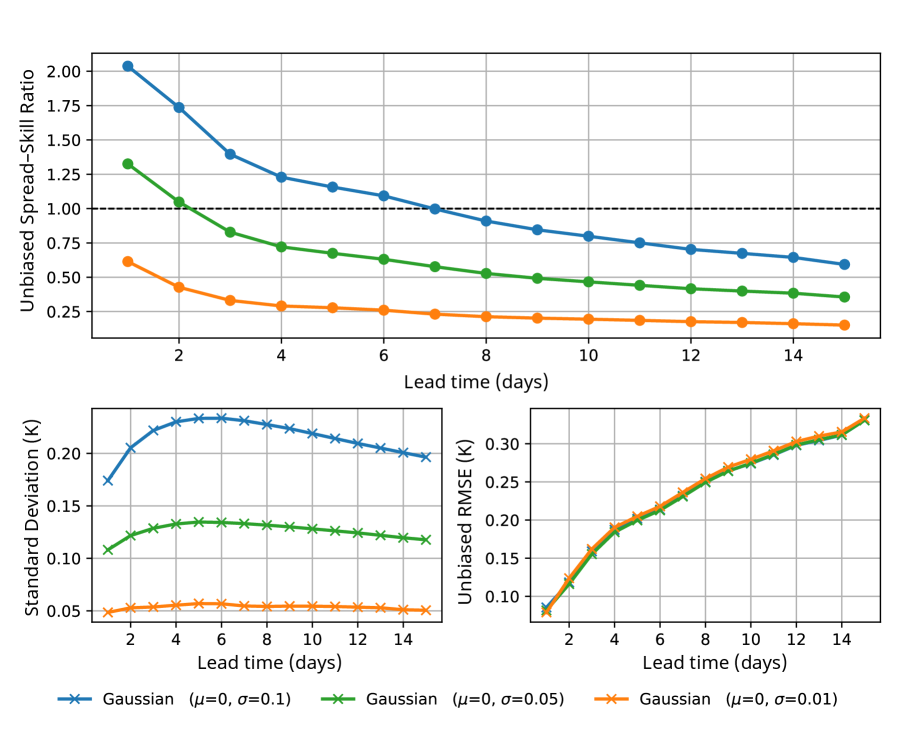
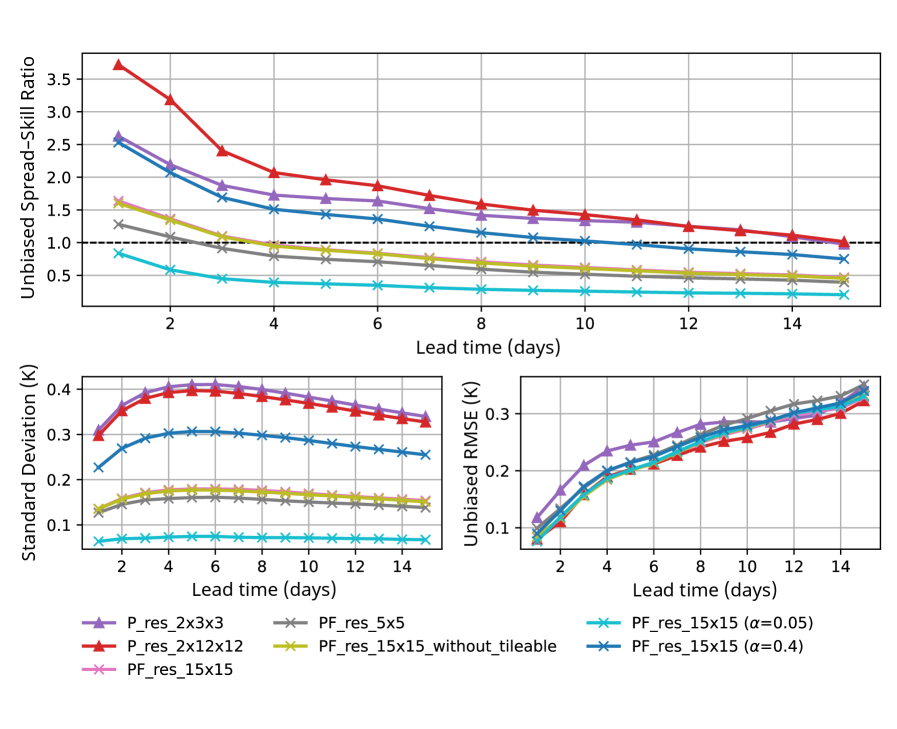
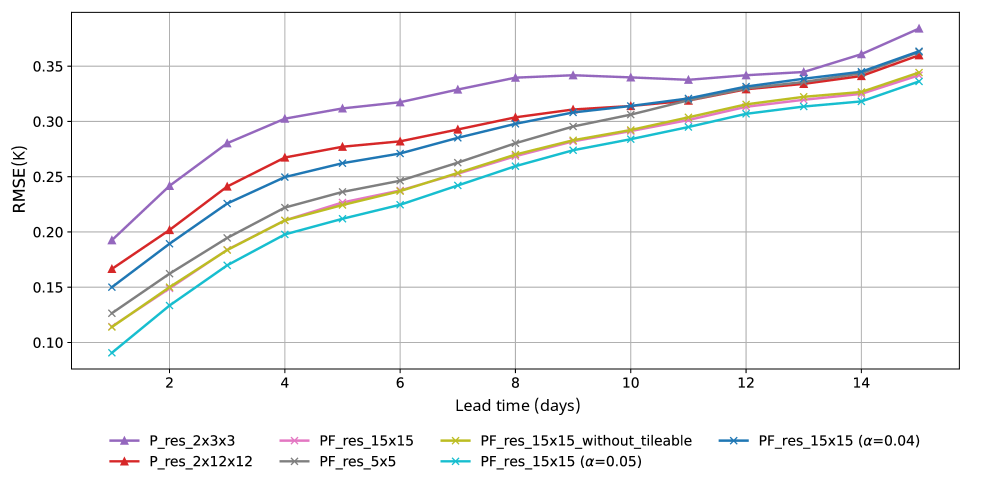
Evaluation of ensemble forecasting systems requires metrics that assess both reliability and skill; the Spread-Skill Ratio is a key indicator of calibration, representing the relationship between ensemble spread and forecast accuracy. Analysis within SeaCast demonstrates that spatially coherent noise models, specifically Perlin Noise and Fractal Perlin Noise, provide improved uncertainty quantification compared to isotropic Gaussian noise. Configurations utilizing Perlin Noise at higher resolutions, such as P_res_12x12, exhibited Spread-Skill Ratios approaching 1, indicating well-calibrated ensembles. This improvement in calibration was also reflected in lower Continuous Ranked Probability Score (CRPS) values, particularly at extended forecast horizons, and comparable or slightly reduced Root Mean Squared Error (RMSE) values relative to both Gaussian noise and single-model forecasts.
Analysis of ensemble forecasting results indicates that higher resolution Perlin noise configurations, such as P_res_12x12, demonstrate improved calibration as measured by the Spread-Skill Ratio, approaching a value of 1. This suggests a strong correspondence between the forecast spread and the actual forecast skill. Furthermore, these configurations consistently achieved lower Continuous Ranked Probability Score (CRPS) values compared to ensembles generated with Gaussian noise, particularly at extended forecast horizons. The reduction in CRPS indicates a more accurate probabilistic forecast, with improved reliability in predicting the distribution of possible outcomes.
Root Mean Squared Error (RMSE) analysis indicated that ensemble forecasts utilizing spatially coherent, higher resolution Perlin noise configurations generally maintained accuracy levels comparable to those of the single-model forecast. Importantly, these configurations demonstrated a slight reduction in RMSE values when compared to forecasts generated with Gaussian noise, with the improvement becoming more pronounced at extended forecast horizons. This suggests that while the ensemble approach does not significantly degrade overall accuracy, the incorporation of structured noise, specifically at higher resolutions, can offer marginal gains in predictive skill over longer time periods.
Impact and Future Directions in Oceanic Prediction
SeaCast’s predictive capabilities, centered on accurate forecasts of Sea Surface Temperature and related oceanographic variables, underpin a diverse spectrum of practical applications. Maritime industries benefit from improved navigational safety and optimized fuel efficiency, while offshore energy operations gain through better planning and reduced risk. Beyond commerce, precise ocean predictions are vital for effective ecosystem monitoring, allowing scientists to track harmful algal blooms, assess marine heatwave impacts on biodiversity, and manage fisheries sustainably. Furthermore, these forecasts directly inform coastal management strategies, aiding in the mitigation of erosion, the prediction of storm surges, and the safeguarding of vulnerable coastal communities – demonstrating the broad societal value derived from enhanced ocean prediction systems.
The integration of Graph Neural Networks (GNNs) with ensemble forecasting represents a significant step toward robust ocean prediction, particularly when navigating inherent uncertainties. GNNs excel at capturing complex spatial relationships within oceanographic data, allowing models to understand how different areas influence one another – crucial for accurate forecasting. Combining this capability with advanced ensemble methods, which generate multiple possible future scenarios, provides a more complete picture of potential outcomes than single-model predictions. This approach doesn’t simply offer a single ‘best guess’ but rather a range of plausible futures, each weighted by its probability, empowering decision-makers in sectors like maritime navigation, resource management, and disaster preparedness to assess risks and formulate strategies that account for a spectrum of possibilities. The resultant probabilistic forecasts allow for more informed and adaptable responses, even when faced with unpredictable ocean conditions.
Ongoing development in ocean prediction centers on combining the strengths of different probabilistic forecasting systems. Researchers are actively working to integrate GenCast, a system designed for generating ensemble forecasts, with NeuralGCM, a neural network-based global climate model. This synergy aims to move beyond deterministic predictions – single, fixed outcomes – towards quantifying uncertainty and providing a range of possible future ocean states. By merging the computational efficiency of GenCast with the sophisticated physical modeling of NeuralGCM, scientists anticipate a substantial increase in the reliability and accuracy of forecasts, extending predictive horizons and enabling more informed decision-making across diverse sectors reliant on ocean conditions. This integrated approach promises not just what the ocean will do, but a clear assessment of how likely each potential outcome is.
The ocean’s role in regulating global climate and supporting marine ecosystems demands continuous advancement in predictive capabilities. Climate change is intensifying ocean-related hazards – including marine heatwaves, altered currents, and sea-level rise – necessitating increasingly sophisticated forecasting tools. Sustained innovation in ocean prediction isn’t merely an academic pursuit; it is fundamental to proactive risk management for coastal communities, fisheries, and vital shipping lanes. Further research promises not only more accurate forecasts, but also the ability to model a wider range of scenarios, allowing for informed decisions regarding resource allocation, conservation efforts, and the development of adaptive strategies for a changing ocean. Ultimately, ongoing investment in this field is crucial for bolstering resilience and ensuring the long-term sustainability of our planet’s largest ecosystem.
The research demonstrates a systemic approach to probabilistic forecasting, recognizing that initial conditions profoundly influence outcomes. This echoes Vinton Cerf’s observation: “The Internet treats everyone the same.” Just as the internet’s architecture demands consistent treatment of data packets, the forecasting model reveals that structured perturbations – like Perlin noise – offer a more coherent representation of uncertainty than purely random variations. The study highlights how understanding the ‘bloodstream’ of initial conditions – and the patterns within them – is crucial; a single alteration necessitates consideration of its wider impact on the entire forecast system. This systemic view is not merely about prediction, but about acknowledging the inherent interconnectedness of the ocean’s behavior.
The Horizon Beckons
The pursuit of skillful probabilistic forecasting, as demonstrated by this work with graph neural networks and initial condition perturbations, reveals a familiar truth: optimization merely relocates the fundamental challenges. Introducing structured noise, specifically Perlin noise, improves uncertainty representation, yet this begs the question of which structure best reflects the underlying generative process. The ocean doesn’t randomize; it evolves according to physical laws, and mimicking that evolution – even approximately – remains the elusive goal. This isn’t simply a matter of selecting a superior noise function, but of architecting a system that acknowledges the inherent interconnectedness of ocean dynamics.
Future work must move beyond treating noise as a proxy for uncertainty and instead focus on embedding mechanistic understanding directly into the model architecture. Graph neural networks, with their ability to represent complex relationships, offer a promising avenue, but only if the graph structure itself is informed by oceanographic principles. The system’s behavior over time – the forecast itself – is dictated by this structure, not a static diagram on paper.
Ultimately, the true test lies not in achieving incremental improvements in forecast skill, but in building models that are robust to model misspecification. A perfect model, perfectly initialized, is a theoretical construct. The real world demands resilience, and that requires acknowledging the limitations of any single approach. The search for skillful forecasting is, therefore, a continuing exploration of system design, a process of refinement guided by an understanding that every fix creates new tension points.
Original article: https://arxiv.org/pdf/2603.06153.pdf
Contact the author: https://www.linkedin.com/in/avetisyan/
See also:
- United Airlines can now kick passengers off flights and ban them for not using headphones
- Katanire’s Yae Miko Cosplay: Genshin Impact Masterpiece
- All Itzaland Animal Locations in Infinity Nikki
- How to Complete Bloom of Tranquility Challenge in Infinity Nikki
- How to Get to the Undercoast in Esoteric Ebb
- Gold Rate Forecast
- A Dark Scream Theory Rewrites the Only Movie to Break the 2-Killer Rule
- All Golden Ball Locations in Yakuza Kiwami 3 & Dark Ties
- Fire Force Season 3 Part 2 Episode 24 Release Date, Time, Where to Watch
- BloxStrike codes (March 2026)
2026-03-09 21:56