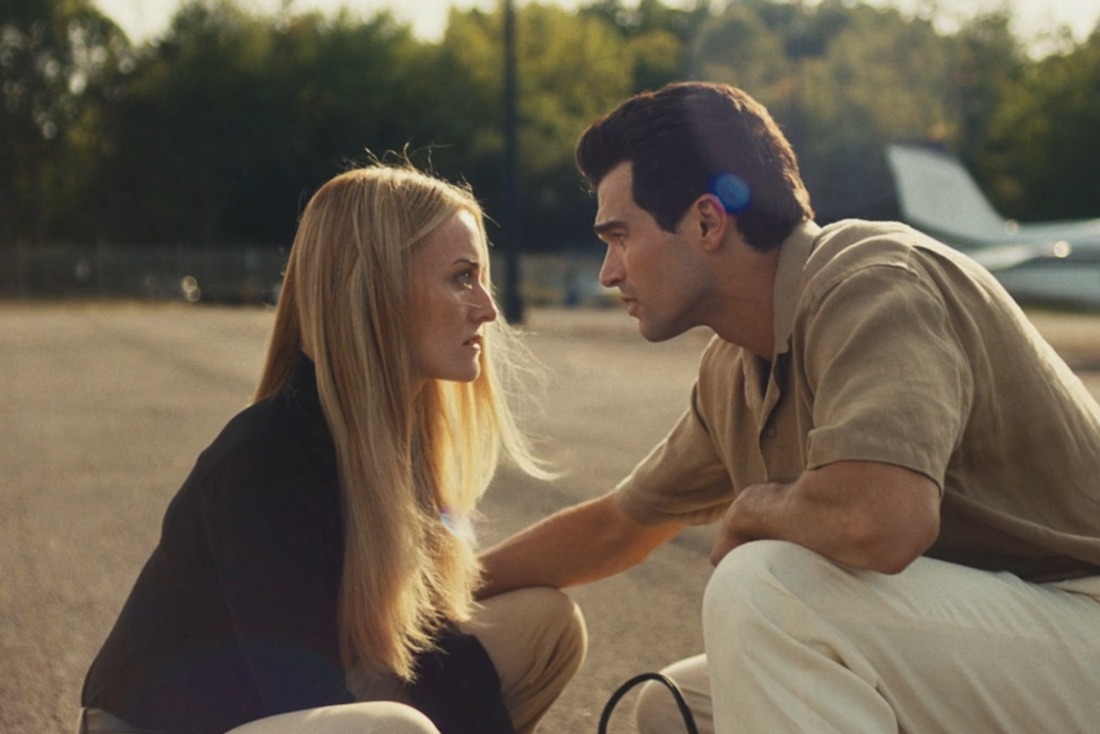
The FX miniseries Love Story centers on the complicated romance between John F. Kennedy Jr. and Carolyn Bessette, and it begins and ends with the story of their tragic final flight in 1999. The series opens with them taking off on a summer afternoon and concludes with the events of that flight and how it affected those who knew them, as well as the public. This final episode is particularly important, both historically and within the show’s narrative, but questions remain about its accuracy.
The show accurately portrays the basic facts of what happened. John tried to fly his Piper Saratoga from Caldwell, New Jersey, to Martha’s Vineyard and then on to Hyannis, Massachusetts, with Carolyn and her sister Lauren on board. They took off at 8:40 p.m. on July 16th, flying east along the Connecticut coastline. Over the ocean near Martha’s Vineyard, John became confused about his location and lost control of the plane. When the plane didn’t arrive, search teams were dispatched. Four days later, the wreckage and the bodies of all three passengers were discovered.
The movie generally follows the story outlined in the official crash investigation report. However, filmmakers took liberties with certain details – particularly what happened inside the cockpit, as there was no audio recording of the flight. Some of the things shown are also simply not correct. Here’s a breakdown of the major inaccuracies.
Wrong: John tried to get a flight instructor to come along with them.
When Carolyn gets to the airport in the show, she asks about the flight instructor. John simply tells her that he wasn’t able to come.
John frequently asked his flight instructors for extra help because he was having difficulty becoming a skilled pilot, even though he’d flown many hours. He was recently learning to fly in challenging weather conditions like clouds and haze, but he was struggling with the training. He had to repeat one particular lesson – the 11th of 25 – three times before he mastered it. His instructor later told investigators that John struggled to handle several things at once while flying.
The flight instructor didn’t abandon them, actually. Investigators said one of the instructors even volunteered to fly with them, but John insisted on flying by himself.
Wrong: They took off in daylight.
The show depicts the characters taking off with the sun shining brightly, and continuing their flight to Martha’s Vineyard while it’s still daylight. However, the actual flight didn’t begin until 8:39 p.m., after the sun had already set.
John was licensed to fly at night, and nighttime flights are generally safe when visibility is clear. However, the show accurately portrays that John was warned about hazy weather, which can be particularly disorienting when flying in the dark. The instructor who offered to accompany him later told investigators he wouldn’t have allowed the flight given the conditions near Martha’s Vineyard that night.
Wrong: The plane flew into bad weather, with turbulence and sudden clouds that cut visibility to zero.
The issue wasn’t simply the bad weather they encountered; it was that John kept flying when he could no longer see well enough to know which way the plane was pointing.
It was completely dark when he encountered problems, and a thick haze obscured the horizon. This can lead to spatial disorientation, where your inner ear sends misleading signals about which way is up. This is especially dangerous for pilots, as it can trick them into thinking the plane is level when it’s actually turning – and then into making that turn even sharper, potentially leading to a dangerous, high-speed dive without them realizing it. A key part of pilot training is learning to overcome these misleading sensations and trust the plane’s instruments instead. This would have been one of the first things John learned when he began flight school.
Wrong: Alarms went off, red light filled the cockpit, and the dials on John’s instruments spun.
The plane was functioning normally and there were no mechanical issues that would have triggered any warnings. In the show, the compass spins wildly, but in reality, it would have moved smoothly and gradually as the plane turned.
Wrong: Carolyn was initially sitting in the back seat, but then looked at John in the front seat and decided to move forward to sit next to him.
The Saratoga aircraft had six seats arranged in three rows. John was piloting the plane from the front row. Lauren and Carolyn sat behind him in the second row, facing the rear. Because of this seating arrangement, Carolyn wouldn’t have been able to see John while they were flying. There’s no proof she ever moved to the front, and the small space inside the plane would have made that difficult.
Wrong: Carolyn knew John was panicking and tried to comfort him while maintaining a Zenlike calm.
Even if Carolyn had been in a good position to notice things going wrong, she couldn’t have guessed that John’s confusion and growing panic were the sole cause of the problems.
She probably would have found the plane’s bumpy ride unsettling and confusing. She likely felt herself pressed back into her seat as the g-force increased, and heard a loud rushing wind as the plane descended towards the water. A natural reaction would have been something like, “What on earth is happening?”
Wrong: After the crash is located and the bodies are recovered, John’s brother-in-law was told that spatial disorientation is like “being taken under by a wave.”
Disorientation isn’t something that suddenly hits you from the outside. It happens when a pilot focuses too much on how they feel instead of what the plane’s instruments are telling them. John, with his training, really should have anticipated this possibility.
Right: Carolyn’s mother asserts that John was responsible for the crash.
During an episode, Carolyn’s mother, Ann Messina Freeman, confronted John’s sister, Caroline Kennedy, about rumors circulating in the media. She explained that some reports claimed the plane crash happened because Carolyn was getting her nails done, which delayed their departure. Ann clarified it wasn’t about John’s ability to fly at night – he was qualified – but that Carolyn’s delay, driven by her desire to look good, had held them back.
The show’s portrayal of the media blaming Carolyn for the crash is a fictionalized exaggeration. In truth, the media largely praised her after she died. The detail about her getting her nails done didn’t appear until 2003, and reports actually said she had a pedicure, not a manicure as shown in the series.
Ultimately, John F. Kennedy Jr. was responsible for the accident. Although he had a pilot’s license, he lacked the necessary experience and good judgment to safely complete the flight. He should have recognized his limitations and cancelled the trip, but he didn’t, and that’s why he bears the responsibility.
Read More
- United Airlines can now kick passengers off flights and ban them for not using headphones
- All Itzaland Animal Locations in Infinity Nikki
- Katanire’s Yae Miko Cosplay: Genshin Impact Masterpiece
- How to Complete Bloom of Tranquility Challenge in Infinity Nikki
- How to Get to the Undercoast in Esoteric Ebb
- A Dark Scream Theory Rewrites the Only Movie to Break the 2-Killer Rule
- All Golden Ball Locations in Yakuza Kiwami 3 & Dark Ties
- Gold Rate Forecast
- 6 Ways Invincible Season 4’s Hell Episode Rewrites The Comics
- BloxStrike codes (March 2026)
2026-03-30 23:55