Key Takeaways
Key Takeaways
- Lido DAO is voting on a $20M one-off LDO buyback using treasury stETH, targeting ~8.5% of circulating supply
- LDO/ETH ratio sits at a historic low – 63% below its two-year median
- Lido V3 launched in January 2026 with modular stVaults; Lido Earn followed in March
- The DAO approved a $60M budget for 2026, shifting strategy toward a multi-product organization
The proposal, sent on March 27, 2026, explains the change as a reaction to a significant price difference between LDO and Ethereum.
LDO is currently trading around $0.31, which is near its lowest price since it first launched. Compared to its typical price over the past two years, LDO’s value relative to Ethereum (LDO/ETH) is down 63%, currently at 0.00016. Overall, the token has fallen about 96% from its highest recorded price.
As an analyst, I’m following the proposed LDO buyback closely. If approved, the Lido Growth Committee plans to execute it in stages, purchasing 1,000 stETH at a time. They’ll likely use strategies like limit orders or dollar-cost averaging to minimize any price fluctuations. The goal is to acquire around 70 million LDO tokens – roughly 8.5% of what’s currently available. Importantly, these purchased tokens will be held in the treasury and won’t be used for governance voting.
Lido’s revenue decreased by 23% in 2025, going from $52.4 million to $40.5 million. While Lido remains a leading player in Ethereum liquid staking, with a 23.2% market share, this hasn’t helped its token price. The reason for the revenue drop, according to the DAO, is that more money is now going towards staking on exchanges, newly available spot ETH ETFs, and restaking platforms that offer boosted returns.
Those in favor of buying back LDO tokens believe it shows the DAO is confident in the project and could help prevent further price drops. However, others aren’t so sure. Since October 2025, large LDO holders have sold off nearly 80 million tokens, leading some to wonder if a single purchase can maintain the price while these holders continue to sell. The DAO is also planning a regular, automated buyback program – $10 million worth of tokens each year starting in the second quarter of 2026 – but this depends on the project earning over $40 million in revenue that year.
Lido Earn and the MetaVault Rollout
In March 2026, along with the vote to buy back shares, Lido introduced two new products built on its MetaVault framework. This framework simplifies earning the best returns on decentralized finance (DeFi) by combining various strategies into one easy-to-use interface, making it less complicated than managing them separately.
As an analyst, I’ve been looking into Lido’s products, and their first offering, EarnETH, is essentially a vault designed to grow your ETH. They deploy ETH and stETH into what they consider the most reliable DeFi platforms. Right now, it has around 61,000 ETH locked up, and estimates show an annual return of about 5%. Their second product, EarnUSD, is new – it’s their first step into offering yields on stablecoins. Users can deposit USDC or USDT, and Lido then invests those funds across different strategies, including lending platforms and even some real-world asset protocols.
Mellow Protocol manages the investment strategies for both vaults. To ensure users feel secure, the community approved using $5 million from its funds to cover any initial losses – protecting user investments. The rewards you earn are calculated and added to the value of your earnETH and earnUSD tokens every day.
The 2026 Budget: $60 Million and a Strategic Pivot
The DAO is requesting $60 million in ecosystem funding for 2026, known internally as GOOSE-3. Of that amount, $43.8 million will be used for essential functions like protocol security, upgrades, and day-to-day operations. The remaining $16.2 million is designated for optional growth initiatives.
As an analyst, I’m seeing Lido strategically shift its focus. They’re currently dedicating funds to boost adoption of stETH and Lido Earn – specifically through incentives – and are actively developing exchange-traded products built around stETH for institutional investors. They’re also planning to expand Earn to include stablecoins. The DAO is clearly signaling a move away from being solely a stETH protocol and towards becoming a broader, more diversified ‘innovative organization’ with multiple products. It’s a compelling vision, but whether they can successfully execute this transition remains the key question.
Ethereum Staking
I’ve been closely watching the Ethereum staking landscape, and it’s shifted quite a bit recently, which is important when looking at Lido’s current share – it’s around 23.2%, according to Dune Analytics. A key event driving this change was the SEC and CFTC jointly classifying Ethereum as a digital commodity on March 17, 2026.
As an analyst, I’ve been closely following the SEC’s stance on staking, and their recent declaration is a game-changer. They’ve clarified that staking is an ‘administrative activity,’ not a securities offering – something the industry has been waiting years for. This distinction paved the way for significant movement, and within days, BlackRock launched their iShares Ethereum Trust, offering institutional investors a regulated way to gain exposure to both the price of Ethereum and the rewards from staking. It’s a big step towards bringing staking into the mainstream for larger investors.
On March 30th, the Ethereum Foundation announced it had staked another $46 million worth of its own ETH to support its ongoing work and research. As a result, a record high of 30.9% of all ETH – over 38.1 million ETH (worth about $53.5 billion currently) – is now staked on the network, according to data from BeaconChain. This regulatory clarity is especially welcome news for Lido, a company focused on liquid staking, but it also means they’ll likely face more competition from larger institutions.
Technical Analysis (LDO)
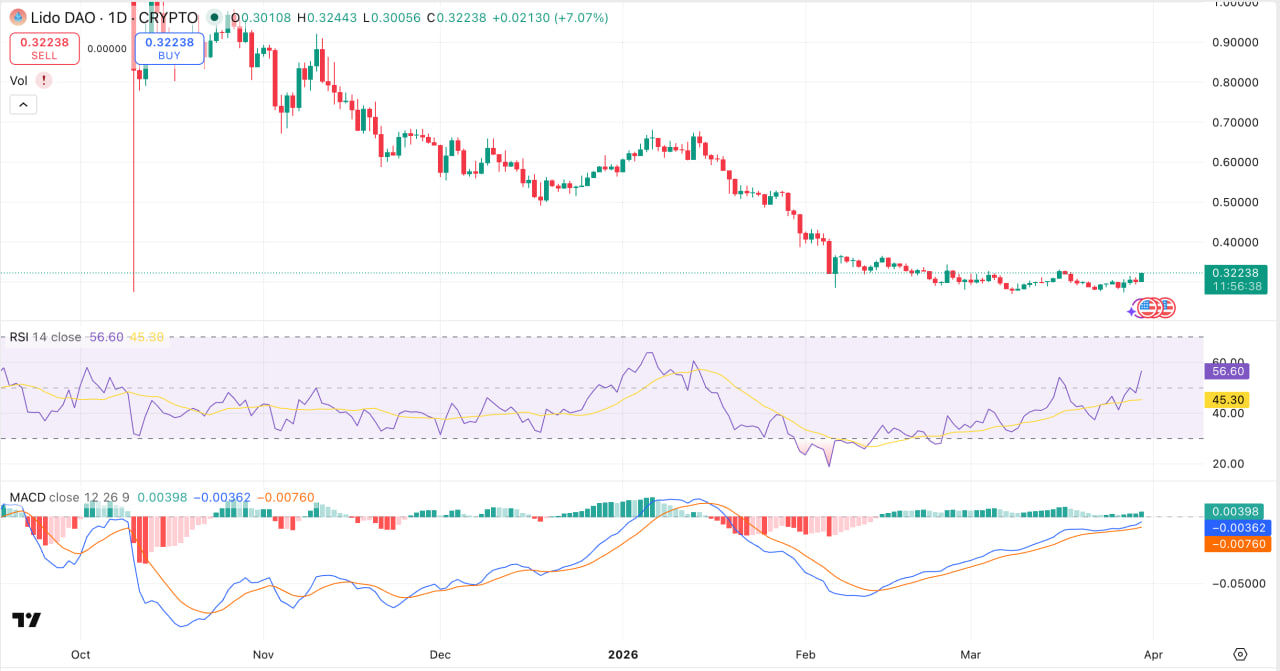
As a researcher tracking LDO, I’m currently seeing it trade around $0.32, which represents a roughly 7% increase today. The Relative Strength Index (RSI) is around 56.6, meaning it’s a bit higher than where it’s been for most of the last six months, but it’s not yet indicating overbought conditions.
The MACD indicator is currently showing a slight positive signal, meaning there’s a little bit of upward momentum in the short term. However, the overall trend for LDO has been downward since September 2025, falling from around $0.90 to its current price. Since late January 2026, the price has been stable, fluctuating between $0.28 and $0.35. If the price consistently rises above $0.35, that would be the first significant positive change in months. For now, today’s price increase appears to be a temporary bounce within this established trading range.
This article is for informational purposes only and shouldn’t be considered financial, investment, or trading advice. Coindoo.com doesn’t support or suggest any particular investment or cryptocurrency. It’s crucial to do your own research and speak with a qualified financial advisor before making any investment choices.
Read More
- United Airlines can now kick passengers off flights and ban them for not using headphones
- Katanire’s Yae Miko Cosplay: Genshin Impact Masterpiece
- All Itzaland Animal Locations in Infinity Nikki
- How to Complete Bloom of Tranquility Challenge in Infinity Nikki
- How to Get to the Undercoast in Esoteric Ebb
- Gold Rate Forecast
- All Golden Ball Locations in Yakuza Kiwami 3 & Dark Ties
- A Dark Scream Theory Rewrites the Only Movie to Break the 2-Killer Rule
- BloxStrike codes (March 2026)
- Fire Force Season 3 Part 2 Episode 24 Release Date, Time, Where to Watch
2026-03-30 16:09