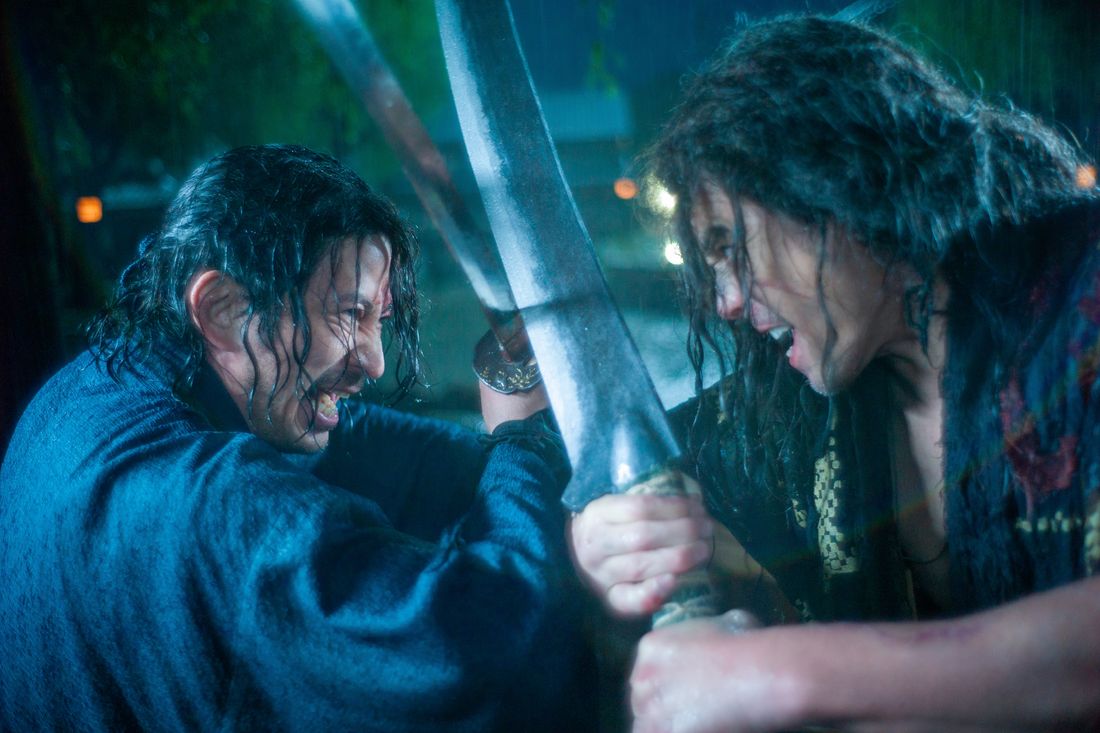
Because Squid Game was initially seen as a take on the Battle Royale concept, its huge popularity now means any show with a similar premise – many competitors, a large cash prize, and deadly competition – risks being called a copycat. This is especially true for shows like Last Samurai Standing, which heavily emphasizes those shared elements in its marketing. The new six-episode series, which premiered on Netflix November 13th, follows a group of samurai traveling from Kyoto to Tokyo, competing to kill each other for a life-changing reward. The trailer highlights the violence and betrayal, clearly drawing a comparison to Squid Game. While understandable given Squid Game‘s success, this approach ultimately does a disservice to Last Samurai Standing.
Yes, there are definite parallels between Last Samurai Standing and Squid Game: people fighting to the death for money. However, Last Samurai Standing has its own unique background. It began as a 2012 novel called Ikusagami by Shogo Imamura, which was then adapted into a manga series in 2022. Being Japanese, rather than South Korean, the story is rooted in the Meiji period of the late 19th and early 20th centuries—a time when Japan was transitioning from a feudal society to an industrialized one. Unlike Squid Game’s brutal violence, Last Samurai Standing features beautifully choreographed martial arts and sword fights, with graceful movements and artistic displays of combat. There are many reasons to enjoy Last Samurai Standing for what it is, and here are five of them.
The fights
In 1878 Japan, the country is changing from an old feudal system, but many villages and poor people are being left behind. A deadly cholera epidemic is spreading, particularly affecting children. The government has also eliminated the samurai class, outlawing swords and causing widespread poverty among them. At this time, a mysterious notice begins circulating, inviting former samurai to a temple with the promise of a 100,000 yen reward. When they arrive, they find a group of guards dressed in black military uniforms – with no identifying marks – who explain the rules of a game called Kodoku. The samurai must journey to Tokyo, stopping at seven checkpoints along the way. To pass each checkpoint, they need a certain number of points, which they can only earn by killing each other and collecting the wooden nameplates of the fallen. Anyone who quits the game or reveals its existence to outsiders will be executed.
The initial conflict sets the stage for exciting battles, and Last Samurai Standing doesn’t disappoint. The lead actor, Junichi Okada, also choreographs the action, creating a diverse range of fights – from one-on-one duels to large-scale brawls, even incorporating unique settings like a religious festival or a deadly duel fought across a river. Each episode introduces new characters with compelling backstories, such as a member of the Anui people whose archery is deeply connected to his faith. This constantly expanding cast adds even more variety to the already impressive fight scenes, showcasing each character’s unique skills. It’s a smart approach that keeps the focus where it belongs: on the thrilling action.
The lone wolf and cub
Though Last Samurai Standing features a large cast, the story primarily focuses on Shujiro Saga, a legendary samurai known as “Kokushu the Manslayer,” and Futaba Katsuki, a young girl who has suffered greatly from illness and loss. They form an unexpected bond when Shujiro, feeling sympathy for Futaba at a meeting, begins to protect her. He eventually agrees to escort her to Tokyo. The plot follows a predictable path – he’ll help her become stronger, and she’ll help him become more compassionate – but as a new take on the classic manga Lone Wolf and Cub, it fits right in and pays homage to its predecessors.
The political machinations
Revealing too much of the plot would ruin the season finale, which leaves viewers wanting more. However, if you enjoyed FX’s Shōgun, you’ll definitely want to watch Last Samurai Standing. It explores Japanese society after the samurai lost power and shows how the country changed during the pre-World War I Meiji period. Like Shōgun, it presents a thought-provoking view of Japanese nationalism, contrasting the honor of the samurai with the challenges of industrialization. There’s also a compelling storyline about how Western ideas impacted Japan’s evolving legal system. Currently, the show taps into satisfying anti-colonial themes, but these could become problematic if the series relies on them too heavily. That’s something for a potential second season to address, but the question of whether outside influences were detrimental to Japan is a strong focus of the first season.
The semi-supernatural stuff
Okay, let me tell you about Gentosai Okabe, the central figure in Last Samurai Standing. This guy is legendary – a virtually immortal warrior who can effortlessly take on hordes of samurai. He’s tasked with tracking down and eliminating those who’ve abandoned his martial arts order. The filmmakers do a brilliant job of keeping his backstory shrouded in mystery, focusing instead on his incredible physicality and using sound – especially the chime of his walking stick – to build tension and a real sense of dread. Whenever he moves, the music gets all unsettling, hinting that his very existence warps reality. It’s a spooky, fun effect! The film is clearly fond of this bygone era of samurai, but Okabe, presented as this relentless, almost Terminator-like figure, adds a fascinating, contradictory edge. He suggests a supernatural element lingering as this traditional world fades away with modernization, and it’s a welcome surprise that elevates the whole experience.
Kanjiya the Butcher
Shujiro is a principled and realistic man who acknowledges the end of the samurai era. Haunted by the trauma of his last battle, he enters the Kodoku competition solely to support his family. His strong character, brought to life by Okada’s powerful performance, makes him a compelling hero, and allows the series to build a fascinating cast around him. These other fighters each have their own reasons for competing, hidden secrets, and personal conflicts, which are highlighted through individual introductions and dramatic music. Several of them, like the enigmatic Kyojin Tsuge (played by Masahiro Higashide, who portrays him as cunning and playful), are scene-stealers. But Hideaki Ito truly shines as Bukotsu Kanjiya, a delightfully over-the-top character. Ito, who previously played a handsome role in Tokyo Vice, is almost unrecognizable here, embodying a destructive and cynical force. Covered in scars and wielding an enormous sword, he delivers every line with a menacing sneer. Ito completely dominates every scene, making Kanjiya’s personal rivalry with Shujiro feel incredibly intense. It’s hard not to root for a character nicknamed “The Butcher” who actually bites off opponents’ fingers – it’s definitely not traditional samurai behavior, but it makes Last Samurai Standing a thrilling watch.
Read More
- United Airlines can now kick passengers off flights and ban them for not using headphones
- Solo Leveling’s New Manhwa Chapter Revives a Forgotten LGBTQ Story After 2 Years
- The Boys Season 5 Spoilers: Every Major Character Death If the Show Follows the Comics
- Grok’s ‘Ask’ feature no longer free as X moves it behind paywall
- ‘Timur’ Trailer Sees Martial Arts Action Collide With a Real-Life War Rescue
- How to Get to the Undercoast in Esoteric Ebb
- Mewgenics vinyl limited editions now available to pre-order
- Gold Rate Forecast
- Invincible Season 4 Episode 6 Release Date, Time, Where to Watch
- TikToker’s viral search for soulmate “Mike” takes brutal turn after his wife responds
2025-11-15 03:01