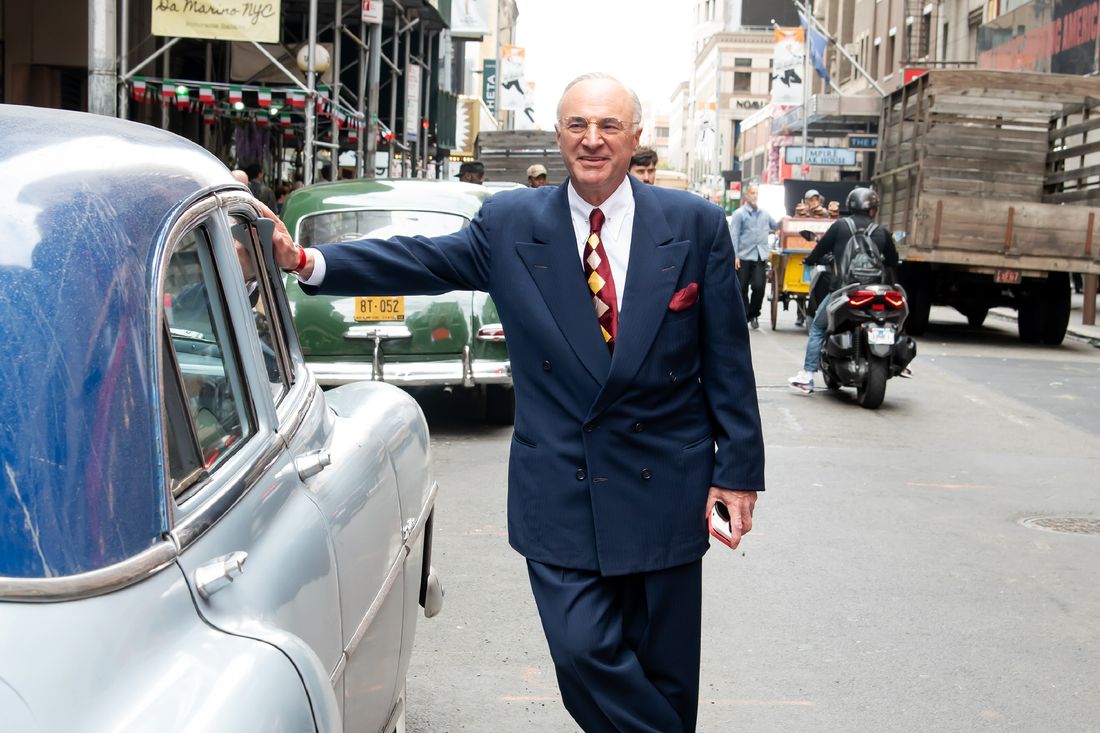
Kevin O’Leary inspired the memorable vampire speech in the movie Marty Supreme. He was showing me proof on his phone while we sat at a busy brasserie on the Upper East Side, surrounded by its regular lunch crowd. Marty Supreme tells the story of Marty Mauser (Timothée Chalamet), an aspiring table tennis champion whose ambitions are stalled by the lack of interest in the sport in 1952 New York City. O’Leary, who plays a publishing magnate named Milton Rockwell, felt strongly that Marty needed to face more serious repercussions for his actions in the film. He kept sending director Josh Safdie videos of himself, staying in character as Rockwell and delivering increasingly elaborate threats to the main character.
This scene quickly became a standout moment in the film – a surprisingly bizarre turn that wasn’t meant to be taken seriously. Milton, a wealthy and unpleasant character who serves as the closest thing to a villain, showed no signs of typical vampire weaknesses like sunlight or a need for blood, and was happily married to his famous wife (played by Gwyneth Paltrow). However, the actor playing him, O’Leary, felt intensely hostile towards the character. He even suggested adding prosthetic fangs and imagined attacking Milton violently. The director, Safdie, decided against making the character a literal vampire, a choice most people (except O’Leary) probably agreed with. The scene remains wonderfully strange, a result of casting performers who bring their own unique personalities to the film.
Kevin O’Leary, known to fans of Shark Tank as Mr. Wonderful, arrived for lunch wearing a striking black paisley suit, looking surprisingly imposing despite his tan. Like many successful and conservative business leaders today, he now lives in Miami. Originally from Montreal, O’Leary first made his money by starting a company that produced and sold educational software on CD-ROM. He then became a TV personality, first on the Canadian show Dragons’ Den and later on the American Shark Tank, where he’s been a judge since the very beginning in 2009. Over time, he’s become known as the toughest judge on the show – the one who delivers blunt criticism, memorable insults, and creative analogies to aspiring business owners.
Kevin O’Leary, much like his famous Joker persona, offers different explanations for how he earned the nickname “Mr. Wonderful.” He once told me it stemmed from a sarcastic remark made by his former co-host, Amanda Lang, during their time on CBC’s The Lang and O’Leary Exchange. Others claim Shark Tank co-star Barbara Corcoran gave him the name because of the tough royalty deals he proposed to entrepreneurs in the show’s first season. Regardless of its origin, the nickname is clearly ironic. Videos circulate online showing O’Leary harshly criticizing contestants, calling them greedy or even admitting he’d hire them just to fire them. With his signature dark suit and bald head, he’s cultivated a deliberately over-the-top image as a ruthless capitalist, openly dismissing emotional considerations and constantly focusing on profit – even from those facing hardship. O’Leary believes his blunt critiques on Shark Tank are actually helpful, providing a harsh reality check to those with unrealistic ideas and, as he puts it, “wasting their parents’ money.”
https://youtube.com/watch?v=watch?v=WQ9AIqGyTgo
O’Leary jokingly describes himself as playing a deliberately unpleasant character in the film Marty Supreme, and that’s exactly why he was cast. Director Josh called him directly, saying he was looking for someone truly unlikeable, and O’Leary fit the bill. He recalls Mark Burnett saying the same thing when he was cast on Shark Tank. His agent at UTA initially worried the role would damage his public image, using the blunt phrase, “We think you could really mess this up.” However, O’Leary delivers a surprisingly strong performance. His character, Milton, is deliberately irritating – complete with a toupee, a smug attitude, and a natural sneer – and serves as a stark contrast to the relentlessly ambitious protagonist. Milton views everything as a transaction, even the death of his son, and shockingly expects gratitude from an Auschwitz survivor he encounters.
O’Leary isn’t the only non-actor in the large cast of Marty Supreme – it also features rapper Tyler the Creator, table-tennis champion Koto Kawaguchi, filmmaker Abel Ferrara, and businessman John Catsimatidis. However, he’s the one who directly clashes with Timothée Chalamet, who gives a particularly strong performance, in a series of increasingly intense competitions where their characters battle for control. One scene takes place in a Parisian restaurant, much like the one where we’re having lunch in New York, and involves Milton offering Marty money to appear at an event in Tokyo. Marty is so insulted – because he’d be expected to lose on purpose to please the Japanese audience – that he responds with an offensive remark about Milton’s son. O’Leary’s character freezes, but his anger is clear. This moment impressed a documentary filmmaker at the screening, who, not being a fan of reality TV, asked me afterward, “Who is that actor? What else has he been in?”
Kevin O’Leary’s ability to land a role in a major movie, especially as his first acting job, speaks to his remarkable confidence. He’s carefully cultivated a no-nonsense image through years on television, appearing frequently as a commentator on the news and even briefly considering a run for office in Canada. In person, he’s less aggressive than his on-screen persona suggests. He explains that his “Mr. Wonderful” character isn’t an act, but rather a realization that any reaction – even strong dislike – is better than being ignored. “I realized I only need to please a small group of people – my business partners and family,” he says while eating a salad. “Trying to make millions happy is impossible. I actually respect people who take the time to write lengthy critiques of me – think of the effort that takes!”
O’Leary is known for his good taste, so we decided to share a bottle of Puligny-Montrachet with our French onion soup and beef bourguignon. He’s also a watch enthusiast, and today he’s wearing two vintage watches – a signature style of his – with a striking pair of red leather straps. He explained their history effortlessly, clearly having told the story many times before. He was determined not to use borrowed watches in Marty Supreme, so he went to great lengths to find a special set appropriate for the film’s post-war setting: a Patek Philippe and a unique watch gifted to him by Seiko, with the agreement it would be featured on screen.
Kevin O’Leary seems more approachable than some other wealthy celebrities who’ve become public figures because, despite enjoying offering his opinions, he doesn’t typically engage in culture wars. When he ran for leadership of the Canadian Conservative Party in 2017, he presented himself as fiscally conservative but socially liberal, opposing carbon taxes and regulations while supporting LGBTQ+ rights and abortion access. (It’s unclear how committed he was to a political career, as he withdrew from the race rather than learn French, which was necessary to gain support in Quebec.) He generally opposes unions, frequently talks about urban crime, and surprisingly, has even called for banks to fail. While he previously supported Donald Trump, he’s recently been more critical, particularly regarding tariffs, some immigration policies, and the government’s investment in Intel. During his campaign, he offered a puzzling comment about J.D. Vance, saying, “I think anyone that is as close to the sun as he is has done a masterful job at staying out of trouble.”
Kevin O’Leary’s advice on social media is fairly traditional – he encourages people to keep mortgage payments under 30% of their income and to save and invest another 30%. While few would disagree with these ideas, they’re increasingly hard to put into practice. Beyond his social media presence, O’Leary often finds himself in the news. He and his wife were involved in a tragic boating accident in 2019, though his wife was later found not guilty. In 2021, he invested in the cryptocurrency exchange FTX and lost a significant amount of money when the company failed. He also made a $20 billion offer to buy TikTok in early 2025, but the deal didn’t go through. More recently, O’Leary has become a strong supporter of artificial intelligence, suggesting it could help filmmakers create more movies by using AI-generated extras.
O’Leary is primarily focused on establishing himself as a strong advocate for capitalism. He insists he’s willing to work with anyone, regardless of their political affiliation. Although Zohran Mamdani’s team declined a meeting request during the recent election, O’Leary still respects Mamdani’s campaign’s video production quality but doubts he’ll be able to deliver on all his promises. He bluntly warns that increased taxes are inevitable, comparing the situation to a foreboding warning. He even uses harsh language, stating that those earning from media will be heavily burdened. O’Leary admits he doesn’t worry about how such statements are received. He believes that appearing successful is now more important than actually being successful, and part of that image involves being deliberately abrasive. He openly admires figures like Elon Musk and Steve Jobs, despite characterizing both as difficult and unpleasant people – he describes Jobs with particularly strong language, calling him exceptionally mean and offensive.
Despite everything, or maybe even because of it, I enjoy talking to O’Leary. I actually find myself liking him more when he playfully teases me about my old iPhone and jokes that he could drink more than me, even though I plan to relax with a drink or two on the Upper East Side. A woman at a nearby table, who had been trying to contain herself throughout our meal, finally came over to ask for a picture. She was clearly thrilled to talk about Florida, watches, and how excited she was to meet him. She didn’t expect O’Leary to be rude, but seemed hopeful he might be. Instead, he recommended a movie to her: “You have to see Marty Supreme on Christmas Day.”
There’s a distinction between genuinely being unpleasant and simply playing that role, and Kevin O’Leary has mastered the latter. He understands that audiences enjoy a villain, especially one who speaks his mind without caring what others think. He’s not challenging those in power, but there’s a strange connection created – and perhaps our willingness to be drawn in is partly why we’re in the situation we are today. O’Leary knows his role in the Safdie brothers’ film is exceptional, but he’s still dreaming up his next big screen appearance. He envisions a movie where he’s a villain who uses AI to destroy the world, starting with a dramatic explosion. Or, he considers a Bond villain role – someone who dominates the anti-aging industry and actually discovers a working rejuvenation technology. “I’d be unbeatable because I’ve found the fountain of youth, and I’m not sharing it with anyone,” he says with obvious enthusiasm.
That made him think of a recent experience in Dubai, where he tried a cutting-edge health treatment called EBOO – extracorporeal blood oxygenation and ozonation. The process involves removing blood, filtering out toxins with a dialysis machine, and then returning it to the body infused with oxygen and exosomes. He claims it made him feel incredibly rejuvenated, like he had the energy of a six-year-old. He jokes that, like a vampire, he might actually achieve a youthful existence. But he also feels he could be a compelling villain in a movie, someone so convincingly evil that it would truly highlight the importance of goodness. He believes he could be a villain audiences would actually enjoy.
Read More
- United Airlines can now kick passengers off flights and ban them for not using headphones
- Gold Rate Forecast
- How to Complete Bloom of Tranquility Challenge in Infinity Nikki
- How to Solve the Glenbright Manor Puzzle in Crimson Desert
- 8 Actors Who Could Play Blackbeard In One Piece Live-Action Season 3
- A Dark Scream Theory Rewrites the Only Movie to Break the 2-Killer Rule
- All Golden Ball Locations in Yakuza Kiwami 3 & Dark Ties
- All MLB The Show 26 Quirks & What They Do
- How to Get to the Undercoast in Esoteric Ebb
- Crimson Desert Bustling Hill guide: How to complete the Dispatch the Howling Hill expansion mission
2026-01-02 17:56