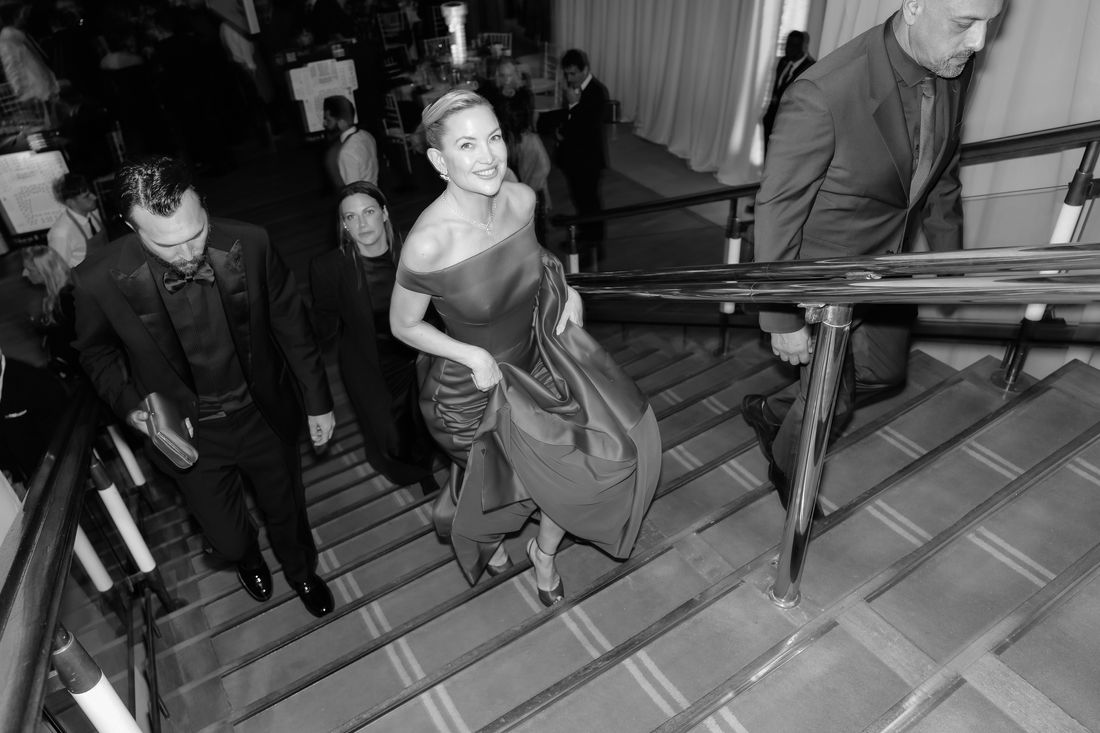
It’s a rainy afternoon, and Kate Hudson is making me promise not to reveal her favorite East Village noodle shop. “Don’t tell anyone,” she says with a smile, asking me to simply call it a “mysterious favorite.” She’s been coming here for years, ever since she lived in the neighborhood, and they even start her Perrier before she has to ask. While she now lives in Los Angeles, she’s always maintained some kind of residence in Manhattan – from Gramercy and King Street to a somewhat rundown Chelsea loft she shared with her ex-husband, Chris Robinson, a memory she fondly recalls during our lunch. She admits that when she goes a couple of years without a place here, she feels unsettled.
Kate Hudson has received an Oscar nomination for her role as Claire Sardina in Song Sung Blue. The film tells the true story of a Milwaukee hairdresser who, with her husband Mike (played by Hugh Jackman), formed a hugely successful Neil Diamond tribute band. Hudson got the part after appearing on CBS Sunday Morning to promote her debut album, Glorious. Hugh Jackman saw the interview and recommended her to the director, Craig Brewer, leading to Hudson quickly being cast. This is her first Oscar nomination in over two decades – she was previously nominated at age 21 for her performance in Cameron Crowe’s Almost Famous – and many are calling it a major career resurgence.
The star of Knives Out and Running Time doesn’t particularly like labels, but she’s happy to discuss the highs and lows of her career so far. This includes reflecting on her years doing romantic comedies – both the good ones and the not-so-good – and what films like The Skeleton Key and Le Divorce mean to her now. She also shares what she learned about the industry from Goldie Hawn, Kurt Russell, and Meryl Streep. She’s less willing to talk details about her upcoming romantic comedy, which has been described as similar to Sleepless in Seattle, When Harry Met Sally, and You’ve Got Mail. She explains that when a movie does well, people often try to replicate it with a lower budget and new actors. However, she believes that’s a different kind of romantic comedy than the originals, and doesn’t consider them the same genre. She shared these thoughts while enjoying a bowl of noodles.
Congratulations on the Oscar nomination! Where were you when you found out, and what did you think? I was at home. Even when people expect you to win, it’s still a shock. I wasn’t even sure I wanted to watch the nominations be announced – I almost tried to sleep through it and just see if my phone rang! But then I realized we’ve all worked so hard on this film – everyone’s been promoting it, and people are really enjoying it. I felt like I needed to be present, to experience either the end of this chapter or a reason to celebrate more. So I watched. These are my colleagues, people I respect and love working with. It’s my professional community, and when they recognize my work, it feels incredibly supportive and like a warm embrace.
Have you talked to Claire recently? Not yet, but I plan to. She’s great and really enjoyed the film, which is wonderful to hear. When you’re portraying a real person, it’s important to remember that their life is real. I realized this during an early interview when I could tell the interviewer was approaching the story in a certain way, and it reminded me that we’re talking about people’s lives.
The specific details aren’t important, but when telling someone’s life story, it’s crucial to approach it with sensitivity and respect – more so than with any other kind of storytelling.
I wanted to portray Claire authentically, capturing her spirit as shown in the documentary, while also respecting Craig’s interpretation of their story for the film. It’s a balancing act – understanding who Claire is, what Craig envisioned, and what he wanted to communicate through the script. Getting to know Claire during filming, I was struck by her incredible joy. The documentary beautifully captures her deep love for Mike.
You really portrayed a strong connection with Hugh in the film. It felt like you two were inseparable, like neither of you could have existed without the other.
What was the hardest thing about filming Song Sung Blue? It was definitely the prosthetics – I had to sit in makeup for three and a half hours, which was a new experience for me.
About my leg, yes. It’s tough being someone who’s always on the go and then having to sit for hours, but the work itself was really engaging. Filming only took 36 days, and it wasn’t done in a traditional studio – we filmed in people’s homes, like bedrooms and basements. Hugh and I really enjoyed working together. You don’t often meet people in this business who you know you’ll stay friends with for life, but that happened with him.
You two have a similar vibe, so it’s not surprising you’ve connected. We’re quite different, but both very motivated and hardworking. We both have a lot of energy and are physically active – he’s always on the go too. But surprisingly, he’s really relaxed and down-to-earth. He has a star quality, so you’d expect him to be more flamboyant, but he’s actually very laid-back.
I saw an interview where you mentioned you like to have a lot of physical connection with your scene partners, and that you told Hugh Grant that right away. Can you explain what that looks like in practice? I don’t mean with all your co-stars, of course! [Laughs] It’s not like I go around insisting on touching everyone.
I approached this romantic story differently than anything I’ve done before. The way the characters meet is charming, but the entire film hinges on the believability of their connection. If the romance didn’t feel genuine, the movie wouldn’t work. During our first read-through, I told Hugh that I wanted us to be completely comfortable with each other – I planned to be very physically affectionate and ask him lots of personal questions. I emphasized that he needed to tell me immediately if anything made him uncomfortable. Creating a sense of closeness and intimacy was crucial, and I believed that came from being genuinely curious about each other. We quickly got to know each other very well – within just three days, we shared everything. It was wonderful to be forced to truly connect with someone, and I appreciated how open he was to that. Not everyone is so trusting.
I noticed you’ve called your character, Claire, a “frustrated musician,” and I was curious if you identified with that part of her. Actually, I don’t feel frustrated anymore! Making my own album really changed things. That’s actually why I’m here talking about this movie – Hugh saw me discussing the album and offered me the role. I realized I didn’t need to wait for the perfect movie opportunity; I could create my own. I’d always hoped to sneak into acting through a different path and then feel more secure making music. But then the pandemic hit, and I knew I just had to release my music.

You know, it’s funny, COVID actually felt like the right time for me to shift gears. I got incredibly lucky early in my career – I was nominated for an Oscar at 21! Things were really taking off, and honestly, I thought, ‘Why mess with a good thing?’ I was worried that if I released an album that didn’t do well, it could really set me back at that point in my career, so I just felt like it wasn’t the right moment.
I was really busy back then. My partner, Chris Robinson, was touring with his band, so my own musical pursuits kept getting pushed aside. I still wrote songs and wanted to make music, but as I got older, it felt harder and harder to actually perform. I started to feel anxious when people asked me to sing. I never wanted to be a singer who performs other people’s songs – it didn’t feel authentic, because I’m a songwriter myself. I don’t think performing covers is wrong, but my connection to music has always been about creating my own.
The pandemic really made me take stock of my life and career. I realized I wasn’t truly happy with what I was creating. I kept thinking, ‘I’m not doing the things I’m passionate about!’ I hadn’t been sharing my writing, whether it was for songs or movies, and I hadn’t been brave enough to risk putting myself out there and potentially failing. It felt like if things were going to end, I’d really regret not even trying. I knew I had things I wanted to accomplish, and I decided right then and there that I was going to do them, no matter what. And honestly, before I knew it, I was in the studio with Linda Perry, actually working on an album!
I recently finished something I’m excited to share. Someone asked me to write a song for a project related to a hobby that’s always been important to me personally, even though I haven’t focused on it professionally.
How did your dissatisfaction with your creative work affect your experience in film? The challenge with acting is that you often have limited control over the final product. You do your best work, trusting the director and other creatives to bring the vision to life, but sometimes things just don’t click. You can have a fantastic script and a talented director, but the film might still not turn out as you hoped. I’ve realized throughout my career that the real satisfaction comes from the work itself, not necessarily the final result.
I don’t think people realize you have to be wanted for a job or position. It’s not enough to just assume you’ll get your first choice – someone needs to actually want you in that role.
You mentioned feeling like people didn’t recognize your ability to play more complex, darker characters. Some did see that side of me. I was in a film called Music with Sia, which I really enjoyed, but it didn’t get much attention. I also did Mona Lisa and the Blood Moon. I honestly believe that if I hadn’t taken that role, Rian Johnson wouldn’t have cast me in Glass Onion. These projects are important to me personally. But when it comes to how the public sees me, people usually expect me to do comedies or romantic comedies. I think all actors get typecast, and I just happen to be known as the ‘cute and funny’ one. It’s great to get to be playful and lighthearted, [laughs] but it does mean I have to work extra hard to show people I can do more.
Following the success of films like “How to Lose a Guy in 10 Days,” you starred in many romantic comedies throughout the 2000s. However, you took a break from that genre after 2016. Was there a particular point when you decided you wanted to move away from comedies? It wasn’t a career decision, really. Being a mom has always been my top priority – I’ve been raising children since I was quite young. If a project meant being away for months, especially when my kids were little and in school, it just wasn’t possible. I only started feeling comfortable with projects that required me to be away once they got older.
Uh-oh. Something just went in my eye. I think one of those things of wasabi went in my eye.
You’re dealing with this really well. [She blinked rapidly several times.] Alright, I think I’m finished now.
What really strikes me is how difficult it is to create truly good comedies. It’s not necessarily about the genre itself, but more about what motivates these films. Often, they’re made because they’re initially profitable, but that success doesn’t usually last. I think the best romantic comedies are the timeless classics – films like As Good As It Gets, You’ve Got Mail, and Sleepless in Seattle. Even something like Private Benjamin with my mom – those are the movies you can watch again and again.
It’s amazing how much the romantic comedy genre has changed since “How to Lose a Guy in 10 Days” came out – it’s truly a classic! I still receive royalties from it, which is incredible. It’s a film that continues to be popular with new audiences. Just recently, a young girl told me she loves the movie, which is wonderful to see. It’s wild how it keeps getting discovered by each new generation.
Back in the mid-2000s, a lot of romantic comedies were being produced, but many didn’t have lasting appeal. I see two main types of rom-com scripts. One focuses on complex stories with well-developed characters and meaningful themes, creating a timeless quality that speaks to the universal desire for love. When done well—with strong writing and actors—these films can endure.
When romantic comedies do well, everyone wants to copy the formula, but with lower budgets and new actors. While those versions – like the Hallmark movies – are popular and that’s fine, they’re not the kind of films I want to make, and I don’t consider them to be the same genre. Take movies like As Good As It Gets and Pretty Woman – they were truly great, and Pretty Woman was even a bit daring for its time, with a story about a sex worker. It really took risks!
What was it like experiencing the romantic comedy genre as it changed? Did you ever read a script that seemed amazing, only to find it didn’t translate well to the screen? Or were the scripts generally not very strong? That period – my 20s and 30s – was really a time of learning on the job. I started with How to Lose a Guy when I was only 22. I relied on talented directors and trusted their vision. Looking back at the films that succeeded – and those that didn’t – helped me understand what worked, what didn’t, and why. That insight only comes with experience.
Many viewers enjoyed your comedic performance in Glass Onion, and with Song Sung Blue also receiving praise, some are suggesting this could be a ‘comeback’ role worthy of an Oscar. Do you agree with that idea? Honestly, I don’t really focus on it. [Laughs] If that’s how people interpret it, that’s fine with me! It’s not something I intentionally created, so if others see it that way, that’s great. There’s nothing wrong with it.
Does this Oscar nomination feel like a recognition of everything you’ve done throughout your career, or does it feel more focused on this particular performance? Right now, I’m just feeling a lot of support and love from people I’ve known for years – people who are genuinely happy for me. It’s a really wonderful feeling to have that kind of positive response.
It’s been surprisingly insightful to revisit my past work and consider it all together. I usually only reflect on things when prompted, like during interviews. I never intentionally sit down and analyze my performances. I recently received an award in Santa Barbara, and watching clips from my older movies – some over 20 years old – was a strange experience. Seeing everything at once really highlighted how much time has passed. I have pages of notes on my own work, little observations like ‘That was a bold choice!’ But generally, I don’t dwell on the past. I can talk about my process or my future goals, but acting is a constant journey of growth. If you’re not continually learning, you’re missing the point. Looking back, I see the early stages of my career, which now feels distant. But seeing the evolution of my work is fascinating.
Have you seen Jay Kelly’s work? What you’re saying makes me think of the end of that movie, where he’s watching his old clips and getting really emotional. No, I haven’t seen it! It’s amazing because it’s not just about the finished product. When I watch those scenes or look back at the films, I remember everyone who was there, how cold I was, and how uncomfortable things were. I even remember times I couldn’t finish a scene because I was laughing so much. It’s like I’m reliving my life through it all.
The most impactful scene for me during the retrospective was the beer scene from Almost Famous. Cameron Crowe is a phenomenal writer, and the way John Toll filmed it is just incredible. Whenever I watch that scene, I’m instantly transported back to that field – it was a really stressful day because we were losing daylight. I can still feel all the pressure when I see it.
To me, that scene perfectly captures what acting is all about: balancing joy with deep sadness. Cameron and I often discuss this idea of “happy-sad,” which he writes about in his book, The Uncool. It’s about that magical moment where happiness and sadness coexist – it’s the core of life. I, and Cameron, naturally gravitate towards that space. Some people can see both the beauty and the inherent sadness in life simultaneously. I always choose optimism, but I’m also deeply aware of how bittersweet life is, especially when you love intensely, because everything is temporary. I think many artists feel this way.
That’s the kind of emotional impact I aim for in my films – the ones that really move people. That particular scene has that classic, bittersweet quality you often find in Cameron Crowe’s work. It’s wonderful to collaborate with people who understand and appreciate that balance.
I’d love to see another movie starring Kate Hudson and Cameron Crowe. It’s funny, actually, because Cameron Crowe lives right next door to me – we’re practically neighbors!
Do you hang out?
Yeah. He’s the best.
I came across an old profile of you in Vanity Fair from around 2000, when Almost Famous came out. Do you remember it? Wow!
I remember being at Chris Robinson’s place, wearing one of his Black Crowes shirts, and apparently, I kept flashing the writer as I talked! I even said, “I don’t even have breasts!” [Laughs] It was so typical of me. We were living in a basic, walk-up apartment in Chelsea back when the neighborhood was still pretty rough. The elevator was always broken. My ex-husband and I had to walk ten blocks just to get coffee, and we’d usually go to the strip club nearby. I’d just quickly pop my head in and ask for a black coffee, and they’d happily serve me. It was a wild time, and honestly, I’m sure whoever was observing thought the place was filled with marijuana.
It sounded like a lot of fun.I’m sure it was a mess, too. What was I thinking? I was 21.
You seemed deeply in love back then, and you were. I’m curious about something you mentioned – a quote from Kurt Russell. You said he told you that you might only get four roles as good as Penny Lane in your entire career. Now, looking back, what roles would you say have measured up to that level? Kurt is incredibly insightful. People always ask about advice from your mom, but you’ve said your conversations are about life, not work. Kurt, on the other hand, offers amazing perspective on the industry, and you’re so grateful for that. There’s even a family joke that a successful movie means another seven years of work!
You never really know when things might fall apart. Kurt always emphasized focusing on the work itself, enjoying the process, and being professional. We didn’t see it as a guaranteed path to success, quite the opposite actually. He’d say pursuing this path could easily lead to hardship, financial struggles, and maybe just doing work for the love of it, like community theater. It’s funny, though, that so many of us have found success. I think it’s because we all focused on perfecting our skills, respecting the craft, and remembering why we loved it in the first place. That’s how I was raised, and Kurt always said you’re fortunate to get even one opportunity, let alone multiple.
I prefer not to think about my career in terms of just four projects. It feels unfair to the other people I’ve enjoyed working with. Still, there have been key moments that really mattered. The success of a film like Almost Famous completely changed my career trajectory. Bride Wars was the first and only time I took on a producing role, aside from Running Point. Those projects gave me a fulfilling career and allowed me to provide for my family, including sending my kids to private school. I’ve rarely had truly terrible experiences, and even when things get chaotic, I try to learn from them and stay calm. It might sound a bit simple, but I believe every experience offers a valuable lesson.
Looking back, working with James Ivory and the Merchant Ivory team on Le Divorce really stands out. Naomi Watts and I had a wonderful time, and even though it’s hard to say where the film exists now, that experience was definitely a highlight for me.
I really enjoyed making The Skeleton Key. Working with Gena Rowlands and Peter Sarsgaard was fantastic. Our camera operator, Mitch Dubin, is incredibly talented – he’s done work for Spielberg and is one of the best in the industry. I’ll always remember a particularly challenging week of nighttime shoots in the rain. There was one moment where Mitch and I were both covered in mud in a ditch, and I remember thinking, ‘This is exactly where I want to be!’ We sat there for what felt like forever in the pouring rain. You quickly find out if this kind of experience is something you love, or if it makes you want to quit. Luckily, I absolutely love it.
I’ve been thinking about what you said about your mom, and I’m so fascinated by your relationship! You mentioned talking about things beyond just everyday stuff, and I’m really curious what those things are. It’s amazing to me how much you’ve learned just by watching her perform comedy, versus having direct conversations about it. You described being very close, like many daughters with brothers, and how different your approaches to acting are. What really struck me is how you described your mom – completely spontaneous and brilliantly instinctive! I love that you also value spontaneity in your own comedy, but it sounds like your process is unique. You even mentioned Kurt, and how much you enjoyed observing his process when you were younger – that’s such a lovely insight!
Growing up, I had the amazing chance to observe so many talented artists. It was like having a front-row seat to a master class – a huge opportunity. Parents can’t get you work in this field; it doesn’t work that way. The real opportunity comes from being around creative people and witnessing their dedication and skill. That inspires you to approach your own work with respect and honor. If you don’t value the craft, you risk disappointing those who paved the way and wondering what went wrong.
I’ll never forget the first time I saw Meryl Streep in Death Becomes Her. Even as a little girl, I could tell I was watching someone truly exceptional, a real master of acting. It really stuck with me.
I’ll always remember watching Ron Howard direct Backdraft. He was amazing at leading such a high-energy set, especially in that huge Chicago warehouse. The final scene involved a lot of pyrotechnics, but what really stuck with me was how calmly and confidently Ron handled everything. I thought to myself, That’s how I want to direct if I ever get the chance. It’s incredible to have had those experiences. When I started out in this industry, I felt a lot of pressure to succeed and not disappoint anyone.
It’s definitely a demanding career. I expect my children will follow suit – if you have the talent, it’s hard to ignore. My son, Ryder, especially loves performing. I just hope I can pass on the same support and positive values my parents gave me, should my kids decide to pursue this industry themselves.
Do you remember being on the set of First Wives Club, and do you have any memories of Diane Keaton? Oh, yes, I do. Let me think… First Wives Club came out in 1995, I believe. I was probably still in high school then, but I did visit the set a few times. My mom really enjoyed it – it’s such a classic movie!
Being nominated for an Oscar for the first time in 2000 was completely overwhelming – it still feels that way! I was so young and new to everything, it felt like a huge welcome into the industry. Now, when these events happen, it’s different. I’ve built so many relationships over the years with producers, writers, and colleagues, and it’s wonderful to share those moments with them in the room.
Does this feel more important than previous times? How much did you want to win then, compared to now? I’d love to win an Oscar someday, but I also know that an award isn’t everything. For example, I admire Kurt’s work so much, and I’m surprised he hasn’t won one, but it hasn’t stopped him from having a great career.
After talking with you for an hour, I feel like I can predict your answer to my next question. Oh, this should be interesting!
It feels like watching the Oscars has become a game now, with everyone focused on predictions and odds. And honestly, the story that always stuck with me about your first nomination was that you were the clear favorite, but somehow didn’t win. I’ve always wondered how you felt about that. Your reaction is so graceful though! You immediately acknowledged Marcia Gay Harden’s incredible performance in Pollock, and it sounds like you truly believe everything unfolds as it should, regardless of whether people see it as a ‘win’ or a ‘loss’. It’s a beautiful perspective, and I have to admit, it’s exactly the kind of thoughtful answer I expected from you.
Absolutely. I often wish I could be a little less agreeable. My friends tease me sometimes, asking if I can ever say something critical. [Laughs]
Ultimately, the results will be what they will be. I do wish there were a few more award categories, as I think other films deserve recognition. However, everyone involved is talented and deserving of being considered. Of course, there’s always some behind-the-scenes maneuvering and a lot of money spent, but generally, the decisions are pretty accurate. It’s a situation where you have to ‘hope for the best, prepare for the worst,’ because things will unfold as they’re going to unfold. It’s amazing how momentum can shift things.
Someone asked if I still meditate, and I do – I also enjoy knitting. I think being constantly in the public eye can be really harmful. My family has stayed grounded because, growing up, we focused on the work itself, not the surrounding attention. Getting caught up in that attention is disruptive and can feel intrusive, whether the feedback is good or bad. Too much focus on someone isn’t healthy. You need to disconnect. Being an artist is actually a very private life. People might see us as outgoing, but we really need time alone, quiet, and anonymity. And I think the best way to protect that is to avoid dwelling on questions like these – the very things you’re asking me are what I try not to think about.
I’m so sorry. You’re like, “You’re confronting me with this.”[Laughs]
As a real cinema lover, I’m always a little self-conscious about being recognized, you know? I was thinking about that on my walk over here, wondering if I could even be anonymous. Actually, two people did stop me, which was sweet, honestly. It wasn’t a big deal, just a nice little moment.
What are your hopes for the next five years? Honestly, I haven’t really thought that far ahead. I don’t plan things out meticulously – I’ve never been a planner. What I do want is to collaborate with people I respect and enjoy being around. I know I won’t always make the perfect decisions, but ultimately, I just want to find joy and have a good laugh.
I really love working on Running Point. It’s a fantastic show, and even if it weren’t a leading role, I’d happily do it for six years. We have so much fun – the laughter never stops! Brenda Song is an amazing person, and my co-stars, Scotty, Drew, and Justin, are incredible. Plus, my showrunners, especially Ike Barinholtz, are just the best people to work with.
My main goal is to get people to go to the movies. My mom always says that when an entire theater is laughing, it’s a truly special experience – almost divine. I completely agree, and I feel the same way about people crying. It’s actually a bit easier to make an audience cry than to make them laugh! And I think we’ve had a really successful year, with fantastic films in theaters. Take Wuthering Heights, for example. Critics’ opinions don’t really matter; what’s important is that it earned $76 million at the box office and people were moved and enjoyed it.
What’s been most exciting is being able to read a script and immediately see its potential to draw audiences and build a larger experience – from advertising to special events. That’s a really good feeling to work towards, especially when you’re trying to make romantic comedies.
So, you’re working on another romantic comedy, ‘Hello & Paris’? What can you tell us about it? Well, I can’t really discuss it yet—it’s still very early stages. I actually didn’t even know an announcement was going to be made! We’ll share more details when everything is finalized.
Read More
- United Airlines can now kick passengers off flights and ban them for not using headphones
- Crimson Desert: Disconnected Truth Puzzle Guide
- All 9 Coalition Heroes In Invincible Season 4 & Their Powers
- The Boys Season 5 Spoilers: Every Major Character Death If the Show Follows the Comics
- Mewgenics vinyl limited editions now available to pre-order
- Invincible Season 4 Episode 6 Release Date, Time, Where to Watch
- Assassin’s Creed Shadows will get upgraded PSSR support on PS5 Pro with Title Update 1.1.9 launching April 7
- Grok’s ‘Ask’ feature no longer free as X moves it behind paywall
- Grey’s Anatomy Season 23 Confirmed for 2026-2027 Broadcast Season
- Nintendo Officially Rewrites Princess Peach After 41 Years
2026-02-27 19:02