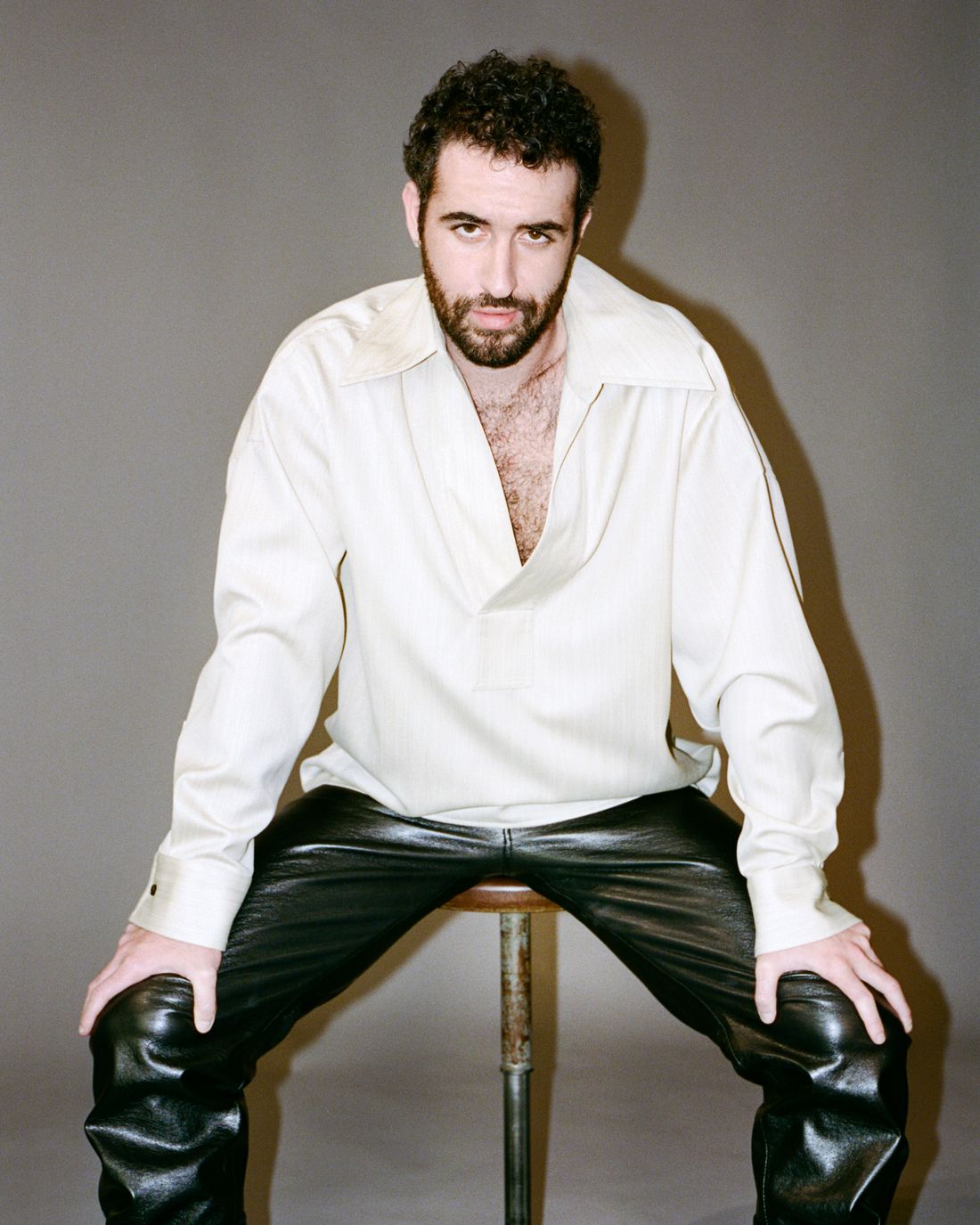
Jordan Firstman‘s character on Rachel Sennott’s HBO comedy, I Love LA, is known for being inappropriately playful, and the show leans into that by putting him in uncomfortable situations. In a recent episode, his character, Charlie, finds himself at a crowded wake, relegated to an overflow section. While there, he awkwardly runs into a past fling, Andrew, who has a new boyfriend. Charlie’s attempts at nonchalance—like commenting on Andrew’s sideburns and feigning indifference to his move to New York—fail to mask his disappointment. The encounter throws Charlie off balance, leading to muttered protests and a desperate attempt to appear composed by suggesting everyone “watch the funeral.”
Charlie, a character comedian Firstman often plays, is energetic, outspoken, and playfully wild. This persona first gained popularity online when he pretended to be the publicist for banana bread during the pandemic. He’s since appeared as a heightened, chaotic version of himself in the film Rotting in the Sun and as a quirky love interest on the TV show English Teacher. Firstman describes Charlie as a mix of Samantha Jones from Sex and the City – confident and direct – and Ari Gold from Entourage – someone who’s effective and gets things done. What makes Charlie stand out is his genuineness; he isn’t trying to be conventionally attractive or appeal to those unfamiliar with gay culture. He’s as fashionable, clever, and sometimes frustrating as the real people you’d find at a place like Akbar.
This role marks a high point in the career of Jordan Firstman, a figure known for constantly sparking debate online. He’s become famous – and infamous – through the very internet communities that discuss him. While he apologized for past racist tweets, saying he’s changed significantly, he’s also faced criticism for other statements, like a video where he suggested straight men have better style than gay men. Often, backlash from the gay community felt less like genuine criticism and more like pre-existing frustration. Now, he observes, “It feels like hating on me as a gay man is becoming predictable.” He doesn’t sound entirely sure if things are truly changing, though.
So, how did I get this role? I’ve known Rachel since around 2016 or 2017. Back then, she was really up-and-coming, kind of mentored by Cat Cohen. I was working with Ayo Edebiri on Big Mouth at the time. Rachel and I actually met through karaoke. Ayo and I were belting out Kate Bush’s “Wuthering Heights,” and right before the song ended, Rachel accidentally skipped our track thinking it was her turn. It was a pretty frustrating moment! We playfully gave her a hard time, maybe about 40% joking, and then she started crying – which, honestly, is so typical Rachel.
She moved to Los Angeles in 2020, and we started spending more time together. We became really good friends around three years ago while we were both working in Atlanta – she was filming Saturday Night, and I was working on English Teacher. After that, she sold the show to HBO, wrote the first episode, and asked me to read it over. The character of Charlie felt strangely personal, but she didn’t say anything about that. I was confused and wondered why she was sharing it with me. She’d actually written the character with me in mind, but she didn’t want me to realize that! I texted her, saying Charlie seemed familiar, and she playfully replied that I was ‘on the list’ – meaning I was being considered for the role. I knew working with HBO would be a challenge, and they were very involved in every detail, making sure everything was just right.
I was very confident going into the audition, really hoping to get the role. I took a lot of risks with my self-tape, adding a lot of improvisation. Even after that, there were several rounds of callbacks. At one point, I had dinner with Owen Thiele, and when she stepped away, I practically begged him to ask if I’d been chosen. I even tried to create another opportunity by excusing myself to the bathroom, hoping he’d ask then. He gently told me he already knew if it was Jordan, but she still wouldn’t tell me either way.
People often ask how much of the character Charlie is based on me, and honestly, there are definitely pieces of my own life in there. I recognize the tendency to be judgmental, for sure. But Rachel, the director, really brought out a more vulnerable and sensitive side that I think a lot of people don’t see. I am a pretty sensitive person, but growing up with the internet and being so public means everyone has an opinion – you’ve probably even had thoughts about me yourself! Especially as a gay guy in New York who’s probably active on Twitter, I’m sure you have!
I’ve never mentioned you on Twitter. It’s just that, as a gay man online, people often make assumptions and it can be unsettling. There’s a side of me that people don’t see, and Rachel was trying to reveal that.
When it comes to my role in ‘Rotting in the Sun,’ I really went for it – I played a completely unhinged character. That’s a big difference from how I approached Charlie. With Charlie, I aimed for someone strong-willed and determined, who always gets her way. My character in ‘English Teacher’ was much more dreamy and naive. For Charlie, I specifically wanted to deliver a classic, funny comedic performance.
I’m realizing I get too caught up in trying to define who I am. I also need to spend less time online. Lately, people are quick to say someone is just being themselves when they have a unique style, and I find that odd. It makes me wonder, are they expecting me to pretend to be someone else, like a character from the past? Many comedians have always done this – Adam Sandler, for example, essentially plays a heightened version of himself. It’s a common practice for performers who want to make people laugh.
They don’t get that because there are basically no hard comedies now, right?
They don’t know.
In the latest episode, I really started to notice Charlie unraveling, and it seemed to begin at the funeral. I think he’s been living in a comfortable, but distant and selfish place for a long time, but something else is trying to break through. It’s like when you get settled into a friend group here in L.A., you don’t really meet new people who challenge you. You end up stuck being who you’ve become. I remember filming the walk to the funeral and saying, “I’m fine. People die every day.” It was a clear sign he was struggling. The episode before, he actually tried being nice and seemed to enjoy it – honestly, he didn’t even realize being a good person was an option! But then he’s forced to deal with this relationship he’s been avoiding for years, and it’s all the “what ifs” flooding back. He’s seeing how much he’s changed, and even when he watches that old sex tape, he seems so much more vulnerable and gentle than he used to be.
There’s a trend within the LGBTQ+ community where it’s become common to constantly criticize things, but many of us are tired of it and don’t know how to shift away from that negativity. It feels like everyone else is participating in this constant complaining – joining group chats to bash the latest shows, while only offering praise for artists like Zara Larsson.
When he watches the recording, he says, “We were just kids.” He’s clearly processing a lot of difficult emotions, particularly grief over what might have been with someone named Andrew, who remains largely unknown to us. I was the one who ultimately made choices that defined that relationship.
What does he do now? I imagine he’s left his previous profession and is enjoying a comfortable life in Los Angeles. He probably has hobbies like gardening and works in a creative field. There’s a lot of people in LA like that, especially in design – I have a friend who does landscape design and he came to mind. Andrew could have been a stable influence for Charlie, but now he’s seeing Andrew find happiness with someone else, moving to New York and starting over. It makes Charlie feel like his own life has stalled. This season is really difficult for Charlie, filled with one embarrassing situation after another.
It’s common for writers to put their characters in embarrassing or humiliating situations. I think they do that with me because they recognize a certain dynamic. I project confidence, but underneath that, there’s also insecurity, and that contrast is compelling for a writer to explore. That’s why I feel like Rotting in the Sun and this current project are the best things written about me – the writers really understand that tension. I don’t typically share my vulnerabilities publicly; that just doesn’t fit my public image.
Honestly, if I shared this, it would probably come across as just showing off how vulnerable I am, and I’m wrestling with that. People who really know me understand I’m a Jewish person with a lot of internal conflict – I’m full of contradictions! But it’s not all a front; I am genuinely confident, it’s not just me trying to hide my insecurities. Both sides of me are real, and it’s hard to figure out how to share that honestly.
I wanted to discuss the sex tape because I was really struck by how natural and unposed it felt, especially compared to shows like Heated Rivalry. We were going for authenticity, and it’s definitely gay. Honestly, after watching the first two episodes of Heated Rivalry, it didn’t feel realistic. It didn’t represent how gay people actually connect physically. There’s so little genuine representation of gay sex on screen. One of my favorite moments in our scene is when we both say ‘that part’ after climaxing – that actually happened to me! A guy I was with and I were obsessed with saying that phrase in the moment, and we both came and just burst out laughing. To me, that’s a very gay moment, and I don’t think a straight writer would be able to capture that kind of intimacy and connection. It’s about the shared experience and camaraderie, and I really pushed for that in our scene.
There was a lot of debate about whether Charlie was dominant or submissive. He’s very driven and determined, always getting what he wants. It’s common for people in positions of power to prefer a submissive role, and it would be interesting – and perhaps a bit of a statement – to have a lead character who is submissive.
I figured he was open to oral sex. Honestly, most people enjoy it. But I get the feeling he prefers to be the receptive partner. The sex scene we filmed was exciting because we were short on time, and I wanted it to feel special. There was already a strong connection with that actor – a really intense chemistry. We both had a lot of sexual tension, both emotionally and physically.
People were wondering about his sexuality, but he’s not gay. Despite that, we had a strong connection. We’d already filmed a scene with a lot of playful energy and intense eye contact – a moment where my character even showed him a picture of someone I was seeing. There was a lot of history and tension built in, and I didn’t want any of that for a later intimate scene. I wanted it to be purely sensual and exciting. We had an intimacy coordinator and the director present, but we were short on time. I asked them to let us film it ourselves with just a video camera, assuring them we’d both be comfortable and respectful. They agreed to stay nearby but not watch. All they heard was sounds of intimacy. There was a lot more to the scene than what made it into the final cut, but we stayed within boundaries and had a good time.
You performed an actual intimate scene for the film Rotting in the Sun. Did that experience affect how you worked on this project? It actually made me feel more at ease. I’m comfortable portraying intimacy – I’ve always explored it in my writing, and it’s a significant theme in my work. While that particular storyline was shortened a bit, it was very important to me, and I had many conversations with Rachel about the message I wanted to convey.
Being the most experienced one, after living in L.A. for a decade, thinking back to 2015 and my friend Akbar brings a strong sense of contrast. It really highlights how much my life has changed – now I’m surrounded by well-known women. I was able to draw on those past experiences and bring them into my current work.
I understand you’ve been dealing with some negative reactions online to the show. How has that been for you? Honestly, it’s been tough. I even tried hypnosis to help me stop caring. I gained a large following quickly on Instagram during the pandemic, and almost immediately, I noticed a lot of negativity from within the gay community. It’s something I’ve been addressing with the press for five years now, and it hasn’t gotten any easier. Though, I’m happy to say that I’m seeing less criticism than usual, which is a relief.
You haven’t shown a complete lack of concern, but I’m definitely seeing a shift in your attitude. To be honest, disliking me simply because I’m gay feels pretty unoriginal right now. It’s a tired trope.
The more interesting take is to like Jordan Firstman?
Yeah.
I’ve been wrestling with something lately while watching this film. I really admire those artists who can just create without feeling the pressure of representation, but honestly, that’s not where my head is at. My work is deeply connected to the experiences I see around me, specifically within the LGBTQ+ community. I’m immersed in those spaces, and I feel a responsibility to tell stories that reflect what I’m witnessing. It’s not about wanting to be ‘one of those’ detached artists; it’s about authentically portraying the world as I know it.
It’s strange when people who are unkind to me online suddenly ask for photos in person. It’s especially hurtful because I’ve dedicated a lot of my work to representing the LGBTQ+ community and sharing their stories through my art, and it feels like that effort isn’t recognized – I feel like I’m being penalized for it.
Are they perhaps envious? Many LGBTQ+ individuals aren’t deeply connected to their own emotions. It might not be jealousy at all, but simply feeling uneasy when they see a reflection of themselves in others.
I really felt like ‘Rotting’ was the most authentic portrayal of gay life in a film for the past ten years. However, audiences seem more interested in ‘Heated Rivalry.’ I go to art hoping to be challenged and to think deeply, but many people just want to be entertained, even if it means watching a movie with a superficial depiction of gay relationships – like two straight hockey players pretending to be gay.
They haven’t publicly discussed their sexual orientation, leaving their sexuality open to speculation. Frankly, I find that frustrating. If they were gay, they’d likely be open about it. I don’t have respect for them because it seems like they’re prioritizing their career over being honest about who they are, worrying about how being perceived as gay might affect things.
My audience is always shifting depending on what I’m working on. I still get a lot of young women reaching out about my role in promoting the banana bread recipe. On this show, I think a lot of women connect with the way Rachel wrote the character. My character is often seen as the funny, honest friend many women wish they had. I also have a following among more artistic gay men who appreciate the nuances of my work. And then there’s a segment who just want to see something risqué. But honestly, overthinking who you’re trying to reach—which I definitely do—can be a never-ending problem.
I’m excited to see Charlie experience more emotional range next season. I really enjoyed his stability in episode eight, but I also liked playing a more difficult, flawed character earlier on. I’d love to continue exploring those highs and lows. I’m hoping Charlie goes through some bigger challenges in season two, maybe even a real emotional breakdown. He had a small moment of self-realization this season, but I’d like to see a much more significant one next time around.
Rachel reveals details about my personal life as a gay man, and how much of it I keep hidden from my friends. Even when they ask about my boyfriend, Andrew, they don’t really know anything about him. It’s common for gay men who date women to only share so much about their relationships – people often only want to know so much.
Are people only interested in hearing a simplified version of your life, or are you the one holding back? It often comes down to a desire for acceptance – wanting to present a version of yourself that won’t shock or disappoint others. You worry that if people knew what you really did, they wouldn’t understand. You want to keep things casual and light. For example, you might share a funny anecdote, but hesitate to reveal the deeper, more vulnerable parts of your experiences. They wouldn’t want to hear about the darker or more intense moments. I’m interested in seeing a more honest portrayal of this person’s private life, especially within their relationships. I’d love to see how close friends react to each other’s vulnerabilities and how those connections deepen.
Read More
- United Airlines can now kick passengers off flights and ban them for not using headphones
- Gold Rate Forecast
- How to Complete Bloom of Tranquility Challenge in Infinity Nikki
- How to Solve the Glenbright Manor Puzzle in Crimson Desert
- How to Get to the Undercoast in Esoteric Ebb
- 8 Actors Who Could Play Blackbeard In One Piece Live-Action Season 3
- All Golden Ball Locations in Yakuza Kiwami 3 & Dark Ties
- A Dark Scream Theory Rewrites the Only Movie to Break the 2-Killer Rule
- Binance’s Bold Bitcoin Bet: $1B SAFU Fund Dives Into Crypto’s Deep End
- NEXO PREDICTION. NEXO cryptocurrency
2025-12-11 18:59