Be warned: the following contains spoilers for the first three episodes of the fifth season of For All Mankind, including details from the episode “Home,” which aired on April 10th.
Throughout his 43 episodes on For All Mankind, Joel Kinnaman played Ed Baldwin as a dependable leader – someone you’d rely on when things got tough. As a Navy pilot, NASA astronaut, and later an employee of the aerospace company Helios, Ed evolved from a traditional figure to a rebel, championing independence for Mars and the rights of its people. Ultimately, this new dedication to his cause tragically leads to his death.
At the start of season five, Ed has become a key figure in the Sons and Daughters of Mars, a group fighting against the established government – a government he once served. He dies while helping his old friend, Lee Jung-Gil, a North Korean defector and fellow astronaut, avoid false murder charges at the Happy Valley base. Even though he’s 81 years old and battling late-stage cancer, Ed knows he’s the only one who can free Lee from prison and get him to safety on another base. He firmly states, “I won’t leave my friend behind.”
The show For All Mankind consistently highlights the power of collaboration to create positive change. Joel Kinnaman brilliantly portrayed Ed Baldwin as a symbol of this idea, both through his dedication to activism and his leadership of the Baldwin family, inspiring his daughter Kelly (Cynthy Wu) and grandson Alex (Sean Kaufman) to pursue their own interests. The final episode centers around Ed’s reflections on his life, recalling his experiences in Korea and the beginnings of his NASA career, and features touching returns from former cast members Michael Dorman (as Gordo) and Shantel VanSanten (as Karen), both characters who have previously passed away in the show.
Joel Kinnaman has starred in several popular series, including the Swedish soap opera Storstad, the Netflix adaptation of Altered Carbon, and the AMC show The Killing (where he worked with Mireille Enos, who later joined season five of For All Mankind). However, he says saying goodbye to his character Ed Baldwin was more emotionally difficult than any other role he’s played, describing Ed as the show’s “moral center.” Kinnaman explains that he enjoys exploring his rebellious side through his characters, and the writers were excellent at recognizing and developing that aspect of Ed Baldwin with a clear, long-term vision that they successfully brought to life.
Fans of ‘For All Mankind’ are thrilled to see Ed causing trouble on Mars even in his 80s! I don’t think anyone predicted he’d be on the show this long. Back in early 2018, the creators, Ron Moore, Matt Wolpert, and Ben Nedivi, shared a five-season plan with me, and everything they described has come true. I knew from the start I’d be playing Ed throughout the decades – in my 40s, 50s, 60s, 70s, and even 80s. They included me in discussions about how to eventually wrap up Ed’s story, and there was some worry because he’s such a central character. The plan was to surprise the audience and then pass the lead to someone new, which was a great experience working with young Kaufman – he’s incredibly talented and a genuinely kind person. I also enjoyed seeing the direction the Baldwin family’s story was taking, and it was wonderful to work with Mireille again.
I’ll admit, I’m still used to saying “Yo, Linden,” so I was a little bummed we didn’t see a scene with both of you. I don’t think it made the final cut, but there was a moment where Mireille came over while I was sitting down, and I just had to say, “What’s up, Linden?” [Laughs]
When I first read the script detailing Ed’s sacrifice to save Lee, my immediate reaction was positive. Unlike other shows where I often question the dialogue or plot, every script for For All Mankind felt authentic and well-developed – I was genuinely excited by it. The writing was so realistic and nuanced that I found myself simply grateful for the opportunity to perform it. There was plenty of discussion and collaboration, and I contributed ideas throughout the series. I’m good at adding subtle personality traits to characters, and the writers of both For All Mankind and The Killing were fantastic at incorporating my improvisations into the storylines. This allowed characters like Baldwin and Holder to become unpredictable and bold. I think I bring a bit of that attitude to my roles, and the writing really allowed it to shine.
One unusual thing that happened was when I started swearing. I began imitating Ed’s distinctive, higher-pitched cursing, saying things like, “Goddamn son of a bitch!” It was a dramatic moment – Ed almost seemed like a character from a tragic play like Medea.
Okay, so picture this: I had this really strange thought while working on the character. It was like, what if a Tyler Perry Madea movie, but with Eddie Murphy playing the over-the-top mom figure, almost like a version of my character, Ed Baldwin? Totally bizarre, I know! But it got me thinking about how I could really lean into Ed’s personality. I started playing around with his quirks – how much he loves to playfully rib people, his strong opinions, and especially what really gets under his skin. Remember that scene with the huge pile of Parmesan cheese? That was a turning point. I remember doing it and thinking in Ed’s voice, “Parmesan, this is the best cheese. Nothing beats it!” And from then on, we just kept finding ways to bring that little obsession back into every pasta scene. That’s the magic that happens when you have a great connection with the writers. You really fall in love with the character, and then these little details just become him. It feels so real because we’re all building it together.
Could you describe how you see Ed now? He’s older, but still playful and a bit of a troublemaker. He’s become disciplined from his military experience, yet he strongly believes in working together to achieve things.
His change in perspective was surprising. While he used to be motivated by his own ambition and desire for adventure, he now has a strong moral compass focused on the good of the group. I think his passion for the Mars project – a unified human effort, and his frustration with Earth’s politics – are driving this. He’s determined to help humanity expand to other planets. As a sense of Martian identity develops, and Mars feels like a fresh start, Earth begins to seem like the old, controlling world. That’s really where his focus on collective action comes from – it’s about being a Martian.
What I find compelling about Ed is his imperfection. He’s definitely made errors – he’s been self-centered at times and prioritized his own goals over his family. However, he’s never been one to simply follow the crowd. As he’s aged, he’s become even more independent and willing to challenge the status quo, which I admire. I appreciate that he always stayed true to his own values, even when it meant going against others.
I’m really interested in how you created Ed’s physical characteristics – his prosthetics, the way he walks, and his voice – especially considering he’s 81 years old. Could you describe your process for developing those details? I’ve always enjoyed acting like an older person. A big inspiration was Ernst-Hugo Järegård, a Swedish actor I admired. He passed away before I started acting, but he made recordings of acting lessons while he was ill. I would study them before every role. He had some great techniques for portraying age. For example, he suggested folding your toes under in your shoes while walking. This creates a slightly unsteady, older man’s gait, and it’s a little uncomfortable, which adds to the effect.
Playing characters in their 60s and 70s felt much more challenging. Aging affects everyone differently, and it really shows physically. Season four was especially demanding for the role. Looking back, I realize I could have pushed myself further and done even more with the performance. I also spent a lot of time considering the impact of the set – specifically, the dry, recirculated air – on my voice and vocal cords, and I wanted to make a significant change to the character’s voice to account for that long-term effect.
Filming for the fifth season was much shorter – only a month instead of six – so I found myself slipping back into my own personality between scenes. A key part of the performance was creating a contrast between how Ed appeared externally and what was happening internally. While Ed moved and spoke slowly, internally he was still very active. A lot of effort went into maintaining that slow, natural exterior. The challenge with a character like this is avoiding overthinking the physical aspects. It’s important to rehearse enough so the physicality becomes second nature, allowing me to focus on truly listening and connecting with the other actors. When you’re fully present and attuned to their nuances, your responses feel genuine and synchronized. If I was preoccupied with how my body was moving, it would break that connection and make the performance feel less authentic to the audience.
I noticed Ed has this distinctive, slightly mischievous laugh – a real ‘heh-heh-heh’ sound. It reminded me of how I imagine I’ll laugh when I’m older. He was particularly pleased with himself when he intentionally triggered his ankle monitor by putting it near the control room in Happy Valley. It’s a laugh I sometimes have in everyday life, especially when I’m playfully teasing my wife.
Getting Ed transformed into his older self with makeup took a really long time. The fourth season was particularly grueling – I spent over five hours in makeup sometimes, even starting as late as 1 a.m., before a 12-hour (or longer) shoot day. It then took another hour to remove the makeup, leading to 18- to 20-hour workdays. The makeup, a beard wig with loose hair applied all over, was incredibly itchy and involved constant adjustments to my face and eyelids. While the makeup artists were excellent and did their best, the process was physically and mentally exhausting – it was the hardest psychological challenge of my career. I had to meditate for hours just to stay calm. Thankfully, the makeup process improved significantly in the fifth season, taking only two and a half hours initially, and eventually just two hours, as they used larger prosthetic pieces.
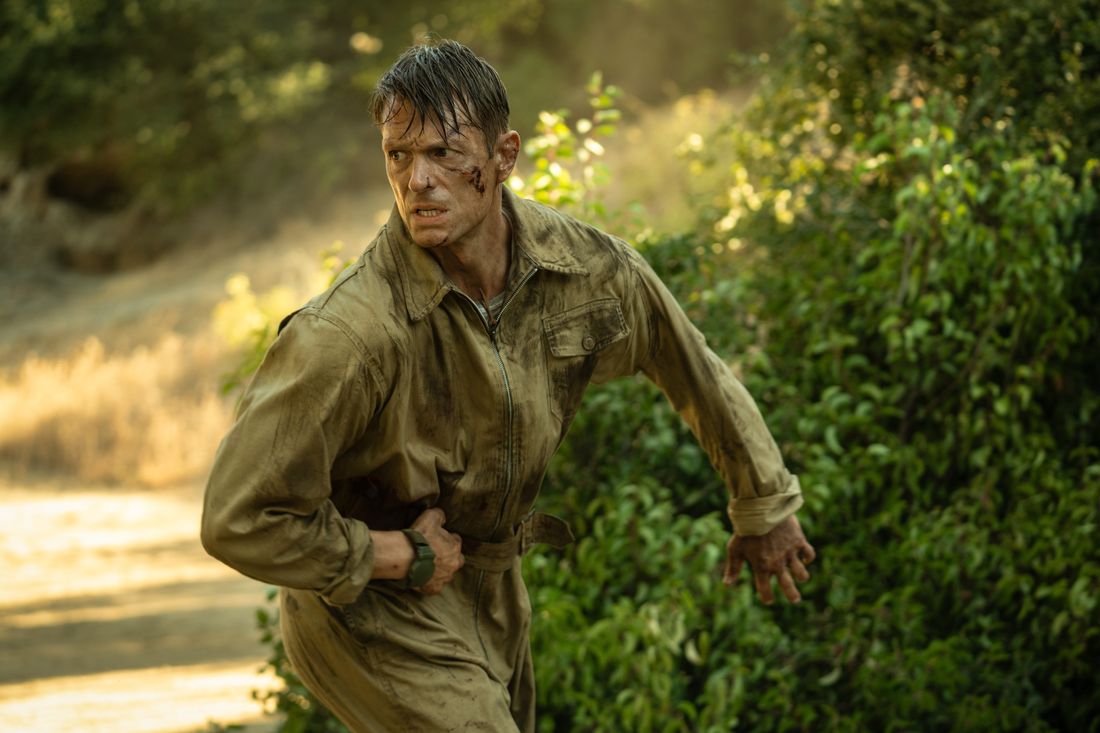
I’m curious about Ed’s experiences in the final episode, particularly the flashbacks to his time being captured in Korea. You portray Ed at different ages in that episode, including his younger self during the Korean War. Can you describe what it was like filming those scenes – the parachute jump, the struggle for survival, and witnessing the death of a fellow pilot?
The story of Ed’s time in Korea had been discussed with the writers for about four years. They had several ideas for a flashback episode, but it kept getting cut because it didn’t quite fit the overall story. Finally, they were able to incorporate it into the last episode, which felt very meaningful for Ed’s character. It was special to play both the youngest and oldest versions of him in the same episode. We filmed those scenes in Malibu, actually, while I was in the middle of moving. I was wearing a lot of prosthetics and texting with movers at the same time! We used Ronald Reagan’s old ranch near Malibu Creek State Park – it was a beautiful location, but sadly it burned down about a year later.
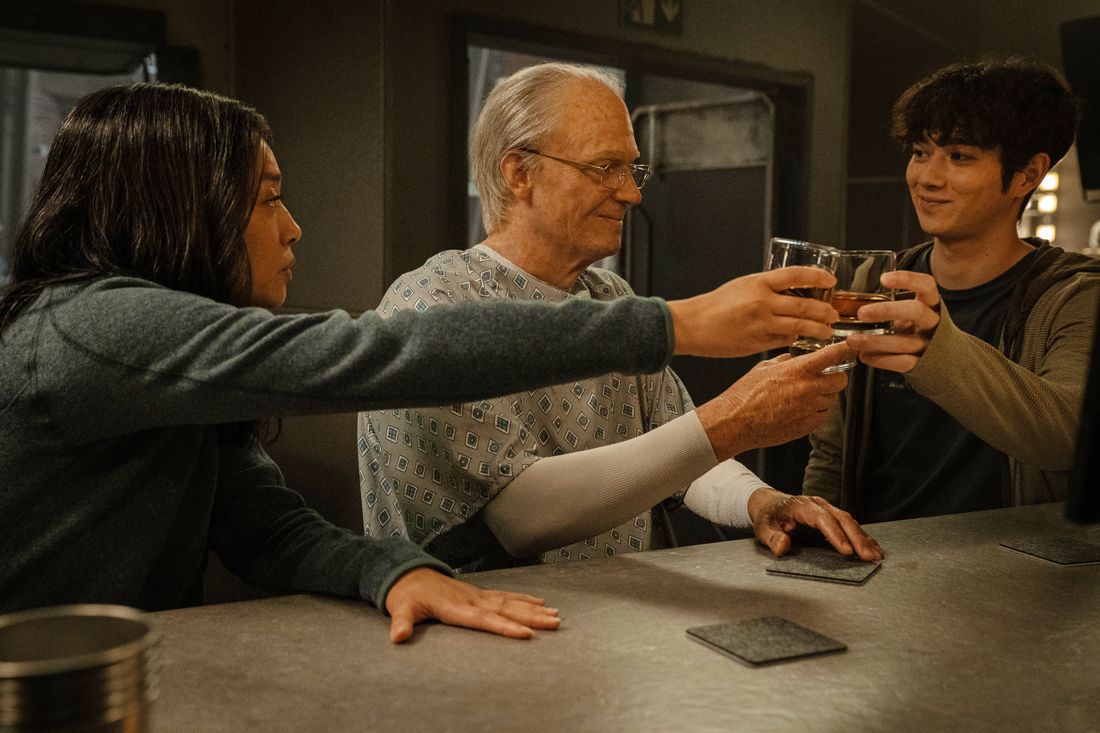
Ed is very sick after risking his health to save Lee, but he still leaves the medical bay to go to Ilya’s bar. He’s joined by his daughter, Kelly, and grandson, Alex, who understand his decision to forgo cancer treatment. I’d like to talk about filming that scene with Sean and Cynthy. Working with Cynthy has been fantastic. She joined the show in season two, and she was pretending to be much younger than she was – she played a character who looked like a young teenager, even though she’s actually quite young herself! They needed someone who could convincingly portray that youth and then age significantly. She really embodied that young character, and even acted like a teenager. In the first season, I didn’t really connect with the person behind the character. But in season two, when she played a role closer to her actual age, I realized what she was doing, and we became friends. Sean came in with a great energy, bringing his own unique touch to the character while also being respectful. It felt like a special moment, a passing of the guard in a way.
The three of them were having shots, and knowing Alex had experience with alcohol but Kelly hadn’t, they quietly told him to act like it was his first time in front of his mother. It created a really sweet moment between a grandfather and grandson. I believe that entire scene was made up on the spot – it wasn’t in the original script. I was ad-libbing a lot, and Alex, along with Dimiter Marinov, who plays Ilya, played along with me. The final episode was incredibly moving.
The scene where Ed is dying is incredibly powerful. He envisions himself in his spacesuit, walking through a hallway filled with applauding NASA staff, and being kissed goodbye by his wife, Karen, and son, Shane – all of whom have passed away in the show. It was particularly moving to work with Michael and Shantel again. Those flashback moments with Michael were really emotional; we became close friends playing Gordo and Ed, and he’s someone I genuinely cherish. Seeing him and sharing that moment was special. The same went for Shantel. The very last thing we filmed was inside the original capsule from season one. We ran way over schedule, finishing around 1:30 a.m. I immediately drove out to Malibu to meet five friends from Sweden and my wife, because we were heading to Burning Man to get married. A few hours later, I found myself driving a huge RV across Northern California, completely overwhelmed with feelings and honestly, a little lost.
The last week of filming was really difficult for me, and I’m still trying to understand why it affected me so strongly. I felt incredibly emotional. This character has been a huge part of my life for almost eight years – it’s the longest I’ve ever played one. As actors, we often form close bonds with our castmates, like a temporary family, and saying goodbye is usually tough, but this felt different. I was really shaken up. I think it was the experience of playing the character through so many stages of life, and facing the idea of aging myself. It made me think a lot about my own mortality. By the end, I was playing a character the same age as my father, lying on his deathbed and saying goodbye to his family, which really brought the reality of life and loss into sharp focus.
Read More
- United Airlines can now kick passengers off flights and ban them for not using headphones
- The Boys Season 5 Spoilers: Every Major Character Death If the Show Follows the Comics
- Invincible Season 4 Episode 6 Release Date, Time, Where to Watch
- Solo Leveling’s New Manhwa Chapter Revives a Forgotten LGBTQ Story After 2 Years
- TikToker’s viral search for soulmate “Mike” takes brutal turn after his wife responds
- Assassin’s Creed Shadows will get upgraded PSSR support on PS5 Pro with Title Update 1.1.9 launching April 7
- All 9 Coalition Heroes In Invincible Season 4 & Their Powers
- Grok’s ‘Ask’ feature no longer free as X moves it behind paywall
- Nanako from Persona 4: The Adorable Character Who Warms Our Hearts
- Nintendo Officially Rewrites Princess Peach After 41 Years
2026-04-10 22:57