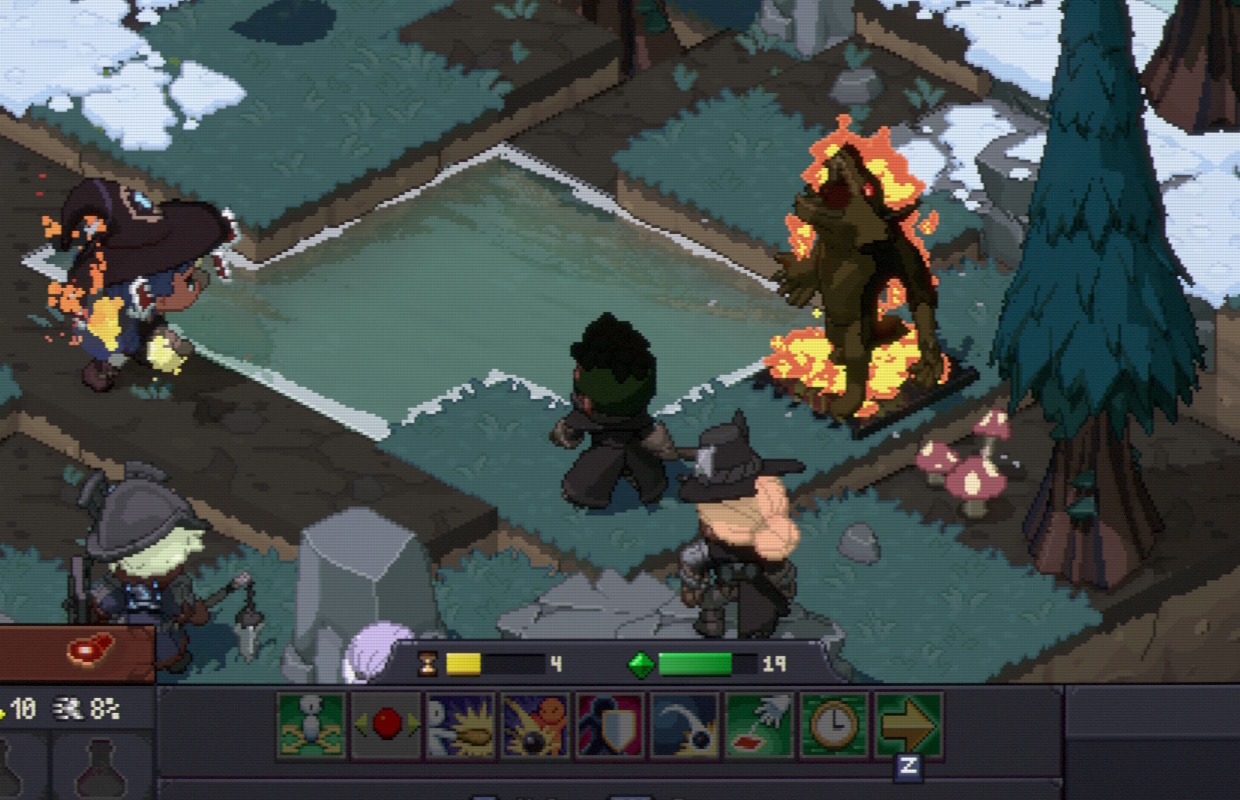
A great part of events like GDC is the chance to see indie games at special showcases. It’s particularly helpful for finding new games, as it can be tough to discover them otherwise, and it’s exciting to meet the developers. I recently got a preview of one called Never’s End, a complex, strategy-focused RPG with a world that changes with each playthrough.
At GDC, I spoke with Ryan Juckett, who used to be the lead sandbox designer for Destiny and now runs the development team Hypersect. He’s been working on a project called Never’s End for almost eight years, with a small team of both full-time and part-time employees, plus some freelance help. Other important people contributing to the project include character artist Masayoshi Nishimura (known for Triangle Strategy and Octopath Traveler) and composer Doseone (who has worked on Enter the Gungeon and Gang Beasts).
Juckett explains that Never’s End draws inspiration from both Final Fantasy Tactics – with its traditional, Square-style gameplay – and Battle Brothers. He notes that while classic strategy RPGs like Final Fantasy Tactics are fairly structured, Battle Brothers offers a more open and flexible experience with a large world, complex systems, and detailed combat. Juckett’s goal is to incorporate those same intricate tactical elements into Never’s End.
Even after just a few minutes with the Combat Demo, it’s clear that Never’s End is a deeply detailed RPG with lots of numbers and systems. Everything – not just characters, but also their armor, weapons, and hats – has its own health bar. The screen is filled with icons and numbers showing information about everything from character stats and weapon types to armor qualities and available resources, and likely much more.
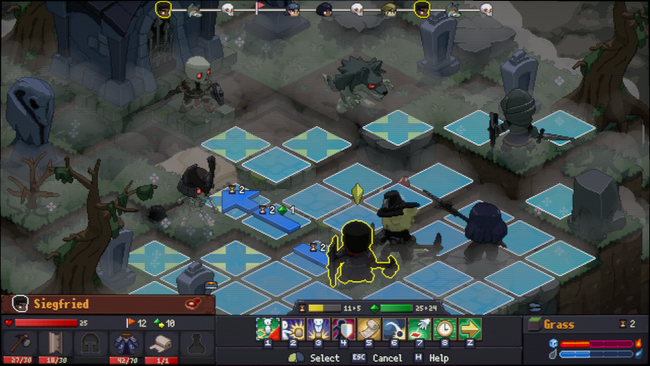
During battles, you’ll manage two key resources: Time and Stamina. Time refills each turn, letting you act frequently, while Stamina recovers slowly over a longer period. Every action requires both, so you’ll need to carefully balance both your immediate and long-term resources to succeed in tactical combat.
Never’s End features a deep system of character roles and abilities. From the start, in the Combat Demo, you’ll build your team by recruiting characters from the tavern. Each character is unique, with different strengths. For instance, a ‘Carpenter’ recovers Stamina faster than others, while a ‘Swift’ character is harder to hit. Traits like ‘Smart’ offer various other advantages. You’ll also need to consider how different weapons and equipment affect combat, including damage types like slashing, crushing, and piercing, as well as factors like range and weight.
It’s understandable if all the icons, symbols, and numbers seem overwhelming at first. Fortunately, Never’s End always offers helpful assistance. Simply press a button to pause the game and then move your mouse over anything on the screen to get a detailed explanation of what it is.
Juckett describes a feature where users can simply activate a ‘tip mode’, point to anything on the screen, and ask for information. While adding depth to a game can be complicated, the goal is to make it simple for players to pause, investigate on-screen elements, and quickly understand what things mean. Players can essentially pause the game and explore, learning what each symbol or item represents.
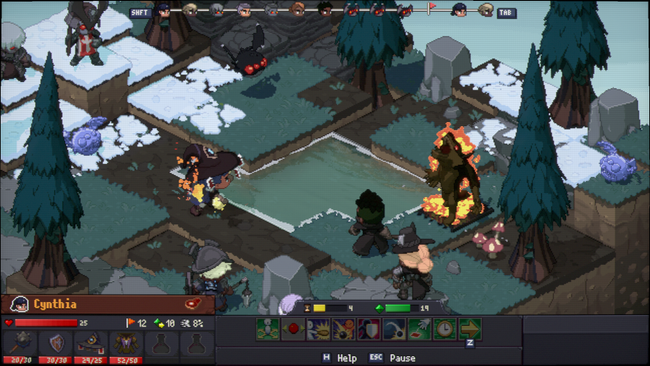
Never’s End features a unique magic system. Instead of traditional spells like fireballs, you control the temperature of the battlefield itself. You can heat up or cool down any area, and this temperature change naturally creates wind. This wind isn’t just for show – you can use it to push enemies around, knock them into obstacles, or even send them falling off edges.
Wind behaves differently depending on the surface it blows across. On granite, it simply pushes units. However, wind over sand creates a blinding sand cloud. Tiles can also heat up and catch fire, damaging anyone standing on them, or cool down, creating ice or snow. According to Juckett, this magic system isn’t about just casting spells; it’s a tool you need to master. Manipulating temperature can have unintended consequences, so it’s crucial to understand how it works quickly.
So, the game has this cool humidity system that works with the weather, creating things like fog that can mess with your aim. I’ve noticed some enemies really struggle in the heat – it drains their stamina faster, making them easier to beat. Others, like bats, are super vulnerable to fire. But some enemies, like skeletons, don’t care about the temperature at all! Even they’ll still be affected by fog though, which is a nice touch.
Battles also have other details to keep in mind. For instance, walking through water will make your character wet, which reduces their chance to hit with attacks. While I was trying out the different weapons in the demo, Juckett offered some helpful tips.
He explains that each weapon has a unique approach to combat. Take the pickaxe, for example. It has both a pick and an axe side, which change the type of damage it deals. This makes it effective against a wide range of enemies. Some enemies, like those with wooden shields or tree-like bodies, are vulnerable to one kind of damage, while others, such as those with metal armor or a tough outer shell, are weak to crushing damage. The pickaxe lets you exploit both of these weaknesses, giving you an edge in any fight.
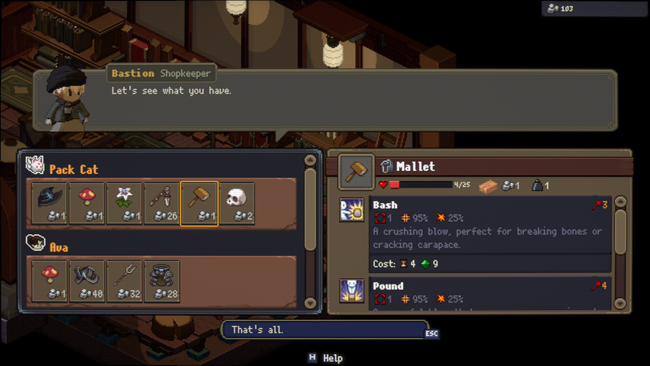
During my hands-on time with the Never’s End demo, I quickly learned that understanding different damage types and resistances is key to winning. For instance, leather armor protects better against blunt attacks than cuts or fire. As you’d expect from a good tactical RPG, where you stand during combat matters a lot – attacking from higher ground increases your chances of landing a critical hit. I also discovered some interesting interactions; Juckett showed me that setting an enemy on fire could ignite their wooden flail, making it even more dangerous. Flails are also effective against shielded enemies because their design allows them to bypass the guard. This means choosing the right weapon isn’t just about raw power – its type and how it interacts with enemies is important too.
While helpful, shields require some thought. They don’t automatically protect you—you need to actively use them in combat, which uses up time and stamina, just like any other move.
Smaller shields are inexpensive and quick to use, but don’t offer much protection. Larger, heavier shields take more effort, but significantly increase your ability to block attacks. Juckett demonstrated the game’s detailed calculations, showing how damage, hit chances, blocks, and dodges are determined. For players interested in the specifics, the game can display a complete breakdown of all factors, including status effects and terrain.
Juckett described some of the other things to think about when assessing the combat area and deciding what gear to bring for a fight.
This saw weapon does extra damage to cloth, making it particularly effective against enemies wearing cloth armor combined with metal helmets – it’s better to aim for the body rather than the head. Getting the most out of combat involves managing how often your attacks hit and how much damage they do. Additionally, this saw causes bleeding on fleshy targets. Bleeding damage builds up over time, adding extra, continuous harm. So, if an enemy has exposed skin, you can quickly inflict several stacks of bleed damage with the saw.
Once I began to understand how to control the game’s systems, I started trying out different tactics, like using bleeding and burn effects. But Juckett warned me to be careful.
According to Juckett, burning a bleeding wound actually stops the bleeding by sealing the wound, which makes sense.
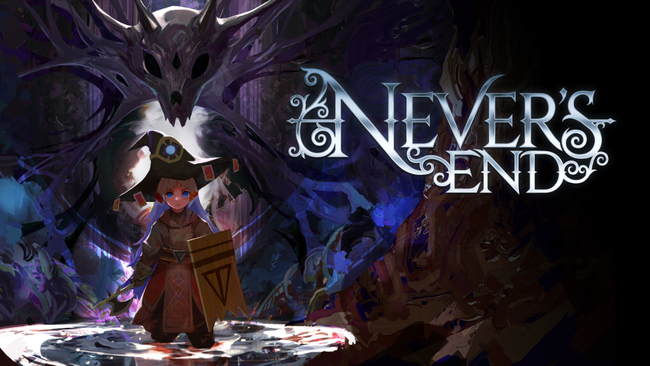
At the end of the game demo, I inquired about the team behind its creation, specifically mentioning that Masayoshi Nishimura had a hand in developing the game’s unique art style.
Masayoshi Nishimura created the concept art. He’s skilled at both pixel art and illustration, and you’ve likely seen his work in games like Triangle Strategy and Octopath Traveler. For our game, he designed characters and monsters, and also contributed some UI elements. Interestingly, even though his style evokes classic pixel art, all our characters are actually 3D models. His art has been instrumental in creating the game’s authentic, traditional JRPG tactical feel.
Since the demo focused solely on combat, it was hard to get a sense of the game’s story or how important it would be. I asked the developer, Juckett, to briefly explain the game’s main idea, and he replied:
A dark, corrupting force called the Never is destroying the world, driving people insane as it spreads. Humanity is on the brink of collapse, with only one safe haven remaining. You appear mysteriously from this island – a unique being created to venture into the Never and fight back, with the hope of saving everyone.
As someone who really loves RPGs and how their systems work, I was immediately intrigued by the interconnected mechanics in Never’s End during the demo. It’s hard to say for sure how engaging those systems will be over the long term, though. The game features a system where time passes, changing the world and causing corruption to spread. You also have to manage your army by paying them daily.
As a fan, one of the things I’m most curious about with Never’s End is how it holds up over the long haul. It’s tough to tell from a demo, but the game’s random map generation is really cool – it should make every playthrough feel different. My big question is, will it stay fresh, or will things start to feel samey after a while? I’m also a little worried about the ‘corruption’ mechanic – will it make it feel like you’re not really getting anywhere, even if you’re winning fights? I’m excited to find out when the game comes out later this year!
Never’s End will launch in 2026 on PlayStation 5 and PC, through Steam. You can try out a combat demo right now on the game’s Steam page.
Read More
- United Airlines can now kick passengers off flights and ban them for not using headphones
- Katanire’s Yae Miko Cosplay: Genshin Impact Masterpiece
- How to Complete Bloom of Tranquility Challenge in Infinity Nikki
- All Itzaland Animal Locations in Infinity Nikki
- Gold Rate Forecast
- How to Get to the Undercoast in Esoteric Ebb
- A Dark Scream Theory Rewrites the Only Movie to Break the 2-Killer Rule
- Australia’s New Crypto Law: Can They Really Catch the Bad Guys? 😂
- Fire Force Season 3 Part 2 Episode 24 Release Date, Time, Where to Watch
- All Golden Ball Locations in Yakuza Kiwami 3 & Dark Ties
2026-03-29 06:28