Andrew Stanton is having a remarkable year at the Sundance Film Festival and is arguably its biggest success story. While he’s famous for directing three incredibly popular and critically acclaimed Pixar films – Finding Nemo, WALL-E (often considered Pixar’s masterpiece), and Finding Dory – which have earned billions, his true passion lies in live-action filmmaking. Though his 2012 film John Carter wasn’t a commercial success, it has redeeming qualities. Over the years, Stanton has also directed numerous live-action television episodes for shows like Stranger Things, Better Call Saul, and 3 Body Problem, all while maintaining a leadership role at Pixar. He co-wrote Toy Story 4 in 2019 and is directing Toy Story 5, set to release later this year. In a past interview, he explained his approach, saying, “I wasn’t trained as an animator; I was trained as a filmmaker.”
Director Andrew Stanton’s new film, In the Blink of an Eye, echoes themes from his earlier work, WALL-E, particularly the idea that even small details can reveal larger truths about society. Like WALL-E, which offered a hopeful vision amidst a bleak, polluted world, this new film suggests a positive outcome is possible. This is reflected in one of the film’s storylines, which follows a Neanderthal family around 45,000 B.C. They communicate using a simple, untranslated language, creating a feeling similar to watching a silent film.
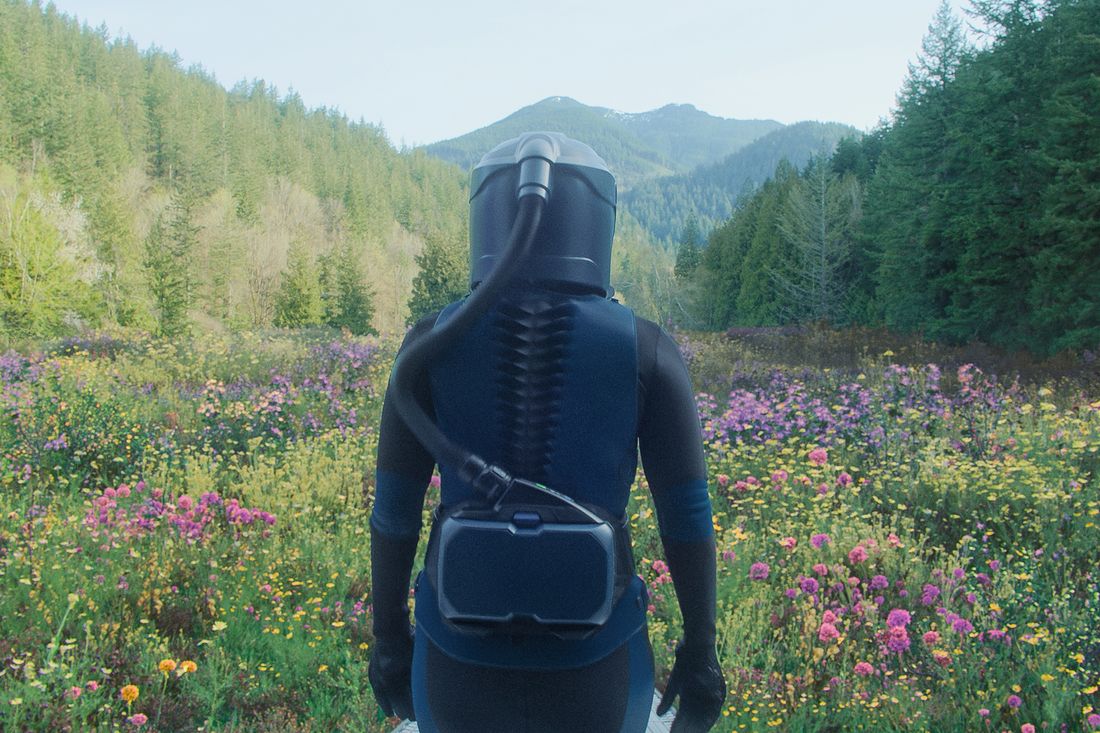
The show also follows two other storylines. One centers on Claire (Rashida Jones), a researcher at Princeton who’s studying a Neanderthal fossil while starting a new relationship and coping with her mother’s illness. The other follows Coakley (Kate McKinnon), the only person on a spaceship tasked with delivering human embryos to a distant planet after a journey of over 400 years. These stories aren’t directly linked, but they share common themes. The cavepeople deal with fundamental survival issues, while those in the present face personal and career choices, and the future representative struggles with a potentially catastrophic oxygen leak on the spaceship that could doom humanity.
The stories don’t have a lot of traditional action, which is surprising considering one involves the fate of humanity. However, that’s intentional. The director is aiming for a broader, more impactful cinematic experience. He uses editing to connect the different timelines, showing how similar emotions – like grief – can resonate across vastly different eras. The film occasionally delivers genuinely powerful moments, and the music by Thomas Newman enhances these effects.
Honestly, what bothers me about this film is that the director, Stanton, seems so focused on the big picture that he doesn’t let us really connect with the characters. We don’t get to feel their losses or understand their struggles because he doesn’t give us the time to get to know them. I get that he’s aiming for something grand, but it feels cold compared to a movie like The Tree of Life. Both films have these devastating early phone calls – in this one, it’s Claire finding out about her mother’s cancer, and in Malick’s, it’s about a son’s death. And in both cases, we’re dropped into the moment before we fully know the characters. They both cleverly only show one side of the conversation. But the impact is worlds apart. Malick really stays with the actor’s face, letting us feel his pain. Stanton, though, handles the scene so briefly and distantly that I just couldn’t connect with Claire at all. It felt…flat, and that’s a real missed opportunity.
In Stanley Kubrick’s 2001: A Space Odyssey, scenes featuring cavemen and astronauts are drawn out and seemingly simple, but actually quite captivating. In contrast, director Andrew Stanton presents similar scenes in a much more straightforward, practical way. He is a skilled storyteller, using visuals efficiently to move the plot forward – and he’s a celebrated animation director. However, Stanton lacks Kubrick’s masterful patience, opting instead for a quick and functional delivery of plot points. And because this film isn’t really driven by plot, we’re left feeling like we’re waiting for something substantial to happen. It feels more like a statement of ideas than a fully developed argument.
Let’s be real, the director isn’t going to be the next Malick or Kubrick, and that’s okay. But this film, In the Blink of an Eye, really swings for the fences with its ambition, and it’s a tough balancing act to pull off. He actually told me before filming that it would be a quiet, slow-burn art film, but the finished cut is only 94 minutes, so I wonder if there’s a longer version somewhere. Honestly, it doesn’t feel slow at all. It feels rushed and a bit all over the place, like it’s not really paying attention to the details. I didn’t get a strong sense of real people and their lives, which is strange. I think some of that was probably on purpose, but for a movie about humanity surviving, it feels like it’s missing… well, humanity.
Read More
- United Airlines can now kick passengers off flights and ban them for not using headphones
- Crimson Desert: Disconnected Truth Puzzle Guide
- How to Get to the Undercoast in Esoteric Ebb
- Katanire’s Yae Miko Cosplay: Genshin Impact Masterpiece
- All Golden Ball Locations in Yakuza Kiwami 3 & Dark Ties
- All Itzaland Animal Locations in Infinity Nikki
- HBO’s Harry Potter Is Already Breaking My Heart
- Zendaya’s 4 Big 2026 Movies Could Beat Brie Larson’s Box 2019 Office Record
- Gold Rate Forecast
- All 9 Coalition Heroes In Invincible Season 4 & Their Powers
2026-01-30 20:56