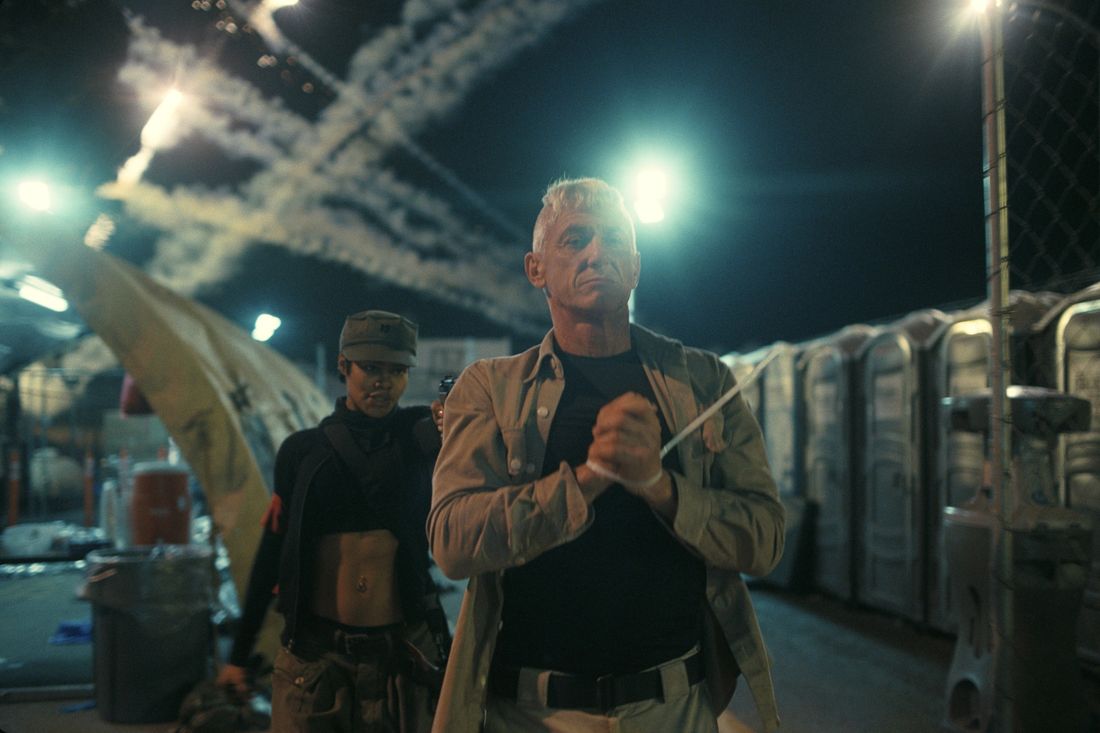
You know, hearing the Colonel talk about the Christmas Adventurers Club, it really struck me. He didn’t say it made you the best, smartest, or even wisest guy around. He said it made you… better. Better than most people, and that you’d always have good fortune and amazing friends. It’s a pretty powerful idea, honestly.
I immediately recognized a familiar echo when a character spoke these lines in Paul Thomas Anderson’s film. While the exact words were different, the way they were said – the tone and meaning – strongly reminded me of a speech from Stanley Kubrick’s Barry Lyndon. In that film, Lord Wendover explains to Redmond Barry why he should trust him, saying, “When I take someone under my wing, they are safe. There’s no further doubt about them. My friends are simply the best – not necessarily the most virtuous, intelligent, or wealthy, but the best. They are people you can rely on.”
Okay, so when Lockjaw went off on Willa, it seriously gave me chills! He yelled about being a ‘Christmas Adventurer’ and having a ‘higher calling’ – it was so intense! It instantly reminded me of Jack Nicholson in The Shining when he’s screaming at Wendy. The way Lockjaw delivered it – that mix of desperation and feeling like he was entitled to be upset – and how he kept going on about his responsibilities… it was almost a direct echo of Jack Torrance’s rant about his contract and letting down his employers. He kept repeating things like, ‘Have you ever thought about my responsibilities?’ and questioning if anyone understood what a ‘moral and ethical principle’ even was. It was unsettlingly similar, and honestly, a really powerful moment. It really struck me how much that scene captured the same kind of unhinged frustration and pressure.
I’ll admit, I’m really fascinated with Stanley Kubrick’s films, and I think there’s a clear connection in some unexpected places. The way characters in the series Lockjaw and The Christmas Adventurers talk about losing power through intimacy mirrors the bizarre ideas expressed by Colonel Jack D. Ripper in Dr. Strangelove. For example, Lockjaw describes being drugged and having his “power” taken while unconscious, saying, “The enemy employed deception… my power was, and I believe it was taken advantage of.” Compare that to Ripper, who felt a “profound sense of fatigue” and “emptiness” after sex, interpreting it as a “loss of essence” because, as he puts it, “Women sense my power, and they seek the life essence.” It’s a strikingly similar concept.
One reason scenes with Lockjaw feel reminiscent of Kubrick’s films is that Wes Anderson films them in a similar style. Like Kubrick, Anderson frequently centers Lockjaw in the frame, often using symmetrical compositions. The camera smoothly follows his movements, suggesting his control. This contrasts sharply with the more chaotic camera work used during Leonardo DiCaprio’s character’s scenes. The ordinary locations in The Christmas Adventurers – like hotels and homes – are visually similar to those in Kubrick’s Eyes Wide Shut and The Shining, with slow, deliberate camera movements creating a strangely calm but unsettling atmosphere of power. Even the empty office building where Lockjaw ultimately meets his end recalls the early scenes of The Shining, when Jack Torrance is first shown around the Overlook Hotel.
Early in his career, some critics accused Anderson of simply copying the styles of great directors like Martin Scorsese, Robert Altman, Jonathan Demme, and even Stanley Kubrick, calling him a film enthusiast who borrowed too much. While unfair at the time, Anderson was a devoted film lover, and his early work clearly showed the influence of others. As he matured as a filmmaker, he became more skilled at weaving references into his own unique style. The Kubrick-like elements in his film One Battle After Another are mainly focused on Lockjaw’s storyline – a fitting choice, considering Kubrick’s interest in how the desire to maintain power can lead to subtle but disturbing acts of violence. Kubrick often showed characters calmly discussing horrific things, and even in his more chaotic films like Dr. Strangelove and Full Metal Jacket, you can sense his anger at how easily cruelty and destruction become accepted – like a detached calculation of potential deaths from a nuclear attack, or a compliment about Lee Harvey Oswald’s shooting skills.
As a movie fan, I’ve always been fascinated by characters who desperately claw their way up, and Lockjaw is a perfect example. He’s not just some crazy guy with power, but someone who embodies that classic ‘striver’ archetype – constantly pushing to climb the ladder and be accepted into an exclusive group that feels… eternal. What’s really brilliant is seeing this tough, military man become a total pushover around these ridiculously wealthy, laid-back guys – it’s almost darkly comedic. It surprisingly makes him more human. Josh Penn plays him as a bit over-the-top, sure, but underneath it all, Lockjaw’s ambition feels genuinely real. He’s already got authority, but he doesn’t just want power, he wants belonging. He wants to be one of the ‘Christmas Adventurers’, to hang with these new rich friends, get a fancy office, and even eat Alice’s banana pancakes like he’s one of the guys. But the tragic thing is, he never will. And that’s where the movie gets really interesting – the very things that help you succeed can also be the things that destroy you. Lockjaw’s relentless chase for the French 75 gets him invited into the Adventurers’ circle, but his continued obsession with the Fergusons ultimately leads to his downfall, destroyed by the very people he was trying so hard to impress.
Sean Penn is a contender for Best Supporting Actor at the Oscars, and while some predict he’ll win, the race is tight. Benicio del Toro, Delroy Lindo, Stellan Skarsgård, and even Jacob Elordi all have a strong chance. The long awards season has overshadowed the fact that this year’s nominees are exceptionally talented – a rare occurrence. Penn’s performance is particularly noteworthy. Some viewers find it over-the-top, similar to Jack Nicholson’s work in The Shining, and usually that would be a problem in a realistic film. However, director Paul Thomas Anderson intentionally creates a unique, almost Kubrick-esque atmosphere around Penn’s character in One Battle After Another, making it fit perfectly. His character, Lockjaw, is intentionally absurd – from his tight clothes and peculiar speech to his outlandish haircut. He’s a larger-than-life figure, yet also feels like a puppet controlled by an outside force. The contrast between Penn’s deliberate movements and Leonardo DiCaprio’s more stumbling gait highlights the film’s focus on physicality and how actors use their bodies. It’s a bold character and an equally bold performance, and both Penn and Anderson execute it flawlessly.
Read More
- United Airlines can now kick passengers off flights and ban them for not using headphones
- Crimson Desert: Disconnected Truth Puzzle Guide
- How to Get to the Undercoast in Esoteric Ebb
- All Golden Ball Locations in Yakuza Kiwami 3 & Dark Ties
- All 9 Coalition Heroes In Invincible Season 4 & Their Powers
- Katanire’s Yae Miko Cosplay: Genshin Impact Masterpiece
- All Itzaland Animal Locations in Infinity Nikki
- HBO’s Harry Potter Is Already Breaking My Heart
- Zendaya’s 4 Big 2026 Movies Could Beat Brie Larson’s Box 2019 Office Record
- Fire Force Season 3 Part 2 Episode 24 Release Date, Time, Where to Watch
2026-03-13 15:55