Have you ever tried explaining a complicated game story, like that of Diablo, only to lose your friend’s attention quickly? It happens to everyone. Being able to get to the most important parts and skip the unnecessary details is a valuable skill. That’s what a good summary achieves – it doesn’t just rehash information, it captures the essence of the original work. This guide will teach you how to clearly and effectively explain anything – from a game plan to a complicated story – without boring your audience.
Key Takeaways
- Focus on the Core Mission: Before writing, pinpoint the single most important message of the original text. Build your summary around this central idea and ruthlessly cut any details that don’t directly support it.
- Translate, Don’t Just Copy: The best summaries are written in your own words. This allows you to create a smooth, readable narrative instead of a clunky list of extracted sentences, ensuring the information flows naturally.
- Balance Brevity with Vibe: A good summary is short but not soulless. Ensure you capture the original tone—whether it’s funny, serious, or technical—and provide just enough context to be clear without getting bogged down in unnecessary details.
What Makes a Summary Actually Good?
Ever find yourself explaining a complex game story, like that of Diablo, and realize you’ve been talking for ages? That’s when a good summary really helps. It’s more than just shortening the text – it’s about capturing the core essence of the original. A great summary delivers the most important information quickly, respecting the reader’s time without leaving out key details.
A good summary is like a highlight reel for a video game competition – it focuses on the most important and exciting parts. Instead of every detail, it gives you the key findings and insights in a clear, concise story. It’s the difference between sifting through a lengthy document and getting a quick, useful overview of what really matters – like quickly understanding the important changes to a game character instead of reading through pages of details.
The Must-Have Elements of Any Summary
What makes a good summary different from just a quick, lazy retelling? It boils down to a few key things. The main purpose is to highlight the most important ideas and details from the original text, giving someone a fast way to grasp the main points without having to read everything.
To summarize effectively, first pinpoint the author’s main idea – what they truly want you to understand. Then, include only the most important details that support that idea. Skip anything repetitive, unnecessary, or overly descriptive. The result should be a concise and accurate version of the original text.
Why Shorter Isn’t Always Better
Many people believe the best summaries are as short as possible. While being concise is good, it’s more important to be clear and accurate. Cutting too much can distort the original meaning or leave out important details. For example, describing the complex game Honkai: Star Rail simply as “a gacha game in space” isn’t entirely wrong, but it misses everything that makes the game unique and enjoyable.
Even AI tools built to shorten text struggle with truly effective summarization. The key isn’t just making something brief, but ensuring it still makes sense and accurately reflects the original meaning. The goal is to provide the most value to the reader using as few words as possible – and sometimes, that means being slightly longer to ensure the message is clear.
How to Find the Main Point in Anything
To write a great summary, first understand the original material. It’s like focusing on the main story in a video game – if you get distracted by everything else, you’ll miss the important parts. Identifying the core idea lets you explain it clearly. This skill is essential for creating summaries that are helpful, not confusing.
Pinpoint the Central Idea
Start by reading the text and figuring out its main point – what’s the single most important thing the author wants you to understand? Don’t worry about remembering every detail on your first read. Focus on getting the overall argument or message. Skilled readers can identify this main idea by looking for what the text is building towards. Often, you’ll find a thesis statement early on, or a concluding thought that summarizes everything. Sometimes the main idea is stated clearly, but other times you’ll need to figure it out based on the supporting details.
Cut the Fluff: What to Keep vs. What to Ditch
After you understand the main point, focus on filtering out unnecessary information. Not every detail is crucial, so separate the essential facts from anything extra. Effective summarizing means shortening the original content while retaining its core ideas, which requires careful editing. Ask yourself if each detail directly relates to the main idea. If you can remove something without changing the overall message, it’s likely not essential and can be cut. This ensures your summary stays focused and powerful.
How to Tackle Dense or Complicated Texts
Okay, so sometimes you come across game stuff that’s just… a lot. Like, really deep lore explanations or those super detailed patch notes? It can feel like trying to drink from a firehose. But I’ve found a trick that actually helps me learn! Instead of just reading it and hoping it sticks, I try to summarize as I go. Seriously, forcing myself to reword things or quickly write down the main ideas in my own words makes a huge difference. It breaks down all that complicated stuff into smaller, easier-to-handle pieces, and I actually understand it way better. It’s like, the act of summarizing is the learning process, you know?
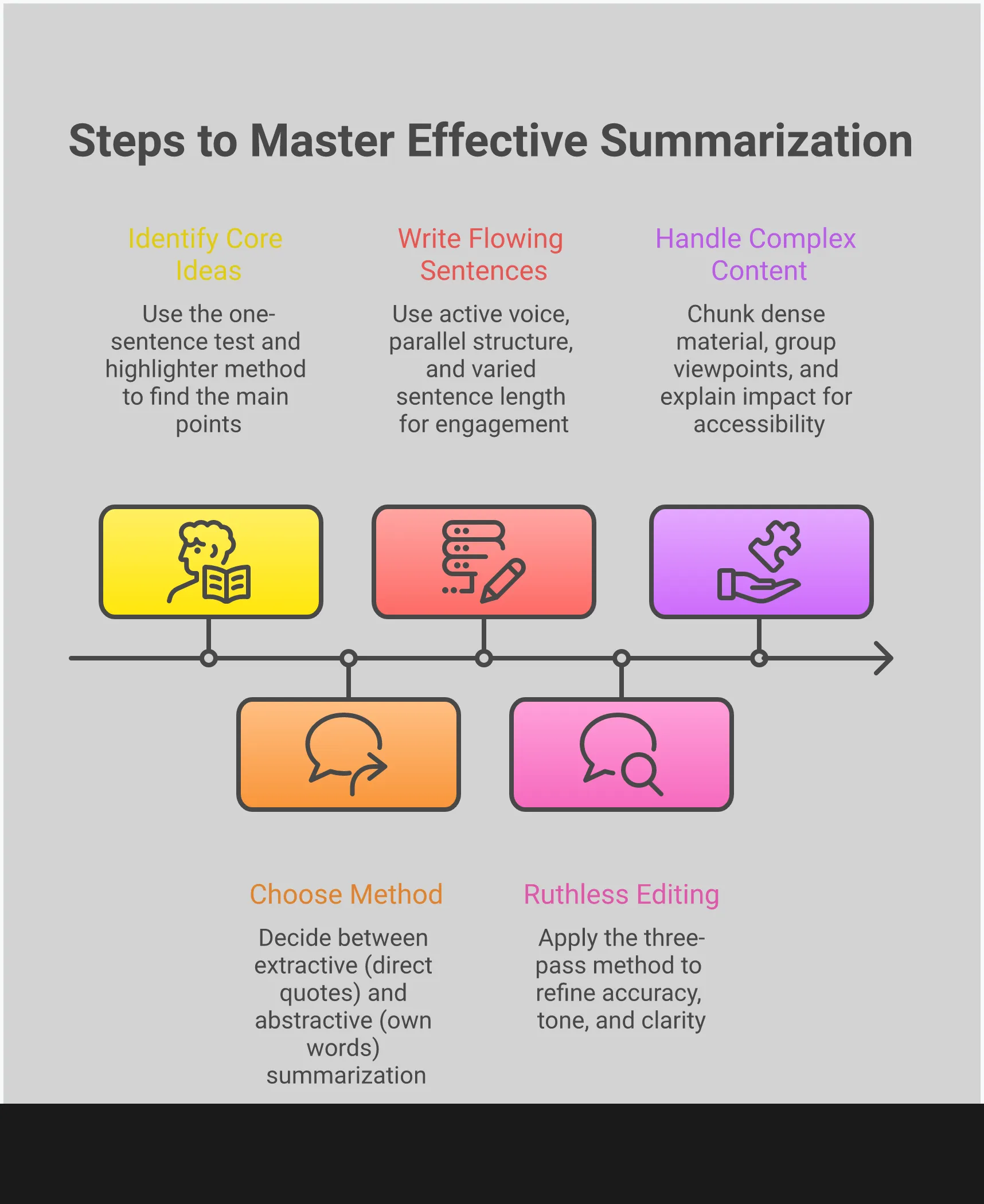
Extractive vs. Abstractive: What’s the Difference?
There are generally two approaches to creating summaries: extracting key information or creating a new, condensed version. It’s similar to building a character in a role-playing game. You can either carefully follow a pre-made guide and use its recommended items (extractive summarization), or you can understand the underlying principles and create a custom approach that works for you (abstractive summarization).
Both approaches can work well, but they’re best for different situations. The trick is knowing which one to use to create a helpful summary – one that’s clear and concise, not just a long block of text. One method focuses on using the author’s exact words, which is ideal when precision is important. The other lets you reword things and make the summary read more naturally. Let’s look at how each method works with some examples.
Extractive Summaries: The “Copy-Paste” Method
The simplest way to summarize text is by extraction. It’s like highlighting the most important sentences and phrases and then combining them. You don’t rewrite anything or add your own words – you just copy key parts directly from the original. This method is ideal when it’s important to use the exact wording, such as when recording specific instructions or quoting official statements.
One benefit is that it’s quick and helps ensure the original meaning isn’t lost. However, the result can sometimes sound awkward or choppy, more like a series of points than a smooth paragraph. This is because the summary might not read naturally, as the sentences weren’t initially intended to connect with each other.
Abstractive Summaries: Using Your Own Words
Abstractive summarization means creating a summary using your own words, rather than simply copying phrases from the original text. You read the material, understand the key ideas, and then rewrite it in a clear and concise way. Think of it like explaining a complex story – you wouldn’t repeat everything verbatim, but instead give a friend the overall picture in a way they can easily understand.
This method creates summaries that are easy to follow and more interesting to read. It helps simplify complicated topics while keeping the information well-organized. Many AI summarization tools today are designed to achieve this, producing text that sounds natural and clearly communicates the main ideas.
How to Choose the Right Method
Which option is better? It depends on what you’re trying to do. If you need to quickly jot down notes or find specific information for things like Warzone loadouts, an extractive summary is the way to go. It’s fast, effective, and makes sure you don’t miss important details.
When you’re writing something like a game review, explaining a story, or creating content for others, it’s best to use a method that lets you rewrite things in your own words. This makes your writing more engaging, easier to understand, and genuinely pleasant to read. That’s where the real benefit of summarizing comes in – you’re not just repeating information, but making it clearer and more accessible.
Common Mistakes That Weaken Your Summaries
Creating a strong summary requires finding the right balance. It’s simple to make mistakes that can turn a clear overview into something confusing. It’s similar to explaining a difficult challenge to your teammates – a good explanation leads to success, while a bad one can lead to failure. Fortunately, these errors are usually easy to identify and correct. Let’s explore four common mistakes to help you improve your summaries.
Mistake #1: Including Too Much (and Missing the Point)
This is the classic “can’t see the forest for the trees” problem. It happens when you have trouble separating the main ideas from the supporting details, resulting in a summary that’s almost as long as the original piece. You end up recounting every side quest and piece of lore instead of just explaining the main storyline. The goal of a summary is to deliver the core message quickly. If your reader has to sift through paragraphs of extra information to find the point, you’ve defeated the purpose. Before you write, force yourself to answer this question in one sentence: “What is the absolute most important thing someone needs to know?” Start there.
Mistake #2: Focusing on Minor Details
This error is similar to the previous one, but it happens when you get lost in unimportant details and lose sight of the main point. It’s like focusing on the exact color of a character’s armor instead of simply saying they have improved equipment. Including these small, irrelevant facts weakens your summary and makes it unclear. A good summary provides a broad overview. Always consider whether a detail is crucial to understanding the core message. If the summary remains clear without it, it’s best to leave it out.
Mistake #3: Losing the Original Vibe
When you summarize something, don’t just list the facts – capture how it feels too. If the original piece is funny or energetic, your summary should be as well. It’s important to get the original meaning and vibe across. Whether the source is lighthearted, serious, or critical, your summary should reflect that same tone. Pay attention to the author’s writing style and try to match it in your own words, so your reader gets a true sense of the original content.
Mistake #4: Adding Unnecessary Backstory
When summarizing something, it’s easy to get carried away and include details that weren’t actually in the original source. Remember, a summary should be a brief overview, not a comprehensive explanation. For instance, if you’re summarizing game update notes, you don’t need to explain the entire history of the game. Focus on what the source material actually says. Adding unnecessary background information can make it unclear what came from the original text and what’s your own addition. Your goal is to provide a short, accurate representation of the source, so save any extra details for a separate article.
How to Write Sentences That Actually Flow
Even if a summary includes all the correct information, it can still be difficult to understand if it doesn’t read smoothly. That smooth connection between sentences – what we call ‘flow’ – is key. It’s like a well-executed combo in a video game. You don’t need to be a great writer to achieve this; just a few simple techniques can make your writing clear and interesting.
Combine Ideas Without Creating a Mess
As a reader, I find it so dull when every sentence sounds exactly the same! It really helps to shake things up and vary how sentences are structured. What I love is when an author mixes short, quick sentences with longer, more descriptive ones – it creates a natural rhythm that just keeps me engaged. Those short sentences really hit hard and grab your attention, while the longer ones are great for building up ideas and giving you the full picture. For instance, instead of saying, “The final boss is tough. It has three phases. You need to learn its patterns,” a much better way to put it is, “The final boss is tough, forcing you to learn its attack patterns across three distinct phases.” It’s the same information, but it just flows so much better and keeps me hooked!
Why Active Voice Is Your Best Friend
Okay, so as a gamer, when I’m writing about a game, I’ve learned that using active voice just makes things way better. Instead of saying something like “The treasure was found by the hero,” which feels kinda clunky, I try to say “The hero found the treasure.” See? It’s punchier! It’s super important for getting your point across clearly – you immediately know who did what. When I’m summarizing a story or what a character does, active voice keeps the focus on the character actually doing stuff. It makes the whole thing feel more exciting and like you’re right there in the game with them!
Use Parallel Structure to Guide Your Reader
To make your writing clear and flow smoothly, ensure items in a list have a similar grammatical structure. This is called parallel structure. Instead of a clunky phrase like, “In this game, you’ll be fighting monsters, quests are completed, and to gather loot,” a better version would be, “In this game, you’ll be fighting monsters, completing quests, and gathering loot.” Using the same grammatical form for each item helps readers understand how your ideas connect and makes your writing more enjoyable to read. It’s a simple technique with a big impact on clarity.
The Toughest Parts of Writing a Good Summary
Let’s face it: summarizing can be tough. Sometimes you’re stuck with a lot of complicated text and don’t know where to begin. Whether it’s a difficult research paper, a highly technical manual, or a lengthy story, certain problems come up repeatedly.
It’s common to face challenges when summarizing, but understanding those challenges makes them easier to overcome. Most difficulties boil down to three key areas: tackling complex information, deciding how much detail to include, and staying focused on the main points. Improving in these areas will help you create summaries that are concise, clear, and impactful.
How to Handle Super Technical or Academic Content
Have you ever struggled to quickly understand a long, detailed guide – like one explaining how to create a character in a game, or listing all the changes in a big update? It can be really tough. The biggest problem with complicated texts is figuring out the most important information and separating it from less important details. You need to determine what the key ideas are and what’s just extra explanation. A helpful trick is to look for clues the author provides, such as the first sentence of each paragraph, words or phrases they repeat, or headings that break up the text. Interestingly, the process of summarizing actually helps you understand the information better, making it a powerful learning tool, not just a way to rewrite it.
Find the Balance Between Short and Sweet vs. Too Vague
Summarizing effectively is a delicate balance. You need to be brief, but not so much that your summary loses all meaning and becomes unhelpful. Aim for a sweet spot between conciseness and completeness – like a good video game quest description. It should tell you the main objective and why it matters, without getting bogged down in every minor detail. Condensing information well requires skill, because oversimplifying can remove the crucial details that give the original text its importance.
Stay on Track and Avoid Rabbit Holes
It’s common to get carried away when you’re really interested in a subject, like game details or specific tactics. A frequent issue is getting lost in minor details and straying from the main topic. You might start writing about a small point and forget what you were originally trying to say. To prevent this, quickly outline the key ideas before you begin writing. This outline will keep you on track and help you avoid unnecessary tangents. For your summary to be effective, it needs to stay focused on the most important information.
Can AI Write Your Summaries for You?
You might be thinking about letting AI do all the summarizing for you, and that’s potentially possible. AI is a fantastic tool for creating a first draft, but it won’t automatically produce a perfect summary. It’s best to see it as a strong assistant – it can handle the initial work, but you still need to guide the process and make the final edits.
AI can be incredibly helpful when you have a lot of text to sift through – think years of World of Warcraft backstory or a long discussion thread about a game trailer. However, to use these tools well and avoid getting a robotic-sounding summary, it’s important to understand how they work, what to expect, and where they sometimes struggle.
What AI Summarizers Actually Do
AI summarizers are tools that use artificial intelligence to quickly condense large amounts of information – like text, audio, or video – into a shorter, more manageable form. They identify the most important points, saving you time by providing a quick overview without unnecessary details. Imagine a program that can quickly tell you the main changes in a long update – that’s what an AI summarizer does.
Key Features to Look For in an AI Tool
AI summarizers vary in quality. Simple tools just extract a few important sentences, while more sophisticated ones go much further. The best ones actually understand the original text – its context, subtle meanings, and overall feeling. This is crucial for things like gaming content. It’s not enough to know what happened in a game’s story; you want to understand how it made you feel. So, choose a tool that can distinguish between different writing styles, like a funny online post and a professional review.
Why a Human Editor Is Still Essential
AI is powerful, but it’s not flawless. It can sometimes misunderstand things, miss nuances like sarcasm, or create summaries that are factually correct but lack personality. A key challenge is making sure AI-generated content makes sense and fits the situation – it might not get inside jokes or understand the background of popular trends. That’s why you need to review AI summaries as a starting point. Your role is to refine the language, add any missing information, and ensure the final result accurately reflects the original tone and meaning. You’re the one who adds the polish and makes it truly connect.
How to Summarize Gaming Content (Without Being Boring)
Writing about a game is different than writing a book report. You’re not just retelling what happened, but trying to share the whole feeling of playing it – the excitement of a tough battle, the joy of creating a great strategy, and the lasting impression it leaves. The key is to take all those details and emotions and turn them into a short, engaging summary that makes people want to jump in and play themselves.
Explain Game Mechanics and Lore Clearly
Okay, so when I’m explaining a game to someone, I try to keep it simple. Games have so much going on – tons of stats, complicated histories, all that stuff. But you don’t want to overwhelm a new player! I focus on what matters – like, instead of listing every single number on a character sheet, I’ll explain why a certain setup is strong. And instead of going through the entire backstory, I hit the highlights – the stuff that actually impacts the main story. Basically, I’m trying to give them the need-to-know info so they can jump in, feel confident, and have fun right away. It’s about making them feel like they belong in the game world.
Balance Hardcore Details with Newbie-Friendly Language
It’s tough to write content that appeals to both experts and beginners. You need to include enough information to satisfy those who already know a lot, but explain things clearly enough for people who are new to the topic. Try to avoid using specialized terms, and if you must use one, quickly explain what it means. For instance, when suggesting equipment for a game like Warzone, don’t just list the best items – explain why a particular piece of gear is helpful, like how a certain scope improves aiming at a distance. This way, your content will be valuable to everyone, not just experienced players.
Keep the Hype: Don’t Lose the Emotional Punch
Honestly, just listing what happens in a game makes for a really dull summary. Games aren’t about just the facts – they’re about how they make you feel! That rush when you win, the frustration of losing, or just being completely blown away by an amazing world. When I write about a game, I want to capture that feeling. I try to use really energetic language to describe what’s happening and tell people how a certain moment felt to me. AI can give you the basics, but it can’t understand the passion we have for gaming. My goal is to get that excitement across in my writing and make others want to jump in and play it themselves!
A Simple, Step-by-Step Guide to Nailing Your Summary
Let’s make this easy to follow with a simple, step-by-step process. Consider it a three-part task. If you complete each step in order, you’ll end up with a summary that’s clear, short, and helpful.
Step 1: Read and Analyze (Before You Write a Word)
Before you start summarizing, make sure you completely understand the original text. Just like you need to watch a game to explain the story, you need to grasp the core ideas and main arguments of what you’re summarizing. Read the text first to get a general understanding, then read it again, highlighting or taking notes. Focus on identifying the most important points and separating them from supporting details. It’s easy to get caught up in minor examples, so keep asking yourself: what’s the single most important thing I would tell someone about this?
Step 2: Write Your Messy First Draft
Okay, so now I’m trying to actually write things out, and honestly, I’m giving myself permission to not make it perfect right away. I’m just focusing on getting all my thoughts down on paper. Think of it like a first draft – it’s totally okay if it’s rough! I’m trying to put the main ideas into my own words, not worrying too much about how pretty the sentences are or if I’m using the best words. Just writing it all out actually helps me understand things better. Once I have something down, I can go back and make sure it matches the original – that I got the important parts right and the overall feeling is similar. But this first version? It’s just for me, so I’m letting myself be messy!
Step 3: Edit for Clarity, Flow, and Punch
Now’s the time to refine your draft and make it shine. Focus on making your writing clear and to the point. Read it aloud – does it flow smoothly, or does it sound awkward? Start by removing any unnecessary words or phrases. Then, vary your sentence structure. If all your sentences begin the same way, your writing will sound monotonous. Try combining short sentences or breaking up long ones to create a more natural rhythm. Ultimately, you want your summary to be easy to read and keep your audience engaged, leading them effortlessly through your ideas.
Pro-Level Tips for Tricky Content
It can be really hard to summarize certain types of content – things like busy Reddit discussions with lots of different opinions, or highly technical blog posts about software updates. When you’re dealing with material that’s complicated, lengthy, or presents multiple sides of an issue, you need some extra strategies. These tips will help you effectively summarize even the most difficult content, creating something clear, fair, and helpful.
How to Summarize Multiple Points of View
Ever try explaining a complicated online argument to someone? It’s hard to be impartial and represent everyone’s views. When you’re summarizing different opinions, aim to be a neutral observer. Group similar points together to create a clear and unified idea. For example, instead of listing every criticism of a new game character, you could say, “A lot of players think the character is too strong, because of their high damage and quick ability recharge rates.” Then, share the opposing viewpoint. Luckily, today’s AI tools can quickly analyze large amounts of text, like online forums, to identify the main topics, helping you understand the overall discussion without letting personal opinions influence the summary.
Help Others Find the Main Idea
When summarizing a lengthy or complex document, imagine you’re helping someone navigate it. Your reader relies on you to highlight the most crucial information. A key skill is separating the main points from minor details. Before you begin writing, determine the single most important thing you want your reader to remember and start your summary with that. Use things like bullet points or bolding to emphasize key takeaways. You’re not just making the text shorter—you’re making it easier to understand and helping your reader quickly grasp the essential information.
Write Summaries That Make People Act
Effective summaries don’t just share information—they motivate people to do something. Whether you want someone to try something new, change their approach, or join a discussion, your summary should make them want to. Focus on what the reader should do next. Don’t just list updates; explain how those changes will affect them and how they can use them. A good summary quickly explains the key takeaways and helps people decide what to do. By turning your summary into a helpful suggestion, you’ll get a much better response.
Frequently Asked Questions
There’s no set length for a good summary. Forget rules like “10% of the original” – they’re too simple. The ideal length depends on how much you need to explain the main idea and its key supporting points. Imagine you’re explaining a difficult challenge to a friend – you’d focus on the essential strategies, not every detail of your struggles. A good summary is detailed enough to be helpful, but concise enough to be respectful of the reader’s time.
Should you share your personal opinions when summarizing something? Generally, it’s best to avoid doing so. A summary should accurately and objectively reflect the original content. Once you start adding your own thoughts, critiques, or interpretations, it becomes more of a review or a reaction piece. Focus on clearly presenting what the original source says, not your personal viewpoint. You can share your opinions in a separate piece where they’ll be more appropriate.
What’s the difference between summarizing and paraphrasing? It’s easy to mix these two up, but they serve very different functions. Paraphrasing is when you take a specific sentence or a short passage and restate it in your own words, usually keeping it around the same length. A summary, on the other hand, takes an entire article, chapter, or even a whole game plot and condenses its main ideas into a much shorter form. Think of paraphrasing as translating a single line of dialogue, while summarizing is telling someone the entire story arc.
So you’re condensing a lengthy game storyline? That means being selective! Prioritize the core events of the main character’s adventure. Identify the central problem and focus on plot points that directly help solve it. You can generally skip side quests, minor characters, and detailed world-building – unless they significantly impact the main plot. Concentrate on the crucial moments, the villain’s reasons for doing what they do, and how the story ultimately ends.
It’s reasonable to use AI for summarizing, but don’t rely on it completely. AI can quickly create a good first draft by identifying important information, saving you time. However, it often struggles with nuance – like tone, sarcasm, or specific references – and the result might not read smoothly. Think of AI summaries as a helpful starting point, and always review and edit them yourself to ensure clarity, context, and a natural flow.
Read More
- United Airlines can now kick passengers off flights and ban them for not using headphones
- Gold Rate Forecast
- All Golden Ball Locations in Yakuza Kiwami 3 & Dark Ties
- How to Solve the Glenbright Manor Puzzle in Crimson Desert
- How to Get to the Undercoast in Esoteric Ebb
- 8 Actors Who Could Play Blackbeard In One Piece Live-Action Season 3
- How to Complete Bloom of Tranquility Challenge in Infinity Nikki
- Netflix’s 4-Part Crime Thriller Is One Of Its Very Best
- A Gamer’s Guide to the YouTube Algorithm
- CBS Officially Ends NCIS After 34 Years
2026-02-11 15:22