
The ability to explain complicated ideas simply, in just one sentence, is an incredibly valuable skill. It can help you succeed in online discussions, clearly communicate strategies in games, and quickly grasp new gaming trends. This isn’t just about being efficient; it’s about improving your ability to think and communicate effectively. This article will teach you how to write clear, concise summaries—what makes a good one and how to create your own. We’ll also explore AI tools that can help you practice this skill and stay up-to-date with gaming news and guides.
Key Takeaways
- Use summaries as your roadmap and your hook: A strong one-sentence summary not only grabs your reader’s attention from the start but also keeps your writing focused on the main point.
- Match the AI tool to your content: The best summarizer depends on the task. Use simpler tools for straightforward articles and more advanced ones to capture the nuance of technical guides or chaotic community discussions.
- Always add the human touch: AI is a fantastic starting point, but it can miss tone and context. Your final review is essential to refine the summary and ensure it accurately reflects the personality of the original piece.
What is a One-Sentence Summary (and Why Should You Care)?
Have you ever quickly scanned a long online discussion, like on Reddit, hoping to understand the main points without reading everything? That’s what a one-sentence summary does – it provides a concise, easy-to-understand overview of a longer piece of content, getting straight to the essential information.
In gaming, things change quickly, and there’s a lot of information to keep up with. Whether you’re figuring out the best strategies, following community news, or deciding on a new game, a good summary can be incredibly helpful. It quickly gets to the point, saving you time and effort. If you’re a content creator, a strong summary – like a concise sentence at the start of your video or article – can grab people’s attention and keep them engaged, whether you’re sharing a great Warzone setup or something else entirely.
The Power of a Punchy Summary
Effective summaries do more than just save people time—they immediately capture their interest. Just like a compelling movie trailer gives you a taste of the story and excitement, a strong summary quickly explains what an article, guide, or video is about and why it’s worth your time. This is particularly important when dealing with complicated subjects, such as analyzing reactions to a new Diablo 4 trailer or explaining a complex game feature. A well-written summary connects you with your audience, making your content easy to understand and more enjoyable right from the start.
When to Use a One-Sentence Summary
How can you use these concise statements in your writing? They work best at the start of articles or guides, acting as a strong opening sentence to immediately introduce your topic and main idea. This gives readers a clear idea of what to expect. You can also use them to promote your content on social media – a catchy one-sentence summary is ideal for tweets or Facebook posts to grab attention. They’re also useful for video descriptions and even for quickly explaining things in casual conversations, like on Discord.
How Do AI Summarization Tools Actually Work?
Ever wish you had a quick guide to help you understand a really long piece of text, like extensive game update notes or a detailed online discussion? That’s exactly what AI summarization tools do. They don’t just grab random sentences – they use intelligent technology to identify the most important information.
These tools work using something called natural language processing, or NLP. Basically, it’s a way of teaching computers to understand how we humans talk—including everyday language, slang, and everything in between. Imagine an AI that’s read a huge amount of text from all over the internet, like websites, books, and articles. By doing this, it learns to pick out the most important information, understand the main points, and see how different ideas connect.
These AI models quickly find the most important information in any document, saving you time and effort. Instead of reading through everything yourself, the AI summarizes it for you, giving you only the key points. Think of it as a tool to help you manage information overload and find what you need, fast.
Finding the Core Idea in a Wall of Text
The purpose of a summarizer is to identify the most important information within a larger piece of text. When you give it something like an article or a conversation, it analyzes the content to find the key ideas and the details that support them. Essentially, it focuses on the core message, filtering out less important information.
This is especially helpful when dealing with lots of information and needing quick answers. For example, if you’re wondering if a new weapon in Warzone is good, you don’t need to read a long article. AI can quickly provide a short summary with the weapon’s important stats, how it’s best used, and whether it’s worth earning, saving you time and effort.
Abstractive vs. Extractive: What’s the Difference?
Summarization tools aren’t all created equal. Most fall into one of two categories: extractive or abstractive. Knowing how these differ can help you understand the kind of summary you’ll get.
Extractive summarization works by finding the most important sentences in a text and combining them to create a summary. Think of it like creating a highlight reel – the AI simply copies those key sentences directly from the original. This approach is reliable because it doesn’t change the original wording.
Unlike simply pulling out key sentences, abstractive summarization is more like having someone explain a story to you. The AI understands the main ideas and then rewrites them in its own words to create a summary. This usually sounds more natural and human-like. Today’s best summarization tools often combine both approaches – pulling key sentences and rewriting the content – to provide the most effective results.
What Makes a Great One-Sentence Summary?
Writing a truly effective one-sentence summary is a blend of creativity and precision. It’s more than just shortening a piece of text—it’s about capturing its core essence in just a few words. Imagine writing a compelling character description for a video game or a quick, persuasive pitch for your favorite game – you need to highlight the most important details, make it engaging, and stay concise. This ability is valuable in many situations, from writing reviews and participating in online discussions to simply getting your friends excited about a game you’re playing. A strong summary quickly delivers the key information and cuts through all the unnecessary details.
A strong one-sentence summary is a writer’s best asset. It immediately captures a reader’s interest and explains why your content matters. In today’s fast-paced world of endless scrolling, the ability to condense a complex topic – like the music in Diablo 4 or a lively online discussion – into a single, compelling sentence is incredibly valuable. It demonstrates both your expertise and your respect for your audience’s time.
Nailing the Main Point
The most important part of a good summary is accuracy. It should clearly convey the main idea of the original material. For example, if you’re summarizing an article about the best gear for a game like Warzone, your summary should focus on that – not on small details like cosmetic items. According to writing experts at Kellogg Community College, a summary should start with a sentence that identifies the text’s title, author, and your understanding of its central message. Before you begin writing, determine the single most important takeaway you want your reader to have. Everything else is secondary.
Keeping Your Readers Hooked
Okay, so you’ve figured out the most important part of something – awesome! Now comes the fun part: making people care. A good summary isn’t just about laying out the facts; it’s about grabbing your attention and making you want to read more. I always think of it like a movie trailer – you get a glimpse of what’s happening, but it leaves you wanting the full experience. I’ve read that good writers mix summaries with little bits of the original text, like quotes and paraphrases, to make things more interesting, and I think that’s a great idea for summaries too. It’s all about creating a strong opening that pulls people into the bigger picture.
Balancing Brevity with Clarity
The biggest challenge in writing is expressing a complete thought in just one clear sentence. Every word must be essential, avoiding unnecessary filler or complicated language. This is called concise writing – communicating the most information with the fewest words, while still being easy to understand. It’s a tricky balance: too short, and your message gets lost; too long, and you lose your reader’s interest. The ideal sentence is thorough yet simple to grasp.
What Kind of Content Can You Summarize?
If you have a lot of text to read, summarization tools can be a huge help. They work with all sorts of gaming content – whether you need to quickly understand new game strategies, or just want the key takeaways from an interview with the game creators. These tools help you skip the unnecessary details and get back to enjoying the game.
From sprawling guides to chaotic forum threads, here’s a look at what you can effectively condense.
Game Reviews and Walkthroughs
Many game guides are incredibly lengthy, like reading a novel! When you just need quick answers – like how to beat a tough boss or if a weapon is worth earning – a summarizer can save you a lot of time. It quickly extracts the most important information from long reviews or walkthroughs, giving you what you need without unnecessary details. For example, you can quickly see if a new Warzone weapon setup suits your style before investing hours into unlocking everything. You get the key strategies and insights much faster.
Forum Threads and Community Chats
Following popular discussions on platforms like Reddit and Discord can be overwhelming, like trying to drink from a firehose. A helpful summarization tool can quickly condense hundreds of comments into the key talking points. This lets you easily understand what people are saying about things like game updates, changes, or surprising story developments. Instead of endlessly scrolling, you can get a quick overview of how fans are reacting to new trailers or content. It’s a great way to stay informed without getting lost in the constant stream of online chatter.
Epic Guides and In-Depth Articles
If you come across long, detailed articles about game stories or how games work, a summary can be a great way to start. AI tools can quickly find the most important ideas and facts and present them in a shorter, easier-to-understand format. This helps you get the gist of an article – like an in-depth look at the Diablo 4 soundtrack – before deciding if you want to read the whole thing. Ultimately, it’s about making complicated information easier to digest so you can quickly learn what matters most.
Popular Summarization Tools to Try
Interested in trying AI to summarize text? You’re in luck – there are many tools available, and they all do things a little differently. Consider them helpful assistants for quickly making sense of all the gaming information out there, like long updates and extensive online discussions. These tools aren’t just for schoolwork; anyone can use them to get key information much faster.
I’ve been looking for a way to quickly get the important stuff from long videos and guides, and it turns out there are some really cool AI tools that can help! Whether it’s a two-hour developer stream I want to quickly catch up on, or a huge Diablo 4 guide I don’t have time to read all of, these tools can summarize it all. I’m curious to learn what they can actually do, how I can customize them to get the best results, and if the free versions are enough, or if it’s worth paying for something more powerful.
What These AI Tools Can Do
AI summarization tools are all about saving you time. They can quickly identify the most important information from large amounts of text, videos, or podcasts. For example, you could use one to get a quick overview of a long online discussion about the best strategies in Warzone, highlighting only the top weapon setups. These tools help you understand information faster by filtering out unnecessary details. They’re great for shortening long articles, game reviews, and interviews, letting you get the main points without spending hours reading or watching.
Customization and Integration Options
AI summarizers aren’t usually designed to work perfectly for everything right away. Instead, they offer options to customize the results to fit what you need. You can typically control how long the summary is – from a short sentence to a longer paragraph – which is helpful for creating different kinds of content, like a quick social media post or a detailed announcement. Most tools also work with different file types, letting you upload documents or simply paste a web link. More advanced options can even summarize specific parts of a video using timecodes, making it easy to recap long recordings.
Free vs. Paid: Is an Upgrade Worth It?
You don’t need to spend any money to begin with. Many summarization tools have free versions that work great for simple tasks. For example, TLDR This is useful for quickly summarizing articles you find online. These free options are often sufficient for occasional use. However, if you summarize content frequently, a paid subscription could be worthwhile. Paid plans usually offer benefits like faster speeds, the ability to summarize longer texts, more ways to customize the results, and automatic key insight extraction – all of which can be very helpful for professional content creators.
How to Pick the Right Summarization Tool
Okay, so there are a TON of summarization tools out there, and honestly, picking one feels a lot like picking a main character in a fighting game. They all look good, but what works for me depends on what I’m actually trying to do. I want something that just fits into my workflow, almost like I don’t even notice I’m using it. It’s not about finding the ‘best’ summarizer ever, it’s about finding the best one for the specific task I’ve got in front of me.
Need to quickly understand long patch notes or a busy online discussion? Are you looking for a general overview, or do you need all the specifics? Knowing what you need will help you choose the right summarization tool – one that saves you time and lets you get back to enjoying the game.
Consider Your Content Type
Before you start, think about what you need to summarize. Summarizing tools can save you a lot of time when dealing with lengthy guides, updates, and discussions. However, not all tools are created equal. A tool that’s good at simplifying a complex technical guide might struggle to understand the tone of a casual forum post. Some tools are designed for data and technical terms, while others are better at understanding everyday conversation and emotions. Consider what you’ll be summarizing most often. If it’s mostly clear articles and guides, a basic tool will probably be enough. But if you’re working with lively community chats, look for a tool that can understand more subtle language.
Decide on Your Accuracy Needs
Summaries aren’t always the same quality, and how accurate you need them to be depends on the situation. Tools that summarize text can shorten long articles while still hitting the main points, but some are more precise than others. For something lighthearted, like a funny collection of Honkai: Star Rail memes, a general understanding is enough. However, when summarizing important information – like game updates or a complicated guide – an inaccurate summary could cause problems. Some summarization tools are fast but might miss crucial details, while better AI models take more time to create summaries that are both reliable and understand the context. Choose a tool that matches how important accuracy is for the material you’re summarizing.
Make Sure It Fits Your Workflow
Even the best tool isn’t helpful if it’s difficult to use. A good summarizer should fit easily into your routine, not feel like extra work. It can quickly help you understand long game guides, updates, and online discussions, giving you more time to actually play the game. Consider how you like to get information. Do you want a simple browser extension that summarizes with one click, or a dedicated app where you can copy and paste text and adjust the summary? The most effective tool is the one that makes things easier, seamlessly integrating into your workflow whether you’re researching a new strategy or just seeing what people think about the latest news.
Can Summarization Tools Really Improve Audience Engagement?
It’s tough to get people to read anything these days. With so much content competing for their attention – from updates to videos – simply having someone read your entire article or post is a big achievement. And yes, a good summary can significantly improve how people engage with your work.
Summaries are a great way to start any content plan. They don’t just make text shorter—they show respect for your readers’ time and help them easily understand your ideas. A clear, brief summary encourages people to read on, share your work, and truly understand your message. It’s not about simplifying things, but about making your content accessible to everyone, regardless of how much time they have. When you quickly demonstrate the value of your content, people are much more likely to invest their time in it.
Winning the Attention Span War
It’s frustrating when you search for a quick guide, like the best gear for a game, and find a huge block of text instead. Most people will probably just leave. That’s where summarization tools come in – they quickly give readers the most important information. By shortening long updates or complicated stories, you get straight to the point and respect your audience’s time. This makes them more likely to read further when they’re interested, and it’s a great way to grab the attention of someone who’s just quickly scanning for what they need.
Making Your Content More Shareable
You’ve spent time crafting a detailed analysis of a game’s story – now how do you get people to notice it online? Long articles aren’t easy to share. That’s where a concise summary comes in. AI-powered summarization tools help readers quickly understand your key ideas, making them much more likely to share your work. When people instantly get the main point, they feel confident recommending it to others. A good summary acts as a compelling caption, providing context and sparking interest, just like the excitement around a new trailer for a game like Diablo 4.
Helping More People Access Your Ideas
Many people don’t have the time or energy to read lengthy articles, even if they’re well-written. Summaries make your content accessible to everyone, respecting different reading styles. Some prefer to scan quickly, others are busy, and some simply find large blocks of text daunting. Summarization tools save time, allowing people to quickly understand long game guides or discussions without a big commitment. By simplifying complex information, you can reach a wider audience and help more people easily learn new strategies, updates, and background details.
Weave Summaries into Your Writing Process
Summaries aren’t just helpful for people reading your work—they’re a powerful tool for you as the writer too. Using them throughout your writing process can make everything easier, from brainstorming to final editing. Think of a summary as the framework for your article—it gives it shape and helps you stay on track, ensuring your ideas are clear and easy to understand. Creating a summary of your main point before you start writing can be incredibly helpful, keeping you focused and preventing you from getting bogged down in details.
This is particularly helpful when creating gaming content. Explaining complicated topics – like the best weapon setups in Warzone or the detailed backstory of Diablo 4 – can easily lead you off track. Creating summaries, and consistently referring back to them, helps you stay focused on the main point. This leads to clearer, more organized content that gives your audience exactly what they want. It’s about being efficient and creating content that connects with viewers and encourages them to return for more.
Use Summaries to Plan Your Content
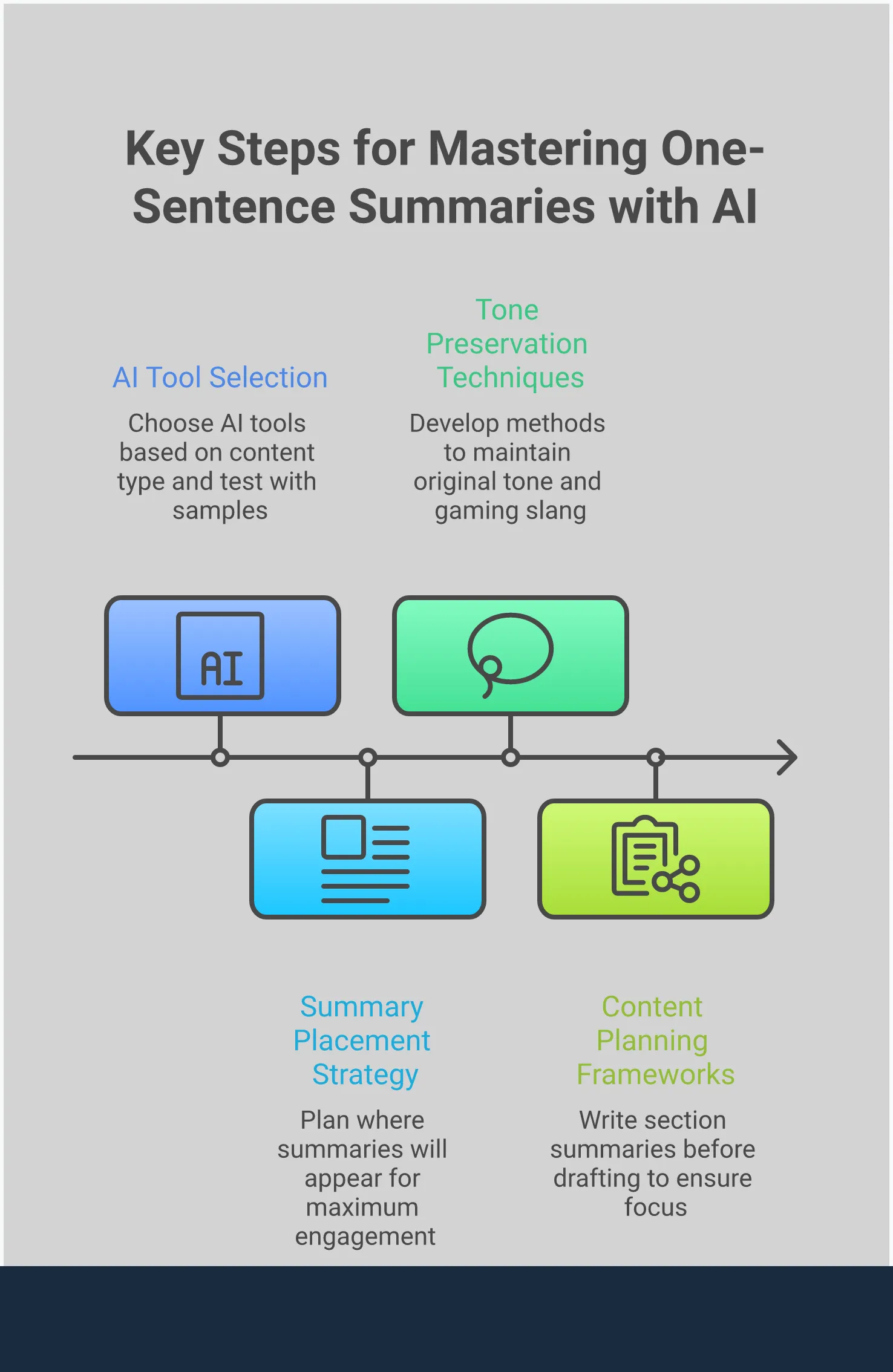
Before you start writing a long guide, create an outline using brief, one-sentence summaries for each section. Condense the main idea of each part into a single, clear sentence. This helps you define your key points before you begin writing, and it’s a simple way to check if your article flows logically. If you struggle to summarize a section in one sentence, it might mean your idea needs more focus. It’s much quicker to revise a sentence than to rewrite entire paragraphs.
Place Summaries for Maximum Impact
How you position summaries within your content significantly impacts reader engagement. Placing them at the very beginning – either right after your title or as the opening sentence of your introduction – immediately gives readers a clear overview of what’s to come, capturing their interest. You can also use summaries as subheadings or highlighted sections to make long texts easier to scan. This helps readers quickly understand the main points of each part. By thoughtfully placing these brief overviews, you help your audience navigate the material and make complicated subjects more understandable.
Mix Summaries with Quotes and Paraphrasing
To make your writing really stand out and feel trustworthy, don’t just rely on summaries. Skilled writers blend summaries, paraphrases, and direct quotes to keep things interesting and informative. For example, you could quote a game developer about a new feature, explain what people are saying in a long online discussion using your own words, and then quickly summarize how it all affects the game. This creates richer, more authoritative content. Direct quotes offer proof, paraphrasing helps you simplify complicated topics, and summaries provide a clear and concise wrap-up.
Common Pitfalls and How to Dodge Them
AI can be a helpful first step for creating summaries, but it shouldn’t be the only step. While these tools are powerful, they aren’t perfect and can sometimes produce summaries that are too generic or inaccurate. Think of AI as a helpful assistant – it can do the initial work, but you still need to review and refine the results. Let’s look at some common mistakes and how to avoid them to ensure your summaries are always accurate and useful.
Don’t Make It Too Simple
Summaries should be short and to the point, but it’s easy to make them too simple. Cutting too much detail can remove what makes the original text interesting. For example, saying the plot of Diablo 4 is just “You fight demons” is accurate, but it leaves out the rich story, atmosphere, and emotional impact of the game. A strong summary captures the main points and reflects the original’s depth. Before sharing your summary, ask yourself if it still conveys the central conflict or the most important message. If not, consider adding a crucial detail or two.
Keep the Original Vibe and Meaning
In gaming, and everywhere else, how something sounds is crucial. When you summarize something funny, like a discussion about how players die in Palworld, it should still be amusing – not boring! Good summaries don’t just shorten content, they capture the original’s spirit and feeling. A simple test: read the original and then your summary back-to-back. Do they feel like they come from the same source? If a summary of an angry online post reads like a calm news report, you need to revise it.
Why a Human Touch Still Matters
AI-powered summarizers are constantly improving, but they still can’t quite match human understanding. They often struggle with things like sarcasm, inside jokes, or the underlying emotions in lively conversations. For instance, an AI might not understand the mixed excitement and worry in fan responses to a trailer like Vessel of Hatred. That’s where a human editor is essential. Your personal touch ensures a summary truly resonates with your audience and captures the subtle details that AI misses. Think of AI tools as a helpful starting point – they can create a first draft, but always review and refine it with your own expertise.
Related Articles
- Deus Ex LFG: Connect with Other Augs in LFG Feature on Z League App
Frequently Asked Questions
Okay, so I’ve been wondering about using AI for summaries, and here’s how I’m thinking about it. It’s like having a really good co-op partner in a game. It can totally handle the grunt work – blasting through a huge amount of text and getting a first draft down fast. But you always need to take over for the final boss battle! That’s where you come in to add your own voice, make sure it actually sounds right, and catch anything tricky like sarcasm. I’m using AI to get things started, but I’m definitely doing a final polish myself to make it perfect.
Yes, these tools can summarize more than just articles – they work with videos and podcasts too. Most advanced tools first convert the audio into text, and then summarize that. This is really helpful for quickly getting the main points from long videos, reviews, or interviews, saving you from having to watch or listen to everything.
Using an AI summarizer isn’t plagiarism if you use it properly. Summarizing means shortening a text to its main points, not copying it directly. It’s about understanding and sharing information in a more concise way. Plagiarism happens when you present someone else’s words or ideas as your own. A summary, however, is simply restating the key ideas, which is a valid way to work with information.
Want to make sure your summary doesn’t sound like it was written by a robot? The best trick is to read it out loud. Does it sound natural, like a person speaking? Compare it to the original text – if the original was lively and your summary is flat, you need to make some changes. Feel free to adjust the AI’s writing by swapping in different words to capture the same tone and personality as the original piece.
What’s the most common error people make when summarizing something? It’s usually oversimplifying it. When trying to be brief, writers often leave out important details or the emotional impact that made the original content engaging. A good summary should be concise, but it also needs to convey the main idea, central conflict, or overall tone. The goal is to be clear and effective, not just to shorten the length.
Read More
- Solo Leveling’s New Manhwa Chapter Revives a Forgotten LGBTQ Story After 2 Years
- Gold Rate Forecast
- The Boys Season 5 Spoilers: Every Major Character Death If the Show Follows the Comics
- All Itzaland Animal Locations in Infinity Nikki
- How to Get to the Undercoast in Esoteric Ebb
- Mewgenics vinyl limited editions now available to pre-order
- Smarter, Faster Networks: Optimizing Early-Exit Architectures for Edge AI
- Shiba Inu reappointed as “inspector” dog by Japanese police
- CBR’s Official Spring 2026 Anime Series Power Ranking (Week 1)
- Silver Rate Forecast
2026-02-10 14:51