
Even if you don’t think of yourself as a writer, you regularly explain games to others – whether you’re getting friends to play with you, discussing updates online, or writing short reviews. Being able to clearly and briefly explain what’s great about a game is a valuable skill. It makes your suggestions more convincing and your opinions more impactful. This isn’t just for streamers or YouTubers; it’s for any gamer who wants to share their love of games effectively. We’ll cover the key steps to help you improve this skill, so you can communicate your thoughts confidently and clearly.
Key Takeaways
- Know your audience to deliver value: Always tailor your summary’s language, tone, and focus to who you’re writing for, whether they are a hardcore veteran or a curious newcomer.
- Build trust with a balanced perspective: A credible summary highlights both a game’s best features and its potential flaws, giving readers an honest preview to help them make an informed decision.
- Prioritize clarity and scannability: Structure your summary with clear headings, short paragraphs, and simple language to help readers quickly find the information they need without getting lost in a wall of text.
What Makes a Gaming Summary Great?
Remember the last time you weren’t sure about trying a new game? You likely read reviews, watched gameplay videos, and searched for a quick explanation to help you decide. That’s what a good gaming summary does – it’s more than just a list of what’s in the game. It quickly shows you what the game is really like, helping you figure out if it’s something you’ll love or want to skip. A great summary gets past the advertising and tells you the honest truth.
A great summary saves you time by getting straight to the point. It explains complicated game features in a clear way and focuses on what makes a game fun. Instead of being overwhelmed by long, confusing explanations, a good summary gives you the key information you need to quickly understand things – whether it’s the best gear in Warzone or what players are saying about a new update. It’s an essential tool for any gamer.
The Must-Have Qualities of a Killer Summary
A truly killer summary does two things exceptionally well: it knows its audience and it’s brutally honest. First, you have to know who you’re talking to. A summary for a hardcore RPG player will look very different from one for a casual mobile gamer. The goal is to provide valuable information that resonates with their specific interests and answers the questions they’re likely to have. Second, a great summary presents a balanced view. It doesn’t just hype up the good stuff; it also points out the weaknesses. This honesty builds trust and gives readers a realistic picture of what to expect, helping them make a truly informed decision.
Why Good Summaries Are a Game-Changer
A great summary can completely change how you experience a game. It helps you avoid wasting time on games you won’t enjoy and introduces you to fantastic games you might miss. For newcomers, a good summary makes a complex game feel much easier to pick up. When writing a summary, imagine you’re explaining the game to someone who knows nothing about it. Plus, well-written summaries encourage better conversations within the game’s community, giving everyone a shared understanding to build upon when discussing characters, stories, and more.
How Summaries Level Up Your Gaming Life
It’s likely you have a huge list of games you haven’t played yet! With so many new titles coming out, it’s hard to keep up and even harder to choose what to play next. That’s where a good game summary comes in handy. It’s not just a short description – it’s a helpful way to simplify your gaming experience. Consider it a quick guide that lets you spend less time looking for games and more time enjoying them.
A good game summary quickly tells you what a game is about, helping you decide if it’s something you’ll enjoy. It helps you make the most of your gaming time and have more fun. Whether you’re choosing your next favorite game or discussing it with friends, a helpful summary is a great starting point for a better overall experience.
Get the Info You Need, Faster
Your time is valuable, so why spend hours watching someone else play a game when you could be perfecting your strategy? A good summary gets straight to the point, quickly explaining the main idea, story, and important features. This saves you time and helps you feel informed without wading through long reviews. It’s a great way to quickly learn about a new game or finally check out one you’ve been meaning to play.
Make Smarter Choices on What to Play Next
It’s frustrating to buy a game you end up not enjoying, isn’t it? Good game summaries can help you avoid that disappointment. They point out what makes a game special, so you can figure out if it’s a good fit for you. Whether you’re after a relaxing farming game or something with a quirky, dark side, a summary will give you a clear idea of what to expect, helping you decide if it’s worth buying. Think of it as getting a recommendation from a friend who knows what you like.
Fuel Better Community Chats
Gaming is often more fun with friends, and having a quick overview of a game helps everyone connect. Instead of explaining the basics, you can jump right into discussing strategies or surprising story moments. It’s a great way to get more out of the experience, especially online where summaries can quickly update everyone on popular reactions and trends, so nobody misses out on the fun.
The Common Hurdles in Summarizing Games
It seems simple, but writing a good game summary is actually quite difficult. You’re trying to capture the essence of a long, complex game – like a 100-hour role-playing game or a quick-action shooter – in just a few paragraphs. It’s easy to get bogged down in specifics or completely miss what makes the game special. Let’s look at some common mistakes to avoid when summarizing a game.
Cutting Through the Noise of Complex Games
Today’s video games are incredibly complex and full of content. Games like The Witcher 3 and Diablo 4 have huge worlds and many different systems. Because of all this, it can be hard to figure out the most important parts of the game and separate them from everything else. It’s a challenge to decide what’s essential to the main experience and what’s just extra. When everything seems important, it’s easy to end up with a confusing summary that doesn’t clearly explain what the game is actually about. The key is to focus on the most important information, but that’s often more difficult than it sounds.
Pinpointing What Truly Matters
When summarizing a game, it’s not enough to just list what happens. You need to identify what really makes it special. Is it the unique way it lets you fight, a compelling story, or its beautiful visuals? This requires careful judgment. In fact, researchers are developing AI to create summaries that are both clear and meaningful. As a writer, your job is to think like that AI – pinpointing the core elements that best represent the game and will most appeal to players.
Keeping It Short Without Losing the Good Stuff
We’ve all faced this: wanting to share everything great about a game – the cool weapons, characters, and gameplay. But a summary needs to be concise, not a complete review. The trick is to pack a lot of information into a short space without losing what makes the game unique. It’s a tough balance. Cut too much, and the summary becomes boring and forgettable. Include too much, and it stops being a summary. You need to be selective and focus only on the most important details to give readers an accurate and appealing overview.
Making Sure It All Makes Sense
A good summary should read smoothly and logically, not just list features. Many summaries, especially those focusing on specific aspects of a game, fail to connect ideas clearly, leaving readers confused. Instead, aim for a summary that tells a mini-story about the game, walking the reader through its main features in a way that’s easy to follow and makes them want to know more. Each sentence should naturally follow the one before it, creating a clear and engaging overview.
What to Include in Your Gaming Summary
Writing a good game summary means more than just listing what the game has. It’s about capturing what the game feels like and giving potential players a clear idea of what to expect. Think of it like a trailer – you want to showcase the most exciting parts, how the game plays, and its overall style without getting lost in minor details. A great summary finds the right balance between essential information and the game’s unique personality, helping players decide if it’s something they’ll love or skip.
Nail the Core Gameplay and Features
To write a good summary of a game, you first need to really get it. That means playing it extensively to understand what it does well and where it falls short. Think about the core gameplay – is it a quick-action shooter where having the best gear is key, or a large, detailed RPG focused on creating items? Focus on what makes the game special. Instead of just saying it has fighting, explain how the fighting feels and what makes it different. Describing these key features will give readers a clear idea of what the game is actually like to play.
Show Both the Highs and the Lows
No game is flawless, and being honest about that builds trust with your audience. A review that’s only positive feels like an ad, while one that’s completely negative just sounds like complaining. The best approach is to be balanced. Point out the great parts, like clever quests, but also mention any issues, such as a frustrating inventory. This fairness makes your review believable and helps readers decide if the game is right for them. It’s similar to how fans react to new game trailers – they get excited about the good stuff but also voice any worries they have.
Know Who You’re Talking To
Who are you writing this summary for? The answer changes everything. To create effective messaging, you first need to define your target audience. A summary for a hardcore strategy gamer will focus on different elements than one for someone looking for a cozy farming sim. When writing for a community like Z League, you can often assume a baseline knowledge of gaming terms. You can make inside jokes or references, like the community’s hilarious take on the F.A.R.M. team memes in Honkai: Star Rail, because you know your audience will get it. Tailoring your language and focus makes your summary more relevant and engaging.
Capture the Game’s Vibe and Art Style
A great game isn’t just about how it plays, but about the overall experience it creates. When summarizing a game, don’t forget to describe how it feels – consider its visual style, sound effects, and the atmosphere they create. Is the game world gloomy and scary, or vibrant and happy? Does the music build tension during battles, or help you unwind while you’re discovering new areas? These details are key to what makes a game special. Explaining how the visuals connect to the story gives a more complete understanding, and remember that a fantastic soundtrack can often be the most memorable part of a game.
How to Structure a Summary for Maximum Impact
After deciding what to include in your summary, focus on how you present it. A clear structure is just as crucial as the information itself. If your summary is disorganized and difficult to read, people won’t pay attention, no matter how good your ideas are. Aim for something both informative and easy to understand – like carefully assembling the right tools for a job, each part playing a specific role to achieve the best results.
Good summaries value your reader’s time. Gamers are always searching for information to help them choose games, make purchases, or improve their skills, and they don’t want to wade through lengthy text. Organizing your thoughts clearly lets them quickly find what they need. Focus on the most important details first, use straightforward language, make your writing easy to scan, and aim for a balance between being informative and engaging. If you can master this approach, your summaries will be much more helpful, and you’ll earn a reputation as a reliable source within the gaming world.
Lead with the Most Important Info
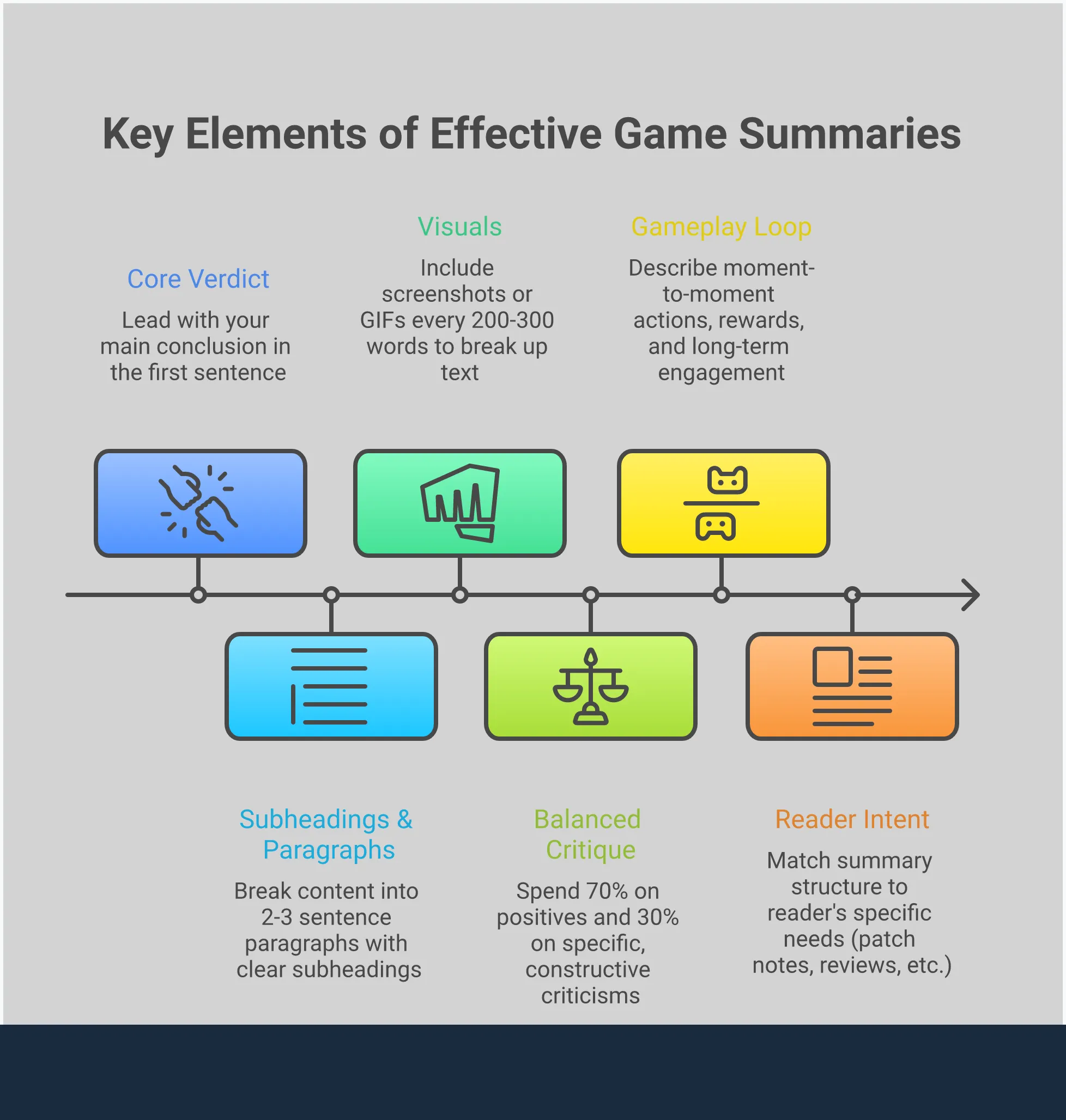
Get straight to the point! Begin your summary with the most important information. Think about what your readers need to know first – is this update a big deal? Is the game worth buying? Give them the key takeaway immediately to grab their attention and make them want to continue reading. A strong blog post doesn’t waste time. Instead of slowly revealing your opinion, start with it. For example, you could say, “Diablo 4’s latest season dramatically improves the endgame, though getting started can still be a bit of a grind.” This provides the essential information right away.
Write in Clear, Simple Language
Video games have a unique vocabulary, but when you’re explaining them – whether in a review or just chatting with friends – it’s important to be clear for everyone. Don’t use complicated terms or confusing sentences. Focus on getting your point across simply and honestly, as that builds trust with your readers or listeners. When reviewing a game, highlight what it does well and where it falls short in a way that anyone can understand. For example, instead of using technical language like ‘ludonarrative dissonance,’ try saying something like, ‘The game is really fun to play, but the gameplay doesn’t always fit with the serious story.’ Straightforward language is always more effective and makes sure your message is understood.
Make Your Content Easy to Scan
People generally skim online content, so it’s important to make your summaries easy to scan. Use short paragraphs, bold important words, and bullet points to break up large blocks of text. Headings and subheadings help readers quickly find the information they’re looking for. Making your content readable is a straightforward way to keep people interested. For example, a simple “Pros and Cons” list with bullet points is a great way to quickly summarize the best and worst parts of something.
Keep It Informative and Entertaining
A good game summary should be informative and enjoyable. Let your enthusiasm show! Remember, games are meant to be fun, so write like it. Imagine you’re explaining the game to someone who’s never heard of it – what would grab their attention? Use descriptive language and write as if you’re having a conversation. Share your personal experiences – what made you smile, what challenged you, and what really stood out. This mix of facts and personal feelings is what makes Z League’s content, like our look at the funny F.A.R.M. team memes, so captivating. It’s not just about what the game is, but how it feels to play.
Pro Tips for Nailing Your Game Summaries
Want to take your game summaries to the next level? It’s not enough to just list what a game has – you need to capture what it feels like to play. These tips will help you write clear, engaging summaries that truly connect with other gamers and provide real value to the community.
Actually Play and Understand the Game
It sounds simple, but genuine experience is key to writing great summaries. To really understand a game, you need to play it extensively – feel how it flows, notice the subtle details, and move beyond just what the marketing tells you. This allows you to form a truly honest opinion and confidently discuss what works and what doesn’t. Your insights will be authentic because they’re based on real understanding, which is essential for creating valuable content, like an in-depth analysis of something like the often-overlooked soundtrack of Diablo 4 – something you can’t achieve with just a quick play.
Break Down the Key Parts
Okay, so when I’m trying to explain a huge game to someone, it can be tough to know where to start. What I’ve learned is to break it down. I think about the different parts – how it plays, the story and who you meet, how it looks and sounds, and how well it actually runs. If I focus on each of those things separately, I can get a really clear idea of what’s good and what’s not. It’s like, instead of rambling, I’m building a solid understanding, piece by piece. It helps me stay on track and make sure I cover everything important – basically, using what game devs think about when they make the game to help me talk about it!
Combine Different Viewpoints
Effective summaries appeal to all players, not just those who are already familiar with the game. When writing one, consider what a brand-new player would need to understand, and then think about what a long-time veteran would want to know. Balancing these different needs creates a helpful summary for everyone and demonstrates that you’ve considered the entire community, not just your own experience. This ability to understand different perspectives is crucial for connecting with your audience and providing valuable context for your opinions – it’s why we find diverse fan reactions so interesting, as each person offers a unique viewpoint.
Give Your Readers Actionable Takeaways
Your summary should do more than just describe the game; it should help your reader make a decision. End your summary with clear, actionable advice. Is this game a must-buy at full price, or should they wait for a sale? Who is this game for? Be specific. For example, “If you love fast-paced shooters with a high skill ceiling, you’ll feel right at home, but players looking for a deep story should probably look elsewhere.” This gives your audience a clear takeaway and helps them decide if the game is a good fit for them. Providing this kind of direct guidance turns a simple description into a genuinely useful piece of content, much like a good Warzone loadout guide.
Tools and Tricks for Easier Summarizing
You don’t need to struggle with a blank page when writing a summary. Many helpful methods and tools can simplify the process, allowing you to organize your ideas and present them clearly. Consider them as boosts to your writing – they help you eliminate unnecessary details, focus on the most important information, and make a challenging task much easier.
Use a Simple Framework
It’s easy to feel overwhelmed when designing a large game like an open-world title or RPG. A basic plan can help keep you on track. Before you start writing, try to define three key things: What does the player do repeatedly (the core gameplay loop)? What’s the ultimate goal of the game? And what makes your game stand out? For instance, in a game where you collect loot while shooting, the core loop is fighting and finding new items. The goal might be to finish the story, and what makes it special could be its unique futuristic world. Having this simple structure helps you stay organized and focused on the most important parts of your game.
Get Help from Digital Tools and AI
You don’t need to start your summaries from zero. AI tools are really helpful for condensing large amounts of information, like game updates or developer blogs. Use an AI summarizer to create a first draft of the main points, but remember it’s just a starting point. AI excels at identifying facts, but it can’t convey what it feels like to play the game. Always add your own thoughts and explain why those changes matter to players. This lets AI handle the detailed information while you focus on making the summary engaging and fun.
Use Images and Smart Formatting
Large blocks of text can feel overwhelming. Effective summaries use images and clear formatting to make information easy to understand and interesting. Use bullet points, bold important words, and include screenshots or GIFs to illustrate your ideas. A single, well-chosen image – like a thrilling moment from a game or a beautiful scene – can often communicate more than a whole paragraph. This makes your summary easy to scan, so readers can quickly find what they’re looking for. Think about how people use memes and short clips in online discussions – you can use the same approach to make your summary more engaging.
Map Out Complex Game Systems
When explaining games with complicated features – like detailed crafting or extensive skill trees – it’s helpful to map things out visually first. Use paper or a digital whiteboard to create a simple diagram showing how different parts of the game connect. For example, how does crafting affect combat, or how do stats impact gameplay? Doing this beforehand will make it much easier to explain the game clearly and concisely to others. It’s especially useful for games that seem overly complex.
Mistakes to Avoid When Summarizing Games
Creating a game summary seems simple, but it’s easy to make mistakes that can make it confusing. It’s common to get bogged down in too much detail or forget who you’re writing for. Luckily, these errors are easy to avoid if you know what to look out for. Let’s review the most common problems so you can write summaries that are clear, concise, and helpful for other players.
Don’t Overwhelm with Too Much Detail
When summarizing something, aim for a quick overview—like a movie trailer—instead of a complete, detailed explanation. It’s easy to get carried away listing everything, but that can hide the most important points. Instead, highlight the main strengths and weaknesses. A good summary lets readers grasp the core ideas quickly and easily. For example, if you’re summarizing a game like Diablo 4, focus on things like its dark mood and rewarding loot, and avoid getting lost in the specifics of every skill. Keep it brief and to the point.
Don’t Forget Your Audience
Before you start writing, think about who you’re writing for. A summary aimed at experienced esports players will be very different from one for people who just want a relaxing game like a farming simulator. Knowing your audience is the most important thing! Adjust your writing style, the words you use, and what details you emphasize to match what they care about. If you’re writing for dedicated strategy game fans, you can use specialized terms. But if your audience is new to the game, explain things clearly and focus on the overall fun. The best summaries connect with readers because they’re written in a way that’s easy for them to understand.
Don’t Lose the Game’s Unique Spark
What makes this game different from the dozens of others in its genre? That’s the question your summary needs to answer. Avoid generic descriptions that could apply to any fantasy RPG or sci-fi shooter. Dig into what gives the game its personality. Is it the quirky humor, the stunning art style, or a groundbreaking mechanic? For example, a summary of Palworld would be incomplete without mentioning its uniquely dark humor. Capturing these unique aspects is what makes a summary memorable and helps a game’s true character shine through.
Don’t Make It Hard to Read
As a gamer, I really appreciate a good summary, but honestly, a huge block of text just doesn’t cut it. What really helps is when someone structures things well. I mean, short paragraphs, headings that tell you what each section is about, and bullet points – those are lifesavers! You should be able to quickly scan a summary and instantly get the important stuff. That’s what makes content easy to read and actually keeps me engaged. And keep the language straightforward, okay? We’re trying to figure out if this game is for us, not read a novel! Good formatting just makes everything more inviting and makes sure the key info actually gets through.
Tailor Your Summary for Any Content Type
Okay, so I’ve learned that a good summary really depends on what I’m summarizing. Like, if I’m writing up a game review, I need to focus on things like gameplay, story, and graphics – the stuff that helps someone decide if they want to buy it. But if it’s patch notes? Totally different! I just need to quickly tell people what’s been fixed or changed. It’s all about giving the reader what they need to know in that specific situation. Basically, you wouldn’t use a hammer to tighten a screw, right? Same goes for summaries – a detailed review summary won’t work for a quick update, and vice versa. It’s about picking the right approach for the job.
Taking the time to understand your audience and clearly state what your content offers is crucial. It shows respect for their time and builds trust, making your content more impactful. When someone clicks on a link, they’re looking for something specific, and your summary is their first impression. A good summary quickly lets them know if you have what they need, acting as a confident introduction to your work. It demonstrates you understand both the game and the people you’re talking to. Let’s look at how to adapt your approach based on the type of gaming content you’re creating.
For Game Reviews and First Impressions
When writing a game summary for a review, imagine you’re explaining it to someone who’s never heard of it. Be fair and give an accurate overview of what it’s like to play. Focus on the key gameplay elements, what makes the game unique, and the overall experience. Don’t just highlight the good parts – mention both the strengths and weaknesses. For example, if the combat is excellent but the story is weak, be sure to say so. The goal is to give readers a clear idea of what to expect so they can decide if the game is right for them. Think of your summary as an introduction – it prepares readers for a more detailed review, like one focusing on the game’s music.
For Patch Notes and Updates
When summarizing game patch notes, focus on being clear and concise. Players want to quickly understand what changed and how it impacts their gameplay, not read lengthy descriptions. Skip the hype and get straight to the important details – major balance adjustments, crucial bug fixes, and any new features. Your summary should highlight information that directly affects how players approach the game. Think about what a player needs to know before jumping into a match – especially when it comes to things like optimal builds or strategies that change with each update. A well-written summary can be the key to success and avoid frustrating losses.
For Strategy Guides and Walkthroughs
When writing a strategy guide, your summary is like a promise to the reader. It should clearly state the problem your guide solves – whether it’s defeating a difficult boss, locating a hidden item, or understanding a complicated game feature. Start by building the reader’s confidence and setting clear expectations. Players seeking guides are often frustrated, so your summary needs to be reassuring and tell them, “I understand your struggle, and this guide will help.” Essentially, you’re offering a straightforward solution, whether it’s explaining a frustrating game element or walking them through a lengthy quest.
For Community Recaps and Hot Takes
When summarizing what people are saying about a game, focus on the overall feeling – not just the game itself. Are players happy, annoyed, or making jokes? Your summary should sound like the voice of the community, highlighting what everyone is talking about and what they generally think. You’re telling the story of how players are experiencing the game, and showing off the fun, unique culture that grows around it – like popular memes or enthusiastic fan responses.
Frequently Asked Questions
So, how long should a game summary be? There isn’t a perfect length, but generally, one to three paragraphs is a good target. The most important thing is to be brief but informative. Consider what you would want to know before starting a new game. Your summary should cover how the game is played, its overall feel, and what sets it apart – all in a way that someone can read quickly, ideally in just a minute or two. Focus on being clear and easy to understand, rather than making it long.
It can be tricky to summarize something without spoiling the best parts! The trick is to focus on how the story begins, not how it ends. Talk about the basic idea of the game, what the main character is trying to achieve at first, and the world they’re in – but avoid revealing any big surprises. Instead of what happens, describe the overall mood of the story (is it scary, funny, exciting?) and how the game is played. If you absolutely have to hint at a major plot point, keep it vague – for example, you could say “something happens that changes everything” without giving away the details.
If you strongly dislike a game, it’s important to write a fair review. Don’t just say it’s “bad” – explain why you didn’t enjoy it. Be specific! Were the controls awkward, the tasks boring, or the story lacking imagination? Pointing out precise issues helps readers understand your perspective and decide if those flaws would bother them too. Also, remember to acknowledge what the game tried to achieve, even if it didn’t quite succeed.
You don’t have to finish a very long game—like one that takes 100 hours—before you can write about it. It’s more important to understand how the game works and what it’s like to play. You don’t always need to reach the very end. Just be upfront with your readers about how much of the game you’ve played. For example, if you’ve only played for 20 hours, let them know. This helps them understand your review is based on a good amount of experience, but isn’t a complete overview.
If you could only give one tip for writing a great summary, what would it be? Always write for your reader. Before you type a single word, ask yourself: “What does someone need to know to decide if this game is for them?” This simple question will guide you to focus on the most important details, adopt a helpful tone, and cut out the fluff. A great summary isn’t about showing off how much you know; it’s about providing a clear, honest, and useful service to another gamer.
Read More
- United Airlines can now kick passengers off flights and ban them for not using headphones
- How to Complete Bloom of Tranquility Challenge in Infinity Nikki
- Gold Rate Forecast
- How to Solve the Glenbright Manor Puzzle in Crimson Desert
- 8 Actors Who Could Play Blackbeard In One Piece Live-Action Season 3
- All Itzaland Animal Locations in Infinity Nikki
- All Golden Ball Locations in Yakuza Kiwami 3 & Dark Ties
- A Dark Scream Theory Rewrites the Only Movie to Break the 2-Killer Rule
- All 10 Potential New Avengers Leaders in Doomsday, Ranked by Their Power
- NEXO PREDICTION. NEXO cryptocurrency
2026-03-05 16:51