
Ever pick up an RPG after a break and feel totally confused about what’s going on? It’s easy to forget who your character is, why you have certain items, or even what your goal was! Games like Diablo 4 have amazing stories, but they can be hard to follow. AI summarization can help by acting like your own personal guide to the game’s story. It can take complicated information – like a character’s history or a long quest – and turn it into a simple, easy-to-understand summary. It’s a great way to quickly remember what’s happening and jump right back into the game.
Key Takeaways
- Reclaim Your Gaming Time: Use AI summarizers to quickly digest long patch notes, lore wikis, and strategy guides. This gives you the critical information you need without sacrificing hours you could be spending in-game.
- Choose Your Method Wisely: Select simple “extractive” tools to pull key facts from content like patch notes, and use more advanced “abstractive” tools to understand the nuance of complex stories and character arcs.
- Guide the AI, Don’t Just Trust It: Treat AI as an assistant, not an author. Always review and edit its output to add the essential gaming context, tone, and inside knowledge that an algorithm will miss, ensuring the final summary is truly useful.
What is Text Summarization? (And Why Should Gamers Care?)
You probably want to be playing the game, not reading about it! Text summarization takes long articles – like huge patch notes, detailed backstories, or lengthy guides – and boils them down to the essential information. It’s like a super-smart “too long; didn’t read” tool. For gamers, this is a big help. Instead of spending ages figuring out every little change, you can quickly learn what’s important and get straight into playing. It’s the difference between studying an entire textbook and having a perfect cheat sheet for a test.
Look, I’m a gamer, and my time is valuable. When a new season drops for a game I love, I want to know what changed right away, not spend hours wading through a huge article. That’s where summarization tools come in handy. They cut straight to the important stuff – like which characters got buffed or nerfed, and what’s different with items. This saves me a ton of time so I can quickly figure out if my favorite character is still good, or if I need to try a new strategy. Whether I’m trying to find the best loadout in Warzone after an update, or just get the story recap before a big expansion, summarization lets me get the key info without all the extra fluff. It’s all about being efficient and staying ahead of the game!
The Problem: Gaming Information Overload
Today’s video games aren’t just huge in scope; they also require players to read a lot. The amount of dialogue and other text is often overwhelming. For example, Baldur’s Gate 3 has three times as many words as the entire Lord of the Rings trilogy! When you add in updates, developer blogs, guides, and online discussions, it’s easy to feel overloaded with information. Keeping up with even a single game can be a challenge, and it can make gaming feel like work instead of fun.
Manual vs. AI Summarization
For a long time, people have summarized information by hand – reading articles for important points, taking notes, or asking someone else to fill them in. While this works, it takes time and it’s easy to overlook crucial details. AI summarization offers a faster solution, using technology to quickly scan large amounts of text and create concise summaries. The trick is to choose the right tool for the job. A good AI summarizer can even turn a complex guide into a clear list of steps you can take. It’s not about replacing your thinking – it’s about giving you a helpful assistant to handle the more boring parts.
How Do AI Summarization Tools Work?
Ever wonder how AI can take a long article from a game wiki and turn it into a short, easy-to-understand summary? It’s not simple, but it’s incredibly effective. AI summarization works by teaching computers to understand language the way humans do – including all its subtle meanings and context. This is done through a field called Natural Language Processing, or NLP, and it’s what allows these tools to go beyond just identifying important words.
Think of it like teaching a friend the lore of a game you love. You don’t just read them the entire script; you pick out the important parts, explain the relationships between characters, and give them the highlights so they get the gist. AI summarizers learn to do the same thing, but they use complex algorithms instead of years of playing the game. They analyze sentence structure, identify key terms (like character names or locations), and figure out which ideas are central to the story. This technology is what separates a jumbled mess of phrases from a summary that actually makes sense and saves you time. It all comes down to two main approaches: one that acts like a highlighter and another that works more like a storyteller.
The Basics of Natural Language Processing
For an AI to summarize information, it needs to be able to understand language first. This is achieved through Natural Language Processing (NLP), a branch of AI focused on enabling computers to understand, interpret, and create human language. NLP is the core technology that allows tools to make sense of complex text, like a busy online discussion, and extract the most important information. Instead of simply seeing words, an NLP-powered tool identifies parts of speech and how they relate to each other, allowing it to understand the text’s meaning and differentiate between things like people and places.
Extractive vs. Abstractive Methods
AI summarizers typically work in one of two ways: by extracting key information or by creating a new, condensed version. Extractive summarization is like highlighting the most important parts of the original text and then combining those highlighted sections to form a summary. It’s a quick process and ensures the summary uses the exact wording from the source, making it ideal for things like release notes or lists of features.
Unlike extractive summarization, abstractive summarization doesn’t just pull sentences from the original text. It uses sophisticated AI to truly understand the content and then create a completely new summary, rephrasing ideas and making it sound natural. This is especially useful for complex topics – like the detailed backstory of a game such as Diablo – because it can explain complicated plot points in a clear way, without simply copying information from another source.
Keeping the Context in Gaming Content
When it comes to video games, understanding the story and world is crucial. A good AI summary tool needs to be specifically trained on gaming narratives because simply listing events isn’t enough. It needs to recognize important moments, like a character’s betrayal changing the entire plot, or understand that something like the ‘Vessel of Hatred’ in Diablo 4 is a key story element, not just a fancy name. The best tools can follow character actions, track the plot, and appreciate the detailed world-building that makes a game’s story engaging. Without this understanding, you just get a collection of facts instead of a meaningful summary.
How to Choose a Summarization Tool for Gaming
Choosing the right AI summarizer is important – it’s like preparing for a big challenge. You wouldn’t use the wrong weapon for a difficult fight, and you shouldn’t use a standard business tool to understand complicated gaming information. Gamers need a tool that gets our world – the unique language, what’s at stake, and the small details that make a strategy truly effective. A summary that doesn’t capture the feeling of a community’s reaction to a new game trailer isn’t helpful.
Finding the right AI summarization tool means looking past impressive websites and focusing on what really matters: keeping the original meaning intact. Just like concentrating a strong potion, you need to preserve all the important details. To choose a reliable tool, consider these three things: its ability to accurately understand the context, how easily it integrates with your other apps, and whether you can adjust the summaries to fit your needs. If you find a tool that excels in these areas, it can significantly improve your workflow.
Prioritize Accuracy and Context
A poorly written summary of a game guide can mean the difference between successfully completing a challenge and failing completely for your whole team. That’s why getting the details right is crucial. The best tools can turn complicated instructions into clear, easy-to-follow steps while still respecting the original meaning. They need to understand gaming slang – for example, recognizing that a “glass cannon” isn’t a real weapon. This understanding of gaming terms is essential. While a general AI might not understand words like “proc,” “nerf,” or “kite,” a specialized one will know they’re important gameplay concepts. It should also capture the original writing style, whether it’s the serious tone of an update or the enthusiasm of a player sharing a new find.
Look for Platform Integrations
Stop wasting time copying and pasting! The best way to summarize information is with a tool that fits right into what you’re already doing. Look for browser extensions that can quickly summarize webpages – like long forum discussions or detailed articles – with just one click. Tools that connect with apps you already use, such as Notion or Discord, are also incredibly helpful. They let you easily share summaries – like game updates with your friends or important story details for yourself – and get back to playing. The key is to find a tool that simplifies gathering and sharing information so you can spend more time enjoying your game.
Find Customization Options
A good summarization tool is like a set of editing tools – it doesn’t just give you one fixed result. Instead, it lets you adjust and improve the summary to fit your specific needs. This is important because sometimes you need a very short summary, like for a tweet, and other times you need something much more detailed, like a full overview of a character’s history. The best tools allow you to control the length, choose between different formats (like paragraphs or bullet points), and even tell the tool which keywords are most important. This level of control makes the AI a helpful assistant, letting you create exactly what you need for any situation.
The Best AI Summarization Tools for Gamers
Whether you’re trying to understand years of backstory or just need the key details from a long update, the right AI tool can be incredibly helpful. However, with so many choices available, it can be hard to decide which one is best for you. Your needs will determine the best tool – are you creating in-depth content, or just looking for a quick summary before playing something new?
There are tools that can either identify the key sentences in a text, or completely rewrite it to be shorter and easier to understand. We’ll explore some of the best options for gamers. If you create content, love game stories, or just want to stay informed, these tools can help you manage the huge amount of information in today’s games. Let’s see which ones are most helpful.
QuillBot
QuillBot is a helpful writing tool, particularly good at condensing information. Its Summarizer feature is especially useful for quickly getting the key details from long texts – like a character’s lengthy backstory from a game. What’s great for gamers is the ability to adjust how short or detailed the summary is. You can choose a very brief overview or a more comprehensive one, saving you time while still giving you the important information. This makes it easy to quickly understand and remember complex game lore.
Grammarly
Many people use Grammarly to check grammar and spelling, but it can also help you summarize text, focusing on making it clear and concise. Although it’s not as advanced as tools specifically designed for summarization, Grammarly is great for polishing your writing so it’s easy to understand. This is especially helpful when creating content for an audience, like explaining a story background online or writing a video script, as it ensures your main ideas are communicated clearly and professionally. Grammarly focuses on improving readability more than simply shortening the text.
Jasper AI
Jasper AI is a tool that creates original content, going beyond simply shortening existing text. It crafts writing that sounds natural and human, allowing you to transform complicated information into engaging stories. Instead of just extracting key points, Jasper understands the meaning and rewrites content in a compelling way. This is especially useful for content creators who want to easily turn complex storylines, like those found in games such as Diablo 4, into captivating content for their audience, while still preserving the original style and making it easier to understand.
Copy.ai
If you need to create great content fast, Copy.ai is a good option. Its AI can quickly understand lengthy documents and identify key ideas, character developments, and plot points. This is especially helpful if you regularly create content like blog posts, social media updates, or discussions about game stories. For instance, you could give it transcripts from a recent Honkai: Star Rail quest and get a short summary perfect for sharing with your audience, encouraging discussion without spending hours writing it yourself.
Claude and ChatGPT
Claude and ChatGPT are powerful AI tools that are great at understanding language and what you mean. This makes them perfect for quickly summarizing complicated game stories. You can chat with them to get exactly the information you need – like details about a specific character, explanations of confusing parts, or a summary that matches the story’s original mood. This is especially helpful for gamers who want to create content from a certain perspective or have in-depth conversations about complex stories. They can often offer unique insights that other tools overlook, making them ideal for detailed analysis.
Choosing the Right Method for Your Gaming Content
As a gamer, I’ve realized that AI summaries aren’t always the same – you can’t use the same method for everything! What works for one thing might be terrible for another. It really depends on what you’re trying to figure out. Do you just want a quick rundown of new game updates? Or are you diving deep into a complex story with tons of background? Maybe you’re searching for the best way to play a character? Each of those needs a different approach to get the best results.
Choosing the right summarization tool is like picking the right weapon for a fight. You wouldn’t use a long-range rifle in a tight space, and similarly, some summarization methods work better for certain types of gaming content. A basic summarizer might miss important story details, while a more complex one could make simple information, like a list of game changes, harder to understand. When you choose the right tool for the job, you get summaries that are accurate, helpful, and give you a deeper understanding of the game, ultimately helping you play better. Let’s look at which methods work best for different kinds of gaming content.
For Game Reviews and News
As a gamer, I need info fast when it comes to reviews, patch notes, or news. I don’t want to wade through a ton of extra stuff – I just want the important bits. That’s where extractive summarization tools are awesome. They basically scan an article and pull out the most important sentences, exactly as they’re written. So if there’s a huge update posted, a good summarizer can quickly give me the highlights without me having to read everything!
As a huge Diablo 4 fan, I’m always trying to stay on top of everything – patch notes, what’s getting buffed or nerfed, new items, and all the latest news. Honestly, it used to take forever! But these summarization tools are a game changer. They quickly pull out the important stuff, so I can get a quick overview of reviews, see what’s strong and weak, or just catch up on everything without having to read a ton of different articles. It’s seriously a huge time saver and helps me stay informed without the hassle.
For Complex Lore and Story Analysis
When I really get into a huge game like Final Fantasy or The Witcher, I can’t just skim for the important bits. I need to understand the big ideas, why characters do what they do, and how everything connects. That’s where those fancy AI summarizers come in handy. They don’t just pull sentences from the game; they actually read everything and then write a brand new summary, almost like another player explaining the story to me!
This approach is perfect for fully understanding a game’s story. Research suggests AI can analyze game narratives, potentially leading to more engaging and customized experiences for players. It can help you make sense of complicated storylines and truly feel a character’s development, much like the powerful soundtrack in Diablo 4 allows you to do.
For Strategy Guides and Community Threads
Online strategy guides and community forums, like Reddit, are full of helpful information, but they can also be overwhelming. It takes time to sort through everything and find the advice you actually need. That’s why a tool to quickly pinpoint and organize the most important details is so valuable.
As a gamer, I’ve found that having the right tools to sift through all the online info is a game-changer. I love using summarizers that can turn long, complicated guides into simple bullet points – perfect for learning tricky boss fights or figuring out the best weapon setups in Warzone. And it’s amazing how these tools can take a huge discussion thread and pull out the key takeaways, like what everyone thinks is the best way to build a new character. Basically, it takes a chaotic mess of info and turns it into a clear, easy-to-follow checklist – it saves me so much time!
How to Use Summarization for Complex RPG Stories
Modern role-playing games are huge these days. Titles like Baldur’s Gate 3 and Diablo 4 have so much story, conversation, and background information that it can feel like a second job just trying to follow everything. If you take a break from playing for even a few weeks, it can be confusing when you come back. You might forget who characters are, why you’re carrying certain items, or even what your character was trying to achieve. It’s easy to get lost in the details.
AI summarization is a great way to quickly understand complex game stories and quests. Instead of rereading long logs or wikis, these tools give you a concise overview of important plot points. It’s like having a personal assistant that boils down hours of gameplay into just a few paragraphs. For instance, you can paste a quest’s wiki text and receive a bulleted list of objectives and key story moments. This is particularly helpful in large, open-world games with many ongoing quests. Whether you need a reminder of a character’s past, the impact of a choice you made, or just a quick refresh on the game’s lore, summarization helps you jump back in without getting lost. Ultimately, it lets you spend less time catching up and more time enjoying the game.
Track Complex Character Arcs
The best role-playing games feature characters that evolve and respond to your choices, leading to unique and complex stories. It can be hard to remember everything about each companion – their background, who they support, and how they feel about you. An AI summarizer can help by creating a quick overview of a character’s entire story. Just give it their dialogue or information from the game’s wiki, and it will highlight their important moments and what drives them. This makes it easier to understand how they’re developing and to make choices that strengthen your relationship – whether it’s a friendship or a rivalry. Think of it as having a guide to help you navigate your in-game connections.
Condense Branching Narratives
Many role-playing games let your choices significantly impact the story, making them highly replayable. However, this can also leave you wondering about the ‘what ifs’ – what would have happened if you’d made different decisions? AI summarization offers a solution. Instead of replaying hours of gameplay, you can use AI to condense summaries of different story paths, quickly showing you the key outcomes you missed. This helps you understand the full scope of the game’s story and truly appreciate the impact of your choices.
Create Quick Lore Cheat Sheets
Role-playing game worlds, like those in Diablo and Faerûn, are famous for their incredibly detailed histories and settings. While this rich lore is amazing, it can be a lot to keep track of! Instead of trying to remember everything from lengthy game books and item details, you can use AI to quickly create summaries. Simply copy text from a detailed wiki and paste it into an AI summarizer to get a handy reference guide on any topic. This is especially useful for quickly reviewing important events or character backgrounds right before they come up in the game.
Common AI Summarization Mistakes to Avoid
AI summarization tools are really helpful, but they require some effort – they’re not a completely hands-off solution. They’re more like advanced tools that need skillful use, not like self-driving cars. Simply pasting a lot of text into a summarizer and copying the result often leads to summaries that are boring, incorrect, or unhelpful. The aim should be to create a summary that’s actually useful and captures the essence of the original material, not just a shorter version.
The main problem is that AI doesn’t really get gaming. It misses things like community jokes, the impact of a character’s story, or why certain items are popular. That’s where you come in – you’ll help the AI by guiding it, reviewing its work, and adding the insights that other gamers will appreciate. Avoiding a few simple errors can turn a confusing result into a helpful and well-written guide.
Relying Too Heavily on Automation
As a fan, I think the biggest mistake people make with AI is seeing it as someone who creates the work, instead of a tool to help you. Just hitting ‘summarize’ and letting it run is a really bad idea! AI can easily miss the little things – the feeling, the specific way a character talks, or connections that any real fan would immediately notice. Honestly, the best stuff happens when you work with the AI. I like to use it to get a rough draft going, organize my thoughts, or even shorten long conversations. But I always do a final edit myself. That’s what lets us push the limits of what’s possible with AI, and make sure the final result actually feels right and is accurate. It’s your unique voice and what you think that makes a summary worth reading in the first place!
Losing Critical Gaming Context
As a huge gamer, I’ve been thinking about how AI summarizes games, and honestly, it’s a bit worrying. An AI can tell you what happened – like a character traveled from one place to another – but it usually misses why it was important. Games are full of subtle details and backstory that really add up, like clues hidden in the environment or even a small side quest that turns out to be a big deal. I’ve seen summaries of games like Baldur’s Gate 3 that get the main story right, but totally skip over the amazing character development you get from spending time with your companions. Those companion quests are key to what makes the game so good! So, if you want a truly useful summary, it’s better to break the game down into smaller pieces and add your own thoughts to connect everything and make sure the important stuff doesn’t get lost.
Picking the Wrong Tool for the Job
Summarizing tools aren’t one-size-fits-all. Different tools work best for different kinds of writing – what’s good for a research paper won’t necessarily work for a funny online conversation. Using the wrong tool can result in summaries that sound strange or miss important details. For example, summarizing a how-to guide requires a tool that can identify and list key steps, while a casual discussion about a game like Honkai: Star Rail needs a tool that understands slang and informal language. The best approach is to choose a tool specifically designed for your content. Try out a few different options to find the one that gives you the best results.
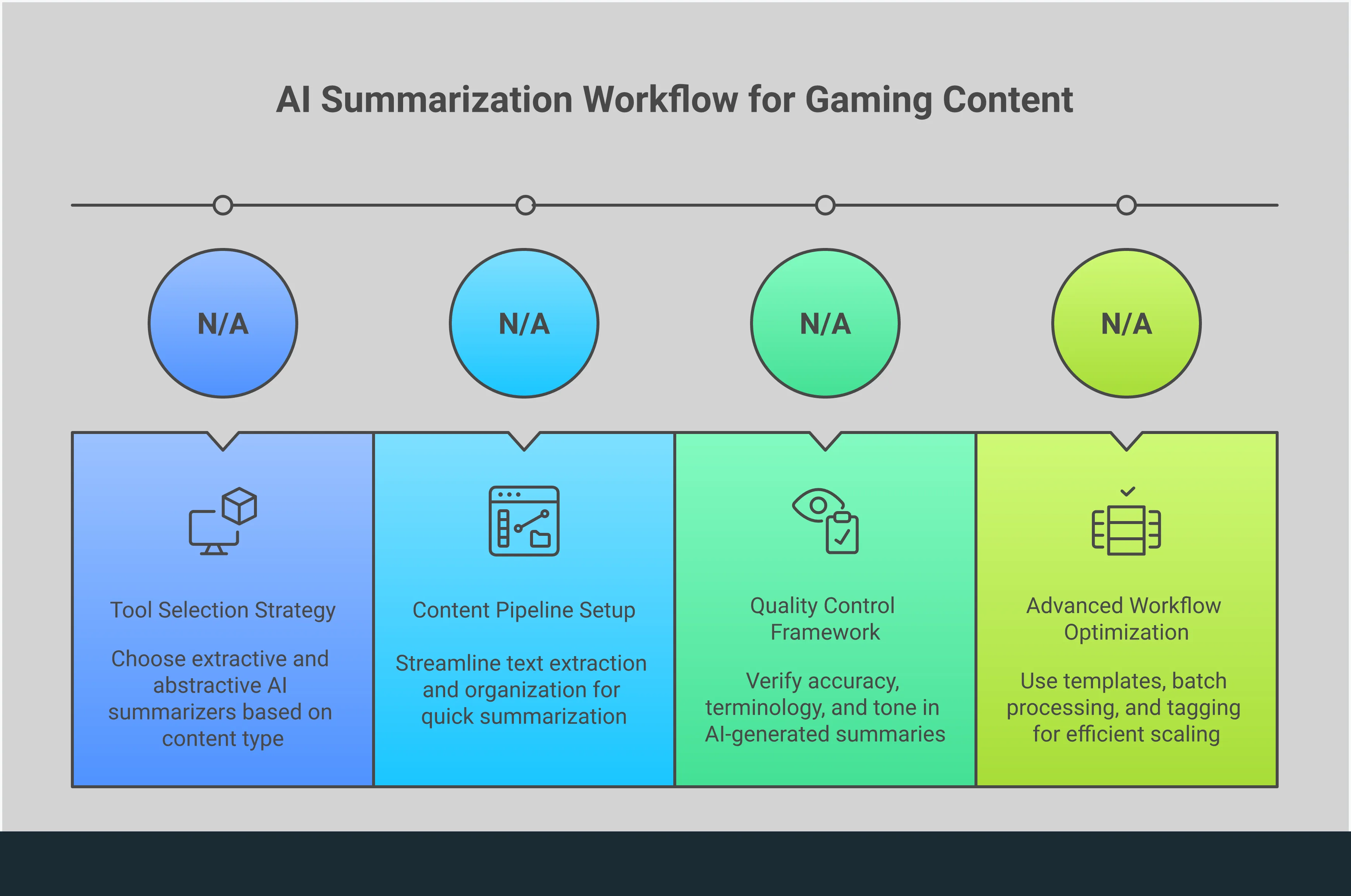
How to Build Your First Gaming Summarization Workflow
Want to easily manage tons of game lore? Creating a workflow might sound complicated, but it’s simply about finding a process you can use consistently. It’s about turning overwhelming amounts of text into clear, helpful summaries without getting frustrated. The idea is to make the process fast, so you can spend more time enjoying or creating the game, and less time trying to understand everything. Think of it like building your own personal assistant to handle all the lore. With just a few steps, you can create a dependable way to summarize anything from detailed character histories to expansive world-building details.
Set Up Your Content Pipeline
To start summarizing, you need to get the text into your AI tool – this is your content pipeline. It can be as simple as copying and pasting, or using a tool to automatically grab text from a webpage. Some platforms make this even easier with built-in AI and user-friendly designs, helping you handle lots of information. The most important thing is to keep the process simple. If it takes too many steps, you won’t be likely to use it. Aim for a quick and easy way to get text from its source – like a game guide, fan wiki, or long online post – into your summarization tool.
Test Different Tools and Methods
Summary tools vary in quality, and the best one to use depends on what you need. For simple things like shortening a list of gaming tips, a tool that makes clear bullet points is ideal. But if you want to understand a complex story, like a character’s history in a game like Diablo 4, you’ll need a tool that can grasp the story’s details and emotions. It’s worth trying out a few different tools with the same text to see which one works best for you. This experimentation will help you find the perfect tool for your needs.
Measure What Works for You
Once you start testing, you need a way to decide what’s actually working. Create a simple checklist to judge the quality of your summaries. Ask yourself a few key questions: Is the summary accurate? Did it miss any critical plot points or character motivations? Does it capture the original tone? Most importantly, did it save you time? The ultimate goal is efficiency and clarity. You might find that one tool is perfect for quick news roundups, while another is your go-to for deep dives into complex narratives. Developing your own framework for what a “good” summary looks like will help you refine your process and consistently get the results you want.
Related Articles
- Deus Ex LFG: Connect with Other Augs in LFG Feature on Z League App
Frequently Asked Questions
This is designed for all players, not just those who create content. While it offers powerful tools for content creators to work more efficiently, any gamer can use it to enhance their experience. It helps you quickly get back into a game after a break, understand important changes in updates, or see what other players think about new strategies – all without spending hours reading. Ultimately, it’s about saving you time so you can focus on playing.
Okay, so if someone asked me to explain extractive vs. abstractive summarization, I’d say it’s pretty simple. Extractive summarization is like when I’m reading patch notes – it just picks the most important sentences straight from the text, no changes. It’s all about getting the facts right. But abstractive summarization? That’s when a friend explains a complicated game story to me. They understand what happened and then tell it back in their own words, making it easier to grasp. It’s way better for things like character backstories or deep lore.
Does using an AI to summarize game lore spoil the fun of discovering the story on your own? It depends on how you use it. It shouldn’t replace actually playing the game, but act as a helpful tool. You could use it to quickly remember details about a character you encountered earlier, or to clarify a bit of backstory you might have skipped. It’s meant to fill in missing pieces and improve your understanding, not ruin major plot twists you uncover yourself.
You don’t need to be tech-savvy to create a “workflow.” It might sound complex, but a workflow is simply a routine you create for yourself. It can be as basic as using a browser extension whenever you find a lengthy guide online. The main idea is to establish a simple, consistent process that saves you time – whether it’s a two-step or five-step process. It’s all about finding what works best for you.
Will these AI tools actually grasp gaming terms like ‘nerfs’ and ‘builds’? It depends on how you use them. While AI is improving at understanding context, it can still struggle with specialized gaming language. That’s why it’s crucial to double-check the AI’s summaries to ensure it correctly interprets things – for example, recognizing that a ‘glass cannon’ refers to a character with high damage but low defense, not an actual weapon.
Read More
- United Airlines can now kick passengers off flights and ban them for not using headphones
- Crimson Desert: Disconnected Truth Puzzle Guide
- All 9 Coalition Heroes In Invincible Season 4 & Their Powers
- Mewgenics vinyl limited editions now available to pre-order
- Grey’s Anatomy Season 23 Confirmed for 2026-2027 Broadcast Season
- How to Get to the Undercoast in Esoteric Ebb
- The Boys Season 5 Spoilers: Every Major Character Death If the Show Follows the Comics
- Does Mark survive Invincible vs Conquest 2? Comics reveal fate after S4E5
- NASA astronaut reveals horrifying tentacled alien is actually just a potato
- Viral Letterboxd keychain lets cinephiles show off their favorite movies on the go
2026-01-12 18:21