
Daniel Lopatin, who performs as Oneohtrix Point Never and also composes music for films, used to create jingles for commercials. He recalls that the advertising firms would give him complete creative freedom, telling him to just ‘be himself.’ However, the brands themselves often reacted negatively to his unconventional work, finding it too strange. Lopatin compares his experience to David Lynch’s surreal commercials, noting that when clients requested changes, he’d often respond by making deliberately silly music – ‘music for clown cars’ – and then wouldn’t hear from them again. This pattern was typical for him.
Since his first album, Betrayed in the Octagon (2007), which transformed the often-dismissed synthesizer sounds of 1980s New Age music into a haunting and atmospheric soundscape, the 43-year-old artist has gained recognition from many influential people in Hollywood. He’s now a go-to creative collaborator for artists like Charli XCX, ANOHNI, Soccer Mommy, and The Weeknd, who are looking to add a unique and unconventional edge to their work.
Lopatin’s film scores are what’s earning him critical attention. Director Josh Safdie, a fan of Lopatin’s earlier work, reached out while developing the sound and emotional feel of his 2017 film, Good Time, which he made with his brother Benny. Lopatin’s music for that film built tension and anxiety, ultimately leading to a moving and powerful resolution, featuring Iggy Pop. He collaborated with the Safdies again on 2019’s Uncut Gems, creating a calm, dreamy score that reflected the optimistic outlook of Adam Sandler’s character. Now, for Josh Safdie’s new film, Marty Supreme, set in the 1950s, Lopatin has composed a score incorporating sounds from the 1980s and later. Like Trent Reznor and Mica Levi, he’s successfully brought sounds typically found in underground music scenes to mainstream film. His music is best experienced with headphones, capturing a feeling that is both hopeful and isolating – a common feeling in today’s digital world. By layering complex emotions into scenes, Lopatin is establishing himself as a leading film composer. As Sofia Coppola’s music supervisor, Brian Reitzell, puts it, he can “make the music weave into the picture to become one complete, immersive, living thing.”
Lopatin is surprisingly kind and approachable in person. He’s constantly using his hands when he speaks, whether he’s explaining something technical or discussing complex ideas. We met for lunch at a dumpling place in a mostly empty mall in Chinatown, and he came from his home in Williamsburg. While we were eating, a fan approached our table to tell Lopatin how much his music has inspired him. Lopatin seemed genuinely interested in the fan’s work and what he thought of the food. This happens to him often – years ago, Timothée Chalamet introduced himself at a party, excitedly asking for guitar advice. “He said he couldn’t really explain why, but he needed to learn,” Lopatin remembers. “I told him I wasn’t much help.” Chalamet, barely able to contain his enthusiasm, then whispered that he was playing Bob in a film.
Let me tell you about Daniel Lopatin, the man behind Oneohtrix Point Never. He really is a product of his upbringing – a fascinating blend of classical training and psychedelic rock. His mother was a pianist and musicologist, his father a synth-playing engineer, and they emigrated from the USSR to Massachusetts in ’82, finding work in the tech world. While stuck in a dull publishing job in Boston, Lopatin started making music, playfully naming his project after a local easy-listening radio station he grew up with. What began as a creative outlet quickly evolved. He started crafting these incredible soundscapes – he called them ‘eccojams’ – layering snippets of cheesy 80s radio hits over found footage from YouTube and old VHS tapes. It’s this beautiful, glitchy, and strangely nostalgic stuff that feels like lost film scores. He eventually moved to New York, partly to study library science at Pratt, but also to escape what he describes as the overly aggressive vibe of the experimental music scene back in New England.
In 2011, Reitzell discovered Brian Lopatin’s atmospheric music, filled with samples from old television shows, on the album Replica and reached out to him. Lopatin suggested Reitzell consider composing music for film, inviting him to Los Angeles to learn the ropes. Reitzell couldn’t pass up the opportunity. He’d always been drawn to filmmaking – he even applied to NYU’s film program, though he wasn’t accepted – and often thought of his own music as a score for a movie that didn’t exist. He quickly became involved in whatever Lopatin was working on, including selecting music for the film The Bling Ring, where Lopatin’s compositions added a subtle, fragrant touch. According to Reitzell, Sofia Coppola described his music as having the quality of perfume.
In 2013, Lopatin joined Warp Records, a well-respected electronic music label. His first album for them, R Plus Seven, was full of upbeat, MIDI-driven sounds. He later began experimenting with instruments like the harpsichord and even influences from nü metal and the static between radio stations. His music caught the attention of brands and television, and his work was displayed in prominent museums like MoMA, Tate Britain, and the Hammer Museum. However, Lopatin became concerned about the creative compromises required for commercial projects. In 2015, filmmaker Josh Safdie contacted him about a song Lopatin made in 2007, “Behind the Bank,” which Safdie had first heard on a mixtape while working in Little Italy. Safdie shared a visual mood board for his film Good Time, including a picture of SpongeBob and images of heists. Lopatin was immediately drawn to this unusual combination, saying it was exactly the kind of contrast he enjoyed. He was impressed by Safdie’s vision and felt they shared a similar artistic sensibility. They quickly began collaborating, even illegally downloading software to create unique sounds and discussing how synthesizers could be used in a film score.
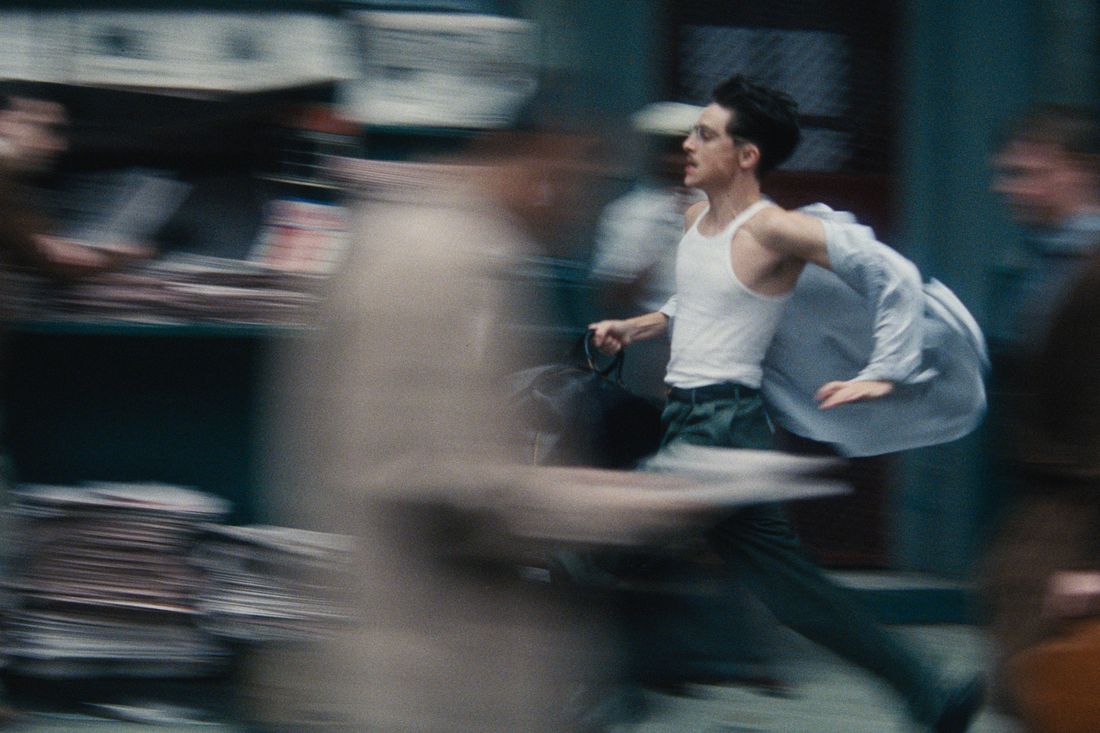
Though Good Time and Uncut Gems take place in more modern settings and their soundtracks reflect that, Marty Supreme is set in the past. The film centers on Marty, a determined young man played by Chalamet, who tries to escape poverty in New York’s Lower East Side by becoming a skilled ping-pong player and using his charm. The initial script included music from different eras. According to composer Lopatin, this reflects Marty’s desire to be ahead of his time and create an idealized version of himself, expressed through music that hasn’t yet been invented. Given Lopatin’s usual use of electronic sounds, recreating authentic 1950s music wouldn’t be a natural fit for him.
Throughout the summer and fall of 2025, composers Lopatin and Safdie collaborated on the film’s music in a small studio. Safdie requested complex, Baroque-inspired arpeggios, playfully prompting Lopatin with references to Bach’s Brandenburg Concertos. While the initial sound wasn’t quite right, they eventually created a unique score. One scene, set in Central Park, moves from a light, minimalist tune to a dramatic guitar solo. Elsewhere, the music echoes the grand, orchestral style of groups like the Trans-Siberian Orchestra. The blending of classical elements with 80s hits, like Tears for Fears’ “Everybody Wants to Rule the World” and a beautiful choral version of Alphaville’s “Forever Young,” contributes to the film’s unusual, time-bending feel. The score has been recognized for its quality and is currently being considered for an Academy Award.
Daniel Lopatin’s work with the Safdie brothers led to a collaboration with The Weeknd, beginning with music for the film Uncut Gems that wasn’t ultimately used. Since then, they’ve worked together on several albums, a Super Bowl halftime show, and a full-length movie. Lopatin is clearly impressed with The Weeknd’s voice, saying it’s so beautiful it can be distracting during work. He scored Hurry Up Tomorrow, a film essentially functioning as a long-form music video exploring the difficulties of being a pop star, which accompanied The Weeknd’s last album under that name. The film received largely negative reviews, with The New York Times calling it empty and Pitchfork criticizing it as being overly focused on The Weeknd’s public persona. Lopatin defends the film, describing it as an enjoyable rock opera and suggesting that criticism was influenced by the negative reception of The Idol, another series about the challenges of pop stardom. He believes critics sometimes simply repeat each other’s opinions rather than forming their own.
He doesn’t just feel bad for famous people. He was recently deeply disturbed by a cruel video on Instagram where someone used AI to scare an elderly person. He believes this kind of thing, and the general lack of shared understanding of what’s real, is deeply upsetting and draining. He feels like humanity is slipping away, almost within reach but slowly drifting further and further apart.
Lopatin isn’t against using artificial intelligence in music. In fact, he used AI-generated and altered sounds on his 2023 album, Again, even incorporating OpenAI’s Jukebox. He feels AI was most interesting when it was imperfect. Now that it’s improving, he thinks it’s becoming too generic. While he’s skeptical of many claims made by the tech industry, he’s open to AI as a creative tool. He believes artists shouldn’t dismiss something simply because it’s flawed, arguing that doing so limits their perspective. However, he chose not to use AI when creating his latest album, Tranquilizer, or the score for Marty Supreme.
Lopatin calls his artistic approach “compressionism,” which aims to capture and simplify the messy, often disturbing aspects of modern life. He explains it as a question: “Do you want to take control and find enjoyment even as things fall apart?” (This is a key theme in his work, Marty Supreme.) Or, will you simply let the chaos overwhelm you and feel trapped by it?
Read More
- United Airlines can now kick passengers off flights and ban them for not using headphones
- Gold Rate Forecast
- How to Solve the Glenbright Manor Puzzle in Crimson Desert
- All Golden Ball Locations in Yakuza Kiwami 3 & Dark Ties
- How to Get to the Undercoast in Esoteric Ebb
- 8 Actors Who Could Play Blackbeard In One Piece Live-Action Season 3
- Netflix’s 4-Part Crime Thriller Is One Of Its Very Best
- How to Complete Bloom of Tranquility Challenge in Infinity Nikki
- Blind Tekken 8 player reaches one of the game’s highest ranks after two years of grinding
- “A waffle has many spheres” is puzzling you in Cookie Jam? We know the answer
2025-12-30 15:56