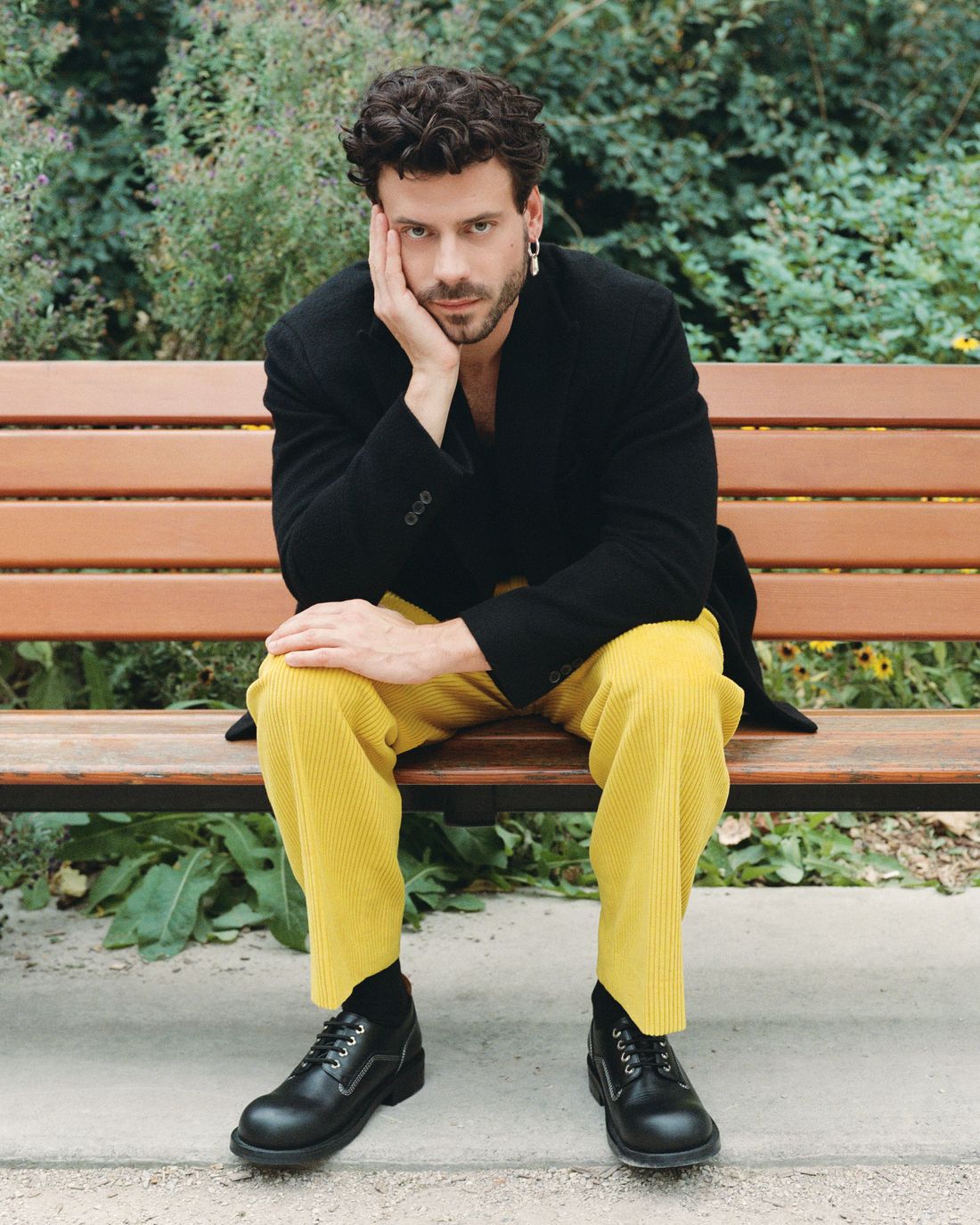
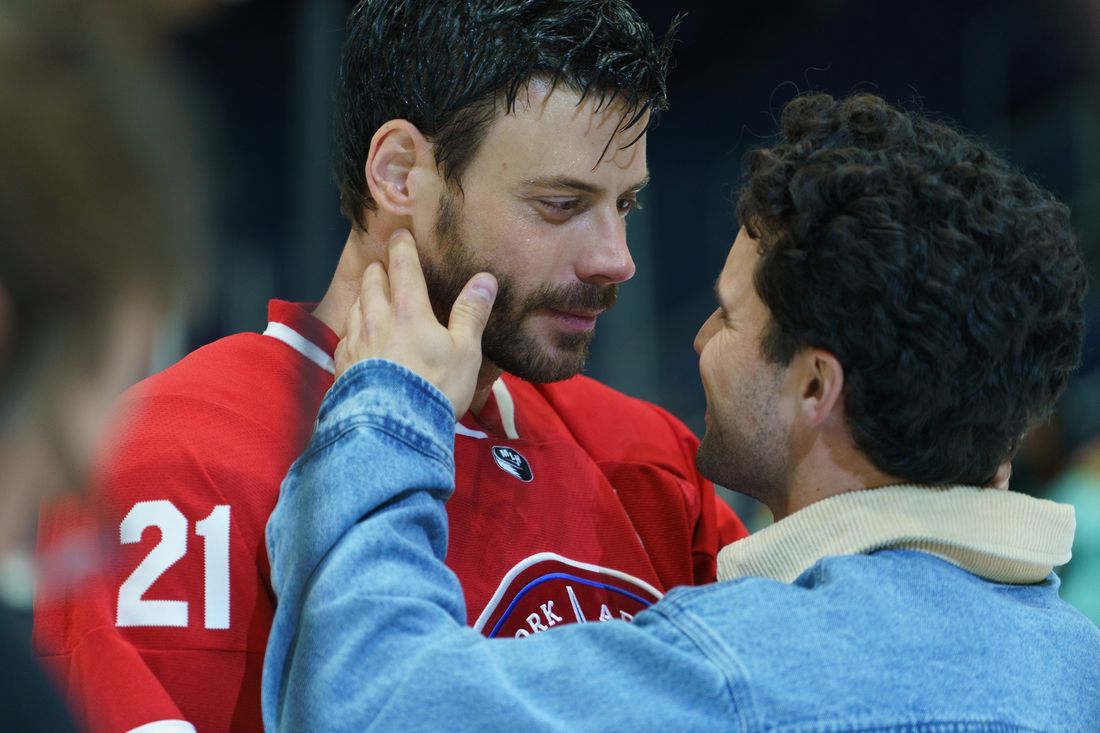
The show Heated Rivalry just took a big step forward in its portrayal of LGBTQ+ relationships. While the series mainly focuses on Ilya and Shane, a secondary couple publicly came out at the end of episode five. We see New York Admirals captain Scott Hunter, played by François Arnaud, leading his team to a Stanley Cup win. After the celebration, Scott spots his ex-boyfriend, Kip (Robbie G.K.), in the crowd and invites him onto the ice. To the soundtrack of Wolf Parade’s “I’ll Believe in Anything” – the same song that played when they first connected – Scott shares a public kiss with Kip, effectively coming out to his team and the world. This is the first time the show has featured a public gay kiss, and it provides a satisfying emotional release after weeks of building tension.
Both on screen and in real life, Arnaud is the most experienced member of the cast at 40 years old, playing a contrasting role to the younger leads who are in their early twenties. He’s a familiar face, having appeared in many shows like Schitt’s Creek, Yellowjackets, and unReal, and had starring roles in The Borgias on Showtime and The Moodys on Fox. What sets Arnaud apart is his ability to play both straight and LGBTQ+ characters, which is unusual in an industry that often typescasts actors. While he’s consistently worked, Heated Rivalry represents his biggest opportunity yet – it’s the first time he’s been the central focus of such a popular show.
Before I was cast in Rachel Reid’s series, I hadn’t read much romance and wasn’t familiar with her books. But I quickly learned they were very popular. I’ve known Jacob Tierney for 17 years – we’d been trying to collaborate on a film for a while, but it never happened. We reconnected when he directed some episodes of a show I did for Fox, called The Moodys. I really admire his work, and I think he feels the same way about mine. He’s incredibly intelligent. He called me and suggested I read episodes three, five, and six if I didn’t have time for the whole series, but I ended up reading everything. My agent and I were reading the first episode – where I don’t have a huge role – and we both thought it was incredibly intense.
So, are you asking about sex? Yes, sex is involved. I wasn’t sure how that aspect would work, but I doubted Jacob would do anything he didn’t genuinely feel comfortable with. I expected him to approach it in a unique way, and that’s how I see the show too. The explicit content is what initially draws people in, and there’s nothing wrong with that, but it develops into something much deeper and more meaningful – while still being, in my opinion, quite sensual.
I was glad my character’s journey allowed for a fresh take on coming to terms with identity, both personally and within the high-pressure world of sports. There were many moments with Scott where I felt empowered to express things I’d been wanting to say. The writer, Jacob, even told me he hadn’t originally envisioned me in the role, but that he couldn’t help but imagine me speaking the lines as he wrote them.
When I said I was “ready to say those words,” I was referring to the intense emotional moment my character shares with Kip after their first night together. I really felt that scene deeply. We didn’t film it until later, but I was prepared, as the character, to finally express those feelings. The actor playing Scott, had a tough upbringing but a successful career, and he carries himself in a way that suggests he’s always holding back. Despite not fully being comfortable with how others see him, he’s very emotionally open, which I connected with. Personally, I’m not interested in superficial relationships; I want something more meaningful.
So, you’re saying you don’t believe in casual relationships? That makes sense. I’m not really into that scene. I prefer to keep my circle small and focus on building strong, meaningful connections with people. I guess you could say I’m a bit of a homebody when it comes to relationships.
Scott and Kip are incredibly attracted to each other. It’s often joked that they’re a couple who move in together very quickly, and honestly, that feels pretty accurate.
The connection between these two characters feels natural, even if it started by chance. The show is, at its heart, a romantic fantasy – it’s not meant to be realistic, and it stays true to the core of the love story while adding other elements. It’s a classic story of two people meeting and falling for each other.
It’s interesting that Kip is openly gay, as he’s one of the few characters on the show who is. It makes you wonder about Scott’s attraction to him, especially considering how some men who are hiding their sexuality might react to openly gay people. I hadn’t considered that before, but you’re right – their connection was clear. The sad part is that Scott eventually asks Kip to hide his true self, to go back into the closet and pretend he hasn’t come so far. That’s why Scott skips Kip’s birthday party – his love is so strong that he prioritizes Kip’s happiness, even if it means sacrificing their relationship.
He’s upset after being criticized by Kip’s friend, and it was interesting to portray that moment. For Scott, it’s a harsh wake-up call – he suddenly understands how self-centered he’s been and doesn’t consider what he’s asking of Kip. It really shocks him. I’ve noticed a tendency in some well-known people to believe others should feel privileged to be around them, and that perspective is something the character embodies. But another character offers a contrasting viewpoint that really makes an impact.
Let’s discuss the kiss scene at the end of episode five. Could you describe how you envisioned it playing out? It’s a pivotal moment for the character – he’s surrounded by teammates celebrating with loved ones, but feels incredibly alone. He’s both energized by the victory and completely drained, needing a moment to breathe it all in. Everything is happening quickly, and he’s facing a deep fear that he ultimately decides to overcome. He realizes that life has no meaning if he can’t share these moments with the person he cares about.
It doesn’t seem like he has many friends outside of his hockey team. He’s a very private person, and keeping a long-held secret has caused him to become isolated. He’s afraid of his secret being revealed, so he intentionally keeps his social circle small. He’s particularly close to his teammate, Carter, and those involved with the show wondered if Carter had any idea about his personal life. He’s carefully cultivated a public image as a perfect role model, and as the team captain, he feels responsible for protecting not only himself but also the reputation of the sport. This concern heavily influenced how his character was portrayed playing hockey in the show.
It’s funny, people always ask me how someone like him even plays hockey! It’s such a rough sport, but Scott always rises above it all. Honestly, playing him is a trip – he’s the most genuinely good person I’ve ever portrayed. He’s almost too nice, a little boring even, but in the best way!
That also feels like it takes away his individuality. It’s as if people won’t be curious about him as a person, because he’s focused entirely on being the ideal representative for his sport and team.
There wasn’t much discussion about traditional ideas of masculinity on set, and that was a good thing. Because Jacob was the writer, producer, and director, he could make decisions quickly and we often finished filming an hour early. It was a really positive and happy environment – the best I’ve ever experienced. We had a strict rule against anyone being difficult or demanding, and it truly felt like we were all working together as a family.
The story clearly conveyed a strong sense of masculinity, and it didn’t require a lot of explanation. I hadn’t read the original source material before filming began. I felt a strong connection to the script and wanted to stay true to it. Plus, Jacob had great confidence in the actors he’d chosen. While Connor and Hudson might have had more complex intimacy work, our approach was simpler.
Filming the intimate scenes was a really positive experience. So often in movies and TV, you see characters develop a connection, then suddenly cut to a sex scene that feels generic. But the director, Jacob, was very thoughtful about why each scene existed and how it fit into the story, which made them all feel special and unique. That’s what makes it enjoyable to watch – it doesn’t just feel like it’s there to shock or excite people. Of course, it likely does that too! For us, unlike some other characters who start out repressed, it was clear from the beginning that these two characters were finding something freeing and joyful in their physical connection. Jacob encouraged us to just have fun and laugh, like we were genuinely happy to be together.
As a gay viewer, I really appreciated the frankness of two moments in episode three – when one character directly asks the other if they could sleep together. It felt incredibly natural and was a refreshing contrast to other interactions on the show. What really sets our relationship apart from the main couple is that Scott seems to suppress his attraction to men in public, but feels completely free to express it when he’s with Kip in private. A moment that stood out to me was when I asked him to stay, and I came back to find him relaxing on the couch in his glasses. It was like a weight lifted, and he just seemed genuinely happy and excited – almost childlike in his joy.
This is also shown by the fact that they’re the most open couple on the show. It really shows how comfortable they are with each other and how much they want this.
You seem a little bashful talking about sex stuff on the sex show.
I guess so. Maybe I am.
Did you experience that feeling while you were filming as well? Not really. We addressed it early on – we all had to consider if we were comfortable with the show’s explicit content. After that, we didn’t think about it much. I’ve been hearing Connor and Hudson discuss how the show is viewed, and it’s strange to see those perceptions. We quickly focused on other aspects of the production!
It’s a bit strange to be seen that way. I understood it would be part of the role when I accepted it, but it doesn’t quite match how I personally view the character. I’m not overly modest, but I am somewhat shy.
What’s the difference between discussing sex and discussing sexuality? When portraying intimacy as an actor, the key is to get into a mindset where you block out the audience. It’s about truly living a private, intimate moment between two characters, even with a film crew present.
Now that people are watching, will you change your approach for the second season?
That’s something I need to avoid thinking about. It’s like an editor needs to cut out mistakes – I have to block out the pressure of the audience. Focusing on viewership would ruin the natural feel of the show. That’s the main challenge for season two. We created the first season without expecting such a huge response, and that allowed for a more genuine result.
You mentioned wanting the show to feel “authentic,” but also described it as a “fantasy.” How do those two concepts work together? I always try to find the truth in my characters, but this isn’t a real-life story. While it deals with relatable and realistic issues, it’s also meant to be hopeful. Jacob—the creator—wanted to give LGBTQ+ characters joyful endings, free from the tragedies often associated with their stories. Everyone deserves that kind of happiness. We really aimed for a classic romantic comedy vibe with this episode.
As a movie lover, I don’t think it’s our job to try and speak for everyone in a certain group. What really matters to me is telling a specific story about specific people, in a particular situation, and hoping that resonates with viewers. I connect with so many films that don’t directly reflect my own life, and that’s okay! For example, watching something like 45 Years, a movie about an elderly couple, can be surprisingly moving even if I’m decades away from that stage of life. I think that’s a big part of why people connect with this show – it doesn’t have to be about their lives to still make them feel something.
It seemed like you were referencing Jordan Firstman’s remark that Heated Rivalry didn’t portray gay experiences accurately. And yes, that’s essentially what I wanted to get at. I don’t think everyone experiences things the same way. For example, I really enjoyed Rotting in the Sun and admire Sebastian Silva’s work. Jordan Firstman was great in it, but that movie doesn’t necessarily reflect my personal experiences, and I can still appreciate it.
You mentioned it being about “scene-y L.A. guys” on Instagram, and I don’t see a problem with that. It just doesn’t feel like that’s the focus of our show. It’s also not necessarily about my personal experiences, though I can still connect with it. Plus, there was a lot of discussion about the sexualities of the actors, and I wanted to support my co-stars, especially those who are just starting out. Let’s give them some space to figure things out.
I agree with Jordan’s point that it’s wrong to suggest an actor’s career suffers if they don’t publicly come out. I personally kept my private life private for a long time, and it didn’t impact my career either. I believe everyone deserves understanding, and it’s unfair to expect young actors to constantly share personal details, even though they’ve already contributed so much to the show. While positive representation is valuable, actors aren’t obligated to reveal their private lives. It’s a personal choice – if they want to, that’s great, but it shouldn’t be a requirement.
I realized I was tired of hiding who I am – it just didn’t feel right anymore. I’m proud of who I am, and I don’t want to give anyone the impression that being myself is something to be ashamed of. Being authentic is really important to me. I’m incredibly passionate about movies and acting, but my happiness and living my truth mean even more.
I’ve been hesitant about the show Heated Rivalry, partly because I dislike how it seems to celebrate a narrow idea of what it means to be a man. The show’s steamy scenes feel like they rely on a sense of embarrassment. However, I don’t think our episode does that.
Scott gets really embarrassed when he looks at art. And, movies often explore the theme of forbidden romance.
I was really touched by the coming-out scene in episode five, and it actually surprised me. It’s easy to assume you wouldn’t feel any sympathy for that situation, but I did.
I might seem like a flamboyant gay man from New York. I didn’t mean that as an insult to anyone, and I believe everyone is entitled to their own preferences.
It was a little shady.
I found it an entertaining turn of phrase.
Sometimes when I watch a show or movie, I notice that the gay characters are often portrayed as very traditionally masculine and don’t outwardly express their sexuality. While that’s the basis of this particular show, and people are free to not watch if it doesn’t appeal to them, I think it deserves a chance. I get why some people feel the show might be overly focused on the idea of being in the closet, especially with its sexual content, but it’s just the starting point for the story.
As Scott continues to explore his identity, does the show have a responsibility to reflect contemporary LGBTQ+ experiences? I believe the most important thing is to stay true to the characters and their individual journeys. There’s space for all kinds of stories, both queer and straight, that show a range of experiences, and that’s what I wanted to emphasize after Jordan shared his thoughts. I’m not sure if his message was simply expressed in a confusing way.
I thought the message was delivered clearly, but it came across as unnecessarily harsh. It definitely had an unpleasant edge. I don’t believe in blindly following expectations or conforming to what’s considered ‘normal.’ I find groupthink draining and always try to question it. I struggle with the concept of responsibility in general. Being reckless isn’t good, but a show’s primary responsibility is to its characters and their stories. It’s unrealistic to expect a single show to represent an entire group of people. What we really need is a variety of portrayals showing different experiences and perspectives.
Read More
- United Airlines can now kick passengers off flights and ban them for not using headphones
- Crimson Desert: Disconnected Truth Puzzle Guide
- All 9 Coalition Heroes In Invincible Season 4 & Their Powers
- Grey’s Anatomy Season 23 Confirmed for 2026-2027 Broadcast Season
- Mewgenics vinyl limited editions now available to pre-order
- Viral Letterboxd keychain lets cinephiles show off their favorite movies on the go
- Does Mark survive Invincible vs Conquest 2? Comics reveal fate after S4E5
- All Golden Ball Locations in Yakuza Kiwami 3 & Dark Ties
- How to Get to the Undercoast in Esoteric Ebb
- The Boys Season 5 Spoilers: Every Major Character Death If the Show Follows the Comics
2025-12-19 18:59