Ethereum has slipped below the cherished $2,000 mark again, like a nervous hedgehog fleeing a vacuum cleaner while the universe watches and quietly judges the entire concept of financial certainty. The broader crypto market is in a mood that says “don’t get too attached to anything,” which is a nice way of saying the carpet keeps being rearranged while you’re still trying to find your shoes.
A recent CryptoQuant report offers a tidy slice of context by chronicling so-called “accumulating addresses.” Think of these as wallets designed for people who insist on long-term conviction and have decided that selling is for other, less imaginative civilizations. These addresses show no history of outflows, have received at least 100 ETH in their latest inflow, recorded multiple inbound transactions, maintain balances above 100 ETH, and have remained active over the past seven years while excluding exchanges, miners, and smart contract wallets.
According to the report, these accumulation addresses now hold roughly 27 million ETH, representing about 23% of the circulating supply. This concentration suggests that a significant share of Ethereum remains in the care of those who would probably set up a small shrine to the cost bases they’ve stubbornly preserved, even as the market pirouettes around them.
Still, persistent selling pressure below $2,000 highlights the market’s sensitivity to macro conditions, leverage dynamics, and shifting capital flows, leaving Ethereum at a critical inflection point in the near term. Whether buyers defend this area or allow further downside will likely shape sentiment, volatility expectations, and short-term positioning across the Ethereum derivatives and spot markets.
Ethereum Traded Below the Accumulating-Address Realized Price
Ethereum’s recent price action gains additional context from the same CryptoQuant analysis. It highlights how ETH is currently trading relative to the Realized Price of accumulating addresses-the average acquisition cost of long-term conviction holders, which is a nicely bureaucratic way of saying “this is where the folks who bought in early would like to pretend they didn’t overpay.” Historically, trading below this level has been rare and often associated with periods of elevated stress.

According to the report, ETH has traded below the Realized Price of these accumulating addresses only twice over the past nine years. The first occurrence happened during the 2025 cycle low, a moment when broad market weakness and liquidity contraction pushed prices into deep discount territory. The second instance has been unfolding since January 2026, suggesting that current conditions are again testing long-term holders’ cost bases with the calm of a librarian during a thunderstorm.
From a structural standpoint, this deviation can be read in two ways. It may signal capitulation and undervaluation-weak hands exiting while sturdier investors accumulate, like people retreating to the last lifeboat. Alternatively, prolonged trading below realized cost levels can reflect persistent macro headwinds, subdued demand, or leverage unwinds delaying any heroic recovery.
Price Action Showing Weakness
Ethereum’s price action continues to exhibit structural weakness on the weekly chart, with ETH recently losing the psychological $2,000 level after failing to hold above its key moving averages. The break below this zone places the price back under the mid-cycle support area that previously acted as both accumulation and breakout territory, which is a fancy way of saying the universe can be annoyingly repetitive about technicals.
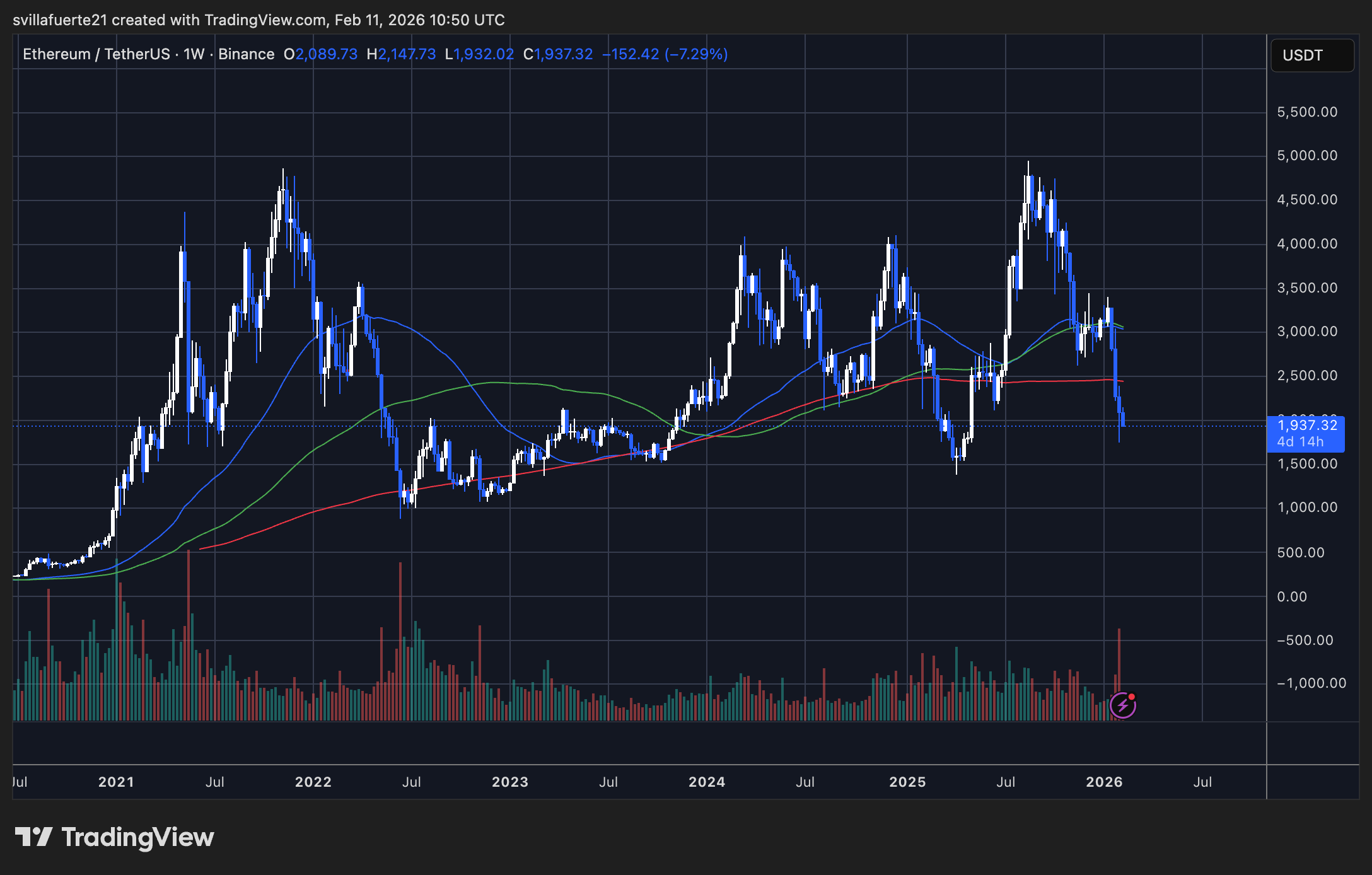
ETH remains below the shorter-term weekly moving average. The longer-term trend lines appear to be flattening, reflecting slowing momentum rather than a clear path forward. Volume patterns also suggest distribution, with recent selloffs accompanied by rising activity, typically associated with risk reduction and position unwinding. In short, the market seems to be tidying up its pockets before deciding whether to embark on the next grand adventure or simply sit stubbornly in a corner and sulk.
Historically, similar setups have preceded either extended consolidation phases or deeper corrective moves. It usually depends on broader liquidity conditions and macro risk appetite. If buyers fail to reclaim the $2,000 region quickly, downside targets could shift toward previous high-volume nodes near the $1,600-$1,700 range, where demand previously kept a cheerful ledger of hopes alive.
Conversely, a decisive recovery above that level would improve sentiment and would also suggest the recent move was primarily a leverage-driven flush rather than the start of a broader structural downtrend for Ethereum in this cycle. Until then, price action likely remains sensitive to macro liquidity shifts and derivatives market positioning dynamics overall, as if the market were participating in a long-running, very expensive game of musical chairs-only with charts and more existential dread.
Read More
- United Airlines can now kick passengers off flights and ban them for not using headphones
- Gold Rate Forecast
- How to Solve the Glenbright Manor Puzzle in Crimson Desert
- All Golden Ball Locations in Yakuza Kiwami 3 & Dark Ties
- How to Get to the Undercoast in Esoteric Ebb
- 8 Actors Who Could Play Blackbeard In One Piece Live-Action Season 3
- How to Complete Bloom of Tranquility Challenge in Infinity Nikki
- All MLB The Show 26 Quirks & What They Do
- Blind Tekken 8 player reaches one of the game’s highest ranks after two years of grinding
- Is Wuthering Heights a romance? Update on Margot Robbie movie controversy
2026-02-12 08:41