Clark Forrest explores extreme roleplay fantasies – everything from acting like a newly-made sex robot to submitting to a dominant partner – all centered around giving up control. While these fantasies might seem common or even uninspired to some, the actor’s detached performance highlights the underlying sadness and strange situations that can disrupt even the most comfortable American lives. It’s about a search for something beyond himself, even if it’s a bit bleak.
The episode “Go Getter” shifts focus from the current murder case to explore the events that led up to it, which breathes new life into the characters and their complicated relationships in DTF St. Louis. It feels like a complete, well-developed TV episode. The way the story jumps between past and present isn’t about delaying answers, but about building a strong foundation for the increasingly complex love triangle and the emotional secrets – hidden behind what Detective Homer calls “suburban lies” – that are starting to come to light.
Okay, let me tell you, everything is pointing to Carol as the one who orchestrated Floyd’s death. And it’s chilling how she’s manipulating Clark – he’s clearly vulnerable and easily led. This episode really hammers that home, starting with a flashback to their first meeting at Jamba Juice. We see Carol being incredibly difficult with the employee, just to establish her controlling nature. Then, we get a truly bizarre and revealing memory from Clark – he recalls hearing Carol’s sob story right after… well, a very intimate moment. It’s clear what she’s doing: she’s using Floyd’s financial troubles as leverage, preventing herself from fully committing to this new life with Clark. Honestly, with Linda Cardellini delivering such a captivating performance, who wouldn’t fall under her spell? It’s masterful, and frankly, a little terrifying.
The story cuts to Clark, who is currently under investigation, and we learn he connected his desire for sexual control with a broader need to be controlled in all areas of his life. While it’s still unclear exactly what Clark is hiding and who he’s protecting, it’s becoming clear he’s deliberately withholding information to shield Carol. A scene of Carol aggressively demanding joggers move while listening to a motivational audiobook feels like an overly forceful attempt to establish her as a flawed character so early in the series. The plot will undoubtedly become more complex, but the audiobook, titled “Life Champions,” highlights how Carol’s actions might be a result of the self-centeredness common in modern American society, where self-care often feels empty and driven by social media. The audiobook’s advice – focusing on personal gain and prioritizing oneself above others – effectively frames Carol’s behavior as a symptom of this larger trend: “Think about how your relationships demand your time, attention, and energy. Then ask yourself what you get out of them. This is a competition. You can’t win if you don’t put yourself first.”
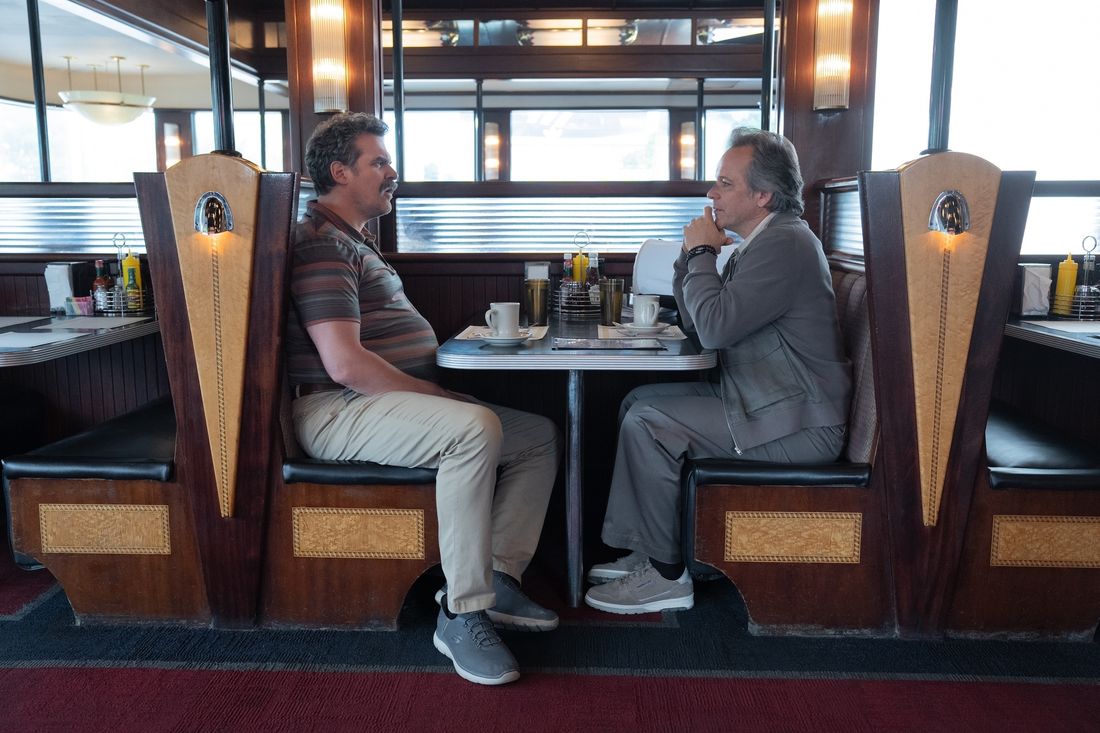
This week’s episode highlights the awkwardness of Floyd’s search for connection using the DTF app. His date, played by Peter Sarsgaard, is a familiar type: a middle-aged, suburban gay man—a role expertly brought to life despite the actor’s profile picture featuring David Bowie in a dress. Sarsgaard elevates even a somewhat predictable character, and his chemistry with David Harbour is fantastic. From the moment they meet at the diner, it’s clear this date is a misstep, but Floyd continues out of politeness. It makes you wonder how many first dates have been derailed by a Bowie profile picture! The scene that follows, including a surprisingly homoerotic workout, is equally compelling, with Harbour delivering a standout line: “I think he read that like a thrusting motion because he gave me one back. He thrust one back.”
Detective Homer dismisses Floyd’s explanation for using a dating app – including a confirmed, though possibly accidental, intimate encounter – as a weak attempt to avoid responsibility, especially given he’s a murder suspect who isn’t being truthful. However, those who know Floyd see it as perfectly in character. The scene of Floyd leaving his date, contrasted with the cold, mechanical intimacy of another couple, highlights the tragedy of a genuinely kind person struggling to survive in a cruel world.
The emotional intensity peaks when Floyd finally connects with his stepson, Richard, at the skate park. Seeing Floyd, who is out of shape, surprisingly perform acrobatic moves on the parallel bars inspires Richard to believe in self-improvement, especially when it helps build real relationships. Richard’s joyful comment, “This is way better than therapy,” is heartbreaking because he’s about to lose the one person who provides him with friendship and a sense of stability.
Clark insists he would never harm Floyd, stating he loved him deeply – a love he describes as essential as water itself. He’s stopped talking without a lawyer present, unnerved by the appearance of a mysterious key held by Homer and Plumb, which prevents him from confessing further. He does admit to forming a genuine connection with Floyd, even though Floyd was already facing danger. A brief, touching memory of Floyd and Clark embracing hints that Carol’s plan to kill Floyd for insurance money – a plan designed to make it seem like she knew nothing about the policy, which Clark handled – isn’t the full picture. Carol’s portrayal as a ruthless killer also feels incomplete, especially considering her final, cryptic words to her grieving son, promising to provide for them no matter what. These words raise the question: how much of anyone’s behavior in this case is truly their own, and how much is influenced by hidden, powerful forces?
Read More
- United Airlines can now kick passengers off flights and ban them for not using headphones
- Crimson Desert: Disconnected Truth Puzzle Guide
- All 9 Coalition Heroes In Invincible Season 4 & Their Powers
- Grey’s Anatomy Season 23 Confirmed for 2026-2027 Broadcast Season
- Mewgenics vinyl limited editions now available to pre-order
- Viral Letterboxd keychain lets cinephiles show off their favorite movies on the go
- Does Mark survive Invincible vs Conquest 2? Comics reveal fate after S4E5
- How to Get to the Undercoast in Esoteric Ebb
- Assassin’s Creed Shadows will get upgraded PSSR support on PS5 Pro with Title Update 1.1.9 launching April 7
- All Golden Ball Locations in Yakuza Kiwami 3 & Dark Ties
2026-03-16 05:55