Author: Denis Avetisyan
Researchers have developed a convolutional operator network capable of modeling and predicting the complex dynamics of plasma turbulence, opening new avenues for understanding and controlling this pervasive phenomenon.
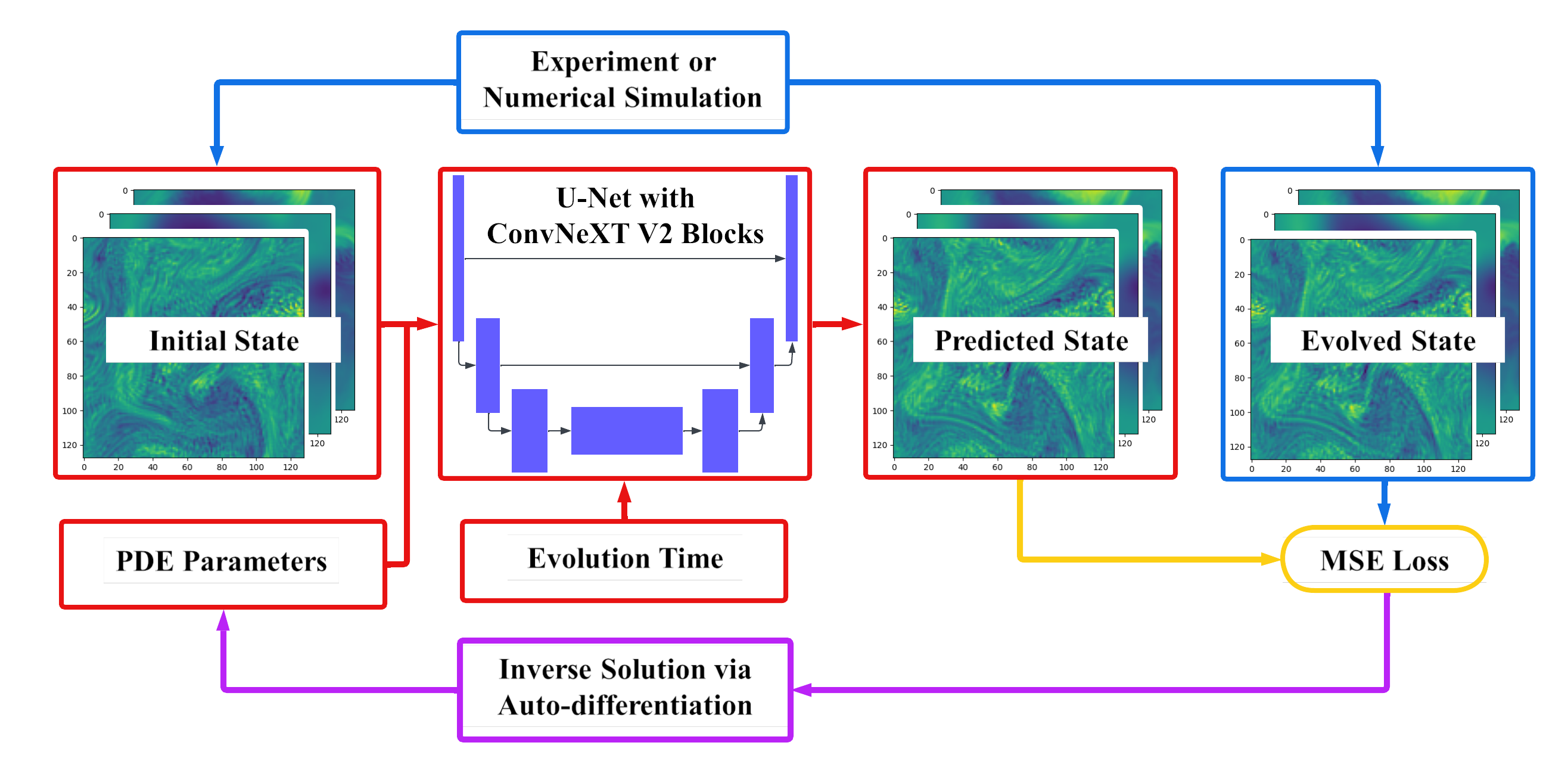
This work introduces FI-Conv, a deep learning framework for solving forward and inverse problems in plasma physics, specifically applied to the Hasegawa-Wakatani equations and parameter estimation.
Accurate modeling of complex spatio-temporal dynamics, such as turbulent systems, remains a significant challenge due to computational constraints and the need for efficient parameter estimation. This work introduces the ‘Convolution Operator Network for Forward and Inverse Problems (FI-Conv): Application to Plasma Turbulence Simulations’, a novel framework leveraging a U-Net architecture with ConvNeXt V2 blocks to predict system evolution and infer governing parameters. Demonstrating strong performance on the Hasegawa-Wakatani equations-a model for two-dimensional electrostatic drift-wave turbulence-FI-Conv achieves accurate short-term forecasting and captures long-term statistical properties while simultaneously enabling gradient-based inverse estimation of PDE parameters. Could this approach provide a broadly applicable alternative to traditional physics-informed machine learning methods for a wider range of complex systems?
Decoding Chaos: The Turbulence Problem
The quest for sustainable fusion energy hinges significantly on accurately characterizing and forecasting plasma turbulence, a complex phenomenon effectively modeled by the Hasegawa-Wakatani equation. Within a fusion reactor, this turbulence governs the transport of heat and particles, directly impacting the efficiency and stability of plasma confinement-the crucial step in harnessing fusion power. Unpredictable turbulent fluctuations can lead to energy losses and disruptions, hindering the development of practical fusion devices. Therefore, a comprehensive understanding of these instabilities is not merely an academic pursuit, but a fundamental requirement for realizing fusion as a viable energy source, demanding innovative approaches to both experimental observation and computational modeling of plasma behavior.
Simulating plasma turbulence, as described by equations like the Hasegawa-Wakatani model, presents a significant computational hurdle due to the inherent complexities of the system. These simulations are not simply demanding in terms of processing power; the very nature of plasma turbulence introduces challenges traditional numerical methods struggle to overcome. The high dimensionality arises from needing to model the behavior of plasma across multiple spatial dimensions and a wide range of frequencies. Compounding this is the nonlinearity – small changes in initial conditions can lead to dramatically different outcomes, making long-term prediction exceedingly difficult. Standard numerical techniques, designed for simpler, linear systems, often require impractically fine resolutions or become unstable, producing inaccurate or meaningless results. This limitation hinders progress in fusion energy research, where understanding and predicting turbulent transport is crucial for achieving sustainable plasma confinement.
The pursuit of predictive accuracy in plasma turbulence hinges on the ability to resolve the intricate dance of spatiotemporal dynamics-how structures evolve both in space and over time. This presents a substantial computational challenge, as traditional simulation techniques falter when confronted with the sheer dimensionality and nonlinearities inherent in these systems. Effectively capturing these dynamics necessitates approaches that are not only efficient – minimizing computational cost – but also scalable, meaning they can handle increasingly complex simulations as computational resources grow. Researchers are actively exploring innovative algorithms and leveraging high-performance computing architectures to meet this demand, aiming to bridge the gap between current capabilities and the detailed understanding required for controlled fusion energy. The development of such methods promises a more reliable pathway towards harnessing the potential of fusion as a clean and sustainable energy source.
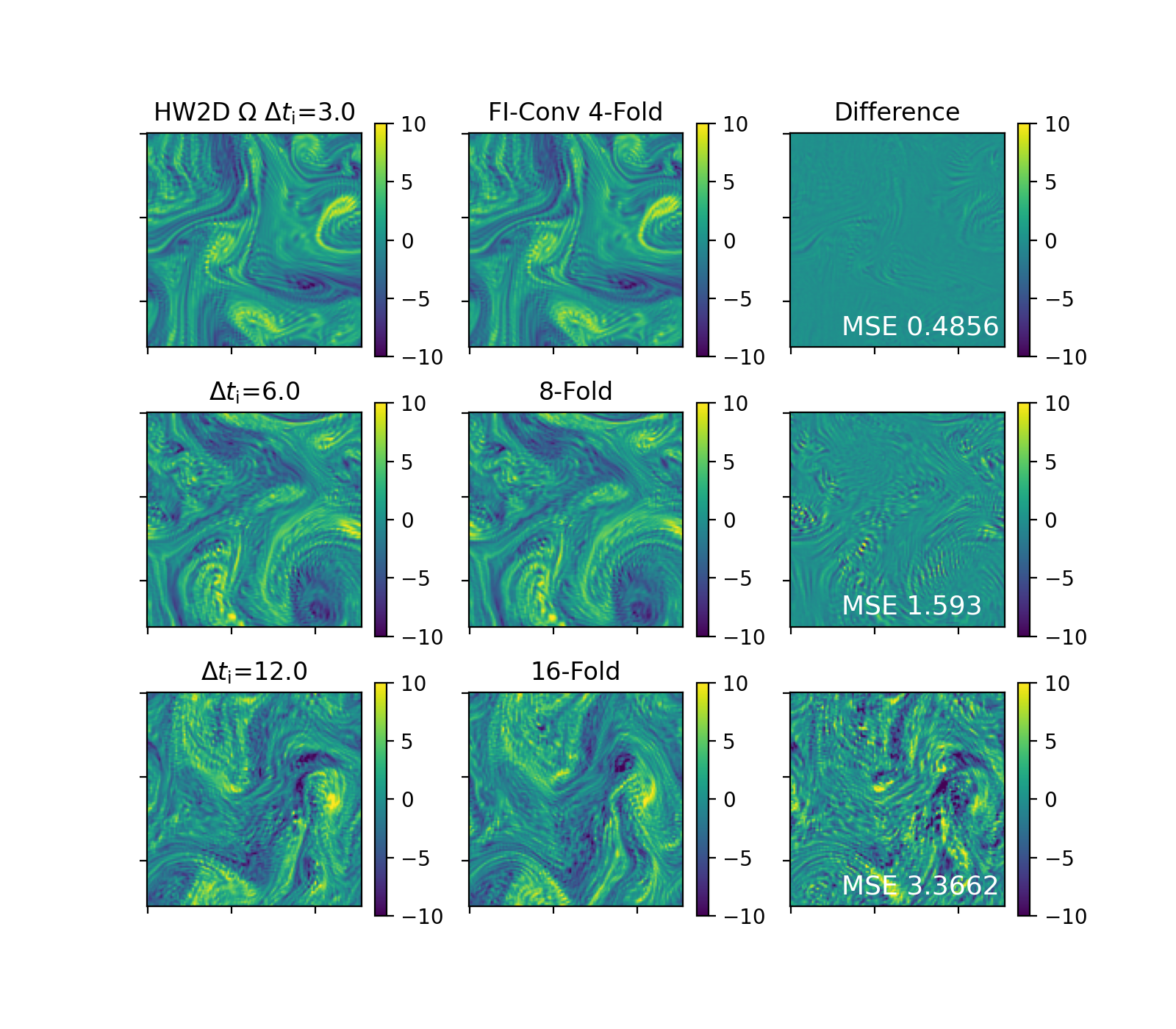
FI-Conv: A System for Dissecting Spatiotemporal Complexity
FI-Conv is a convolutional operator network developed to overcome the deficiencies of existing numerical methods when solving the Hasegawa-Wakatani Equation, a nonlinear partial differential equation relevant to plasma physics. Traditional approaches often struggle with computational cost and accuracy when modeling the complex spatiotemporal dynamics described by this equation. FI-Conv utilizes convolutional layers to directly learn the operator that maps input fields to their temporal derivatives, thereby bypassing the need for explicit discretization schemes. This operator learning approach allows for potentially faster and more accurate solutions compared to finite difference or spectral methods, particularly for high-dimensional and complex scenarios.
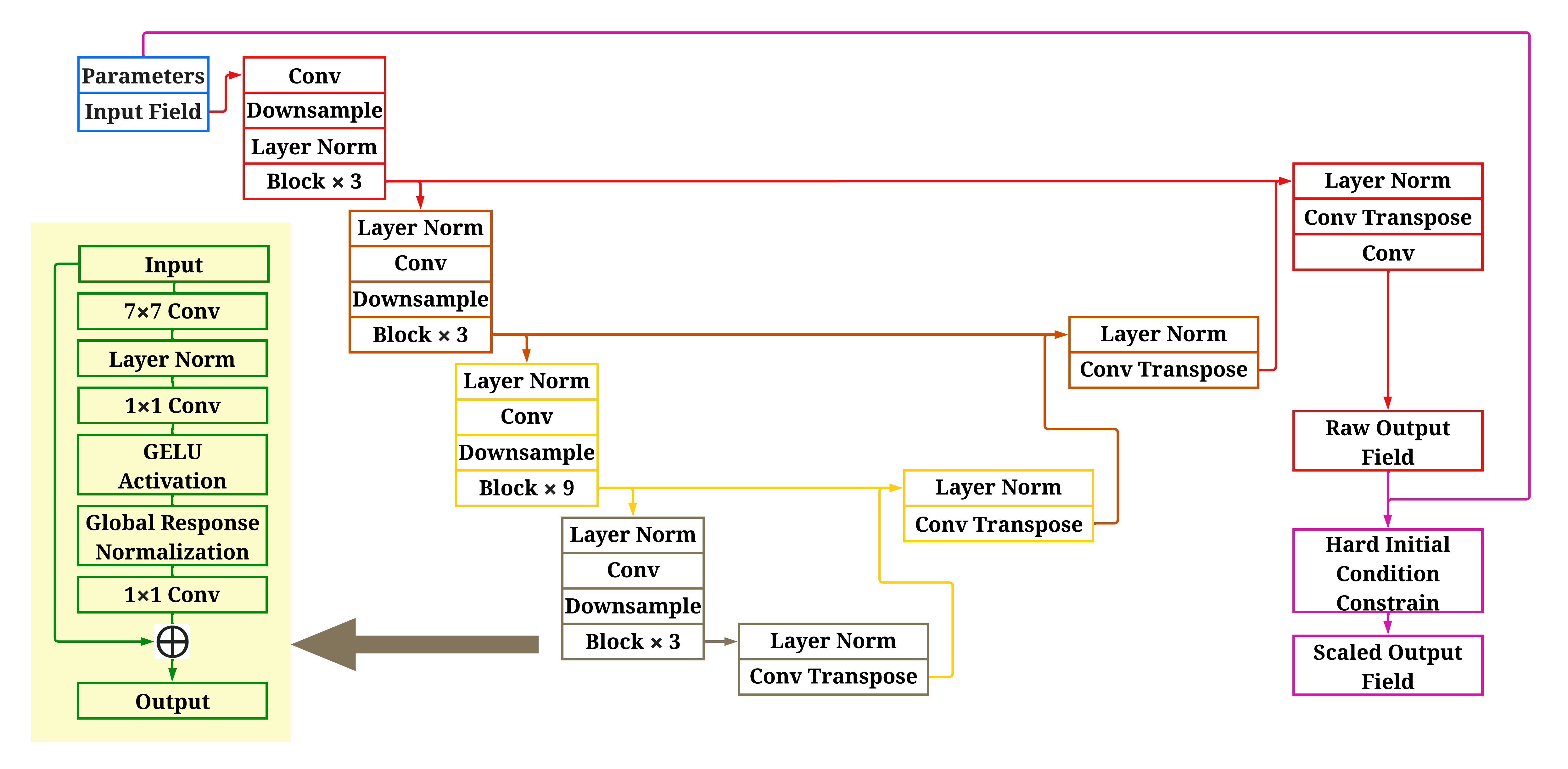
FI-Conv utilizes the computational efficiency of convolutional building blocks, specifically employing the ConvNeXt V2 architecture known for its performance in image recognition tasks. This foundation is integrated within a U-Net framework, a design chosen for its proven ability to capture both local and global features within data. Adaptation of the U-Net for spatiotemporal data involves modifications to handle the temporal dimension, allowing the network to process and learn from sequences of data rather than static inputs. This combination enables FI-Conv to effectively model the dynamics inherent in the Hasegawa-Wakatani Equation while maintaining a comparatively low computational cost.
Training of the FI-Conv network utilizes the Mean Squared Error (MSE) loss function, calculated as the average of the squared differences between predicted and actual values. This metric quantifies the overall error in the network’s output. Optimization is performed using the AdamW optimizer, a variant of the Adam algorithm incorporating weight decay for improved generalization. AdamW adjusts the network’s weights iteratively based on gradients computed from the MSE loss, with hyperparameters tuned to minimize prediction errors and prevent overfitting. The weight decay parameter regularizes the learning process by penalizing large weights, promoting a more stable and robust model. MSE = \frac{1}{n} \sum_{i=1}^{n} (y_i - \hat{y}_i)^2
Reconstructing the Unseen: Solving the Inverse Problem
FI-Conv addresses the Inverse Problem in plasma turbulence by directly inferring underlying physical parameters from incomplete observational data. Unlike traditional methods requiring full-field measurements, FI-Conv operates on partial observations, reconstructing a complete representation of the turbulent state. This capability is crucial for experimental diagnostics and simulations where accessing all relevant data is impractical or impossible. The system leverages a learned operator to map observed data to parameter estimates, effectively reversing the typical forward modeling process used in plasma physics. This allows for the determination of parameters governing turbulence characteristics, even when only limited information is available, and is a core distinction from conventional data analysis techniques.
The iterative solution to the inverse problem is facilitated by Autoregressive Modeling, which extends predictions beyond the directly observed data window. This technique allows for inference over longer timescales, crucial for characterizing plasma turbulence. Specifically, employing autoregressive rollout, the model achieves a Mean Squared Error (MSE) of 0.29 at a prediction time of t=600. This MSE value represents the average squared difference between the predicted and actual parameters, indicating the model’s predictive accuracy over the extended timescale.
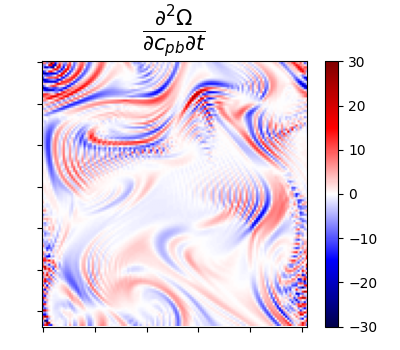
Parameter estimation within the FI-Conv model utilizes Gradient Descent to minimize the difference between predicted and observed plasma turbulence data. This iterative optimization process adjusts model parameters to reduce a defined loss function, enabling accurate determination of key parameters such as k_0 and c_p_b. The algorithm calculates the gradient of the loss function with respect to each parameter and updates the parameters in the opposite direction of the gradient, continuing until a convergence criterion is met. Successful application of this method results in reliable estimation of these parameters, contributing to the model’s overall accuracy in inferring plasma turbulence characteristics.
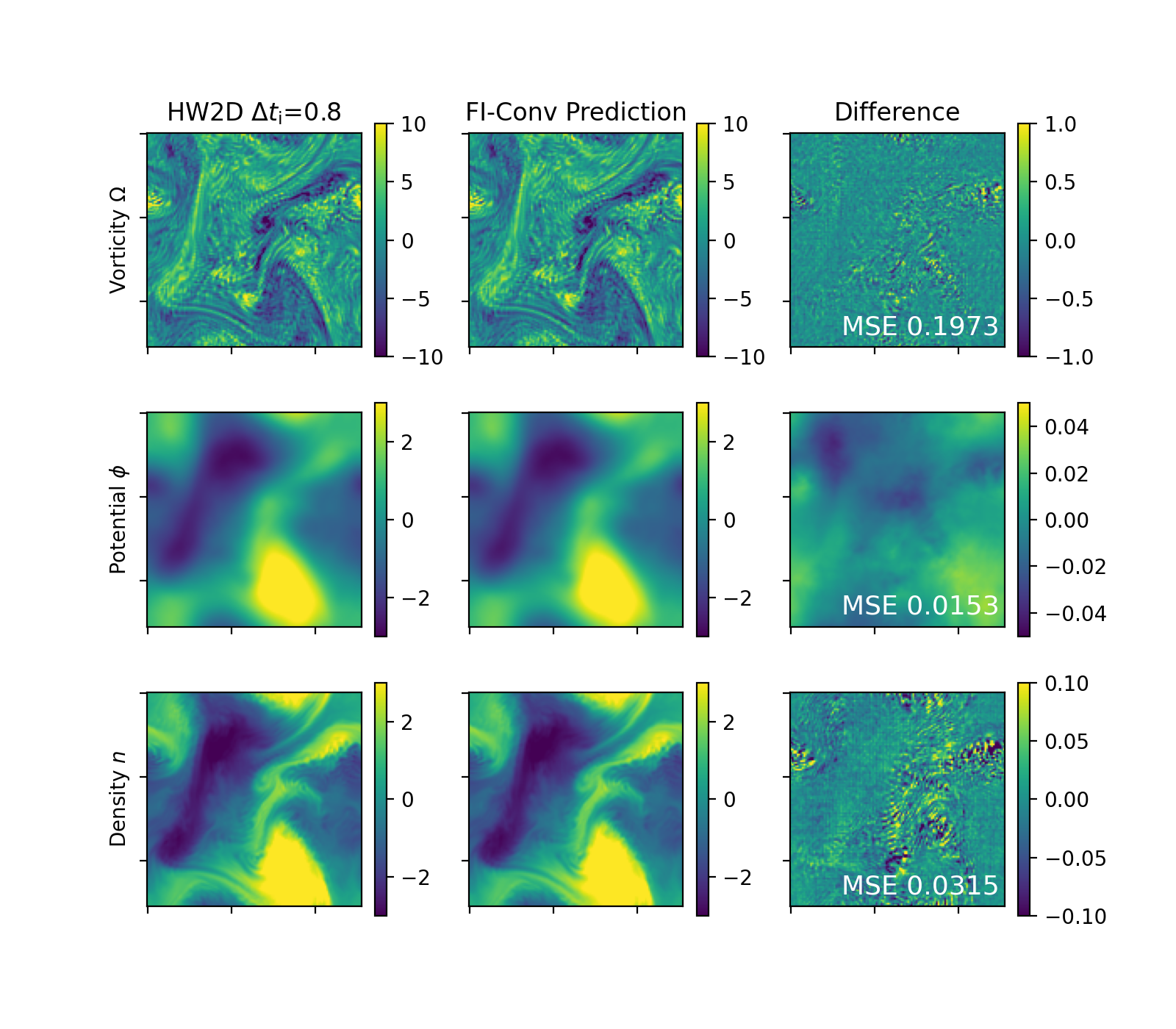
Beyond the Plasma Veil: A Generalizable Framework
The framework underpinning FI-Conv, initially validated through simulations of the Hasegawa-Wakatani equation-a model often used in plasma physics-extends far beyond this specific application. This generality stems from the method’s reliance on convolutional neural networks to directly learn the spatiotemporal dynamics inherent in a wide range of Partial Differential Equations (PDEs). Unlike approaches tailored to individual equations, FI-Conv focuses on the fundamental principles governing how solutions evolve over space and time, making it adaptable to diverse physical systems. This allows researchers to apply the same core methodology to problems in fields such as fluid dynamics, where predicting turbulent flows is paramount, and climate modeling, where accurate long-term forecasting is essential, without requiring substantial architectural modifications. The resulting versatility positions FI-Conv as a potentially unifying tool for tackling complex spatiotemporal predictive challenges across multiple scientific disciplines.
While Physics-informed Neural Networks (PINNs) and Fourier Neural Operators (FNOs) represent innovative strategies for solving spatiotemporal Partial Differential Equations, the FI-Conv method distinguishes itself through a foundational reliance on convolutional neural networks. This architectural choice yields a notable advantage: a compelling equilibrium between computational efficiency and predictive accuracy. PINNs, though capable of incorporating physical laws, can suffer from training instability and sensitivity to hyperparameter tuning. FNOs, while excelling at capturing global dependencies, may require substantial computational resources for high-resolution simulations. FI-Conv, by leveraging the inherent parallelizability and local feature extraction capabilities of convolutions, offers a pragmatic alternative, effectively balancing the need for both speed and precision in diverse applications such as fluid dynamics and climate modeling.
The development of FI-Conv extends beyond theoretical mathematical exercises, promising tangible advancements across diverse scientific disciplines. Accurate and efficient prediction of spatiotemporal dynamics is paramount in fields like fluid dynamics, where modeling turbulence and flow patterns is critical for engineering design and weather forecasting. Similarly, climate modeling, a field grappling with immense complexity, stands to benefit from methods capable of processing and predicting evolving atmospheric and oceanic conditions. Beyond these, applications extend to areas such as materials science, where predicting the evolution of microstructures is vital, and even biological systems, where understanding the spread of patterns-like those observed in neural networks or disease outbreaks-requires robust spatiotemporal prediction capabilities. The versatility of FI-Conv, therefore, positions it as a potentially transformative tool for researchers striving to model and understand complex systems across the scientific landscape.
The pursuit within this work, developing FI-Conv for plasma turbulence, echoes a fundamental tenet of system comprehension: to truly know a system, one must dismantle it, at least conceptually. As Ken Thompson observed, “Debugging is twice as hard as writing the code in the first place. Therefore, if you write the code as cleverly as possible, you are, by definition, not smart enough to debug it.” This mirrors the approach taken with the Hasegawa-Wakatani equations; by constructing a network capable of both forward and inverse prediction, the researchers effectively deconstruct the dynamics to understand-and then reconstruct-the underlying plasma behavior. Each layer of the convolutional network represents a deliberate probing of the system’s intricacies, revealing the inherent imperfections and limitations within the model itself.
Beyond Prediction: Charting the Unknown
The demonstrated capacity of FI-Conv to navigate the Hasegawa-Wakatani equations is, predictably, not the ultimate destination. Rather, it exposes the fragility of current assumptions within plasma turbulence modeling. The network doesn’t merely predict; it implicitly maps the relationships governing complex behavior, and where that mapping diverges from established theory warrants intense scrutiny. The real challenge isn’t achieving higher accuracy on known problems, but deliberately seeking regimes where the model fails – where the underlying physics is genuinely incomplete or misunderstood.
Future work will undoubtedly explore broader applications beyond this specific equation set. However, a more provocative direction lies in turning the network itself into an experimental probe. Could FI-Conv be used to design targeted simulations, specifically crafted to expose the limits of existing theories? Or, conversely, could it identify subtle parameter regimes where seemingly disparate turbulence models converge, hinting at a deeper, unifying principle? The network’s architecture invites manipulation – its convolutional layers are, after all, a codified set of prejudices about how turbulence should behave.
Ultimately, the value of such operator learning isn’t in replacing physics, but in accelerating its discovery. It’s a tool for systematically dismantling established frameworks, revealing the hidden constraints that govern these systems, and, hopefully, pushing beyond them. The pursuit of accuracy is merely a stepping stone towards a more fundamental question: what is the simplest, most elegant description of reality, even if it demands discarding decades of accumulated knowledge?
Original article: https://arxiv.org/pdf/2602.04287.pdf
Contact the author: https://www.linkedin.com/in/avetisyan/
See also:
- United Airlines can now kick passengers off flights and ban them for not using headphones
- Crimson Desert: Disconnected Truth Puzzle Guide
- All 9 Coalition Heroes In Invincible Season 4 & Their Powers
- Mewgenics vinyl limited editions now available to pre-order
- Invincible Season 4 Episode 6 Release Date, Time, Where to Watch
- The Boys Season 5 Spoilers: Every Major Character Death If the Show Follows the Comics
- Grok’s ‘Ask’ feature no longer free as X moves it behind paywall
- Assassin’s Creed Shadows will get upgraded PSSR support on PS5 Pro with Title Update 1.1.9 launching April 7
- Crimson Desert Guide – How to Pay Fines, Bounties & Debt
- Grey’s Anatomy Season 23 Confirmed for 2026-2027 Broadcast Season
2026-02-05 12:03