Author: Denis Avetisyan
New data-driven methods are allowing scientists to unravel the complex dynamics of ecological and epidemiological systems with unprecedented accuracy.
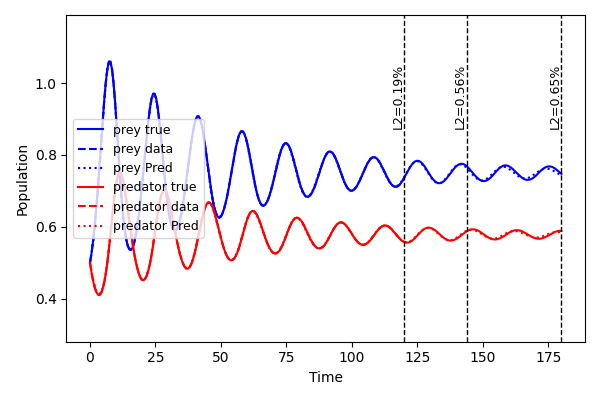
This review explores the application of Neural ODEs, Kolmogorov-Arnold Network ODEs, and SINDy for learning and predicting spatio-temporal dynamics in ecological and epidemiological modeling.
Understanding the interplay between ecological and epidemiological dynamics remains a significant challenge, particularly when analytical solutions are intractable. This paper, ‘Learning Ecological and Epidemic Processes using Neural ODEs, Kolmogorov-Arnold Network ODEs and SINDy’, addresses this by exploring data-driven approaches-Neural ODEs, KANODEs, and SINDy-to learn and predict the behavior of coupled eco-epidemiological systems. Results demonstrate the efficacy of these methods in capturing complex interactions and even inferring hidden coupling mechanisms within spatio-temporal models. Could these techniques provide a pathway toward more robust forecasting and management of real-world ecological and disease outbreaks?
The Limits of Traditional Modeling Approaches
Real-world systems, be it the spread of infectious diseases or the fluctuations within an ecosystem, rarely follow simple, linear patterns. Instead, these phenomena are governed by complex, nonlinear dynamics where small changes can trigger disproportionately large effects – a hallmark of chaos theory. Traditional modeling approaches, often built on assumptions of linearity and equilibrium, struggle to accurately represent these intricate interactions. For instance, predicting an outbreak requires accounting for factors like varying transmission rates, population density, and individual behavior, all of which intertwine in non-linear ways. Similarly, ecological models must grapple with predator-prey relationships, resource competition, and environmental factors, creating feedback loops that defy straightforward prediction. The inherent complexity of these systems means that simplified representations, while computationally convenient, often fail to capture the full range of possible behaviors and can lead to inaccurate forecasts or ineffective interventions.
Conventional modeling techniques frequently stumble when confronted with the intricacies of real-world systems due to a reliance on oversimplified premises. These methods often necessitate a precise understanding of numerous parameters-values that define the system’s behavior-but accurately determining these values can be exceptionally challenging, if not impossible, for complex phenomena. This dependence on exhaustive parameter estimation not only increases the risk of error but also severely restricts the model’s ability to generalize beyond the specific conditions under which those parameters were obtained. Consequently, predictions generated by such models may lack robustness and fail to accurately reflect the system’s behavior in novel or unforeseen circumstances, hindering their practical utility in fields like climate science, financial forecasting, and disease modeling.
To truly understand intricate systems, researchers are increasingly turning to techniques that move beyond static snapshots and embrace the inherent fluidity of change. These methods, often rooted in dynamical systems theory and machine learning, aim to infer the governing equations – the fundamental rules dictating a system’s behavior – directly from observational data. Rather than relying on pre-defined models with numerous adjustable parameters, these data-driven approaches can identify the underlying relationships and predict future states with greater accuracy. Techniques like symbolic regression and reservoir computing, for example, allow scientists to sift through complex datasets and reconstruct \frac{dx}{dt} = f(x, y, z) – the rate of change for a given variable – revealing the hidden mechanisms driving the system’s evolution and offering a powerful new paradigm for scientific discovery.
Embracing Continuous-Time Dynamics with Neural ODEs and KANODEs
Neural Ordinary Differential Equations (Neural ODEs) represent a shift from traditional discrete-time recurrent neural networks (RNNs) by modeling dynamics as a continuous process. RNNs approximate dynamics using discrete steps, requiring a fixed number of layers to represent a given time interval; increasing the number of steps improves accuracy but also increases computational cost. Neural ODEs, conversely, define the derivative of a hidden state as a function of the current state, computed by a neural network. This allows the dynamics to be evaluated at any point in time via an ODE solver, eliminating the need for a pre-defined number of discrete layers and enabling adaptive computation based on the complexity of the dynamics. The continuous-time formulation also simplifies the modeling of irregular time series data, as the dynamics are not constrained by fixed time steps, and facilitates efficient backpropagation through the ODE solver using adjoint sensitivity methods.
KANODEs (Kolmogorov-Arnold Neural Ordinary Differential Equations) achieve parameter efficiency by utilizing the Kolmogorov-Arnold Representation Theorem, which states that any continuous function of multiple variables can be represented as a finite sum of functions of fewer variables. This allows KANODEs to model complex dynamical systems using a significantly reduced number of parameters compared to traditional Neural ODEs or recurrent neural networks. Specifically, the theorem enables the decomposition of a system’s dynamics into a set of independent, lower-dimensional components, each governed by a separate ODE . By learning these component dynamics, KANODEs can accurately represent complex behaviors with a streamlined parameterization, improving generalization and reducing computational cost.
Neural ODEs and KANODEs demonstrate proficiency in extracting meaningful insights from time-series data without requiring pre-defined system parameters. Traditional time-series modeling often necessitates the explicit specification of equations or state-space representations, limiting adaptability and potentially introducing bias. These continuous-time approaches, however, learn the underlying dynamics directly from observed data, effectively discovering the governing functions that describe system evolution. This parameter-free learning capability allows for the modeling of complex, potentially non-linear systems where analytical formulations are unavailable or impractical, offering a data-driven alternative to traditional methods and enabling the identification of hidden patterns and relationships within the time-series.
Uncovering Governing Equations Through Sparse Identification
Sparse Identification of Nonlinear Dynamics (SINDy) operates by leveraging time-series data to construct a candidate library of possible functions representing the system’s dynamics. This library, which can include nonlinear terms and their derivatives, is then subjected to sparse regression techniques – typically \ell_1 regularization – to identify the fewest terms necessary to accurately model the observed data. The \ell_1 penalty promotes sparsity by driving the coefficients of irrelevant terms towards zero, resulting in a simplified and interpretable model. This approach differs from traditional system identification methods by directly inferring the governing equations rather than parameterizing a pre-defined model structure, enabling the discovery of underlying dynamics even with limited data or prior knowledge.
Combining Sparse Identification of Nonlinear Dynamics (SINDy) with Neural Ordinary Differential Equations (Neural ODEs) and Kernel-based Neural ODEs (KANODEs) facilitates the creation of simplified models from complex datasets by leveraging the strengths of each technique. Neural ODEs and KANODEs provide a continuous-time representation of the data, enabling the discovery of underlying dynamics without being constrained by discrete time steps. SINDy then performs sparse regression on the automatically differentiated Neural ODE or KANODE to identify the dominant terms in the governing equations, effectively extracting a concise and interpretable model. This process bypasses the need for pre-defined model structures, allowing the governing equations to be discovered directly from the data itself.
Sparse Identification of Nonlinear Dynamics (SINDy) coupled with Neural ODEs and KANODEs has demonstrated successful application to modeling biological systems. Specifically, the method accurately recovers governing equations for the Lotka-Volterra predator-prey model, as well as epidemic spread models including the Susceptible-Infected-Recovered (SIR) and Susceptible-Infected-Susceptible (SIS) models. Across multiple datasets representing these systems, the approach consistently achieves relative ℓ^2 errors of less than 10%, indicating a high degree of fidelity between the discovered equations and the underlying dynamics.

Towards a More Predictive Future: Numerical Foundations and Emerging Directions
Understanding how things spread – whether a disease through a population or resources within an ecosystem – fundamentally depends on accurately modeling diffusion processes. Traditionally, scientists have relied on numerical methods, most notably the Finite Difference Method, to approximate solutions to the complex equations governing these phenomena. This technique discretizes space and time, allowing computers to iteratively calculate how a quantity changes across a given area. While effective, these methods can become computationally expensive when dealing with high-dimensional problems or complex geometries. Moreover, they often require substantial prior knowledge about the underlying system. The precision of these simulations directly impacts predictions about disease outbreaks, population growth, and even the spread of information, highlighting the ongoing need for refined and efficient numerical approaches to these critical challenges.
The convergence of numerical methods, symbolic regression, and continuous-time modeling represents a significant advancement in predictive capabilities. Traditional approaches to simulating complex systems, such as those governing disease propagation or population shifts, often rely on computationally intensive discretizations like the Finite Difference Method. However, integrating these techniques with the equation discovery potential of Sparse Identification of Nonlinear Dynamics (SINDy) and the continuous modeling framework of Neural Ordinary Differential Equations (Neural ODEs) allows for a more efficient and interpretable approach. This combination not only enhances predictive accuracy but also facilitates the identification of underlying governing equations directly from observed data, moving beyond purely data-driven ‘black box’ models. The resulting models can capture intricate spatio-temporal dynamics with remarkably fewer parameters, demonstrating the power of this synergistic approach in uncovering the hidden mechanisms driving complex phenomena.
Recent investigations into the modeling of complex dynamical systems have revealed that KANODEs – a novel approach combining Koopman operator theory with Neural Ordinary Differential Equations – achieve surprisingly accurate predictions with substantially reduced computational demands. Compared to traditional, deeper Neural ODE architectures, KANODEs require significantly fewer parameters – ranging from 360 to 33539 – to achieve comparable performance in modeling spatio-temporal dynamics. This efficiency stems from the model’s ability to effectively learn hidden local coupling within the system, identifying key relationships and dependencies without the need for excessively complex network structures. The ability to capture these local interactions with fewer parameters not only reduces computational cost but also enhances model interpretability and generalization capabilities, offering a promising avenue for advancements in fields reliant on accurate and efficient dynamic modeling.

The pursuit of understanding eco-epidemiological systems demands a holistic perspective, recognizing that alterations within one component invariably ripple through the entirety of the modeled environment. This research, leveraging Neural ODEs, KANODEs, and SINDy, embodies this principle by attempting to infer the underlying mechanisms governing complex spatio-temporal dynamics. As Lev Landau aptly stated, “The only way to do great work is to love what you do.” This dedication to unraveling the intricacies of these systems allows for the discovery of hidden coupling mechanisms and a more complete understanding of how these models function as integrated organisms, mirroring the elegance of a well-structured system where behavior is dictated by its architecture.
What Lies Ahead?
The pursuit of dynamical systems from data, as demonstrated by these explorations with Neural ODEs, KANODEs, and SINDy, inevitably encounters the limits of observation. These methods excel at interpolating within the observed manifold, but ecological and epidemiological systems are rarely, if ever, fully sampled. Systems break along invisible boundaries-if one cannot see them, pain is coming. The next step isn’t simply more data, but methods to intelligently extrapolate, to anticipate behavior at the edges of knowledge, and to assess the confidence of such predictions.
A critical limitation lies in disentangling correlation from causation. These data-driven approaches can identify how systems evolve, but inferring the underlying mechanisms-the specific couplings driving the dynamics-remains a challenge. Future work must prioritize methods to build more interpretable models, perhaps by incorporating prior ecological or epidemiological knowledge as structural constraints, or by leveraging techniques for causal discovery. The elegance of a model isn’t merely in its predictive power, but in its ability to reveal the hidden architecture of the system it represents.
Ultimately, the goal isn’t just to forecast outbreaks or population fluctuations. It is to understand the principles governing complex systems – to move beyond empirical description toward a unified theory of ecological and epidemiological dynamics. Such a theory will require a synthesis of data-driven discovery with mechanistic modeling, acknowledging that the most powerful insights often emerge from the intersection of different perspectives.
Original article: https://arxiv.org/pdf/2601.09811.pdf
Contact the author: https://www.linkedin.com/in/avetisyan/
See also:
- United Airlines can now kick passengers off flights and ban them for not using headphones
- Crimson Desert: Disconnected Truth Puzzle Guide
- All 9 Coalition Heroes In Invincible Season 4 & Their Powers
- Mewgenics vinyl limited editions now available to pre-order
- The Boys Season 5 Spoilers: Every Major Character Death If the Show Follows the Comics
- Invincible Season 4 Episode 6 Release Date, Time, Where to Watch
- Assassin’s Creed Shadows will get upgraded PSSR support on PS5 Pro with Title Update 1.1.9 launching April 7
- Grok’s ‘Ask’ feature no longer free as X moves it behind paywall
- TikToker’s viral search for soulmate “Mike” takes brutal turn after his wife responds
- ‘Timur’ Trailer Sees Martial Arts Action Collide With a Real-Life War Rescue
2026-01-18 16:44