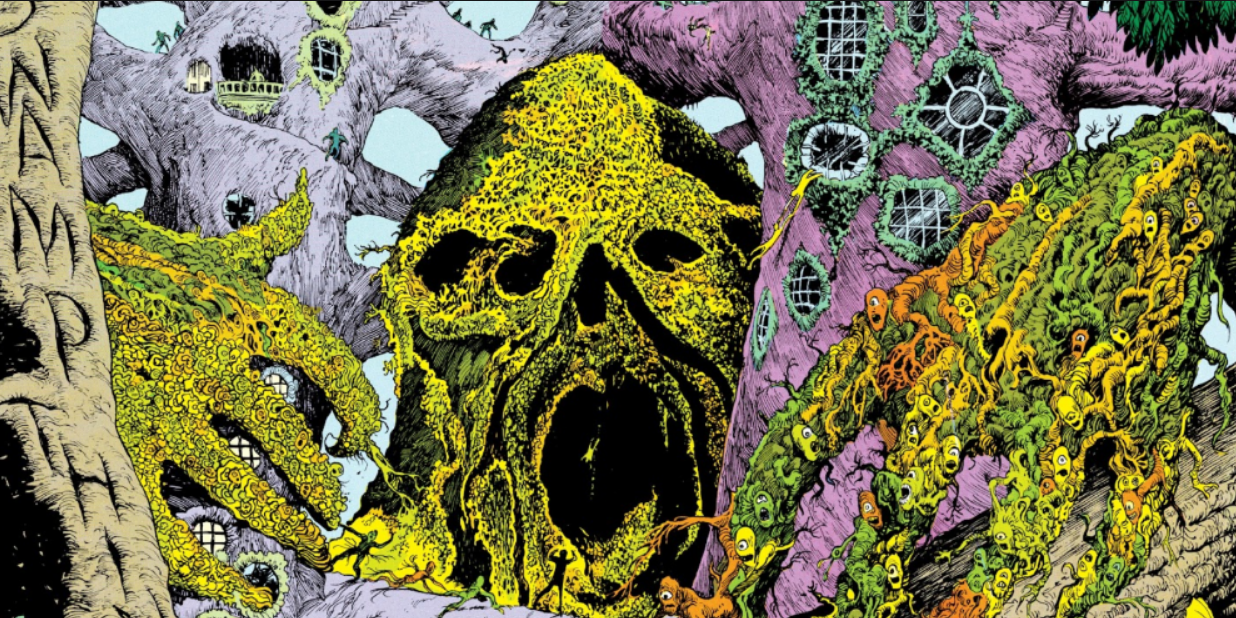
Len Wein and Bernie Wrightson launched the Bronze Age of Comics in 1971 with their creation, Swamp Thing. Inspired by the classic monster The Heap, they had no idea their character would become a defining force in the horror genre. Ten years later, Swamp Thing evolved from a typical monster into a source of Lovecraftian horror and dread.
The Bronze Age of comics saw a resurgence of monster and horror titles, largely because the industry had more freedom after loosening the rules of the Comics Code Authority. This new openness allowed innovative writers like Alan Moore to bring their distinctive vision to genres like horror. His work on Swamp Thing, in particular, became a famously frightening story for DC Comics, and it’s still highly praised by both fans and critics today, even forty years later. Moore transformed Alec Holland’s story into a truly terrifying tale by exploring themes of existential dread and gruesome horror, becoming a defining part of the ’80s comic landscape.
Len Wein and Bernie Wrightson’s Swamp Thing Was Originally Very Different
Swamp Thing originated in 1971 with a story created by Len Wein and Bernie Wrightson about Alec Holland, a scientist whose life was tragically altered. After his wife, Linda, was murdered by criminals connected to a shadowy group called the Conclave, Holland fled into the swamp. There, a special formula he was working on combined with the swamp’s environment, transforming him into a monstrous, plant-covered creature driven by a desire for revenge. While his thoughts mostly remained his own, he struggled to speak, slowly regaining fragments of his former self.
The series began with Holland traveling through Europe and America, searching for a way to become human again. He was captured by Arcane, a deranged scientist and sorcerer, and his creatures, the Unmen. Arcane falsely promised to restore Holland’s humanity if he would transfer his powers into Arcane’s body. Realizing Arcane was a monster who would misuse these powers, Holland decided to remain in his current form, hoping to find a true cure for his condition.
The Wein and Wrightson series was primarily a tribute to classic Universal Monsters. Each issue featured encounters with creatures like werewolves, aliens, and beings determined to destroy the world, even including a Lovecraftian entity. The eighth issue offered an early hint of the series’ later focus on existential horror. However, this shift in tone didn’t fully develop until more than ten years later, when Alan Moore took over as the primary writer for the second volume.
Alan Moore Transformed the Fundamentals of Swamp Thing’s Story
When Alan Moore began writing Swamp Thing in 1984, he immediately challenged everything fans thought they knew about the character. In a dramatic shift from the earlier stories, he revealed in the “Anatomy Lesson” storyline that Alec Holland, the man everyone believed was inside the Swamp Thing, had actually died. Though a part of Holland’s mind remained within the creature’s form, he would never regain his human body. As the Swamp Thing’s body was examined, it became clear that it was entirely plant-based, with nothing left of the original man to restore. This clever rewrite of the character’s history is considered one of the best in comic books, and it made the previous stories even more tragic.
Becoming the Avatar of the Green changed Swamp Thing’s priorities, moving him from seeking a cure to embracing his role as a powerful elemental force. Despite this transformation, he struggled to fully let go of his former life, especially as his feelings for Abby Arcane deepened. This internal conflict turned his already sad story into one of the most emotionally impactful narratives in the DC Universe. He was tormented by memories of who he once was, and constantly tried to reconcile his love for Abby with his vast new responsibilities – protecting not just Earth, but entire worlds, as explored in works like those by Alan Moore.
By adding characters like John Constantine and The Phantom Stranger, the series broadened its possibilities. The dangers in the Swamp Thing universe weren’t limited to human creations or natural disasters anymore – threats could originate from anywhere. As the story progressed, the main character began to understand the swamp as a source of fear and horror, constantly uncovering hidden, disturbing truths with each step he took.
Alan Moore transformed Swamp Thing from a typical monster story into a deeply unsettling exploration of existence. By focusing on inner turmoil and philosophical questions alongside the horror, he created a superhero uniquely suited to confront otherworldly creatures. The series wasn’t just a thrilling horror comic; it was a thoughtful look at life, fear, trauma, and love, cementing its place as a defining work of 1980s horror. It serves as a powerful reminder of how often we underestimate the power of truly thoughtful storytelling.
Moore had a remarkable ability to transform the familiar natural world into something terrifying. His stories powerfully demonstrated that genuine horror can arise from anywhere, at any moment, and that even everyday anxieties can become shockingly real.
How Swamp Thing Redefined Horror Comics
The early versions of Swamp Thing were enjoyable, but they didn’t really offer anything new, as they were similar to stories exploring the internal struggles of a man battling his monstrous side – a theme clearly inspired by Robert Louis Stevenson’s Jekyll and Hyde. This concept was common in monster comics of that era, though often with added layers of detail. However, when Alan Moore began writing the series, he moved away from this idea entirely, focusing instead on Holland’s personal journey of understanding who – and what – he truly was.
I always enjoyed seeing Swamp Thing in action – battling gators, going toe-to-toe with other heroes, and dealing with mad scientists. But honestly, it felt like we weren’t seeing everything he could be. When Alan Moore took over, though? That’s when things got incredible. He brought in these truly frightening creatures from other dimensions – demons, hordes of monsters, just stuff that really messed with your head. And something Len Wein hadn’t done? Moore started making the swamp itself feel like a character, a living, breathing place. Plus, he introduced amazing supporting characters like Constantine, Xanadu, The Phantom Stranger, Blue Devil, and Etrigan. It wasn’t just a horror comic anymore; it became this really powerful, immersive dark fantasy story.
In an interview with DC, Alan Moore discussed his approach to the series, stating that the classic Universal Monsters had become stale. He believed modern fears weren’t about creatures jumping out of the dark, but rather real-world anxieties like nuclear war and other societal concerns. Moore argued that truly frightening horror needed to be rooted in relatable experiences, tapping into what people genuinely feared. He illustrated this with an issue focusing on insect phobias, explaining that he took common fears and amplified them, transforming simple bugs into overwhelming plagues and even demonic, supernatural creatures.
While the initial series celebrated classic horror tropes, writer Scott Moore aimed to tap into real-life anxieties and bring them to life within the DC universe. He expanded the scope to include new, terrifying concepts like the Rot, which he portrayed as a relentless and all-encompassing force of decay. Moore’s issues often felt intensely unsettling, claustrophobic, and eerily foreshadowing in ways the earlier stories didn’t achieve.
The Bronze Age of comics, spanning the 1970s and 80s, was characterized by stories that were carefully considered and dealt with important issues. A great example is the Green Lantern work by O’Neil and Adams. Alan Moore’s run on Swamp Thing built on this trend, tackling genuine anxieties while still maintaining the fantastical nature of the series.
Ram V and Mike Perkins Honored the Best of Swamp Thing
DC fans were thrilled in 2021 when Ram V and Mike Perkins took on a new Swamp Thing series. This reboot shifted the focus from Alec Holland to a new protagonist, Levi Kamei, who had to learn to embrace his destiny as the protector of the Green. Many consider Ram V’s run to be one of the best since Alan Moore’s iconic work on the book, offering a story that felt both innovative and true to the core of what makes Swamp Thing so compelling – a deep sense of existential dread.
Len Wein and Bernie Wrightson started a legendary comic series in 1971, telling the story of Alec Holland. While their work was excellent, it was Alan Moore and Stephen Bissette’s ‘Saga of the Swamp Thing’ that truly established it as DC’s most iconic horror comic.
Found an error? Send it so it can be corrected.
Read More
- United Airlines can now kick passengers off flights and ban them for not using headphones
- Katanire’s Yae Miko Cosplay: Genshin Impact Masterpiece
- All Itzaland Animal Locations in Infinity Nikki
- How to Complete Bloom of Tranquility Challenge in Infinity Nikki
- How to Get to the Undercoast in Esoteric Ebb
- Gold Rate Forecast
- All Golden Ball Locations in Yakuza Kiwami 3 & Dark Ties
- A Dark Scream Theory Rewrites the Only Movie to Break the 2-Killer Rule
- Fire Force Season 3 Part 2 Episode 24 Release Date, Time, Where to Watch
- Superman/Spider-Man #1 Review: Bigger DC-Marvel Crossovers Teased
2026-03-09 04:13