Ah, the cryptocurrency market, a swirling tempest of digital dreams and dollar signs, now appears to be catching its breath, like an asthmatic hamster after a vigorous sprint. Yes, dear reader, Bitcoin and its flamboyant altcoin entourage are making valiant attempts to staunch the tide of relentless selling that has swept through their glittering realms for what seems like epochs. Prices have rebounded ever so slightly-just enough to give some poor souls a flicker of hope-yet the atmosphere remains as delicate as a soufflé in a thunderstorm.
Enter stage left: a tantalizing draft of a market structure bill from the hallowed halls of the US Senate, garnering attention akin to a cat video on the internet. This proposed framework could herald a seismic shift in the way crypto assets are treated in the grand tapestry of the American financial landscape. 🏛️
The bill, in all its bureaucratic glory, seeks to draw a clear line between crypto assets that fall under the banner of commodities and those that strut about as securities. It promises to bestow regulatory oversight with the grace of a ballet dancer, which, let’s face it, is much needed given the current state of affairs where regulations seem more like suggestions, or perhaps friendly nudges in the right direction.
As markets commence their digestion of this potentially game-changing news, the spotlight is shifting from the sensationalism of headlines to the deeper, more profound implications lurking in the shadows. Will this newfound clarity breed confidence, or will it simply lead us down the rabbit hole of uncertainty? Only time, that fickle mistress, shall tell.
Regulatory Clarity: A Glimmer of Hope or Just More Red Tape?
A report from XWIN Research Japan-because who doesn’t love a bit of research with a side of sushi?-highlights a critical nuance in this latest proposal: fully decentralized networks and DeFi protocols are not to be likened to traditional financial intermediaries. Developers, validators, and node operators will not automatically find themselves ensnared in the regulatory web, thus acknowledging decentralization as a legitimate structural trait rather than a loophole begging to be closed. 🍣
This distinction is nothing short of delightful, as it alleviates legal uncertainty for our beloved open-source contributors and preserves the permissionless nature of decentralized infrastructure-a veritable paradise for innovation! Meanwhile, centralized entities find themselves in a more tightly regulated embrace, expected to comply with rules that resemble a high school dress code-strict and full of stipulations.
Within this framework of regulatory bliss, Bitcoin, Ethereum, stablecoins, and spot ETFs could continue to bask in the warm glow of legitimacy within the US financial system. It’s like being invited to the coolest party in town, complete with a velvet rope and bouncers to keep out the riffraff.
On-chain data, that oracle of our times, already reflects this transition. Metrics from CryptoQuant reveal that at the glimmering $90,000 Bitcoin level, retail activity is about as lively as a sloth on a Sunday afternoon, while mid- and large-sized orders are taking center stage. This behavior suggests that investors are not overly excited nor panicking but rather positioning themselves with the precision of a chess master contemplating their next move.

Taken as a whole, these signals indicate a market gradually transitioning from the reactive chaos of headline-driven trading to a more structured existence. While regulatory clarity may not ignite fireworks in the price department, it certainly influences how capital makes its home across the vast expanse of the crypto landscape. 🌌
Total Crypto Market Cap: Consolidation or Complacency?
The grand chart of total cryptocurrency market capitalization displays a market in a state of consolidation-like a runner catching their breath after a grueling marathon. Following a robust expansion from late 2023 into mid-2025, the total market cap kissed the soaring heights of $3.8-$4.0 trillion before entering a corrective phase, reminiscent of a hangover after a wild night out.
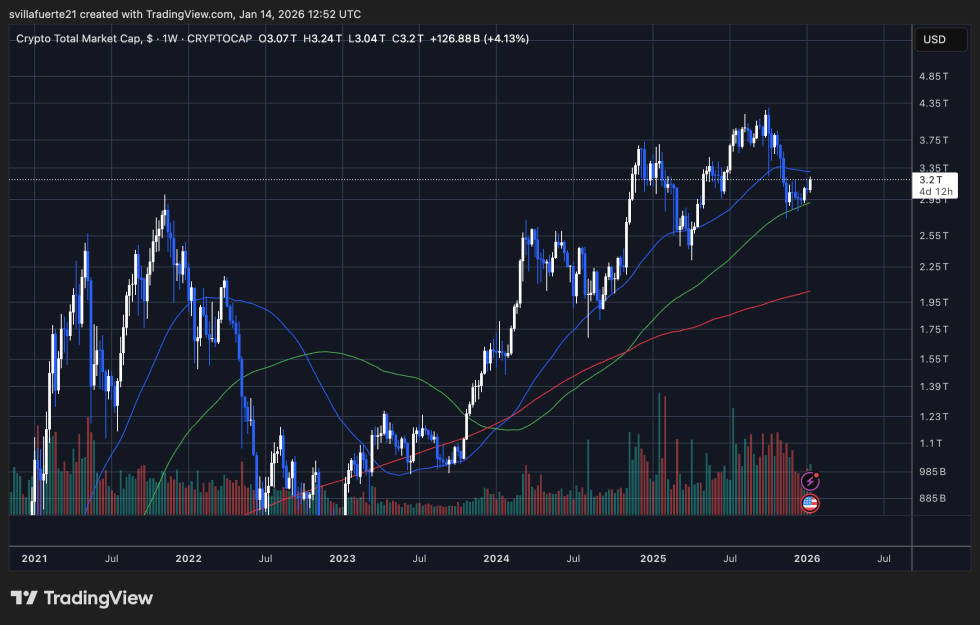
At present, the total market cap is hovering around the $3.2 trillion mark, nestled comfortably within a former resistance zone that has donned the cloak of support multiple times. The weekly structure suggests a cooling phase rather than an impending disaster. The price remains above the rising 200-week moving average, which continues to slope upward like a determined mountain climber, reinforcing the notion that the primary market trend still holds a semblance of constructiveness.
Shorter-term moving averages have flattened, echoing indecision and reduced momentum post the earlier impulsive moves. Volume has dipped from peak levels, hinting that aggressive distribution pressure has eased-like a deflating balloon-yet robust demand for expansion has yet to return. This peculiar combination is typical of mid-cycle consolidation rather than terminal weakness, leaving us to ponder the fate of our digital dollar dreams.
From a structural standpoint, the market is digesting prior gains while maintaining a higher-low framework relative to previous cycles. A sustained hold above the $3.0 trillion region keeps the broader bullish structure intact, but should we fail to defend this sacred territory, we may find ourselves facing deeper retracements toward long-term trend support-an ominous prospect indeed!
Read More
- United Airlines can now kick passengers off flights and ban them for not using headphones
- Crimson Desert: Disconnected Truth Puzzle Guide
- All 9 Coalition Heroes In Invincible Season 4 & Their Powers
- Mewgenics vinyl limited editions now available to pre-order
- Assassin’s Creed Shadows will get upgraded PSSR support on PS5 Pro with Title Update 1.1.9 launching April 7
- Grok’s ‘Ask’ feature no longer free as X moves it behind paywall
- Grey’s Anatomy Season 23 Confirmed for 2026-2027 Broadcast Season
- The Boys Season 5 Spoilers: Every Major Character Death If the Show Follows the Comics
- Viral Letterboxd keychain lets cinephiles show off their favorite movies on the go
- What happened to Tech Jacket in Invincible? Showrunner explains Season 4 change
2026-01-15 09:21