If you’ve played the original DMZ on consoles or PC, you might expect the mobile version to be simpler. But it’s not! In many ways, Call of Duty: Mobile’s DMZ is actually a more developed and detailed experience. The developers have taken advantage of the mobile platform to add intricate features like a detailed skill tree and a Black Market, making the gameplay much more strategic. It’s interesting to see how mobile games often lead the way with new ideas for the franchise, and this version delivers a surprisingly complete and engaging game that console players should definitely check out.
Key Takeaways
- Prioritize the mission over the firefight: Success in DMZ is measured by what you extract, not your kill count. Focus on completing objectives and getting out alive, as every decision involves a risk-versus-reward calculation.
- Turn successful raids into permanent upgrades: The loot you extract converts to cash for buying gear in the Black Market. You can also specialize your operator by investing points in the Talent Tree, making each successful run a direct investment in your future power.
- Teamwork is your greatest asset: DMZ is designed for coordinated squads. Before dropping in, decide on roles (Scavenger, Assaulter, Medic), create a mission plan, and communicate constantly to increase your chances of a successful extraction.
What is CoD: Mobile’s DMZ Extraction Mode?
Extraction shooters are known for their exciting, risky gameplay where success means big rewards. Call of Duty experimented with this style in Modern Warfare 2 with a mode called DMZ, which became popular with a dedicated group of players. However, DMZ always felt like a secondary feature. Now, Call of Duty is fully committing to the extraction shooter concept, and they’re starting with a complete and polished experience on mobile devices.
DMZ in Call of Duty: Mobile is a unique game mode, unlike traditional Team Deathmatch or battle royale. It’s slower and more focused on strategy, where staying alive is just as important as getting kills. You parachute into a map, complete objectives while fighting both computer-controlled enemies and other players, and then need to safely reach an extraction point. This creates a stressful experience that makes you think carefully about every fight and the gear you choose. Instead of simply aiming for the most kills, you’re constantly deciding if the risk of a fight is worth the potential reward. DMZ offers a new and exciting way to play Call of Duty, emphasizing smart tactics over quick reactions.
The Mission: Get In, Get Loot, Get Out
The gameplay is based around a simple, yet captivating cycle: enter a raid, collect valuable items, and escape. Your main objective is to survive and leave with as much good gear as possible. This is a big change from the original DMZ mode, where any items you found were lost after each match, only giving you experience points. In Call of Duty: Mobile, the loot you manage to extract actually has worth – it turns into in-game money you can use to buy more items, making each successful raid feel satisfying and each failure more frustrating.
How DMZ Changes the CoD Formula
DMZ dramatically changes how you experience Call of Duty. It moves away from simply focusing on kills and instead asks you to gather supplies, plan your movements, and choose your battles carefully. The game stays exciting with a constant stream of new missions each week, offering clear goals and rewarding you with in-game currency, experience points, and special items. Interestingly, Call of Duty: Mobile often tests out new ideas that later appear in the main Call of Duty games for consoles and PCs. So, playing DMZ on mobile might give you an early look at what’s coming for the entire Call of Duty series.
Loot and Progression: How Does It Work on Mobile?
DMZ offers a different experience than typical multiplayer modes. Instead of just respawning after each death, your progress depends on successfully removing items from a raid. This creates a challenging economy where your skill isn’t just about getting kills, but about collecting valuable loot and escaping with it. Each successful raid improves your gear, preparing you for tougher challenges. This makes every choice – whether to fight or escape – really matter, rewarding both careful strategy and bold actions.
The Choice: Extract High-Value Loot or Farm XP?
When you start a DMZ match, you quickly have to decide how you want to play: focus on earning experience or focus on collecting valuable items. While defeating AI enemies gets you experience points, the best rewards are the high-value items hidden on the map. As streamer IceManIsaac explains, these items don’t give you XP – they give you cash. This means you’re constantly weighing the risks and rewards: do you brave dangerous areas for expensive loot like a GPU, or do you play it safe and just level up? This decision shapes how your entire DMZ match goes.
Turning Your Haul into Black Market Gear
After a successful raid, you’ll take your hard-earned rewards to the Black Market. This is where you convert your loot into cash and use it to improve your gear for future missions. As IceManIsaac explains, the Black Market lets you buy weapons, attachments, and level up your guns and equipment. Essentially, it’s a way to invest in your operator, making you stronger with each successful extraction and preparing you for the challenges ahead.
Specializing Your Operator with the Talent Tree
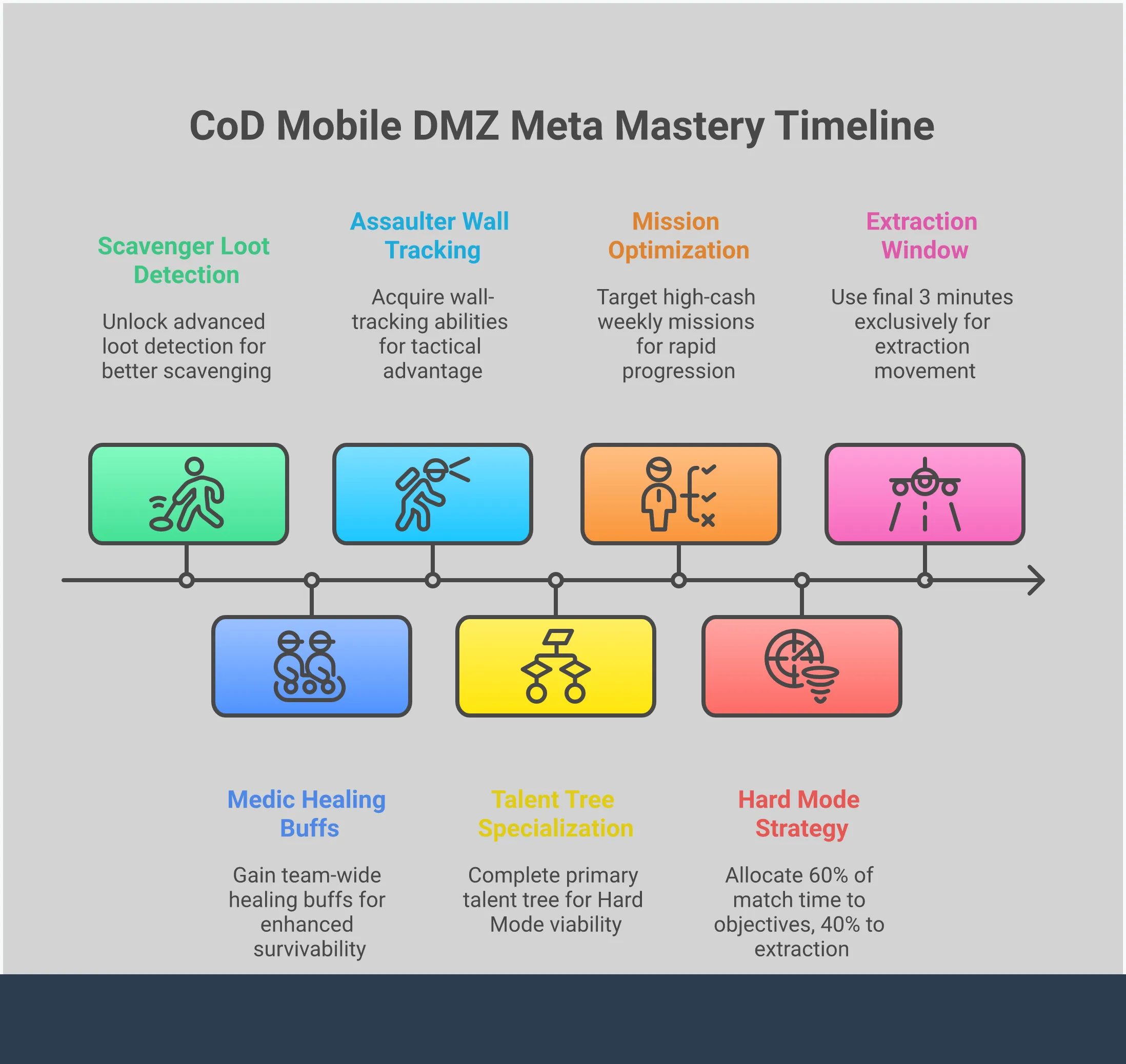
In DMZ, you can improve your operator long-term using a Talent Tree system, letting you customize how you play. There are three different Talent Trees to choose from: Scavenger, Assaulter, and Medical. Each one offers unique skills that fit different playstyles. If you want to focus on finding loot, choose Scavenger. If you prefer direct combat, go with Assaulter. And if you want to support your team by keeping everyone healthy, the Medical tree is the way to go.
Why Team Dynamics Are a Game-Changer in Mobile DMZ
If you’re accustomed to dominating in modes like Multiplayer or Battle Royale, DMZ will require a different approach. It’s less about individual skill and more about teamwork. Success in DMZ depends on clear communication, coordinated actions, and a common plan. While going it alone might yield some initial gains, you’ll likely end up back in the lobby with nothing if you encounter a coordinated team.
This game heavily emphasizes teamwork. It’s designed so you need to work together – players have specialized roles that fit together, and the challenges are extremely difficult to overcome alone. It’s similar to planning and executing a heist: success depends on a solid plan, everyone knowing their part, and having each other’s backs. Teams that talk to each other about their roles, when to use abilities, and how to escape will consistently do better than groups of skilled players who don’t communicate. This focus on working together is what makes the game feel new and satisfying.
Finding Your Role: Scavenger, Assaulter, or Medic
Before starting a match, your team should quickly decide who will focus on what. In DMZ, each player can specialize with one of three Talents: Scavenger, Assaulter, or Medic. Each role offers different strengths. Scavengers are experts at finding valuable loot and keeping the team equipped. Assaults lead the charge, focusing on attacking and eliminating enemy teams. Medics are vital for keeping everyone alive, reviving fallen teammates and providing health during fights. A well-rounded team with one of each role is very effective and can handle any challenge the game presents.
Unleashing Ultimates and Rewinding Time
In DMZ, each operator has a game-changing ultimate ability that can turn the tide of a fight. However, these abilities take a long time to recharge, so you can’t use them constantly. That’s why talking to your team is so important. Using your ultimate at the wrong time can be disastrous, but when used together with your teammates’, they can quickly eliminate an entire enemy squad. For example, an Assaulter could start a fight with their ultimate, while the Medic uses theirs to instantly heal the team, guaranteeing a win. Knowing when to save your ultimate and when to use it is what sets experienced players apart and helps them consistently escape with loot.
Planning Your Mission for a Successful Extraction
Going into the DMZ without a strategy is a sure way to fail. Unlike Battle Royale, where you just try to survive, DMZ focuses on completing specific objectives. Each week brings new missions with valuable rewards like money and experience points. Before you start a match, choose a mission and plan how you’ll complete it. Think about where to land, what you need to do, and where you’ll try to escape. A good plan makes the game smoother, helps you react quickly, and keeps your team focused. Teams that plan together are more likely to escape successfully.
Choosing Your Battlefield: Maps, Modes, and Difficulty
Before each match, you’ll need to make a few important choices that will affect how it goes. Knowing your options – from the map and what you’re playing for – is key to winning. It’s about deciding what kind of challenge you want and getting ready for it. Let’s take a look at the maps, team setups, and difficulty levels available in CoD: Mobile’s DMZ.
Two Maps to Master: The Open Zone and Building 21
You’ll be able to select from two different environments, each offering a unique way to play. The first, Open Zone, is a large map similar to Ashika Island or Al Mazrah. It’s great for long-distance fights and moving around strategically thanks to its diverse landscapes. The other option, Building 21, is a small, fast-paced arena where combat is up close and personal. However, it also features a tiered loot system, meaning you can earn better rewards. Ultimately, the best map for you depends on how you like to play.
Playing Solo or As a Trio
Do you prefer to tackle challenges on your own, or do you thrive working with a team? DMZ gives you both options with solo and three-player modes. Playing solo really puts your skills to the test – you’ll need to be smart, careful, and choose your battles wisely. Teaming up lets you use strategy, cover more area, help each other out, and take on harder objectives. Having teammates changes how you approach everything, so pick the mode that feels right for you.
Risk vs. Reward: Normal vs. Hard Mode
Here, you choose your risk level. Normal mode keeps your weapons safe, meaning you won’t lose them if you’re eliminated. It’s great for learning the map, completing missions without stress, or just practicing. Hard mode is much more challenging. You’ll encounter stronger enemies, and if you die, you’ll lose all the gear you brought with you. However, you have the chance to earn much better rewards. This mode is intense – every choice is important, so be sure to equip a strong loadout to increase your chances of survival.
What Keeps You Playing? A Look at Weekly Missions
It’s true that most games can become repetitive after a while. While DMZ is enjoyable, simply collecting loot and escaping can get stale without a bigger goal. That’s where weekly missions really make a difference. They give players something specific to work towards, encouraging them to come back and try new approaches. Instead of just focusing on survival, you’re always striving for new objectives each week.
These missions aren’t just tasks to complete; they’re meant to challenge you and encourage you to try new things in the game. They’ll have you exploring different areas, experimenting with different weapons, and taking on objectives you’d normally skip. This variety is key to keeping the game mode interesting and ensuring there’s always something fresh to do.
Fresh Challenges and Regular Updates
Weekly missions are a great way to keep the game fresh and exciting. Each week brings something new, like hunting a powerful boss or collecting rare items from a dangerous location. This constant variety keeps players engaged and prevents things from becoming repetitive. Players have noted the ongoing challenges and missions, showing the game is designed to keep them coming back for more. This system ensures that even long-time players have a reason to play every week and avoids the feeling of getting bored with the game.
How Missions Reward You with Cash and XP
Finishing missions isn’t just about showing off – it’s how you earn money and experience points. These rewards are vital for improving your character and unlocking better equipment. Players have told us that the rewards need to feel worthwhile, and many have stopped doing missions because they feel like there’s no point without new content. This shows how important it is for developers to regularly update missions and rewards to keep players engaged and ensure they feel their time is well spent earning the cash and XP needed to progress.
The Community Weighs In: Is Progression Too Slow?
Okay, so DMZ’s missions are cool and give you something to aim for, but a lot of us are finding the leveling process really slow. I’ve been seeing tons of complaints online – Reddit’s full of people saying how much of a grind it is to rank up. It’s a tough spot for the developers, honestly. They want us to feel like we’re earning stuff, but not like we have to play all day just to see a tiny bit of progress. Basically, we all want a good balance between challenge and reward, and right now, the pacing feels a little off when it comes to leveling up and getting those sweet rewards.
The Talent Tree: Powerful, But Is It Perfect?
The Talent Tree in DMZ lets you customize your operator, turning them from a basic soldier into a specialized fighter. It’s a progression system that rewards you for playing, giving you useful upgrades that can really change how you approach the game. As you gain levels, you’ll spend points on different skill trees, unlocking perks that improve things like weapon control and your ability to survive. The idea is to build an operator that suits your playstyle and preferred tactics, so you can tailor your skills to fit you.
Having a powerful system also means dealing with important questions from players. Does it make the game fair for everyone, or does it give experienced players an even bigger advantage? Although the ability to customize things is great, it can take a long time to fully upgrade your character, making some people question if the system is truly well-balanced. Let’s take a look at what works well, what doesn’t, and what’s too strong.
Balancing the Meta: What’s Overpowered?
Within the DMZ community, players quickly discover that some character abilities, or ‘perks,’ are much more effective than others. While all perks have some use, a dominant strategy has emerged, with certain perks providing a significant advantage, particularly in challenging situations. Many players recommend reaching at least level 12 in a specific perk tree before attempting the most difficult game modes. This creates a power imbalance, where experienced players with fully upgraded perks have a clear edge, making it harder for newer players to compete for the best rewards and complete objectives. Currently, the game feels like certain perk combinations are almost required to succeed, and finding the right balance is proving difficult.
Is It Too Complicated for New Players?
DMZ can be really confusing for new players. You’re trying to complete missions, find good loot, escape the map, and avoid other players all at once. The complicated Talent Tree just adds to the chaos. A lot of newcomers find the mode buggy and hard to understand, and the Talent Tree is a major source of that frustration. It’s easy to waste your first upgrades on perks that aren’t helpful right away without a good guide. While experienced players will appreciate the depth, the steep learning curve can discourage people who just want to quickly pick up and play.
Strategies for Optimizing Your Role
To get the most out of the Talent Tree, it’s best to pick one specific playstyle and focus on it. Don’t try to spread your points across different trees too early. Decide if you want to be a strong attacker, a sneaky scout, or a helpful medic, and then commit to that role. For example, if you’re playing as an Assault character, a perk like Tactical Retreat can be incredibly useful, letting you see where enemies are even after getting hit. By specializing, you’ll unlock the best abilities in one tree quickly, making you a more effective teammate. Once you’ve fully upgraded your main tree, you can then start exploring other options.
Mobile vs. Console: How Does DMZ Compare?
If you’ve played in Al Mazrah on consoles or PC, you’re probably curious how the mobile version compares. While the basic gameplay—enter, collect loot, and escape—remains the same, there are important differences that make the mobile game feel distinct. This isn’t simply a simplified version; in many ways, it’s actually a more refined experience, building on what came before. It also offers a look at the future of the game, as mobile often tests out new features and ideas.
Key Differences and Mobile-Only Optimizations
As a huge Call of Duty: Mobile player, I’m constantly amazed by how DMZ keeps pushing the boundaries. It’s seriously ahead of the curve! Streamer IceManIsaac put it perfectly – COD Mobile often introduces quality-of-life improvements and adds depth before the console versions do. Things like the Talent Tree and Black Market really add a whole new level of strategy. And honestly, the tech side is incredible. It’s easy to forget my phone can handle a game this detailed so well, especially when you crank it up to 120Hz – it’s just a super smooth experience!
Is Mobile a Testing Ground for Future CoD Features?
As a huge Call of Duty fan, I’ve noticed how important the mobile game has become. It really seems like the developers use COD Mobile as a way to try out new ideas before putting them in the main console and PC games. If something works well on mobile – whether it’s a new game mechanic or how you level up – there’s a good chance we’ll see it eventually on our other platforms. It honestly feels like we’re getting an early look at the future of Call of Duty when we play on mobile, and it makes the whole Call of Duty experience feel much more connected. It’s cool to see innovations starting on mobile and then making their way to console!
Built on the Same Extraction Shooter Foundation
The mobile DMZ shares the same basic gameplay loop as Call of Duty’s Modern Warfare 2: players enter a zone, collect items, fight opponents, and then try to safely exit. Console players will quickly understand how it works. However, this type of ‘extraction shooter’ isn’t for everyone. The intense pressure and the possibility of losing all your equipment create a different kind of challenge compared to typical multiplayer games.
What Does DMZ Mean for the Future of Call of Duty?
DMZ, which first appeared in Modern Warfare 2 and is now available on mobile, isn’t just a new way to play—it suggests a big shift for the entire Call of Duty series. As ‘extraction shooter’ games become increasingly popular, Call of Duty is clearly investing heavily in this exciting, risky, and rewarding style of gameplay. Players are wondering how this will impact classic modes like Team Deathmatch and Battle Royale, and what the future holds for the Call of Duty they’ve enjoyed for so long. It looks like the game developers are using DMZ, particularly the mobile version, to test what players want to see next.
Is CoD Going All-In on Extraction Shooters?
It increasingly seems like extraction shooters are gaining popularity. Ever since Call of Duty introduced DMZ, players have been excited about the genre. Rumors suggest a new and improved version, potentially called DMZ 2.0, could appear in a future Modern Warfare game, indicating the first attempt was well-received. Some experts predict extraction shooters could become the next major trend in gaming, even surpassing the popularity of battle royale games. This is a strong prediction, but the focus on keeping and upgrading loot, combined with gameplay centered around completing missions, offers a unique and engaging experience that keeps players hooked beyond just surviving to the end.
Why Mobile Gaming is a Major Priority
I’ve been playing Call of Duty: Mobile for a while now, and it’s seriously more than just a simplified version of the big games. It’s actually where Activision tries out a lot of new stuff! Streamer IceManIsaac pointed it out, but it’s true – features often show up on mobile first before they come to PC and consoles. So, with the mobile version of DMZ being so good, I wouldn’t be surprised if what we’re experiencing on our phones right now is basically a test run for the next full Call of Duty game. They’re probably collecting tons of data to see what players like and how to make it even better. It’s pretty cool to think we’re helping shape the future of Call of Duty!
How This Could Impact Multiplayer and Battle Royale
A greater emphasis on the DMZ mode could significantly change how Call of Duty is played. DMZ is described as a large, story-driven experience where players complete missions and extract with their rewards – a far cry from the fast-paced, small-map action of traditional multiplayer. This new style of gameplay includes complex features like ongoing progress and a detailed in-game economy, which could keep players hooked for a long time. If DMZ is successful, these features might be added to other game modes, potentially leading to a Battle Royale with lasting goals or a multiplayer experience with a more engaging storyline. While the traditional Call of Duty experience likely won’t vanish, it could certainly change and improve.
Related Articles
- Deus Ex LFG: Connect with Other Augs in LFG Feature on Z League App
Frequently Asked Questions
The biggest difference between DMZ and standard Call of Duty multiplayer is the objective. While traditional multiplayer focuses on getting the most kills, DMZ is all about survival. You parachute into a large map to complete missions and collect gear, but you only keep your loot if you can reach an extraction point. This makes gameplay more strategic, forcing you to carefully choose when to engage in fights.
If you fail to extract, will you lose all your equipment? It depends on the difficulty level. In Normal mode, you keep your weapons, making it a good option for beginners or those wanting a less stressful experience. But in Hard mode, things are different – if you’re eliminated, you’ll lose everything you brought with you, so every choice matters much more.
Okay, so I’m totally new to DMZ and trying to figure out the best way to jump in. Honestly, the biggest help is playing with friends. Stick to the Normal mode to start, it’s way more forgiving. Before you even load in, quickly talk with your squad about who’s going to focus on what – having someone dedicated to healing or looting is a game-changer. And don’t try to do everything at once! Pick one mission from your list and make that your priority. It’s way less stressful when you have a clear goal in mind when you drop in.
No, the mobile version isn’t simply a scaled-down version of the console DMZ. In fact, it’s often a more complete and refined experience. It features more in-depth progression systems, like the Talent Tree and Black Market, that aren’t available on consoles. Think of the mobile game as a testing ground for new ideas – it sometimes lets players experience features that could be added to the main Call of Duty games later on.
Honestly, one of my biggest frustrations is gearing up and then losing everything if I get taken down! But I’ve realized that loot isn’t just about what I have right now. It’s about what I can do with it later. Basically, everything I manage to pull out of a raid turns into cash, and that’s how I buy better weapons, upgrades, and gear. It’s like investing in myself – a good run means I’m better equipped for the next, even harder, mission. So losing loot stings, but it’s all part of building up a killer loadout for long-term survival.
Read More
- United Airlines can now kick passengers off flights and ban them for not using headphones
- All Itzaland Animal Locations in Infinity Nikki
- Katanire’s Yae Miko Cosplay: Genshin Impact Masterpiece
- How to Get to the Undercoast in Esoteric Ebb
- Crimson Desert: Disconnected Truth Puzzle Guide
- All Golden Ball Locations in Yakuza Kiwami 3 & Dark Ties
- BloxStrike codes (March 2026)
- 6 Ways Invincible Season 4’s Hell Episode Rewrites The Comics
- How to Complete Bloom of Tranquility Challenge in Infinity Nikki
- Zendaya’s 4 Big 2026 Movies Could Beat Brie Larson’s Box 2019 Office Record
2026-01-29 17:05