Spoilers follow for IT: Welcome to Derry through episode seven, “The Black Spot.”
To prepare for his role as a younger Dick Hallorann, Chris Chalk thoroughly researched the character and the story. He read Stephen King’s It, watched The Shining and Doctor Sleep, and even studied a book about Stanley Kubrick’s film adaptation. He was familiar with the backstory of the Black Spot, a burned-down juke joint featured in It: Welcome to Derry. However, he didn’t know how the series’ co-creator and director, Andy Muschietti, would actually bring that history to life on screen.
Chalk describes the scale as overwhelming, saying, “It was bigger than my brain could imagine.” He explains that the initial work with production designers Andy and Joanna Moore involved a lot of teamwork to plan the lighting and actor movement, making what looked effortless actually require a huge collaborative effort.
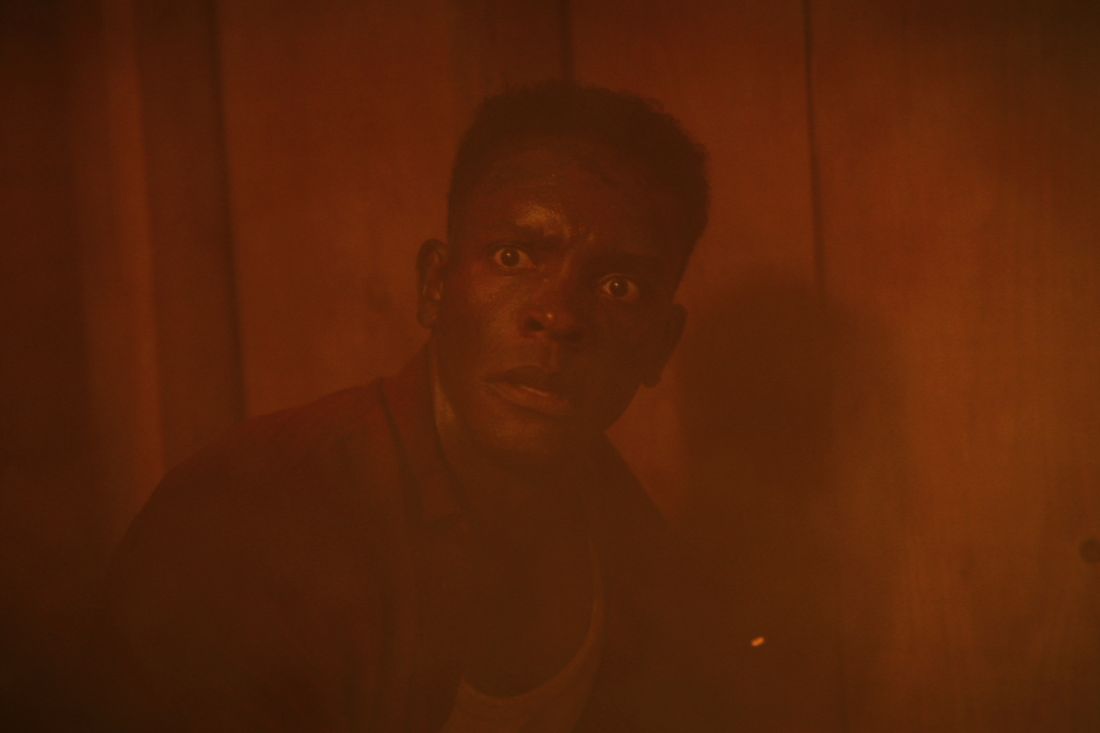
The story reaches its most intense moment yet with a devastating scene: the burning of the Black Spot, a historic nightclub and safe haven for Black soldiers and community members. Pennywise uses fire to incite racist violence, resulting in the deaths of many. Despite previous encounters with Pennywise, teen Rich tragically dies protecting his crush, Marge. Meanwhile, Hallorann, a psychic, experiences a breakthrough – and a weakening of his defenses – after directly confronting Pennywise. He bravely rescues people trapped under the burning club, but fully grasps the immense power of the evil they face. His usual methods for containing spirits are destroyed, and he’s overwhelmed by the approaching ghosts, leaving him deeply shaken and vulnerable.
I think episode seven is where everything really comes together. It’s fascinating watching Dick Hallorann because he keeps thinking he’s figured out the worst of it. First, he believes the slingshot scene is the climax, then it’s the general rejecting the plan, then going into the tunnels, even the box being dismantled, and finally seeing Pauly. It’s like Dick – and honestly, we as the audience – are discovering Pennywise’s power with him. It really hits you that Pennywise isn’t just creating fear, he is fear itself.
As a film lover, I was really struck by the Black Spot sequence. Initially, it’s presented as this safe haven for Black soldiers stationed in Derry – a place where they can relax and enjoy themselves. But then, the unthinkable happens – racists attack, setting the club ablaze and opening fire. Suddenly, it’s pure chaos, everyone scrambling to survive. What I found particularly compelling was Dick’s double struggle. He’s not just trying to escape with his life, but he’s also trying to avoid being seen by the spirits he can now perceive. It felt like a real pressure cooker! And then, the moment Dick touches that slingshot… that’s when he truly starts fighting to survive. It was like a tiny spark of joy for him, a brief moment of peace before everything went to hell. As a filmmaker, my job was to make that joy really stand out, so when it’s brutally ripped away and he’s completely devastated, the audience feels that loss deeply. We needed to give them something to connect with, something to mourn alongside him.
We practiced a lot before filming, and honestly, it was more of a relief to finally put my theater training to use. It felt comfortable and natural – like I was back in my element, focusing on the staging and performance. It’s all about relaxing and remembering each moment. Stephen Rider and I especially looked out for each other, quietly checking in to make sure we were on the same page. Stéphanie Girard-Hamelin, who coordinated the video, created quick previews during rehearsals. She’d quickly assemble footage, giving Andy a rough cut so we could review and refine things – like adjusting a hand position. It was a very collaborative and open process.
What stands out to you about the filming process? It was built in layers. We’d start with the main actors, then add extras, followed by the dancers—they filmed the dance numbers separately. Stunt work came last. Figuring out who would perform each stunt was actually a playful experience; sometimes it was just a random decision like, ‘You, in that spot? You’re getting knocked off next!’ We were all really amazed by the stunt team. They handled so much glass shattering, fire, and overall chaos, and they always nailed it.
The fire felt very real. We actually saw flames – it wasn’t something we had to imagine. People’s legs were visibly on fire, and the pool table was engulfed in a large blaze. I remember seeing Carlos Pinder and thinking he was in trouble. The glass shattered when Richard Walters and Shane Marriott were killed, and again when Dorian Grey escaped through the window. It all felt incredibly theatrical, like we were all experiencing something together. Thankfully, there was a real fire, which made the whole experience much more impactful.
I also want to point out that while the adult actors are experienced professionals, the child actors are truly incredible. They’re professional, yes, but they’re still so young, and their performances are indistinguishable from adults’. I couldn’t have done what they do at their age. Watching them work is amazing – knowing how difficult the conditions were, like needing ten or twenty takes in four feet of water, and realizing they’re only twelve years old… it’s unbelievable. We really need to acknowledge and appreciate these talented kids.
Honestly, as a movie fan, the fear in this episode really got to me – it was more unsettling than even the monster itself! I was really curious how they achieved that. The director explained it’s all about deep research – really knowing the character and the scene inside and out, even better than you know yourself. Pre-planning a scene shot-by-shot? Forget about it, that never works. Instead, they focus on understanding the emotional arc of the character and trusting the process. They always used practical effects whenever possible, which is fantastic. A lot of it came down to how far the actor, Chris Chalk, was willing to go with the fear for his character, Dick. The director pushed him, constantly asking if he could take it further. They shot a ton of footage, trusting that the editor would be able to shape it all into something truly terrifying. It’s a really collaborative process, and it clearly paid off!
Do you think this episode showed Dick at his most scared? Episode seven is definitely where his fear reaches its highest point. He’s completely exposed and feels like no one cares, which is exactly what he dreads – being utterly vulnerable with no support. That’s how he experiences it, regardless of reality: feeling completely alone and exposed, with everyone watching but no one to help. Any terrible day can feel like that, but this episode adds a clown and the presence of ghosts, which is a terrifying combination. Just imagining it is enough to overwhelm me!
What really struck me about this film is that the spirits you see aren’t CGI creations – they’re actual actors in incredible makeup, and sometimes, just a clever bit of tape for later effects! Angeline Morningstar is a standout as Sesqui, but honestly, everyone – even those with smaller roles as ghosts and ghouls – brought their A-game. Their dedication was infectious, and it allowed me, as the viewer, to truly feel the fear. It wasn’t just spooky visuals; it was the feeling of these… things… touching me, whispering, and the unsettling details – the dampness, the smell, even the sense of reading their memories. It was genuinely terrifying.
Okay, so this is round two with Pennywise, and wow, he’s really laying it on thick this time. He’s not holding back at all, just straight-up tormenting everyone. It’s like he’s brought all his buddies with him, too – he’s really ganging up on the Losers’ Club! It’s pretty intense, honestly. [Chuckles]
I was asked about working with Bill Skarsgård. It’s really inspiring to work with someone so completely confident in their role, and Bill embodies Pennywise with incredible assurance. He has no self-doubt, which makes everyone else feel more fearless. As soon as he’s on set and in character, he’s fully committed. I remember one scene where they transformed the set to look like Pennywise’s lair, the Black Spot. They filled the space with falling ash, and we were all worried about safety. It was a small, cramped space with intense lights, haze, and spooky effects. It was genuinely terrifying, which was exactly what director Andy Muschietti wanted – he made sure we all felt the fear!
I was surprised when Dick delved into Taniel’s mind to learn about the pillars and how they trap Pennywise. It felt out of character for the Dick I know, and I was curious about the reasoning behind it. I read you explained it stemmed from Dick’s fear, and I’d love to hear more about that scene and how it fits into his overall development.
Dick isn’t a ‘good’ person, honestly. The Dick we see now is a mature, powerful, 60-year-old man who has been through a lot, including the tragedy at the Overlook. He’s devoted to protecting children and understands his own abilities. He’s allowed to be complex and doesn’t always have to be kind. In that situation, what else could he do? He’s still a Black man navigating a dangerous situation. He could have directly investigated Taniel’s mind himself, but he urged Taniel to do it, and Taniel responded by spitting in his face. I think viewers missed that detail. Dick simply asked him to tell the truth, and that’s how he was treated. Dick is a person, not an idea, and he reacted in a way that ensured his own survival after being disrespected and facing immense pain.
Throughout the season, Dick consistently shows he’s a practical person. He understands the U.S. military is using him, but he’s limited in what he can do about it, and that scene really highlighted that. Dick thinks he has control, but he doesn’t. He’s a Black man in Derry, Maine, compelled to serve in the military in a town haunted by Pennywise. There’s no way he could truly be in charge of the situation, or the chaos unfolding around him. He’s very low on the power scale and just acts like he’s in control, but he’s definitely not the one calling the shots.
Read More
- United Airlines can now kick passengers off flights and ban them for not using headphones
- Crimson Desert: Disconnected Truth Puzzle Guide
- All 9 Coalition Heroes In Invincible Season 4 & Their Powers
- The Boys Season 5 Spoilers: Every Major Character Death If the Show Follows the Comics
- Mewgenics vinyl limited editions now available to pre-order
- Invincible Season 4 Episode 6 Release Date, Time, Where to Watch
- Assassin’s Creed Shadows will get upgraded PSSR support on PS5 Pro with Title Update 1.1.9 launching April 7
- Grok’s ‘Ask’ feature no longer free as X moves it behind paywall
- TikToker’s viral search for soulmate “Mike” takes brutal turn after his wife responds
- All Golden Ball Locations in Yakuza Kiwami 3 & Dark Ties
2025-12-08 06:56