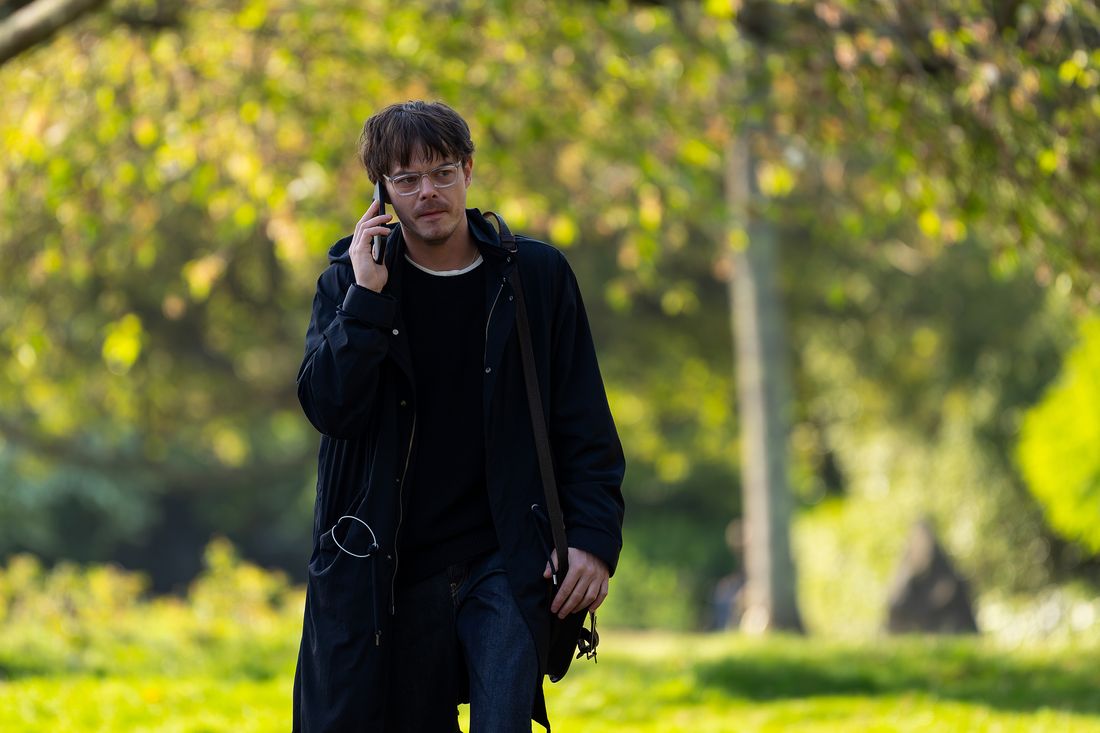
This article contains spoilers for the fourth season of the show Industry, specifically up to and including the fourth episode, “1000 Yoots, 1 Marilyn,” which aired on February 1st.
In the fourth season of Industry, financial journalist Jim Dycker (played by Charlie Heaton) feels like a potential victim waiting to happen. He warns Harper that the people he’s investigating are capable of anything, and this sense of danger follows him as he looks into the questionable practices of the company Tender. As Jim digs deeper into Tender’s unusual structure and history, he begins to suspect he’s being watched and that someone is trying to sabotage his investigation and ruin his reputation. The show leaves you wondering if Tender would go as far as murder to protect itself, especially after Jim’s death by overdose at the end of an episode, which feels far too convenient.
Charlie Heaton immediately felt a connection to his character on Industry – and a sense of foreboding. He knew his audition wasn’t just about getting the role, but performing the scene where the character dies. After playing the kind and reliable Jonathan Byers on Stranger Things for ten years, Heaton was eager for a new, more demanding part. Industry, set in the high-stakes world of London finance, was a huge departure from the supernatural setting of Hawkins, Indiana, and the challenges felt real. “I was honestly intimidated by Industry because it’s so different and intense,” Heaton explains while recording commentary for a re-release of his 2016 film, As You Are. “The complex dialogue and completely unfamiliar world were really appealing.”
I noticed a lot of online comments after the first episode of ‘Industry’ aired, with people surprised to learn I’m British. Apparently, hearing me speak in my natural voice was a shock! It actually came up in my first conversation with my new U.K. agent – he pointed out that many viewers didn’t realize I was British. In a way, that’s a great thing, because it means I was convincing in my role on ‘Stranger Things’. But it was also really refreshing to be able to use my actual voice, and it’s amusing to hear people react to what I actually sound like.
You mentioned being on Stranger Things for ten years, and working on other projects as well. What’s your process for creating a new character? Specifically, how did you approach the role of Jim?
It really varies with each part. I’m actually recording commentary for a film I made a decade ago, called As You Are – one of my first films. Listening back to my American accent in that movie is so different from Jonathan’s voice. I often use accents as a starting point for a character, and once I find the voice, the rest tends to fall into place. Then I focus on understanding the character’s world and fully immersing myself in it. With Industry, the world was already established, so I watched the previous seasons and listened to some related podcasts to get a feel for it.
It was surprisingly fascinating to read the scripts and constantly look up financial terms like the FTSE. It actually happened during the stock market crash last March, and I remember reading an article and realizing I could finally understand what everyone was talking about! That’s what’s great about this job – you get to dive into completely unfamiliar worlds and, for a short time, become a real investigator and researcher.
The audition included the emotionally charged scene where your character reacts to Jim’s death. It starts with a party with Rishi, moves to a tense apartment with another man, all while Ultravox’s “Vienna” plays and your character is under the influence. Can you describe filming that scene? It was the last thing I shot during my three-month stint in Cardiff, giving me plenty of time to memorize the complex dialogue. I knew it would be demanding, especially as it marked the end of Rishi’s storyline and the midpoint of the series. Director Michelle Savill wanted Sagar Radia and me to rehearse extensively. I was just meeting Sagar at the time, so that was interesting. Michelle had us break down the scene into small sections, then discuss what our characters were really trying to communicate – their underlying motivations, beyond the literal words. It revealed subtle nuances, like moments where Jim was subtly aggressive or manipulative. Exploring that psychological space was a really cool experience.
We filmed the scene in a real apartment building, and the day was very physically challenging. It’s a demanding scene, and we shot it all day long. The filming style on Industry isn’t traditional; they don’t focus on perfect continuity. It’s more of a fast-paced, documentary-like approach. We were encouraged to move freely and interact naturally with each other. A big part of it was keeping our energy up throughout the day – sometimes you’d feel great, and other times you’d need a boost from your fellow actors. We’d rehearse with and without dialogue, often using music to help maintain the intensity. By the end of the day, I was completely drained and felt incredibly grimy – all I wanted to do was go home and shower to feel refreshed.
It’s great you noticed the deeper meanings in that scene. Jim says some harsh things to Rishi about his wife, but he also jumps between bizarre imagery – ghost ships, Marilyn Monroe on planes, condensation on mirrors. He covers a lot of complex ideas, and it really shows how he thinks. According to his editor, Burgess, Jim is brave and intelligent. His observations force you to consider his moral compass. He’s speaking a lot of uncomfortable truths about the world today – how disconnected we’ve become because of technology and how that makes things feel less real. He’s pointing out how desensitized we are, especially when he asks Rishi about witnessing something so violent. Even though the scene is set in a chaotic environment with drugs and alcohol, his points are surprisingly clear.
In the first four episodes, the character makes some really sharp observations, notably figuring out what’s happening with Tender before anyone else. He’s examining people he sees as dishonest, and while their actions are questionable, he’s also willing to bend his own morals to get the information he needs. It’s an interesting dynamic to explore as an actor – understanding a character’s motivations without judging them. It’s a complex portrayal, and that’s a testament to the work of Konrad and Mickey.
I kept rewatching a part to understand exactly what happened, especially when Rishi went to the bathroom, because it’s unclear what happened to Jim. Did it seem like a simple overdose to you? Or should we be wary of the other man involved? I’m curious what your take is. We discussed it, and it’s possible we should be suspicious. What I do know is that Jim overdosed, and someone laced his drugs with an opioid – likely morphine or fentanyl – to make it look like a straightforward overdose. However, I’ve only read up to chapter four, so I’m not sure how the story unfolds from there.
I see the show Industry as deeply exploring themes of fatherhood. We see Eric struggling to connect with his daughters, Rishi giving up his parental rights, and Jim becoming a father – and you also became a father during filming. You’ve spoken about how becoming a young father forces you to mature quickly and prioritize what’s truly important. How did you approach portraying Jim’s journey into fatherhood and how did it impact his character?
That scene with Jim and his child, though brief, really adds layers to his personality. He admits their relationship started casually, but still feels a sense of duty. He’s juggling this new responsibility with trying to rebuild his career and battling his own insecurities, particularly feeling overshadowed by his wealthier friends. He’s living a modest life and raising a child with someone he’s not romantically involved with, yet he consistently shows up and does his best.
My coworker, Devon Ivie, recently interviewed Joe Keery, and he mentioned you quite a bit! Joe was talking about the last days of filming Stranger Things and recalled a specific moment: “I was driving to set with Charlie, and I just knew the tears were coming.” Do you remember that day?
I do, very clearly. Joe and I actually started the day with a cold plunge! We drove to work not realizing how emotional it would be – it had been building for a year, and we knew tears might happen. We were driving from base camp to the set in a van, and I noticed Joe was getting very emotional. He really set the tone for the day. It surprised me because Joe is usually such a strong leader and doesn’t often show vulnerability. I honestly didn’t expect him to be the one crying! But then, when we got to set to film the rooftop scene, we all really started to break down.
It feels like there wasn’t much ‘acting’ happening, really. It was more like the four of us were simply saying goodbye to parts of our lives. I specifically remember looking at Joe – and it was the same with Maya and Natalia – and just realizing we had formed truly beautiful friendships. Seeing Joe on that rooftop, it felt like I was seeing both who he is now and who he was ten years ago, all at once. As an actor, that’s what you always strive for – that genuine feeling. This was probably the closest I’ve ever gotten to achieving that honesty in a scene.
Read More
- United Airlines can now kick passengers off flights and ban them for not using headphones
- Crimson Desert: Disconnected Truth Puzzle Guide
- All 9 Coalition Heroes In Invincible Season 4 & Their Powers
- Grey’s Anatomy Season 23 Confirmed for 2026-2027 Broadcast Season
- Mewgenics vinyl limited editions now available to pre-order
- Viral Letterboxd keychain lets cinephiles show off their favorite movies on the go
- Does Mark survive Invincible vs Conquest 2? Comics reveal fate after S4E5
- All Golden Ball Locations in Yakuza Kiwami 3 & Dark Ties
- How to Get to the Undercoast in Esoteric Ebb
- The Boys Season 5 Spoilers: Every Major Character Death If the Show Follows the Comics
2026-02-02 06:58