Time Series Forecasting Gets a Knowledge Boost

A new framework, TiMi, combines the power of transformer networks with textual insights to dramatically improve the accuracy of predictions.
A new framework, TiMi, combines the power of transformer networks with textual insights to dramatically improve the accuracy of predictions.
![By conditioning market probability on textual evidence, a model-MixMCP-refines an initial uncertain forecast of 45% to a more confident 55.5% prediction by strategically combining a stable market prior with evidence-based updates from a large language model-weighted at [latex]\alpha = 0.7[/latex]-thereby resolving market ambiguity and anticipating resolution with 80% confidence as indicated by [latex]p_{\text{mcp}} = 80\%[/latex].](https://arxiv.org/html/2602.21229v1/table/motivational_plot/Motivational_plot.png)
New research shows that combining the insights of prediction markets with large language models can significantly improve the accuracy of forecasting future events.
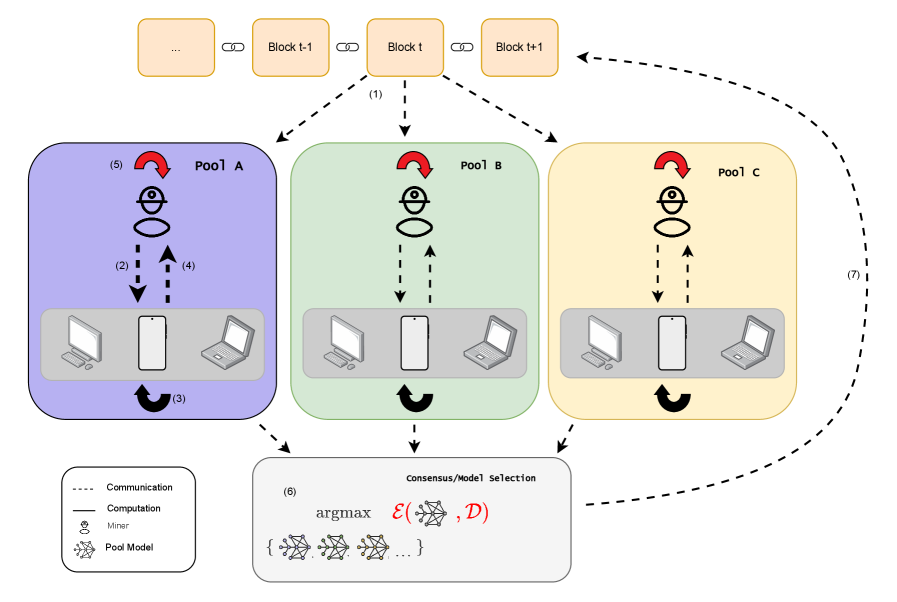
A new framework integrates blockchain consensus with federated learning to create a robust and trustworthy decentralized AI system.

Researchers have released a rigorously curated dataset designed to help detect fraudulent token projects before investors lose their funds.

Researchers are developing systems that combine personal knowledge graphs with large language models to proactively surface relevant information from a user’s past experiences.
Researchers are leveraging the power of formal logic to make cardiovascular risk assessments more transparent and understandable.

A new system leverages the power of language AI to quickly extract critical information from emergency documentation during disasters.

As communication shifts toward AI-driven semantic systems, traditional security measures are proving inadequate, demanding new defenses against evolving threats.
![The study demonstrates that a self-sustained Bayesian predictor frequently achieves performance comparable to, and occasionally surpasses, an in-sample dcGM reconstruction, as evidenced by metric-specific improvements calculated using both [latex] \text{ARE}_k [/latex] and [latex] \text{MRE}_k [/latex] for certain metrics, and a different formulation for others-including [latex] \langle\text{TPR}\rangle [/latex], [latex] \langle\text{PPV}\rangle [/latex], [latex] \langle\text{TNR}\rangle [/latex], and [latex] \langle\text{ACC}\rangle [/latex]-where values exceeding zero indicate superior Bayesian predictor performance.](https://arxiv.org/html/2602.21869v1/x14.png)
A new framework uses Bayesian inference to reconstruct network topology and forecast future connections from limited initial data.
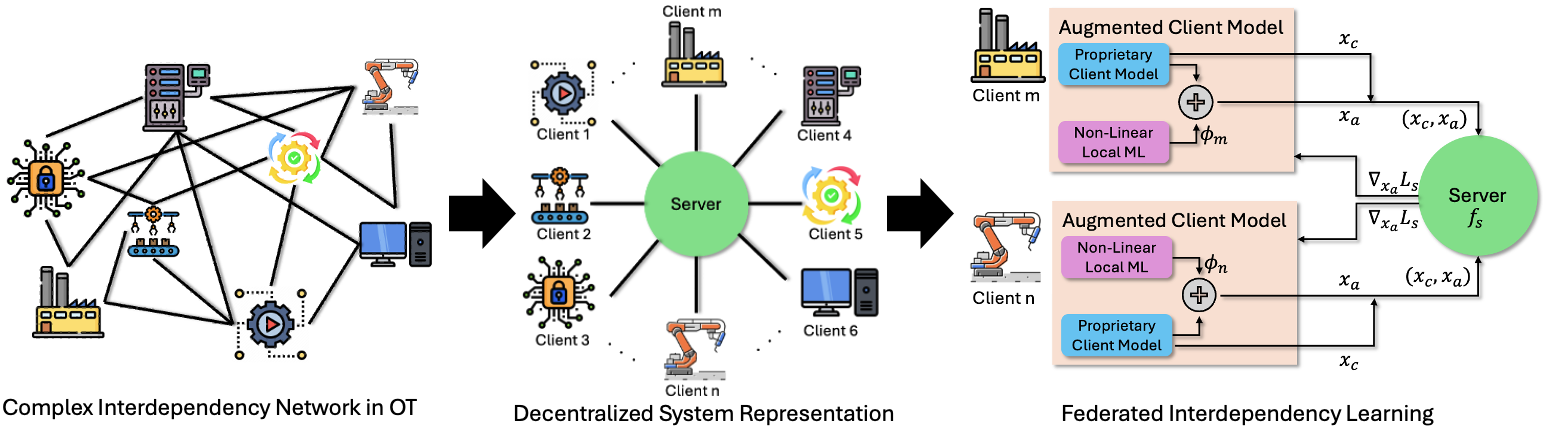
A new federated learning framework enables identifying the origins of anomalies in industrial control systems without compromising data privacy or requiring model changes.