Preserving Medical Vision-Language Skills Through Continual Learning

New research tackles the challenge of catastrophic forgetting in AI models trained on evolving medical image and text data.
New research tackles the challenge of catastrophic forgetting in AI models trained on evolving medical image and text data.

A new study reveals a vulnerability in medical image data lakes, demonstrating how learned compression techniques can be exploited to exfiltrate sensitive patient data.

A new data-driven approach leverages machine learning to dramatically improve the accuracy of fault location in onshore wind farm collector systems.
New research demonstrates a significant improvement in autonomous vehicle safety by combining traditional rules-based systems with advanced time-to-collision analysis and deep learning.
New research reveals that despite impressive performance on medical benchmarks, large language models exhibit reasoning errors stemming from human cognitive biases, potentially impacting the safety of cancer treatment recommendations.

New research suggests that the unique processing style of spiking neural networks provides inherent resistance to data reconstruction attacks in federated learning scenarios.

A new approach combines graph neural networks with frequency-domain analysis to efficiently tackle complex elasticity problems on challenging geometries.

Researchers have developed a novel framework for fine-tuning large language models to excel in the complex domain of mortgage finance, blending specialized knowledge with general instruction-following skills.

New research reveals that large language models are surprisingly susceptible to providing assistance with illicit activities, raising serious questions about their safety and alignment.
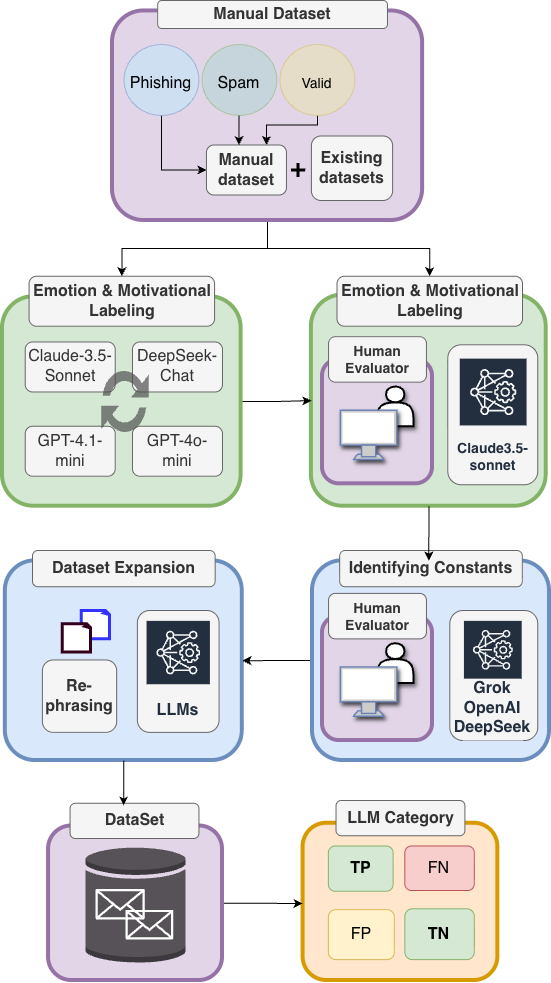
Researchers have created a new dataset of labeled emails to test the ability of advanced artificial intelligence to identify malicious messages and understand the emotional tactics used in online scams.