Why Freeze-Proof Stablecoins Are a Delightful Fantasy
The moment could scarcely have been more inconveniently timed.

Lois Greisman, the FTC’s Associate Director, took the stage before the Joint Economic Committee and delivered a speech that could have made a Victorian cravat jealous. She disclosed that in the year of our reckoning, 2025, the commission was awash with a staggering three million fraud reports-an alarmingly hefty sum of $15.9 billion in outlays. One can only imagine the Howe‑Shift at the receiving end.

In a missive circulated on Wednesday, the IMF portrayed tokenization as far more than a mere contrivance of technology: it is, indeed, an upheaval of institutional propriety. By transforming money, securities, and derivatives into digital tokens recorded upon communal ledgers, this innovation alters, quite dramatically, the manner in which claims are created, conveyed, and settled.

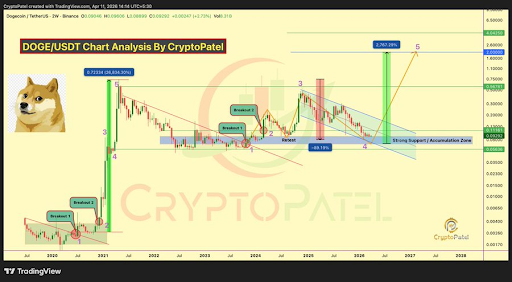
The crypto market is now teetering on the edge of a cliff, contemplating whether to leap or falter. If the bulls fail to defend the $0.05 zone, the entire move risks being dismissed as a mere hiccup in a dominant bearish symphony. However, a decisive flip above $0.05 could spark a continuation leg, shifting the narrative and opening the door to higher resistance-assuming, of course, that the market isn’t just playing a cruel joke on us.
According to their Thursday update, as solemn as a preacher’s sermon, Riot sold the Bitcoin at an average price of $76,626, raking in $289.5 million. By April 3, Bitcoin was trading near $66,867, leaving Riot looking like the shrewd trader at the county fair who sold his prize hog before the price dropped. Meanwhile, Arkham Intelligence spotted a 500 BTC outflow from Riot’s wallet earlier in the week, a move as subtle as a sledgehammer.
On the fateful 2nd of April, 2026 (a date surely chosen to mock April Fools’ Day), the Toulouse-based ST Group declared its intention to list on Lise, a French stock exchange powered by the latest fad in town: blockchain. The subscription period, kicking off April 9, promises to upend the stodgy world of finance with digital glitter and decentralized dreams. One wonders if the DGA’s recommendation was based on logic or just a desperate need for a buzzword.
Coinbase is moving closer to becoming a national bank in the U.S. Federal regulators have given the company initial approval to create a National Trust Bank. This could significantly change how cryptocurrencies are managed and overseen by the government.
According to an announcement on the 2nd of April (no fooling, mind you), this latest addition brings daily up-or-down and closing price contracts for major equity indexes, alongside commodities like gold and oil, and US-listed stocks. The outcomes, my dear reader, are determined using Pyth’s real-time price feeds, and the markets reset at the end of each trading session. Rather like a game of cricket, what?
Behold, the list of its misfortunes, a litany of woe that would make even the most stoic of souls weep:

Crypto expert @ColinTCrypto, whose insights are as reliable as a toddler’s bedtime routine, has declared Dogecoin a “weak altcoin.” Because nothing says “financial advice” like comparing a cryptocurrency to a poorly written essay. The analyst claims the broader market is under pressure, which is just a fancy way of saying “the world is on fire and we’re all wearing pajamas.”