Oh, Bitcoin (BTC), you fickle beast! Your momentum has done a 180 in the fourth quarter, faster than a Mel Brooks punchline. Analysts thought you’d hit the moon, but now you’re struggling to find your way back to the launchpad. 📉🚀 Forecasts are tumbling faster than a banana peel in a slapstick comedy.
What’s the deal, crypto? The macro environment is sunnier than a day at the beach, but demand is colder than a polar bear’s toenails. Market strength? Fading like a bad tan. Confidence? Eroding like a sandcastle in a tsunami. So, what’s changed? BeInCrypto sat down with Ryan Chow, Co-Founder of Solv Protocol, to unravel this crypto conundrum and figure out how Bitcoin can win 2026. 🕵️♂️💭
How Bitcoin Wooed and Lost Institutional Hearts in 2025 💔
Historically, Q4 has been Bitcoin’s time to shine, delivering an average return of 77.26%. 2025 was supposed to be even bigger, with institutions jumping on the bandwagon like it’s the last train to Crazytown. Public companies were hoarding Bitcoin like it’s the new gold. 🏦✨
But then, plot twist! Bitcoin took a nosedive, down 20.69% in Q4. It’s like the crypto Santa forgot to deliver the goods. 🎅💸
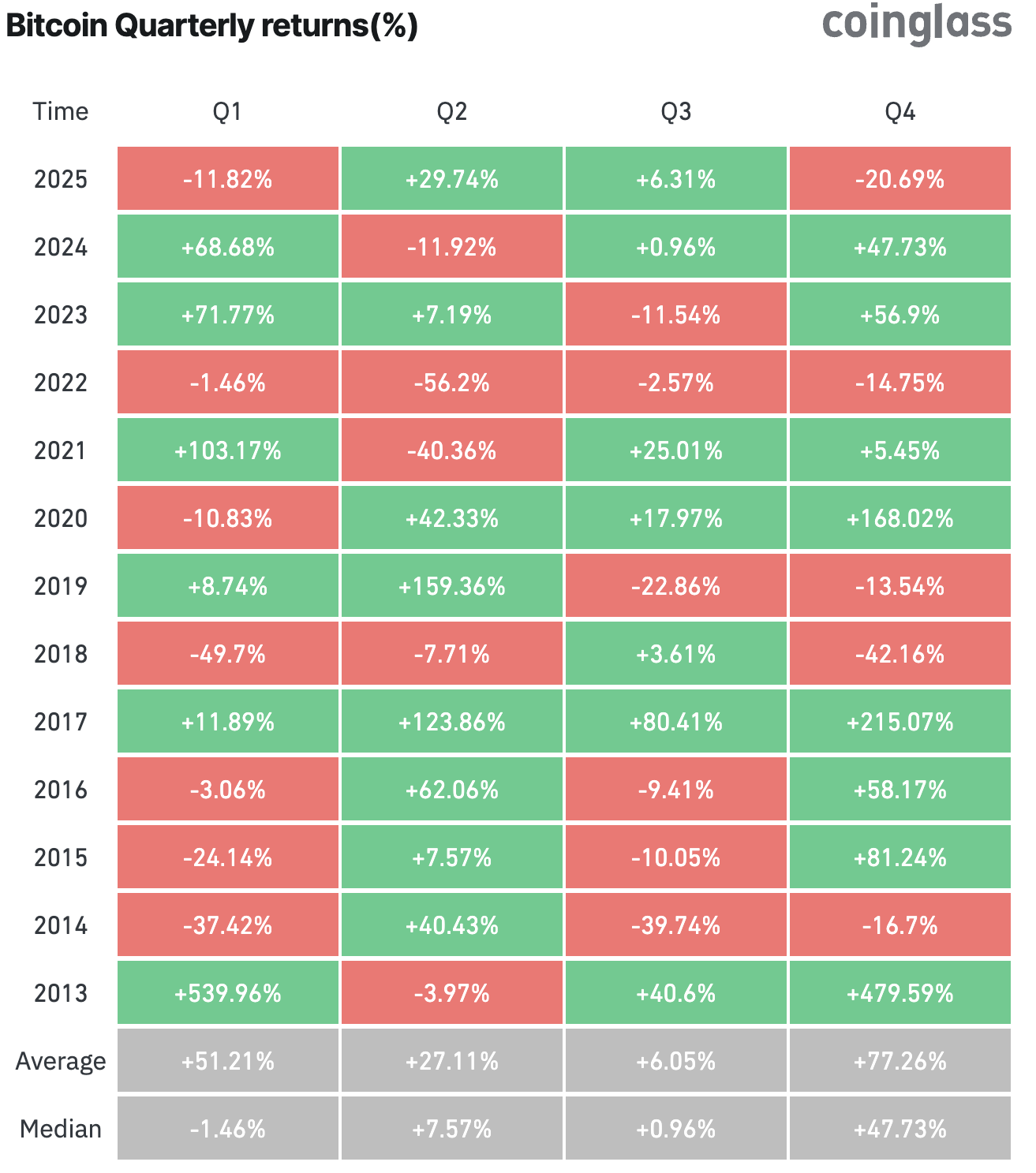
According to Chow, early 2025 was all about institutions getting their Bitcoin fix. 🍬💊
“Spot ETFs, ETPs, and new mandates created an access shock, institutions were simply getting their baseline Bitcoin allocation in place, and mechanical inflows drove prices,” he said. 🤑🤖
But by late 2025, the party was over. Structural buyers had their fill, and Bitcoin had to compete with real yields. Once the highs stopped coming, CIOs started asking, “Why hold a non-yielding asset when T-bills, corporate credit, and AI-driven equities are paying to play?” 🤔💼
“I think the market is finally confronting a truth that’s been obvious for years: passive holding has reached its limits. Retail is distributing, corporates have stopped accumulating, and institutions are pulling back. This time, it’s not because they’ve lost faith in Bitcoin but rather, the current market design doesn’t justify large-scale allocation in a high-rate regime,” Chow added. 🧐📉
Chow also pointed out that Bitcoin’s market structure has shifted. After the ETF and halving trades, it became an overcrowded macro position. The “ETF plus halving equals number go up” thesis? It’s deader than a parrot in a Monty Python sketch. 🦜💀
The next phase of adoption? It’s all about utility and risk-adjusted yield. Chow told BeInCrypto,
“The first half of 2025 was about access, everyone rushed to secure their baseline Bitcoin exposure. The second half is about opportunity cost, now Bitcoin has to earn its place in a portfolio against assets that actually pay you to hold them.” 💰📈
Bitcoin, the digital gold, has always been sold as an inflation hedge. But Chow says that narrative alone won’t cut it for institutions anymore. It’s time to put up or shut up. 🏆🤐
Expert Spills the Beans: Bitcoin’s 2026 Comeback Plan 🌟
Chow warns that the market might be underestimating the macroeconomic shifts in 2026. Unless Bitcoin evolves into productive capital, it’ll stay a cyclical, liquidity-dependent asset. Institutions will treat it like a fling, not a long-term commitment. 💔💼
“Bitcoin will no longer win on narrative alone. It must earn yield, or it will be structurally discounted. The volatility we’re seeing now is the market forcing Bitcoin to grow up,” he remarked. 🌱📈
So, what’s the secret sauce to bring institutions back in 2026? Chow says it’s all about regulated, cash-plus Bitcoin strategies that look like traditional investment products. Think clear legal wrappers, audited reserves, and straightforward risk profiles. 📜🔒
He outlined three categories:
- Bitcoin-backed cash-plus funds: BTC held in qualified custody and deployed into on-chain Treasury bill or repo strategies, targeting an incremental 2 to 4% yield. 🏦💰
- Over-collateralised BTC lending and repo: Regulated vehicles lending against Bitcoin to high-quality borrowers. On-chain monitoring, conservative LTVs, and bankruptcy-remote structures will support this. 🛡️💳
- Defined-outcome option overlays: Strategies such as covered calls, wrapped in familiar regulatory frameworks like UCITS or 40-Act vehicles. 📝📊
Across all of them, regulated managers, segregated accounts, proof-of-reserves, and compatibility with existing institutional custody infrastructure are non-negotiable. 🔐✅
“The products that will bring institutions back aren’t exotic. They’ll look like Bitcoin-backed cash-plus funds, repo markets, and defined-outcome strategies, familiar wrappers, familiar risk controls, just powered by Bitcoin under the hood,” Chow claimed. 🚀🔧
Institutions don’t need 20% DeFi APY, which is often a red flag. A net annualized return of 2 to 5%, achieved through transparent and collateralized strategies, is enough to make Bitcoin a “core reserve asset.” 🏅💹
“Bitcoin doesn’t need to become a high-yield product to stay relevant. It just needs to move from zero percent to a modest, transparent ‘cash-plus’ profile so CIOs stop treating it as dead capital,” the Solv co-founder mentioned to BeInCrypto. 💡💰
What Bitcoin Yield Looks Like in Practice 🛠️
Chow detailed that Bitcoin’s transformation into productive capital would shift it from a static gold bar to high-quality collateral capable of funding T-bills, credit, and liquidity across multiple venues. Corporates pledge BTC into regulated on-chain vaults, receive yield-bearing claims in return, and maintain a clear line-of-sight to underlying assets. 🏗️🔗
Bitcoin would also serve as collateral in repo markets, as margin for derivatives, and as backing for structured notes, supporting both on-chain investment strategies and off-chain working capital needs.
The result? A multi-purpose instrument: Bitcoin as a reserve asset, a funding asset, and a yield-generating asset simultaneously. It’s like Treasuries, but in a global, 24/7, programmable environment. 🌍⏰
“If we get this right, institutions won’t talk about ‘holding Bitcoin’ so much as ‘funding portfolios with Bitcoin.’ It becomes the neutral collateral that quietly powers T-bills, credit, and liquidity across both traditional and on-chain markets,” Chow commented. 💼🔌
Institutions Want Yield: Can Bitcoin Deliver Without Selling Its Soul? 🤔💸
The big question: Can Bitcoin support regulated, risk-adjusted yield at scale without compromising its principles? According to Chow, the answer is a resounding yes, as long as the market respects Bitcoin’s layered architecture. 🛡️✅
“The base layer stays conservative; yield and regulation live in higher layers with strong bridges and transparency standards. Bitcoin L1 remains simple and decentralised, while the productive layer sits on L2s, sidechains, or RWA chains where wrapped Bitcoin interacts with tokenised treasuries and credit,” he noted. 🏗️🔗
Technical challenges? Plenty. The ecosystem needs to evolve from trusted multisig setups to institution-grade bridging, establish standardised one-to-one-backed wrappers, and develop real-time risk oracles. 🛠️🔍
“The ideological challenge is harder: post-CeFi collapse, skepticism runs deep. The bridge is radical transparency, on-chain proof-of-reserves, disclosed mandates, no hidden leverage. Crucially, productive Bitcoin remains optional; self-custody stays valid. We don’t need to change Bitcoin’s base layer to make it productive. We need to build a disciplined financial layer on top, one that institutions can trust and cypherpunks can verify,” the executive elaborated. 🌉🔍
Chow’s message is clear: Bitcoin’s next phase will be defined by disciplined financial engineering, not narrative or speculation. If the industry can deliver transparent, regulated, yield-bearing structures without compromising Bitcoin’s core principles, institutions will return-not as momentum traders, but as long-term allocators. 🏗️💼
The path to 2026 runs through utility, credibility, and Bitcoin proving it can compete in a world where capital demands productivity. Let’s see if it can rise to the challenge! 🚀💪
Read More
- United Airlines can now kick passengers off flights and ban them for not using headphones
- Gold Rate Forecast
- How to Solve the Glenbright Manor Puzzle in Crimson Desert
- How to Get to the Undercoast in Esoteric Ebb
- How to Complete Bloom of Tranquility Challenge in Infinity Nikki
- All Golden Ball Locations in Yakuza Kiwami 3 & Dark Ties
- 8 Actors Who Could Play Blackbeard In One Piece Live-Action Season 3
- A Dark Scream Theory Rewrites the Only Movie to Break the 2-Killer Rule
- NEXO PREDICTION. NEXO cryptocurrency
- Blind Tekken 8 player reaches one of the game’s highest ranks after two years of grinding
2025-12-11 19:29