Imagine, if you will, a world where a co-CEO’s WeChat account is not a fortress of digital might, but a poorly guarded teacup. Enter the villains-sneaky, giggling hackers who sipped through the crack and spilled $55,000 worth of chaos. They promoted a meme token called MUBARA, a name so delightfully absurd it sounds like a rejected wizard’s spell, and watched the gullible masses toss their savings into the void like confetti at a digital funeral.
Just days after Yi He ascended to co-CEO, the villains struck with the timing of a well-rehearsed symphony. This allowed the deceitful posts to masquerade as wise counsel from a crypto oracle. Poor Yi He, now the accidental spokesperson for a token that probably smells like burnt toast and regret, had to explain on X (formerly Twitter) that her account had been “abandoned long ago” and was now “seized for use.” One wonders if the hackers sent her a thank-you note for the free advertising.
How the Attack Worked
The hackers, armed with nothing but an old phone number and a sense of mischief, slipped into Yi He’s WeChat account like a thief in a silk glove. In China, telecom companies reassign unused numbers with the enthusiasm of a toddler swapping toys. This created a security gap so wide you could drive a cryptocurrency truck through it. The villains, presumably sipping bubble tea and cackling, bought 21.16 million MUBARA tokens and waited for the price to balloon like a overinflated balloon animal.
Once the token’s value hit $8 million (a number so high it made the moon wobble), the scammers sold their stash faster than a magician pulling a rabbit from a hat. They pocketed $55,000, left 9.21 million tokens “for the birds,” and probably treated themselves to a fancy dinner. Blockchain analytics firm Lookonchain tracked the whole debacle like a detective with a spreadsheet, but by then, the villains had already vanished into the digital shadows.
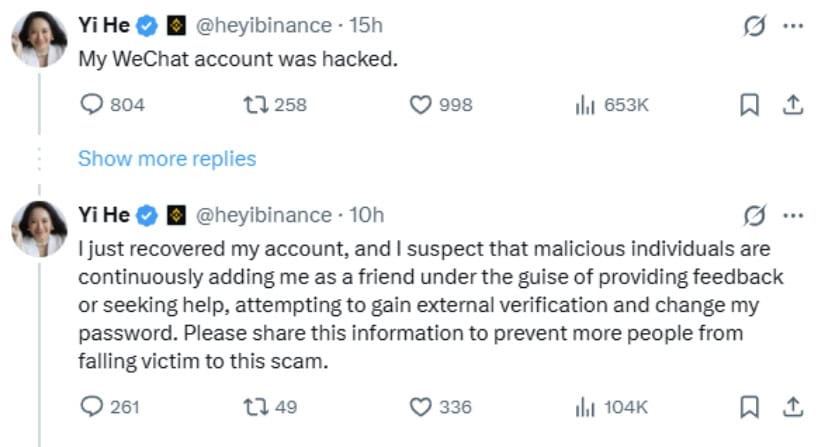
Growing Pattern of Crypto Executive Attacks
This isn’t the first time hackers have played dress-up with crypto CEOs. Just days prior, Tron founder Justin Sun’s WeChat account was hijacked in a similar farce. It seems the villains have a new favorite hobby: impersonating blockchain billionaires and selling tokens that vanish faster than a sugar rush. Security experts, now sounding like broken record players, warn that these attacks thrive on trust-something as fragile as a house of cards in a hurricane.
Changpeng Zhao, Binance’s founder, took to X to shout, “Stay safu!” (a phrase that sounds suspiciously like a pirate’s warning). But let’s be honest-if your co-CEO’s account can be hacked by someone who once met your friend’s friend’s cousin, maybe the real problem is the social media, not the math.
Technical Vulnerabilities in WeChat Security
Yu Xuan, a security sage, explained how these heists unfold. All it takes is two “frequent contacts”-people you may have met once in a group chat and promptly forgotten. The barrier to entry is so low, it’s like letting a toddler loose in a candy store with a credit card. In China, where WeChat is both a messaging app and a payment platform, the villains have turned fake endorsements into a deadly game of hot potato.
Broader Security Risks for Crypto Industry
This hack is a reminder that even the most advanced blockchain tech can’t outsmart a poorly secured social media account. While crypto networks hum along like well-oiled machines, hackers are busy turning Web2 platforms into digital playgrounds for chaos. Binance, meanwhile, faced another mishap when BNB Chain’s X account was compromised, leading to $8,000 in losses. It’s like watching a circus where the clowns are also holding your wallet hostage.
Recovery and Prevention Measures
Binance, ever the hero in this tragicomedy, worked with WeChat to reclaim Yi He’s account. The company reassured users that their funds were safe-probably by waving a magic wand and hoping for the best. Security experts, however, have some sensible advice: ditch old contacts, change passwords regularly, and never link critical accounts to phone numbers that might be reassigned. Because nothing says “trust me” like a number that once belonged to a telemarketer.
-
Remove old or unused contacts from social media accounts (because why keep friends you’ve forgotten?).
-
Change passwords regularly, especially for dormant accounts (because “123456” is still a terrible password, even if it’s your lucky number).
-
Respond immediately to suspicious login alerts (unless it’s just your cat walking over the keyboard).
-
Avoid linking critical accounts to phone numbers that might be reassigned (because nothing says “security” like a number that once sold you life insurance).
The $55,000 Wake-Up Call
The Yi He hack is a $55,000 wake-up call wrapped in a bow of digital despair. It’s a reminder that in the world of crypto, trust is as fleeting as a meme coin’s value. While the amount stolen might seem small compared to bank heists, it’s enough to make you question every post from a “trusted” figure. After all, if a co-CEO’s account can be hijacked by someone who once liked your vacation photos, maybe it’s time to double-check your sources-preferably with a magnifying glass and a healthy dose of skepticism.
Read More
- United Airlines can now kick passengers off flights and ban them for not using headphones
- How to Complete Bloom of Tranquility Challenge in Infinity Nikki
- Gold Rate Forecast
- How to Solve the Glenbright Manor Puzzle in Crimson Desert
- 8 Actors Who Could Play Blackbeard In One Piece Live-Action Season 3
- All 10 Potential New Avengers Leaders in Doomsday, Ranked by Their Power
- A Dark Scream Theory Rewrites the Only Movie to Break the 2-Killer Rule
- All Golden Ball Locations in Yakuza Kiwami 3 & Dark Ties
- Crimson Desert Bustling Hill guide: How to complete the Dispatch the Howling Hill expansion mission
- Daredevil: Born Again Season 2 & 3 Update Is Good & Bad News for Defenders Fans
2025-12-10 23:41