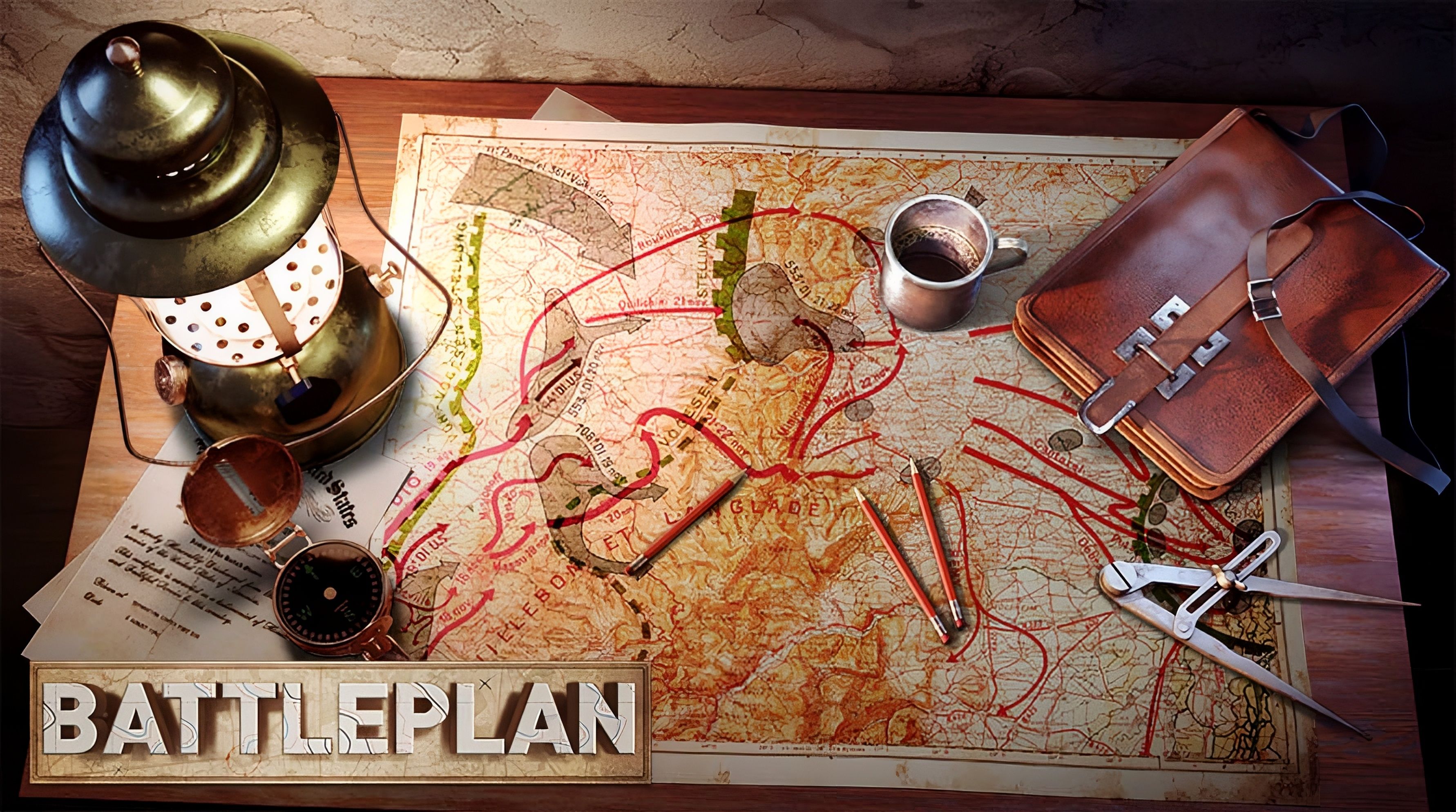
Okay, so the setting is 1944. Basically, most of Europe was still controlled by Germany, and things were looking pretty grim. The Allies knew they needed to make a big push to turn the tide, and they did with two massive operations: Overlord and Bagration. Those were the game-changers we needed!
Battleplan drops you into a command center shortly after the D-Day landings. You’re tasked with marking routes on a map for your troops. Success could mean a swift end to the war, potentially by Christmas. But poor decisions will lead to devastating losses and heartbreaking news for many families.
Foolish Mortals Games Inc., a Canadian game studio, has experience with strategy games centered around planning. They previously made a map-based strategy game called Radio General in 2020, but Battleplan offers a much larger and more complex scope of management.
In Battleplan, you’ll lead several large divisions where your decisions directly impact the war’s outcome. It’s a demanding role – the game frequently emphasizes this – but it offers a unique strategic experience that sets it apart from other games in the genre.
I’ve been a fan of Battleplan since it was first announced. Having worked in newsrooms covering global conflicts, I’ve always thought many strategy games don’t present information to players in a clear or useful way, and I was excited to see how Battleplan would address that.
Strategy games usually focus on either detailed, moment-to-moment unit control – like in real-time strategy – or a broader view of managing territory – as seen in grand strategy. While I generally prefer focusing on tactical battles and directly controlling units, it would be ideal to have both: the ability to give specific orders and also manage the larger strategic picture of map control.
Battleplan aims to blend these elements into a single game, and it largely succeeds, though it occasionally feels overambitious.
Boot Camp
The campaign begins with practice runs for D-Day in England, and I think it’s easy to learn, even if you’re new to the game. Instead of overwhelming you with all thirty objectives at once, it introduces them one by one, letting you understand each before adding more.
Most strategy games let you directly control your units and respond to events as they happen. While this works well for managing small groups, it’s not how things work at a higher level of command. When you’re in charge of larger forces, your role is to create a plan and trust your officers to carry it out, rather than trying to control every detail.
As a fan, I’m hearing that if things go well, this conflict could be finished by Christmas. But honestly, if even one thing goes wrong, it’s going to mean devastating news for so many families – imagine getting a notice that a loved one has been killed. It’s a really heavy thought.
Each day begins with a planning stage where you create and send orders to your units. After that, they carry out those orders on their own. While you can sometimes tell units to hold until a specific signal or time, mostly you just observe how your plan unfolds.
If you’re feeling stressed, you can ask your officers to create detailed plans for both defense and attack. But honestly, I think it’s a bit of a shortcut.
Battleplan’s campaign focuses on recreating historical battles. It’s great that you can choose to fight with the actual units from history, or create a custom army using a point system. If you build your own army, your units carry over between missions, which makes the campaign feel more connected. Personally, I prefer the historical battles because it challenges you to make the best of the resources you’re given, rather than just picking your favorite units.
Trial by Fire
Most missions seem straightforward – take this point, hold that one, deal with injuries, and control a zone. The really enjoyable part of Battleplan is that it doesn’t restrict how you complete these objectives. With such large maps, you have a lot of freedom to get creative with your strategies.
Consider the fight for Caen. You’ll command British and Canadian troops, starting after securing Bayeux and joining forces with the 6th Airborne Division. The main objective is to defend Bayeux until reinforcements land, and then lead the attack to capture Caen.
Could you move all your soldiers back to Bayoux and defend the area? Well, that would essentially invite a long siege. You could also try gathering all your forces and quickly attacking Caen, but that’s likely to be as ineffective as repeatedly trying something that clearly isn’t working.
The best strategies were to either quickly attack and seize the supply centers at Vire and Lisieux, or to surround Caen and then defeat its exhausted troops.
I usually prefer to play it safe in strategy games, and trying to handle multiple goals while also holding back the German forces in Caen seemed like too much to ask.
The game also lets you have your officers create detailed strategies for both defense and attack, but honestly, I think relying on them too much is a bit of a shortcut.
The strategy involved holding the 50th Infantry Division in a strong defensive position near Bayeux, while other troops prepared the way for an attack to surround and capture Caen.
A British infantry division would cross the Orne River and stop just before the marshy areas on the other side. At the same time, the 6th Airborne Division and a Canadian infantry division would advance south towards Caen to keep the German troops occupied until more Allied forces arrived.
I decided to hold back our strongest armored unit, keeping it ready to respond to trouble spots and quickly counter any enemy advances. Basically, I wanted it to be a rapid-response team to plug any holes in the line.
Subscribe for deeper Battleplan and strategy coverage
It might seem complicated when explained, but during gameplay, Battleplan appears as simple as the arrows and lines a general would typically use to plan. The game’s strength is its straightforward design, despite occasionally becoming more complex than intended.
The Debrief
Combat in Battleplan runs pretty well, and while the main screen has a bit too much going on, it’s generally easy to use. The time between battles, though, is much less polished.
The way you build your army is pretty typical: you start with a basic force and can spend points to add units individually or bring in complete groups. The system for getting more units would have been simpler if it just let you replace lost units by spending a few points.
Officers are a key part of Battleplan. Each officer has a unique personality and ability that impacts the units they lead. While the core system works well, the developers added a somewhat clunky RPG-style skill tree. You can choose to ignore it, but it doesn’t quite fit with the game’s otherwise smooth and focused gameplay.
Overall, my biggest issue with Battleplan was that some parts felt unnecessarily complex, but it wasn’t a dealbreaker. Once the fighting started, the game played really well. While things like artillery and air support could be improved, the basic gameplay of infantry fighting for control of territory was better than most similar large-scale games.
You can try out the Battleplan demo during the Steam Next Fest (February 23rd to March 2nd). If you enjoy strategy games or have an interest in military history, this game is definitely worth checking out. With each mission offering a unique experience, Battleplan promises high replayability and looks set to become a standout title once fully developed.
Read More
- United Airlines can now kick passengers off flights and ban them for not using headphones
- Crimson Desert: Disconnected Truth Puzzle Guide
- All 9 Coalition Heroes In Invincible Season 4 & Their Powers
- Mewgenics vinyl limited editions now available to pre-order
- Grey’s Anatomy Season 23 Confirmed for 2026-2027 Broadcast Season
- How to Get to the Undercoast in Esoteric Ebb
- NASA astronaut reveals horrifying tentacled alien is actually just a potato
- The Boys Season 5 Spoilers: Every Major Character Death If the Show Follows the Comics
- Paradise’s Julianne Nicholson Believes in Sinatra’s Leap of Faith
- The Original Resident Evil is Finally Available on Steam
2026-02-23 01:10