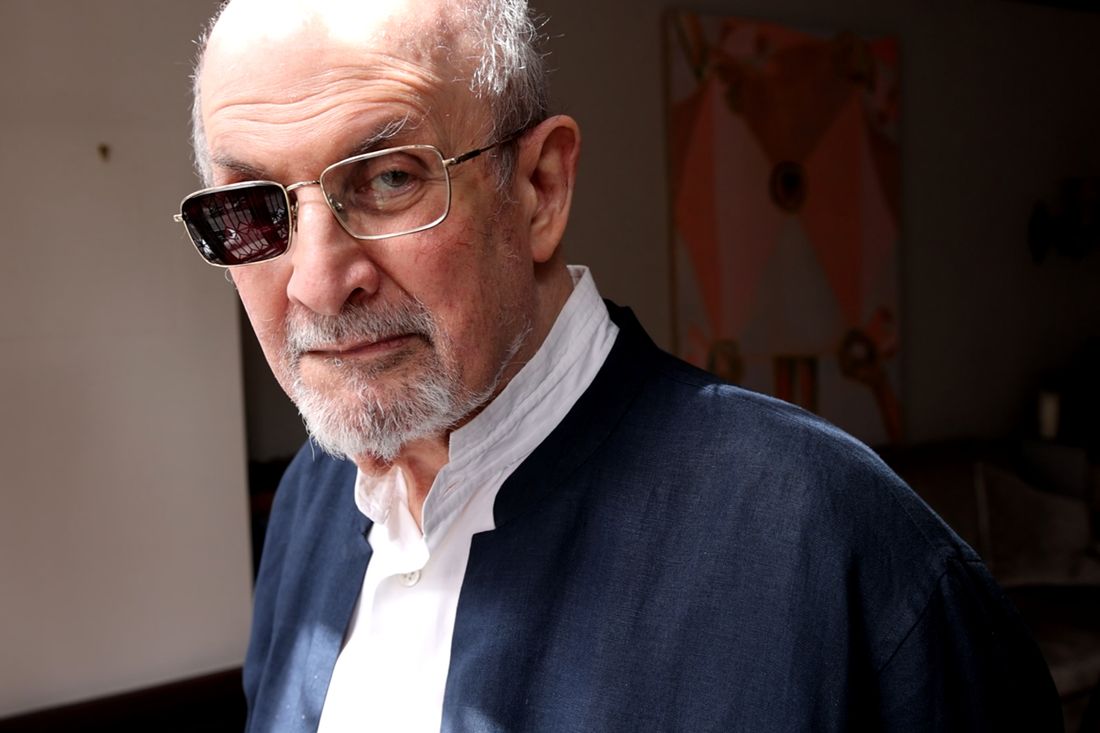
Alex Gibney’s new documentary, Knife: The Attempted Murder of Salman Rushdie, debuted at Sundance yesterday, with Rushdie present and noticeably increased security. The screening was understandably emotional, as the film includes disturbing footage of the 2022 attack that severely injured the author, costing him the sight in one eye. The audience was deeply affected. However, Knife is more than just a powerful depiction of this terrible event. It skillfully combines different aspects of Rushdie’s life and work, functioning both as a biography and a valuable historical account.
The 2022 attack on Salman Rushdie at the Chautauqua Institution made international headlines, but many people weren’t aware of the decades-long history leading up to it. Here’s a quick recap: In 1989, Iran’s Ayatollah Khomeini issued a call for Rushdie’s assassination, and the deaths of anyone involved in publishing his novel, The Satanic Verses. This wasn’t just an empty threat. Following the declaration, bookstores and newspaper offices were attacked, and several people connected to the book were violently targeted. Rushdie’s Japanese translator was killed, his Italian translator was stabbed, and his Norwegian publisher was shot. Tragically, a hotel in Turkey was set ablaze during a conference where Rushdie’s Turkish translator, the renowned author Aziz Nesin, was scheduled to speak, resulting in the deaths of thirty-seven people, primarily artists and intellectuals. (I recall watching these events unfold vividly; I was in Turkey at the time, admired Rushdie’s work, and was surprised to find some friends who felt the attack had some justification.)
The documentary Knife tells the story of Salman Rushdie’s life and the aftermath of the attack that nearly took it. It uses footage of his recovery – initially filmed by his wife – as a central thread, showing the shocking extent of his injuries and the grueling process of regaining basic functions like walking and moving his hand. He candidly shares his desire for simple independence, like using the bathroom on his own. As he reflects on the attack, Rushdie’s mind wanders, blending reality with images from films – from the figure of Death in The Seventh Seal to the knives featured in classics like West Side Story and Psycho, and even the monsters from Jason and the Argonauts. This mix of lighthearted and serious moments mirrors Rushdie’s own complex and multifaceted writing style.
The stark images of the novelist recovering are a striking contrast to how he was seen in the past – first as a promising writer, then as a celebrated, award-winning author, and later as a public figure who lived under constant threat and in hiding. Many once believed Salman Rushdie would remain a fugitive for the rest of his life, never appearing in public again. As Rushdie explains in the film, this is why he intentionally became so public once the danger seemed to lessen. He moved to New York and embraced public life, attending numerous events and essentially making up for lost time after years of being unable to freely participate in society.
This film feels like a follow-up to Rushdie’s 2024 memoir, Knife: Meditations After an Attempted Murder, and director Gibney weaves passages from the book throughout. Some scenes, like a fictional conversation between Rushdie and his attacker, are taken directly from the memoir. However, the film also explores Rushdie’s life more broadly, showing how reconnecting with his native India after a disappointing start in advertising ultimately inspired his writing. His work has always been a blend of different influences, shaped by the unique perspective of an immigrant – a perspective that’s difficult to fully understand, even today. This may be why the fatwa against him felt so deeply personal; Rushdie was a secular artist who understood and often incorporated tradition and religion – myths, gods, and ancient stories – into his creative work.
On the surface, Knife appears to be a straightforward documentary—and director Gibney joined the project after much of the filming was already completed, as he mentioned at the premiere. However, this simplicity is actually a strength. The film explores the surprisingly complex life and career of Salman Rushdie, which he divides into four pivotal periods marked by underlying anxiety, and shaped by both personal struggles and global events. Given the breadth of the subject matter, the documentary could have easily felt disjointed, but Gibney skillfully crafts an informative, emotionally resonant, and sometimes frustratingly honest portrait.
Read More
- United Airlines can now kick passengers off flights and ban them for not using headphones
- All Itzaland Animal Locations in Infinity Nikki
- How to Complete Bloom of Tranquility Challenge in Infinity Nikki
- Katanire’s Yae Miko Cosplay: Genshin Impact Masterpiece
- How to Get to the Undercoast in Esoteric Ebb
- A Dark Scream Theory Rewrites the Only Movie to Break the 2-Killer Rule
- All Golden Ball Locations in Yakuza Kiwami 3 & Dark Ties
- Gold Rate Forecast
- BloxStrike codes (March 2026)
- 6 Ways Invincible Season 4’s Hell Episode Rewrites The Comics
2026-01-26 21:55