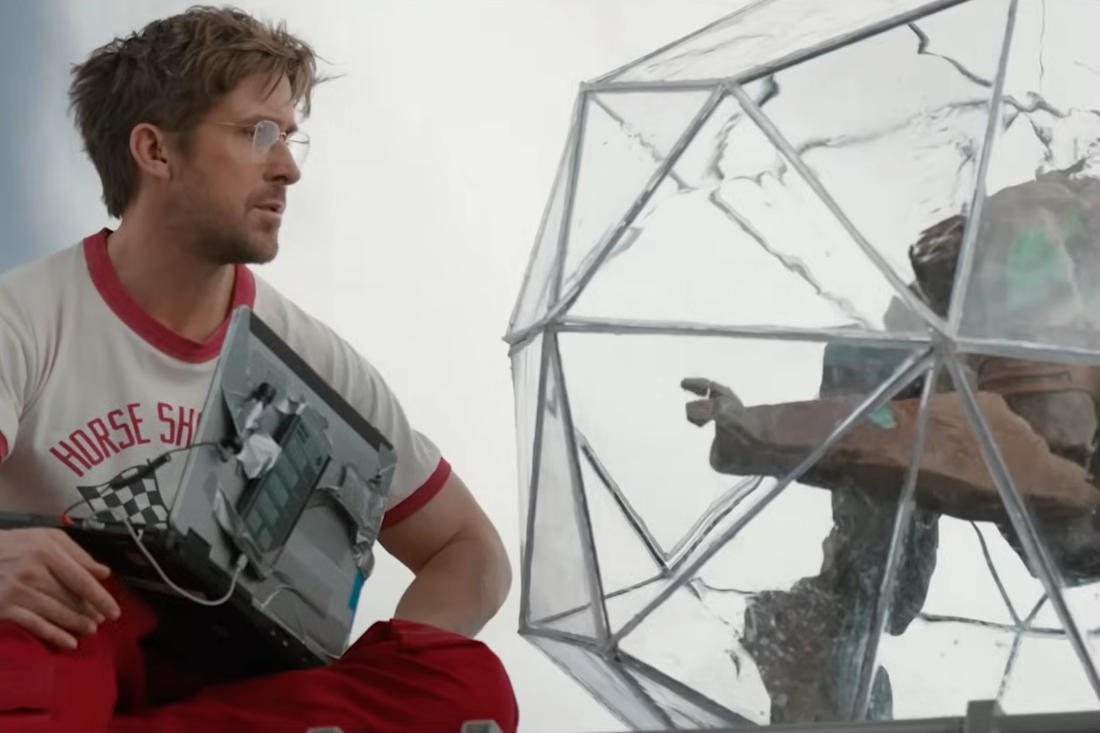
I have to say, in a world obsessed with digital effects, seeing a puppet take center stage in Project Hail Mary was a real surprise – and a wonderful one! It wasn’t just any puppet, though. Rocky, this amazing little alien creature with a rocky shell, felt so alive, and I realized you just can’t achieve that with CGI alone. The team, led by the incredibly talented James Ortiz, built Rocky and then performed him on set alongside Ryan Gosling. Five puppeteers actually shared scenes with Gosling, improvising their parts and bringing Rocky to life in a way that felt completely natural. The movie really became about the connection between Ryland Grace and Rocky, and their shared mission to save both their worlds. It was truly special to watch them interact, and it’s a testament to the power of practical effects and skilled puppetry.
Ortiz says that Ryan respected them as a creative partner and performer during filming. They explain that unlike in theater, where puppeteers are often seen as part of the technical crew, Ryan valued their artistic contribution.
Basil Ortiz became well-known for his incredibly detailed and often spooky puppets in both Broadway and Off-Broadway shows. He created memorable characters like the thin, skeletal Milky White in the revival of Into The Woods, a huge, long-necked brontosaurus for The Skin of Our Teeth, and a surprisingly human-like Tin Man in The Woodsman, a show he also wrote and directed. Project Hail Mary is his first film project. He started as the puppeteer, but directors Phil Lord and Chris Miller were so impressed, they asked him to also provide the voice for the character Rocky. This wasn’t just about moving the puppet; it required careful timing of breaths – Ortiz was even inspired by Katharine Hepburn – to give life and personality to a complex structure of metal rods, fiberglass, and robotic fingers.
“My brain was split every day of shooting,” Ortiz explains.
The biggest challenge while working with the Rocky puppet on set was balancing precise puppetry with improvisational acting alongside Ryan. I’m trained as an actor, but it’s very different trying to create a believable performance with a puppet that doesn’t have a face or conventional features. Every day, I had to switch between the detailed technique of bunraku puppetry and the freedom of playful improvisation.
Phil and Chris have a very specific creative process: they deliberately fill scenes with tons of material, knowing they can always trim it down later. What you see in the final movie gives a sense of freedom and improvisation, but it doesn’t fully capture the lengthy, 45-minute takes we used to shoot. We’d build up scenes with lines, tangents – like a random conversation about Ryland’s favorite films that Rocky wouldn’t get – and then circle back to the script, constantly shifting focus and creating opportunities for characters to miscommunicate. It felt like a very fluid, winding process, but it was challenging because when they’d call “Cut!”, I often couldn’t recall exactly what we’d accomplished. This became a real problem when I moved to second unit and had to film close-ups, because they’d ask about specific scenes – like scene 76 – and I’d honestly have no idea what happened in it.
I’m fascinated by how Rocky moves, especially his delicate actions like using the tape measure or picking things up. Could you explain what you’re doing as the puppeteer to create those movements?
Absolutely. It’s a surprisingly simple system, inspired by traditional bunraku puppetry. I held a hollow fiberglass shell that formed Rocky’s body, which gave me the best control for starting movements. Other puppeteers controlled his legs using steel rods attached to his forearms. The puppet had hidden openings all over, and we could easily swap out forearms – some of which were even animatronic. Basically, we could plug in a new forearm whenever needed. Each rod had a simple three-finger trigger, like a cheap water gun handle, that activated the animatronic fingers to open and close. The machinery did add some weight, but it allowed for incredibly precise movements.
We discovered that the motors controlling his hands would overheat during scenes with a lot of fast hand movements – specifically, when he did “jazz hands.” This would cause them to fail mid-shoot, so we planned each filming day carefully to manage battery life and prevent interruptions.
When the puppet appeared to breathe or eat, how did they create the illusion of movement in its stomach? The puppet had two shells, and one had small stones on top of its head – these were actually the only parts that moved. It was all about making the arms, fingers, and those stones seem lifelike. If the weight of the shell interfered with the stones’ movement, I’d suggest adding the effect digitally.
Could you describe the collaboration process with the other puppeteers? Did you all operate with a shared understanding? We had eight weeks of rehearsal before filming even began, and importantly, we stayed off the actual set during that time. This allowed us to explore and discard any unworkable ideas. I specifically chose performers who were both talented and willing to contribute their own concepts. We worked so closely as a team that even something as small as Rocky’s head movement required coordination and agreement among all of us to ensure smooth operation.
Early in the film, there’s a moment where we’re frantically signaling Ryland to look back. I even asked our sound mixer to mute my microphone one day because I was directing my team. We had to convey a lot of emotion in just two seconds on screen, and the only way my puppeteers could understand where we were in that emotional journey was if I voiced Rocky’s thoughts. So, what you don’t hear in those scenes is me yelling and giving Ryan directions as Rocky. It was a collaborative improvisation – I was working with Ryan, but my puppeteers were responding to me, creating this unique overlap where everyone was contributing at once.
Because Rocky doesn’t have a face, his emotions are expressed through how he moves. Developing that movement style was key. The goal was to connect everything to his feelings, as he’s dealing with past trauma. We figured out what the puppet did well – it was naturally a little unsteady – and that became his physical language. It felt like he was a nervous teenager eager to fit in.
He’s designed to look like a spider, but I didn’t want him to move like one. I was scrolling through TikTok one day and saw a video of a baby owl – a fluffy little thing with big eyes that reminded me of a character from a Miyazaki film. It was clumsily hopping around, constantly tripping over its own feet. That’s when it hit me – that was the movement style I needed! He’s incredibly intelligent, almost like a computer, but that doesn’t translate to physical awareness. He often stumbles into scenes and doesn’t even seem to notice his own awkward movements.
That reminds me, I was curious about the scenes where Rocky’s inside the hamster ball. It was actually a lot of fun to film! They gave me a large plastic ball with handles, and to give Ryan someone to react to, I’d run around the set pushing the empty ball and bumping into things, trying to create a chaotic energy while delivering my lines.
The playing surface of the Hail Mary was built from a grid of removable squares. Lifting these squares revealed hidden spaces underneath where we, as the puppeteers, could operate. Whenever the ball came to a stop, we’d place the puppet inside. Each ball had glass panels on the bottom, allowing us to maneuver the control rods – or even our hands – inside and make the puppet move as realistically as possible. It was a very tight space, like building a ship in a bottle, so we depended heavily on the visual effects team at Framestore to smooth things out and make the movements look convincing.
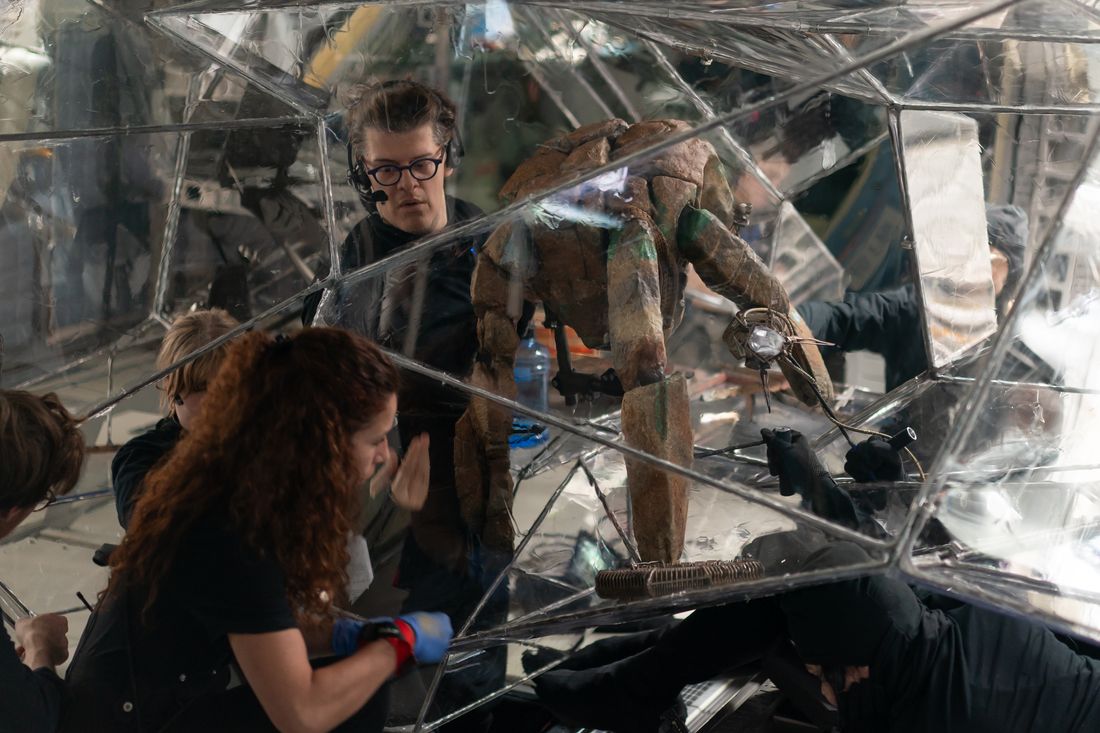
I’ve been getting a lot of questions about how we filmed the scenes where Rocky and Ryland are in the room with all the screens showing Earth. We used a really amazing, life-like robotic puppet called Waldo. It was a fully realistic, 360-degree version of Rocky that we could control from a distance, though it did have some cables sticking out of its head! Waldo was suspended from the ceiling, a bit like a marionette with just one string, and we used it for all the scenes in the spaceship cockpit and the ‘Don’t go crazy room.’ With so much action happening on the screens, it would have been incredibly difficult for the visual effects team to remove the puppeteers if we hadn’t used Waldo. Each puppet had its advantages and disadvantages, but Waldo was very expressive, though sometimes a little unstable – if you lifted three legs, he’d tend to fall forward!
We created a physical puppet – an eight-inch gray figure named Rocky covered in dots – to help us visualize the character. We filmed it extensively, spending around 100 hours on every scene, experimenting with countless variations. A small detail, like the way his legs curl up like a cinnamon bun at the end of the film on the beach, was originally performed with the puppet on a tabletop. It’s incredible that the visual effects team at Framestore paid attention to those subtle movements. Ultimately, the final film is a blend of practical puppetry – where we filmed the puppet and then digitally removed ourselves from the shot – and hand-drawn digital animation.
Do you have a funny story about working with Ryan on set? He’s known for being easily made to laugh. There was a scene that didn’t make the final cut where the ship’s computer, Mary, had taught Rocky how to tell knock-knock jokes. Those days were particularly fun because Priya, another actor, was available to play off of. In the scene, Mary prompted Rocky to deliver a joke. Rocky started with “Knock knock,” and when Ryan, as the responder, asked “Who’s there?”, Rocky simply said, “…ROCKY!” It was such a silly response that Ryan completely lost it laughing.
I collaborated with Neal Scanlon, the creature effects supervisor, to design and build the puppet. We really explored everything – the materials, how heavy it should be, and the overall design. Neal gave me a lot of creative control, perhaps even too much for a first film! We were constantly experimenting. I decided to make it a traditional rod puppet to keep it lightweight, which led us to using thin fiberglass. If you look closely, you’ll notice each arm is unique – we even gave them different names and colors. It was a very customized process. We’d brainstorm ideas like, ‘This elbow should use a bungee cord,’ or ‘That one should have a ball-bearing hinge.’ It took a lot of back-and-forth, but Neal always supported my vision, saying, ‘It’s your character, so go for it.’
I’m really interested in how you developed the puppet’s voice. For me, the voice and how the puppet moved were completely connected. I actually expected Rocky’s AI voice, which is similar to Alexa, to be terrible, but I just figured that was okay. Looking back, I see it was inspired by a lot of different things – a bit of TikTok, the character from the movie Return to Oz, even the voice filters on the TikTok app, and strangely enough, a little bit of Kate Hepburn. Because I chose such a flat, monotone voice, the puppet couldn’t express emotions through speech, so I focused on showing them through its movements. But as we worked on it, we were able to evolve the AI’s voice, and you start to hear hints of feeling within it.
I got my start with puppets when I was given a Charlie McCarthy dummy and a Mickey Mouse marionette from Disney – I was around 6 or 7 at the time. Later, I began making my own, and I remember building a marionette of… well, it was a spooky, hunchbacked woman, I think. It was definitely a bit of a witchy character!
People often ask me which puppet is the most difficult to perform with. It’s definitely Rocky. He’s constantly on the verge of falling over! You’d think with five legs, he’d be stable, but actually, I’m the one holding all his weight. If I let go, he just looks like a floppy, sad puppet.
Many people don’t realize puppeteering is a performance art, really an acting form. It’s often viewed as delicate or requiring extreme precision, like ballet, and sometimes that’s true. But more often, I want audiences to see the puppet as a fellow performer – a scene partner. I’m here to play and collaborate! That collaborative spirit was key to how we approached this film.
Read More
- United Airlines can now kick passengers off flights and ban them for not using headphones
- Crimson Desert: Disconnected Truth Puzzle Guide
- How to Get to the Undercoast in Esoteric Ebb
- All 9 Coalition Heroes In Invincible Season 4 & Their Powers
- All Golden Ball Locations in Yakuza Kiwami 3 & Dark Ties
- Katanire’s Yae Miko Cosplay: Genshin Impact Masterpiece
- All Itzaland Animal Locations in Infinity Nikki
- Warframe Voruna Prime access begins on April 8 for all platforms, new deluxe cosmetic Warframe skins revealed
- Zendaya’s 4 Big 2026 Movies Could Beat Brie Larson’s Box 2019 Office Record
- Dakota County’s plan to end hunger involves locking mayors in escape rooms
2026-04-03 19:58