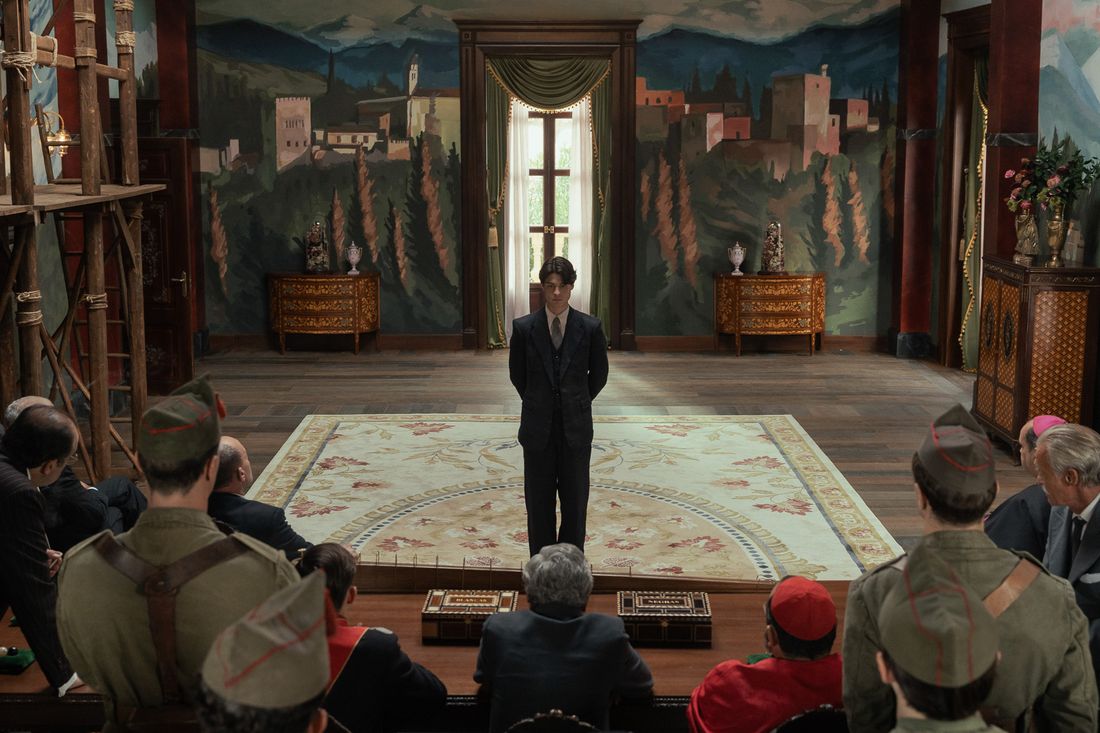
Though inspired by the life of Spanish poet Federico García Lorca, The Black Ball isn’t a traditional biography. Lorca appears late in the film, shortly before his death during the Spanish Civil War. Instead, the movie weaves together the stories of three gay men across different time periods – 1932, 1937, and 2017 – gradually revealing how their lives connect to Lorca and to each other. The film emphasizes Lorca’s identity as a gay man, arguing that his sexuality is just as important to understanding his legacy as his art and political views. It suggests that Spanish history has been slow to acknowledge LGBTQ+ identities, to the point where a foreign scholar of Lorca (played by Glenn Close) is praised as a leading expert, highlighting a pattern of recognition for those outside of Spain.
While captivating while you’re watching it, The Black Ball doesn’t necessarily linger in the memory afterwards – its reach sometimes exceeds its grasp. The film generated a lot of excitement at its premiere in Cannes. It’s the second feature from directing duo Javier Ambrossi and Javier Calvo (known as Los Javis), and a bigger, more ambitious project than their first film, Holy Camp!, which was based on their stage musical about two teenage girls sent to a Catholic camp. However, like Holy Camp!, The Black Ball has a sincere and heartfelt quality that carries it through moments that might feel awkward or overly sentimental with a different director. The film takes its name from an unfinished play by Lorca about a young man ostracized for suspected homosexuality when trying to join his father’s casino. But the surviving fragments of Lorca’s work served more as inspiration for the filmmakers and screenwriter Alberto Conejero, who also wrote a play about Lorca and his lover, Rafael Rodríguez Rapún, which also influenced the story.
In the film, Rafael (Miguel Bernardeau) appears as a prisoner of war, injured and held by Nationalist forces. He’s expected to be interrogated and likely executed once he recovers. It’s there he meets Sebastián, played by musician Guitarricadelafuente, who is new to acting and portrays a somewhat clumsy hero. Sebastián is an aspiring musician who ended up fighting with the Nationalists by chance—they simply rescued him after his village was attacked. He hadn’t given much thought to politics, but as a guard for Rafael, he begins to see the world and his own desires differently. Meanwhile, in a parallel storyline set in 1932, Milo Quifes plays Carlos, a younger version of Lorca’s character. Unlike Sebastián, Carlos is politically aware, associating with radicals and openly gay men, but he struggles to gain his father’s approval and feels pressured to conform to conservative expectations.
The final part of the film focuses on Alberto (Carlos González), a somewhat gloomy graduate student in Madrid. He lives with his boyfriend (Julio Torres) and is researching obscure, rebellious music from the 1920s for his thesis. He receives news of the death of a grandfather he never knew. Unlike the other two characters, Alberto feels more grounded, though he’s still a symbolic figure. The film often portrays the past as something magical, even when trying to make it feel real and emotionally present. It’s when exploring the past that the film is at its most thoughtful, but also at its most beautiful – like when a tipsy Carlos spontaneously sings flamenco at a bar, or when Penélope Cruz appears as a vibrant singer who becomes a mentor to one of the main characters. When the filmmakers aim high, they create moments of genuine beauty, which makes it easy to overlook some of the film’s quirks, like when Lorca explains his new work to an old flame in a way that feels strangely like an Instagram presentation, suggesting it could help people like them.
Read More
- Off Campus Season 1 Soundtrack Guide
- DoorDash responds after customer uses AI to make food look bad and get a refund
- Jon Bernthal Explains Why Marvel Let Him Make The Darkest Punisher Story Ever
- All Golden Ball Locations in Yakuza Kiwami 3 & Dark Ties
- 10 Most Universally Beloved Sci-Fi Movie Villains, Ranked
- Euphoria Season 3’s New R-Rated Sydney Sweeney Scene Proves The Show Is Trolling Us
- Gold Rate Forecast
- Ethereum Eyes Break Above $2,420 as Rally Hangs in the Balance
- The Masterpiece World War II Movie ‘Saving Private Ryan’ is Streaming on Paramount+ in April 2026
- 8 Movie Trilogies That Are More Rewatchable Than The Lord of the Rings
2026-05-22 20:54